
Verwandte Artikel zu Travels with Herodotus (Vintage International)
Inhaltsangabe
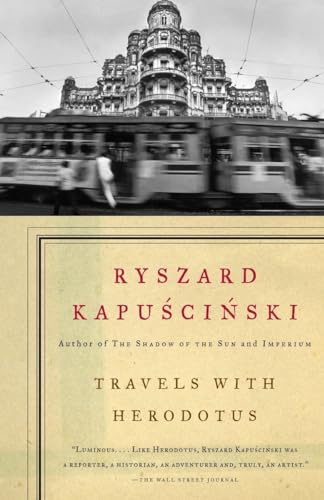
From the renowned journalist comes this intimate account of his years in the field, traveling for the first time beyond the Iron Curtain to India, China, Ethiopia, and other exotic locales.
In the 1950s, Ryszard Kapuscinski finished university in Poland and became a foreign correspondent, hoping to go abroad – perhaps to Czechoslovakia. Instead, he was sent to India – the first stop on a decades-long tour of the world that took Kapuscinski from Iran to El Salvador, from Angola to Armenia. Revisiting his memories of traveling the globe with a copy of Herodotus' Histories in tow, Kapuscinski describes his awakening to the intricacies and idiosyncrasies of new environments, and how the words of the Greek historiographer helped shape his own view of an increasingly globalized world. Written with supreme eloquence and a constant eye to the global undercurrents that have shaped the last half-century, Travels with Herodotus is an exceptional chronicle of one man's journey across continents.
Die Inhaltsangabe kann sich auf eine andere Ausgabe dieses Titels beziehen.
Über die Autorin bzw. den Autor
Ryszard Kapuscinski, Poland's most celebrated foreign correspondent, was born in 1932. After graduating with a degree in history from Warsaw University, he was sent to India, Pakistan, and Afghanistan to report for the Polish news, which began his lifelong fascination with the Third World. During his four decades reporting on Asia, Latin America, and Africa, he befriended Che Guevara, Salvador Allende, and Patrice Lumumba; witnessed twentyseven coups and revolutions; and was sentenced to death four times. He died in 2007.His earlier books--Shah of Shahs, The Emperor, Imperium, Another Day of Life, The Soccer War, and Shadow of the Sun--have been translated into nineteen languages.
Auszug. © Genehmigter Nachdruck. Alle Rechte vorbehalten.
CROSSING THE BORDERBefore Herodotus sets out on his travels, ascending rocky paths, sailing a ship over the seas, riding on horseback through the wilds of Asia; before he happens upon the mistrustful Scythians, discovers the wonders of Babylon, and plumbs the mysteries of the Nile; before he experiences a hundred different places and sees a thousand inconceivable things, he will appear for a moment in a lecture on ancient Greece, which Professor Biezunska-Malowist delivers twice weekly to the first-year students in Warsaw University's department of history.He will appear and just as quickly vanish.He will disappear so completely that now, years later, when I look through my notes from those classes, I do not find his name. There are Aeschylus and Pericles, Sappho and Socrates, Heraclitus and Plato; but no Herodotus. And yet we took such careful notes. They were our only source of information. The war had ended six years earlier, and the city lay in ruins. Libraries had gone up in flames, we had no textbooks, no books at all to speak of.The professor has a calm, soft, even voice. Her dark, attentive eyes regard us through thick lenses with marked curiosity. Sitting at a high lectern, she has before her a hundred young people the majority of whom have no idea that Solon was great, do not know the cause of Antigone's despair, and could not explain how Themistocles lured the Persians into a trap.If truth be told, we didn't even quite know where Greece was or, for that matter, that a contemporary country by that name had a past so remarkable and extraordinary as to merit studying at university. We were children of war. High schools were closed during the war years, and although in the larger cities clandestine classes were occasionally convened, here, in this lecture hall, sat mostly girls and boys from remote villages and small towns, ill read, undereducated. It was 1951. University admissions were granted without entrance examinations, family provenance mattering most--in the communist state the children of workers and peasants had the best chances of getting in.The benches were long, meant for several students, but they were still too few and so we sat crowded together. To my left was Z.--a taciturn peasant from a village near Radomsko, the kind of place where, as he once told me, a household would keep a piece of dried kielbasa as medicine: if an infant fell ill, it would be given the kielbasa to suck. "Did that help?" I asked, skeptically. "Of course," he replied with conviction and fell into gloomy silence again. To my right sat skinny W., with his emaciated, pockmarked face. He moaned with pain whenever the weather changed; he said he had taken a bullet in the knee during a forest battle. But who was fighting against whom, and exactly who shot him, this he would not say. There were also several students from better families among us. They were neatly attired, had nicer clothes, and the girls wore high heels. Yet they were striking exceptions, rare occurrences--the poor, uncouth countryside predominated: wrinkled coats from army surplus, patched sweaters, percale dresses.The professor showed us photographs of antique sculptures and of Greek figures painted on brown vases--beautiful, statuesque bodies, noble, elongated faces with fine features. They belonged to some unknown, mythic universe, a world of sun and silver, warm and full of light, populated by slender heroes and dancing nymphs. We didn't know what to make of it. Looking at the photographs, Z. was morosely silent and W. contorted himself to massage his aching knee. Others looked on, attentive yet indifferent. Before those future prophets proclaiming the clash of civilizations, the collision was taking place long ago, twice a week, in the lecture hall where I learned that there once lived a Greek named Herodotus.I knew nothing as yet of his life, or about the fact that he left us a famous book. We would in any event have been unable to read The Histories, because at that moment its Polish translation was locked away in a closet. In the mid-1940s The Histories had been translated by Professor Seweryn Hammer, who deposited his manuscript in the Czytelnik publishing house. I was unable to ascertain the details because all the documentation disappeared, but it happens that Hammer's text was sent by the publisher to the typesetter in the fall of 1951. Barring any complications, the book should have appeared in 1952, in time to find its way into our hands while we were still studying ancient history. But that's not what happened, because the printing was suddenly halted. Who gave the order? Probably the censor, but it's impossible to know for certain. Suffice it to say that the book finally did not go to press until three years later, at the end of 1954, arriving in the bookstores in 1955.One can speculate about the delay in the publication of The Histories. It coincides with the period preceding the death of Stalin and the time immediately following it. The Herodotus manuscript arrived at the press just as Western radio stations began speaking of Stalin's serious illness. The details were murky, but people were afraid of a new wave of terror and preferred to lie low, to risk nothing, to give no one any pretext, to wait things out. The atmosphere was tense. The censors redoubled their vigilance.But Herodotus? A book written two and a half thousand years ago? Well, yes: because all our thinking, our looking and reading, was governed during those years by an obsession with allusion. Each word brought another one to mind; each had a double meaning, a false bottom, a hidden significance; each contained something secretly encoded, cunningly concealed. Nothing was ever plain, literal, unambiguous--from behind every gesture and word peered some referential sign, gazed a meaningfully winking eye. The man who wrote had difficulty communicating with the man who read, not only because the censor could confiscate the text en route, but also because, when the text finally reached him, the latter read something utterly different from what was clearly written, constantly asking himself: What did this author really want to tell me?And so a person consumed, obsessively tormented by allusion reaches for Herodotus. How many allusions he will find there! The Histories consists of nine books, and each one is allusions heaped upon allusions. Let us say he opens, quite by accident, Book Five. He opens it, reads, and learns that in Corinth, after thirty years of bloodthirsty rule, the tyrant called Cypselus died and was succeeded by his son, Periander, who would in time turn out to be even more bloodthirsty than his father. This Periander, when he was still a dictator-in-training, wanted to learn how to stay in power, and so sent a messenger to the dictator of Miletus, old Thrasybulus, asking him for advice on how best to keep a people in slavish fear and subjugation.Thrasybulus, writes Herodotus, took the man sent by Periander out of the city and into a field where there were crops growing. As he walked through the grain, he kept questioning the messenger and getting him to repeat over and over again what he had come from Corinth to ask. Meanwhile, every time he saw an ear of grain standing higher than the rest, he broke it off and threw it away, and he went on doing this until he had destroyed the choicest, tallest stems in the crop. After this walk across the field, Thrasybulus sent Periander's man back home, without having offered him any advice. When the man got back to Corinth, Periander was eager to hear Thrasybulus' recommendations, but the agent said that he had not made any at all. In fact, he said, he was surprised that Periander had sent him to a man of that kind--a lunatic who destroyed his own property--and he described what he had seen Thrasybulus doing.Periander, however, understood Thrasybulus' actions. He realized that he had been advising him to kill outstanding citizens, and...
„Über diesen Titel“ kann sich auf eine andere Ausgabe dieses Titels beziehen.
Suchergebnisse für Travels with Herodotus (Vintage International)

Beispielbild für diese ISBN
Travels with Herodotus
Anbieter: World of Books (was SecondSale), Montgomery, IL, USA
Verkäuferbewertung 5 von 5 Sternen

Paperback. Zustand: Good. From the renowned journalist comes this intimate account of his years in the field, traveling for the first time beyond the Iron Curtain to India, China, Ethiopia, and other exotic locales. In the 1950s, Ryszard Kapuscinski finished university in Poland and became a foreign correspondent, hoping to go abroad - perhaps to Czechoslovakia. Instead, he was sent to India - the first stop on a decades-long tour of the world that took Kapuscinski from Iran to El Salvador, from Angola to Armenia. Revisiting his memories of traveling the globe with a copy of Herodotus' Histories in tow, Kapuscinski describes his awakening to the intricacies and idiosyncrasies of new environments, and how the words of the Greek historiographer helped shape his own view of an increasingly globalized world. Written with supreme eloquence and a constant eye to the global undercurrents that have shaped the last half-century, Travels with Herodotus is an exceptional chronicle of one man's journey across continents. Artikel-Nr. 00098160280
Gebraucht kaufen
EUR 4,57
Versand gratis
Versand innerhalb von USA
Versand innerhalb von USA
Anzahl: 6 verfügbar
Beispielbild für diese ISBN
Travels with Herodotus (Vintage International)
Verlag:
Vintage (edition Reprint), 2008
ISBN 10: 1400078784
ISBN 13: 9781400078783
Gebraucht
Paperback
Anbieter: BooksRun, Philadelphia, PA, USA
Verkäuferbewertung 5 von 5 Sternen
Paperback. Zustand: Fair. Reprint. The item might be beaten up but readable. May contain markings or highlighting, as well as stains, bent corners, or any other major defect, but the text is not obscured in any way. Artikel-Nr. 1400078784-7-22-13
Gebraucht kaufen
EUR 5,96
Versand gratis
Versand innerhalb von USA
Versand innerhalb von USA
Anzahl: 1 verfügbar
Beispielbild für diese ISBN
Travels with Herodotus
Anbieter: ThriftBooks-Reno, Reno, NV, USA
Verkäuferbewertung 5 von 5 Sternen
Paperback. Zustand: Fair. No Jacket. Readable copy. Pages may have considerable notes/highlighting. ~ ThriftBooks: Read More, Spend Less. Artikel-Nr. G1400078784I5N00
Gebraucht kaufen
EUR 6,05
Versand gratis
Versand innerhalb von USA
Versand innerhalb von USA
Anzahl: 1 verfügbar
Beispielbild für diese ISBN
Travels with Herodotus
Anbieter: ThriftBooks-Reno, Reno, NV, USA
Verkäuferbewertung 5 von 5 Sternen
Paperback. Zustand: Good. No Jacket. Pages can have notes/highlighting. Spine may show signs of wear. ~ ThriftBooks: Read More, Spend Less. Artikel-Nr. G1400078784I3N00
Gebraucht kaufen
EUR 6,05
Versand gratis
Versand innerhalb von USA
Versand innerhalb von USA
Anzahl: 2 verfügbar
Beispielbild für diese ISBN
Travels with Herodotus
Anbieter: ThriftBooks-Phoenix, Phoenix, AZ, USA
Verkäuferbewertung 5 von 5 Sternen
Paperback. Zustand: Good. No Jacket. Pages can have notes/highlighting. Spine may show signs of wear. ~ ThriftBooks: Read More, Spend Less. Artikel-Nr. G1400078784I3N00
Gebraucht kaufen
EUR 6,05
Versand gratis
Versand innerhalb von USA
Versand innerhalb von USA
Anzahl: 1 verfügbar
Beispielbild für diese ISBN
Travels with Herodotus
Anbieter: ThriftBooks-Dallas, Dallas, TX, USA
Verkäuferbewertung 5 von 5 Sternen
Paperback. Zustand: Fair. No Jacket. Readable copy. Pages may have considerable notes/highlighting. ~ ThriftBooks: Read More, Spend Less. Artikel-Nr. G1400078784I5N00
Gebraucht kaufen
EUR 6,07
Versand gratis
Versand innerhalb von USA
Versand innerhalb von USA
Anzahl: 1 verfügbar
Beispielbild für diese ISBN
Travels with Herodotus
Anbieter: ThriftBooks-Atlanta, AUSTELL, GA, USA
Verkäuferbewertung 5 von 5 Sternen
Paperback. Zustand: Fair. No Jacket. Readable copy. Pages may have considerable notes/highlighting. ~ ThriftBooks: Read More, Spend Less. Artikel-Nr. G1400078784I5N00
Gebraucht kaufen
EUR 6,07
Versand gratis
Versand innerhalb von USA
Versand innerhalb von USA
Anzahl: 1 verfügbar
Beispielbild für diese ISBN
Travels with Herodotus
Anbieter: ThriftBooks-Atlanta, AUSTELL, GA, USA
Verkäuferbewertung 5 von 5 Sternen
Paperback. Zustand: Very Good. No Jacket. May have limited writing in cover pages. Pages are unmarked. ~ ThriftBooks: Read More, Spend Less. Artikel-Nr. G1400078784I4N00
Gebraucht kaufen
EUR 6,07
Versand gratis
Versand innerhalb von USA
Versand innerhalb von USA
Anzahl: 1 verfügbar
Beispielbild für diese ISBN
Travels with Herodotus
Anbieter: ThriftBooks-Dallas, Dallas, TX, USA
Verkäuferbewertung 5 von 5 Sternen
Paperback. Zustand: Good. No Jacket. Pages can have notes/highlighting. Spine may show signs of wear. ~ ThriftBooks: Read More, Spend Less. Artikel-Nr. G1400078784I3N00
Gebraucht kaufen
EUR 6,07
Versand gratis
Versand innerhalb von USA
Versand innerhalb von USA
Anzahl: 2 verfügbar
Beispielbild für diese ISBN
Travels with Herodotus
Anbieter: ThriftBooks-Atlanta, AUSTELL, GA, USA
Verkäuferbewertung 5 von 5 Sternen
Paperback. Zustand: Good. No Jacket. Pages can have notes/highlighting. Spine may show signs of wear. ~ ThriftBooks: Read More, Spend Less. Artikel-Nr. G1400078784I3N00
Gebraucht kaufen
EUR 6,07
Versand gratis
Versand innerhalb von USA
Versand innerhalb von USA
Anzahl: 2 verfügbar