
Verwandte Artikel zu Joseph Smith: Rough Stone Rolling
Inhaltsangabe
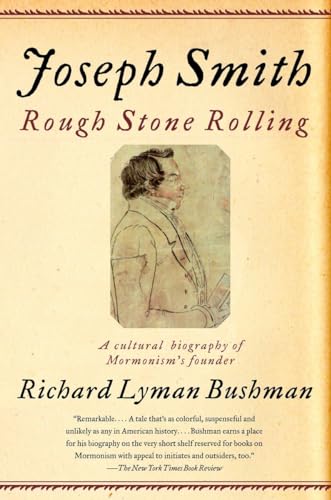
Founder of the largest indigenous Christian church in American history, Joseph Smith published the 584-page Book of Mormon when he was twenty-three and went on to organize a church, found cities, and attract thousands of followers before his violent death at age thirty-eight. Richard Bushman, an esteemed cultural historian and a practicing Mormon, moves beyond the popular stereotype of Smith as a colorful fraud to explore his personality, his relationships with others, and how he received revelations. An arresting narrative of the birth of the Mormon Church, Joseph Smith: Rough Stone Rolling also brilliantly evaluates the prophet’s bold contributions to Christian theology and his cultural place in the modern world.
Die Inhaltsangabe kann sich auf eine andere Ausgabe dieses Titels beziehen.
Über die Autorin bzw. den Autor
Richard L. Bushman was born in Salt Lake City, Utah, in 1931. He took his B.A., M.A., and PhD. degrees at Harvard University. He has taught at Brigham Young University, Boston University, University of Delaware, and Columbia University, where he is currently Gouverneur Morris Professor of History, Emeritus. His previous books are From Puritan to Yankee: Character and Social Order in Connecticut, 1690-1765 (1967), Joseph Smith and the Beginnings of Mormonism (1984), King and People in Provincial Massachusetts (1985), and The Refinement of America: Persons, Houses, and Cities (1992).
Auszug. © Genehmigter Nachdruck. Alle Rechte vorbehalten.
THE JOSEPH SMITH FAMILY
to 1816
My Last request & charge is, that you will Live together in an undivided bond of Love; you are maney of you, and if you Join together as one man, you need not want aney thing; what counsil, what comfort, what money, what friends may you not help your Selves unto, if you will, all as one contribute your aids.
asael smith, “A few words of advice” (1799)
Lucy Mack Smith bade farewell to her sons Joseph and Hyrum a few days after their deaths in June 1844. Joseph’s secretary, Willard Richards, and their brother Samuel had brought the bodies back from Carthage to Nauvoo, and after the corpses were washed and dressed in burial clothes, the Smith family was admitted to the room. “I had for a long time braced every nerve,” their mother wrote,
roused every energy of my soul, and called upon God to strengthen me; but when I entered the room, and saw my murdered sons extended both at once before my eyes, and heard the sobs and groans of my family, and the cries of “Father! Husband! Brothers!” from the lips of their wives, children, brother, and sisters, it was too much, I sank back, crying to the Lord, in the agony of my soul, “My God, my God, why hast thou forsaken this family!”
Six months later, Lucy began a narrative of the early life of Joseph Smith. She was sixty-nine, afflicted with disease and saddened by “the cruelty of an ungodly and hard hearted world.” Within a month she had lost three sons: Joseph and Hyrum to vigilante bullets and Samuel to a fever contracted while escaping the mob. Of her seven sons, only the unstable William survived. Her husband, Joseph Sr., had died four years earlier, and she lived with her daughter, another Lucy, and later with Joseph’s widow, Emma, who was carrying her husband’s unborn son.
In this troubled and uncertain moment, the question of the Prophet’s successor remained unsettled. Lucy’s son William was soon to be among the contenders. The “Gentile” countryside expected the Mormon kingdom to crumble and the Saints to disperse. When they proved inconveniently adamant, the citizens forced the Mormons to leave. But trouble did not slow Lucy’s dictation to Martha and Howard Coray through the winter of 1844–45. One crisply told story after another covered the pages, making her narrative the central source for the early life of Joseph Smith.
Lucy Smith reacted to the sorrows and distresses of her life with indignation, not regret. Recollecting the murder of her sons, she wrote that “my blood curdles in my veins.” At the close of the book, she consigned the malicious and indifferent government officials who had darkened her family’s lives—the governors Lilburn W. Boggs, Thomas Carlin, and Thomas Ford, and President Martin Van Buren—to the judgment of God. She was a proud, high-strung woman, belligerent, capable of anger, grief, and sublime confidence in the final triumph of the innocent. She concluded her account with a lofty judgment: “And I shall leave the world to judge, as seemeth them good, concerning what I have written. But this much I will say, that the testimony which I have given is true, and will stand for ever.”
Lucy did not mention the name of Joseph Smith, Jr., until page 56 of her record. As she told the story, no signs or portents accompanied the birth of her most famous son. She said quite simply that “in the meantime we had a son, whom we called Joseph, after the name of his father; he was born December 23, 1805. I shall speak of him more particularly by and by.” Joseph’s revelations and writings, his part in constructing the city of Nauvoo, the tens of thousands of followers, and his national notoriety—none of this overwhelmed Lucy Smith’s story.
The Smith family stood at the center. Lucy’s pride was the pride of family. When she saw the bodies of Hyrum and Joseph, she spontaneously asked why had God “forsaken this family.” Her narrative began with her father, Solomon, and devoted six chapters to her brothers and sisters before telling about herself. Lucy calculated that six Smith martyrs had fallen because of persecution: Joseph Sr.; sons Don Carlos, Hyrum, and Samuel; William’s wife Caroline; and Joseph the Prophet.
She had little worldly to boast of. Lucy knew of the “attention and respect which are ever shown to those who live in fine circumstances,” but of her sister Lydia, who “sought riches and obtained them,” Lucy wrote but two paragraphs: not that Lydia was less loved, “but she seemed to float more with the stream of common events.”7 Lucy’s pride arose from the way her family met adversity. Joseph and Hyrum lay in triumph in their coffins because justice and charity gave them power over their enemies. She honored those who overcame. Her narrative turned the misfortunes of the Smith family into exemplifications of family character.
solomon and lucy mack
Lucy Mack Smith was the youngest of eight children born to Solomon Mack and Lydia Gates. Lucy briefly mentioned her father’s adventures in the French and Indian War and the American Revolution, and then said little more about him. He was absent for years at a time while Lucy was growing up, and until he experienced a drastic change of heart late in life, he was preoccupied solely with the pursuit of wealth. Solomon was born September 15, 1732, in Lyme, Connecticut, the grandson of John Mack, one of Lyme’s prospering traders. When Solomon was four, his father, Ebenezer Mack, lost the land he had inherited in Lyme, and Solomon was bound out to a hard-hearted and miserly farmer, about whom he wrote in his memoir:
I was treated by my Master as his property and not as his fellow mortal; he taught me to work, and was very careful that I should have little or no rest. . . . His whole attention was taken up on the pursuits of the good things of this world; wealth was his supreme object. I am afraid gold was his God.
Solomon grew up “like the wild ass’s colt,” feeling “no obligation with regard to society.”
Free at age twenty-one, Solomon Mack tried “to make myself great and happy, in the way I was educated,” by accumulating property. Defeated in one venture after another, wounded by falling trees and spills from horses, afflicted with fits and permanently lame, shipwrecked, betrayed by business associates, he always recovered his health and courage and set forth on new undertakings. He enlisted for service in the French and Indian War and with his discharge pay purchased a farm in Lyme. In 1759, at twenty-six, he married Lydia Gates, daughter of Deacon Daniel Gates in nearby East Haddam. But then, carried away by ambition, he purchased rights to 1,600 acres in New York, freighted a vessel for New York City, and sold his Lyme property to purchase a proprietary right in New Hampshire. By July 8, 1775, when Lucy Mack was born in Gilsum, New Hampshire, Solomon had eight children, had cleared scores of acres and owned hundreds more, risked his capital in a variety of ventures, and yet despite all his efforts, “the Lord would not suffer me to prosper.”
The battle of Bunker Hill took place in Boston three weeks before Lucy’s birth. George Washington’s greatest need was for supplies. Sensing a renewal of the opportunities of the French and Indian War, Solomon learned from his brother-in-law in Connecticut how to make saltpeter for...
„Über diesen Titel“ kann sich auf eine andere Ausgabe dieses Titels beziehen.
Suchergebnisse für Joseph Smith: Rough Stone Rolling

Beispielbild für diese ISBN
Joseph Smith: Rough Stone Rolling
Anbieter: World of Books (was SecondSale), Montgomery, IL, USA
Verkäuferbewertung 5 von 5 Sternen

Paperback. Zustand: Good. Founder of the largest indigenous Christian church in American history, Joseph Smith published the 584-page Book of Mormon when he was twenty-three and went on to organize a church, found cities, and attract thousands of followers before his violent death at age thirty-eight. Richard Bushman, an esteemed cultural historian and a practicing Mormon, moves beyond the popular stereotype of Smith as a colorful fraud to explore his personality, his relationships with others, and how he received revelations. An arresting narrative of the birth of the Mormon Church, Joseph Smith: Rough Stone Rolling also brilliantly evaluates the prophet's bold contributions to Christian theology and his cultural place in the modern world. Artikel-Nr. CIN1400077532G
Gebraucht kaufen
EUR 6,06
Versand gratis
Versand innerhalb von USA
Versand innerhalb von USA
Anzahl: 2 verfügbar
Beispielbild für diese ISBN
Joseph Smith: Rough Stone Rolling
Anbieter: ThriftBooks-Atlanta, AUSTELL, GA, USA
Verkäuferbewertung 5 von 5 Sternen
Paperback. Zustand: Good. No Jacket. Pages can have notes/highlighting. Spine may show signs of wear. ~ ThriftBooks: Read More, Spend Less. Artikel-Nr. G1400077532I3N00
Gebraucht kaufen
EUR 8,63
Versand gratis
Versand innerhalb von USA
Versand innerhalb von USA
Anzahl: 1 verfügbar
Beispielbild für diese ISBN
Joseph Smith: Rough Stone Rolling
Anbieter: ThriftBooks-Atlanta, AUSTELL, GA, USA
Verkäuferbewertung 5 von 5 Sternen
Paperback. Zustand: Fair. No Jacket. Readable copy. Pages may have considerable notes/highlighting. ~ ThriftBooks: Read More, Spend Less. Artikel-Nr. G1400077532I5N00
Gebraucht kaufen
EUR 8,63
Versand gratis
Versand innerhalb von USA
Versand innerhalb von USA
Anzahl: 1 verfügbar
Beispielbild für diese ISBN
Joseph Smith: Rough Stone Rolling
Anbieter: ThriftBooks-Dallas, Dallas, TX, USA
Verkäuferbewertung 5 von 5 Sternen
Paperback. Zustand: Fair. No Jacket. Readable copy. Pages may have considerable notes/highlighting. ~ ThriftBooks: Read More, Spend Less. Artikel-Nr. G1400077532I5N00
Gebraucht kaufen
EUR 8,63
Versand gratis
Versand innerhalb von USA
Versand innerhalb von USA
Anzahl: 1 verfügbar
Beispielbild für diese ISBN
Joseph Smith : Rough Stone Rolling
Verlag:
Knopf Doubleday Publishing Group, 2007
ISBN 10: 1400077532
ISBN 13: 9781400077533
Gebraucht
Softcover
Anbieter: Better World Books, Mishawaka, IN, USA
Verkäuferbewertung 5 von 5 Sternen
Zustand: Good. Pages intact with minimal writing/highlighting. The binding may be loose and creased. Dust jackets/supplements are not included. Stock photo provided. Product includes identifying sticker. Better World Books: Buy Books. Do Good. Artikel-Nr. 8155445-6
Gebraucht kaufen
EUR 10,92
Versand gratis
Versand innerhalb von USA
Versand innerhalb von USA
Anzahl: 2 verfügbar
Beispielbild für diese ISBN
Joseph Smith : Rough Stone Rolling
Verlag:
Knopf Doubleday Publishing Group, 2007
ISBN 10: 1400077532
ISBN 13: 9781400077533
Gebraucht
Softcover
Anbieter: Better World Books, Mishawaka, IN, USA
Verkäuferbewertung 5 von 5 Sternen
Zustand: Good. Former library copy. Pages intact with minimal writing/highlighting. The binding may be loose and creased. Dust jackets/supplements are not included. Includes library markings. Stock photo provided. Product includes identifying sticker. Better World Books: Buy Books. Do Good. Artikel-Nr. 4826931-6
Gebraucht kaufen
EUR 10,92
Versand gratis
Versand innerhalb von USA
Versand innerhalb von USA
Anzahl: 1 verfügbar
Beispielbild für diese ISBN
Joseph Smith : Rough Stone Rolling
Verlag:
Knopf Doubleday Publishing Group, 2007
ISBN 10: 1400077532
ISBN 13: 9781400077533
Gebraucht
Softcover
Anbieter: Better World Books: West, Reno, NV, USA
Verkäuferbewertung 5 von 5 Sternen
Zustand: Good. Former library copy. Pages intact with minimal writing/highlighting. The binding may be loose and creased. Dust jackets/supplements are not included. Includes library markings. Stock photo provided. Product includes identifying sticker. Better World Books: Buy Books. Do Good. Artikel-Nr. 4826931-6
Gebraucht kaufen
EUR 10,92
Versand gratis
Versand innerhalb von USA
Versand innerhalb von USA
Anzahl: 1 verfügbar
Beispielbild für diese ISBN
Joseph Smith: Rough Stone Rolling
Verlag:
Vintage (edition Reprint), 2007
ISBN 10: 1400077532
ISBN 13: 9781400077533
Gebraucht
Paperback
Anbieter: BooksRun, Philadelphia, PA, USA
Verkäuferbewertung 5 von 5 Sternen
Paperback. Zustand: Fair. Reprint. The item might be beaten up but readable. May contain markings or highlighting, as well as stains, bent corners, or any other major defect, but the text is not obscured in any way. Artikel-Nr. 1400077532-7-1
Gebraucht kaufen
EUR 11,50
Versand gratis
Versand innerhalb von USA
Versand innerhalb von USA
Anzahl: 1 verfügbar
Beispielbild für diese ISBN
Joseph Smith: Rough Stone Rolling
Verlag:
Vintage Books, New York, 2005
ISBN 10: 1400077532
ISBN 13: 9781400077533
Gebraucht
Soft Cover
Anbieter: Browse Awhile Books, Tipp City, OH, USA
Verkäuferbewertung 5 von 5 Sternen
Soft Cover. Zustand: Near Fine. Later Printing. Small, light soiled spot on bottom edge of text block. Size: Thick Large Octavo. Artikel-Nr. 01124828
Gebraucht kaufen
EUR 11,02
EUR 6,24 Versand
Versand innerhalb von USA
Versand innerhalb von USA
Anzahl: 1 verfügbar
Beispielbild für diese ISBN
Joseph Smith: Rough Stone Rolling
Verlag:
Vintage March 2007, 2007
ISBN 10: 1400077532
ISBN 13: 9781400077533
Gebraucht
Trade Paperback
Anbieter: The Book Garden, Bountiful, UT, USA
Verkäuferbewertung 5 von 5 Sternen
Trade Paperback. Zustand: Good - Cash. General reader wear to the corners, edges, and cover. The covers/corners have some creasing. Previous owner's name and address on sticker inside. Spine creased. The pages show some general reader wear as well. The book is in good condition with some normal reader wear. Stock photos may not look exactly like the book. Artikel-Nr. 1102004
Gebraucht kaufen
EUR 11,02
EUR 6,47 Versand
Versand innerhalb von USA
Versand innerhalb von USA
Anzahl: 1 verfügbar