
Verwandte Artikel zu How to Run the World: Charting a Course to the Next...
Inhaltsangabe
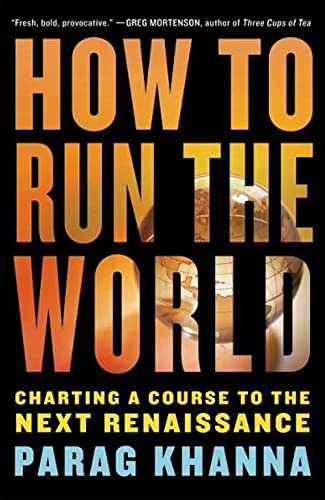
Outlines a provocative approach to diplomacy that addresses the needs of today s globalized world, covering issues ranging from economic imbalance and environmental stress with recommendations for specific actions to unify the resources of governments, corporations and civic groups.
Die Inhaltsangabe kann sich auf eine andere Ausgabe dieses Titels beziehen.
Über die Autorin bzw. den Autor
Parag Khanna directs the Global Governance Initiative in the American Strategy Program of the New America Foundation. Author of the previous international bestseller The Second World, he was picked as one of Esquire’s Most Influential People of the Twenty-first Century and featured on Wired’s Smart List. He has been a fellow at the Brookings Institution and researched at the Council on Foreign Relations. During 2007, he was a senior geopolitical adviser to U.S. Special Operations Command. He has written for major global publications such as The New York Times and Financial Times and appears regularly on CNN, BBC, and other television media around the world. He has traveled in nearly one hundred countries and has been named a Young Global Leader of the World Economic Forum.
Auszug. © Genehmigter Nachdruck. Alle Rechte vorbehalten.
Chapter One
Mega-diplomacy
Breakdown and failure reveal the true nature of things.
-Karl Jaspers
Two millennia of experience and mountains of knowledge have not made us much more capable of managing our affairs than stone-age people.
-Mahathir bin Mohamed,
former prime minister of Malaysia
There is one way to run the world: with diplomacy. Yet for many people, "diplomacy" is a historical term more than anything useful. That needs to change. Until we evolve a new diplomatic design, we will fail to confront and prevent the constant stream of crises-from financial turmoil to failed states-that engulf us. We are running out of time.
Twenty-first-century diplomacy is coming to resemble that of the Middle Ages: Rising powers, multinational corporations, powerful families, humanitarians, religious radicals, universities, and mercenaries are all part of the diplomatic landscape. Technology and money, not sovereignty, determine who has authority and calls the shots. This can be a good thing if it means getting all hands on deck to manage challenges that no government or organization can tackle alone. Success in this new world of mega-diplomacy hinges on bringing the key players together-governments, businesses, and organizations- into coalitions that can quickly move global resources to solve local problems. This is not your grandfather's diplomacy, but today's Generation Y intuitively gets it.
Diplomacy Is Dead! Long Live Diplomacy!
At least once every hundred years, the world goes to war-and then tries to make lasting peace. During six intense months in Vienna in 1814, ministers of Europe's major powers-Britain's Lord Castle?reagh, France's Talleyrand, Russia's czar Alexander I and Count Nesselrode, and Austria's Prince Metternich-were entrusted with redrawing Europe's political map after the defeat of Napoleonic France. Their conservative order, the "Concert of Europe," lasted essentially until World War I. When the great powers gathered again for six months in Paris in 1919, they were represented by France's Georges Clemenceau, Britain's David Lloyd George, Italy's Vittorio Orlando, and America's Wood?row Wilson. As the statesmen negotiated military disarmament, exchanges of territory, payment of reparations, and the dismantling of colonies, it seemed the whole world was in their hands-until it all fell apart again. After World War II, America's Franklin D. Roosevelt envisioned a global version of the Concert of Europe, this time with "Four Policemen"-the United States, the United Kingdom, the Soviet Union, and China-guaranteeing global stability. However, despite the growing membership of the United Nations, Cold War superpower summits reminded the world that some countries were still more equal than others.
Luckily, the Cold War ended without nuclear catastrophe, but the vacuum of the past two decades has yet to give birth to a new global architecture that reflects the rapidly changing realities of power and influence. The nineteenth-century world was run by a few key powers overseeing their colonies, and the twentieth century by power blocks. In the twenty-first century, however, manipulating world order from above won't be enough.
The past decade-from the 9/11 terrorist attacks to the global financial meltdown-has taught us the dangers of interdependence and that outsourcing leadership is a recipe for disaster. Some now fear a breakdown of our global order, but isn't it scarier to realize that the present order has already been broken for years? It's the kind of moment the philosopher Karl Popper had in mind when he argued that tearing down our existing order and constructing a new one from scratch might lead to a more workable system.
How bad is it? Well, today the powers that are expected to keep the peace sell the most weapons, the banks that are supposed to encourage saving promote living beyond one's means, and food arrives to hungry people after they've died. We are hurtling toward a perfect storm of energy consumption, population growth, and food and water scarcity that will spare no one, rich or poor. Our ever-growing list of crises includes financial instability, HIV/AIDS, terrorism, failed states, and more. Any one of these can magnify another, creating a downward spiral for individual nations and regions. Within the next twenty years we could see proxy skirmishes escalate into major war between America and China, more weak states crumbling, conflicts over submerged oil and gas resources at sea, drought-starved refugees streaming out of central Africa, and sinking Pacific islands.
Henry Kissinger said it best: "You do not design a new world order as an emergency measure. But you need an emergency to bring about a new world order." Finally, there is a global debate under way about how to redesign the way we run the world. It's about time-and hopefully not too late. Globalization has thrust us into a chaotic era with which our leading powers and institutions only pretend they can cope. Americans believe they can lead a "multi-partner" world, Europeans think they can tame the world through "civilian power," the Chinese try to buy the world off, most others states just want status without responsibility, and the United Nations is barely spoken of anymore. They all need to seriously rethink how the world is run. The notion of a "G-2" axis between the United States and China is the latest misguided incarnation of our quest for a simple global framework-it ignores the fact that the two powers can't agree on currency, climate, censorship, or many other issues, and that few if any countries want to be dictated to by either the United States or China.
There is no doubt that we need a global redesign to confront this perfect storm-one that doesn't just react to crises but proactively prevents them. What we have right now, though, is global policy gridlock: The West demands interventions and human rights, while the East prefers sovereignty and noninterference; the North is scared of terrorism and proliferation, while the South needs food security and fair trade. Stock prices are crucial for the capital rich; commodities prices for the resource rich. Americans are suspicious of Chinese state-owned companies, while the Chinese are suspicious of American regulators. We seem as far away as ever from a new consensus.
In 2004, the British historian Anthony Sampson published the widely acclaimed book Who Runs This Place? He was motivated by the simple question "Who is accountable to whom and for what?" Inside the book are Sampson's hand-sketched Venn diagrams depicting "The Establishment," interlocking circles of power whose fuzzy relationships seem to lack an obvious purpose of public good: the prime minister, accountants, pension funds, the monarchy, corporations, lobbyists, the rich, aristocracy, diplomats, intelligence, the treasury, Parliament, academia, churches, political parties, lawyers, the military, the insurance industry, television, editors, trade unions-and that's just for Great Britain.
Sampson was worried about British democracy; in international relations there is no such thing. What we have today is a worldwide perpetual no-holds-barred contest for power and legitimacy between regimes, companies, nongovernmental organizations (NGOs), religious groups, and super-empowered individuals all pursuing their own interests. From economic nationalists to resource-hungry companies to religious fundamentalists, everyone is out for themselves. Interest groups are not a marginal sideshow to some "real" politics; they are the politics. The best term for it: mosh pit.
Ironically, our ambition often prevents us from recognizing this reality. Because issues such as the climate and economy are "systemic" in nature, meaning they have worldwide scope and impact, we reach for grand, silver-bullet remedies such as "America must take...
„Über diesen Titel“ kann sich auf eine andere Ausgabe dieses Titels beziehen.
Suchergebnisse für How to Run the World: Charting a Course to the Next...

Beispielbild für diese ISBN
How to Run the World: Charting a Course to the Next Renaissance
Anbieter: World of Books (was SecondSale), Montgomery, IL, USA
Verkäuferbewertung 5 von 5 Sternen

Zustand: Good. Item in good condition. Textbooks may not include supplemental items i.e. CDs, access codes etc. Artikel-Nr. 00099834265
Gebraucht kaufen
EUR 3,99
Versand gratis
Versand innerhalb von USA
Versand innerhalb von USA
Anzahl: 2 verfügbar
Beispielbild für diese ISBN
How to Run the World: Charting a Course to the Next Renaissance
Anbieter: World of Books (was SecondSale), Montgomery, IL, USA
Verkäuferbewertung 5 von 5 Sternen
Zustand: Very Good. Item in very good condition! Textbooks may not include supplemental items i.e. CDs, access codes etc. Artikel-Nr. 00097491530
Gebraucht kaufen
EUR 3,99
Versand gratis
Versand innerhalb von USA
Versand innerhalb von USA
Anzahl: 2 verfügbar
Beispielbild für diese ISBN
How to Run the World: Charting a Course to the Next Renaissance
Verlag:
Random House (edition ), 2011
ISBN 10: 1400068274
ISBN 13: 9781400068272
Gebraucht
Hardcover
Anbieter: BooksRun, Philadelphia, PA, USA
Verkäuferbewertung 5 von 5 Sternen
Hardcover. Zustand: Very Good. With dust jacket. It's a well-cared-for item that has seen limited use. The item may show minor signs of wear. All the text is legible, with all pages included. It may have slight markings and/or highlighting. Artikel-Nr. 1400068274-11-1-29
Gebraucht kaufen
EUR 5,17
Versand gratis
Versand innerhalb von USA
Versand innerhalb von USA
Anzahl: 1 verfügbar
Beispielbild für diese ISBN
How to Run the World: Charting a Course to the Next Renaissance
Anbieter: ThriftBooks-Dallas, Dallas, TX, USA
Verkäuferbewertung 5 von 5 Sternen
Hardcover. Zustand: Very Good. No Jacket. Missing dust jacket; May have limited writing in cover pages. Pages are unmarked. ~ ThriftBooks: Read More, Spend Less. Artikel-Nr. G1400068274I4N01
Gebraucht kaufen
EUR 6,28
Versand gratis
Versand innerhalb von USA
Versand innerhalb von USA
Anzahl: 1 verfügbar
Beispielbild für diese ISBN
How to Run the World: Charting a Course to the Next Renaissance
Anbieter: ThriftBooks-Dallas, Dallas, TX, USA
Verkäuferbewertung 5 von 5 Sternen
Hardcover. Zustand: Very Good. No Jacket. Former library book; May have limited writing in cover pages. Pages are unmarked. ~ ThriftBooks: Read More, Spend Less. Artikel-Nr. G1400068274I4N10
Gebraucht kaufen
EUR 6,28
Versand gratis
Versand innerhalb von USA
Versand innerhalb von USA
Anzahl: 1 verfügbar
Beispielbild für diese ISBN
How to Run the World: Charting a Course to the Next Renaissance
Anbieter: ThriftBooks-Atlanta, AUSTELL, GA, USA
Verkäuferbewertung 5 von 5 Sternen
Hardcover. Zustand: Very Good. No Jacket. May have limited writing in cover pages. Pages are unmarked. ~ ThriftBooks: Read More, Spend Less. Artikel-Nr. G1400068274I4N00
Gebraucht kaufen
EUR 6,28
Versand gratis
Versand innerhalb von USA
Versand innerhalb von USA
Anzahl: 1 verfügbar
Beispielbild für diese ISBN
How to Run the World : Charting a Course to the Next Renaissance
Anbieter: Better World Books, Mishawaka, IN, USA
Verkäuferbewertung 5 von 5 Sternen
Zustand: Good. Former library copy. Pages intact with minimal writing/highlighting. The binding may be loose and creased. Dust jackets/supplements are not included. Includes library markings. Stock photo provided. Product includes identifying sticker. Better World Books: Buy Books. Do Good. Artikel-Nr. 2936307-6
Gebraucht kaufen
EUR 8,32
Versand gratis
Versand innerhalb von USA
Versand innerhalb von USA
Anzahl: 2 verfügbar
Beispielbild für diese ISBN
How to Run the World : Charting a Course to the Next Renaissance
Anbieter: Better World Books, Mishawaka, IN, USA
Verkäuferbewertung 5 von 5 Sternen
Zustand: Very Good. Former library copy. Pages intact with possible writing/highlighting. Binding strong with minor wear. Dust jackets/supplements may not be included. Includes library markings. Stock photo provided. Product includes identifying sticker. Better World Books: Buy Books. Do Good. Artikel-Nr. 5524197-6
Gebraucht kaufen
EUR 8,32
Versand gratis
Versand innerhalb von USA
Versand innerhalb von USA
Anzahl: 1 verfügbar
Beispielbild für diese ISBN
How To Run The World
Anbieter: WorldofBooks, Goring-By-Sea, WS, Vereinigtes Königreich
Verkäuferbewertung 5 von 5 Sternen
Hardback. Zustand: Very Good. The book has been read, but is in excellent condition. Pages are intact and not marred by notes or highlighting. The spine remains undamaged. Artikel-Nr. GOR005867746
Gebraucht kaufen
EUR 3,36
EUR 6,54 Versand
Versand von Vereinigtes Königreich nach USA
Versand von Vereinigtes Königreich nach USA
Anzahl: 3 verfügbar
Beispielbild für diese ISBN
How To Run The World
Anbieter: WorldofBooks, Goring-By-Sea, WS, Vereinigtes Königreich
Verkäuferbewertung 5 von 5 Sternen
Hardback. Zustand: Fine. Artikel-Nr. GOR014942754
Gebraucht kaufen
EUR 3,36
EUR 6,54 Versand
Versand von Vereinigtes Königreich nach USA
Versand von Vereinigtes Königreich nach USA
Anzahl: 1 verfügbar