
Verwandte Artikel zu A Gift to My Children: A Father's Lessons for Life...
Inhaltsangabe
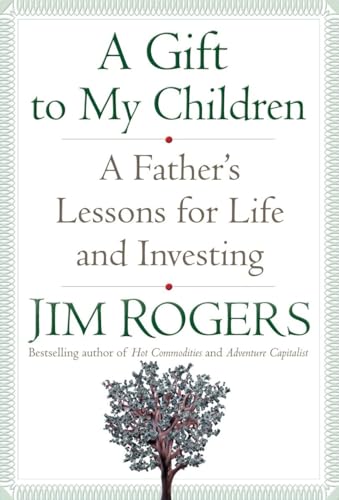
He’s the swashbuckling world traveler and legendary investor who made his fortune before he was forty. Now the bestselling author of A Bull in China, Hot Commodities, and Adventure Capitalist shares a heartfelt, indispensable guide for his daughters (and all young investors) to find success and happiness. In A Gift to My Children, Jim Rogers offers advice with his trademark candor and confidence, but this time he adds paternal compassion, protectiveness, and love. Rogers reveals how to learn from his triumphs and mistakes in order to achieve a prosperous, well-lived life. For example:
• Trust your own judgment: Rogers sensed China’s true potential way back in the 1980s, at a time when most analysts were highly skeptical of its prospects for growth.
• Focus on what you like: Rogers was five when he started collecting empty bottles at baseball games instead of playing.
• Be persistent: Coming to Yale from rural Alabama, and in over his head, Rogers never stopped studying and wound up with a scholarship to Oxford.
• See the world: In 1990, Rogers traveled through six continents by motorcycle, gaining a global perspective and learning how to evaluate prospects in rapidly developing countries such as Brazil, Russia, India, and China.
• Nothing is really new: anything deemed “innovative” or “unprecedented” is usually just overhyped, as in the case of the Internet or TV, airplanes, and railroads before it
• And not a bit off the subject, and very important: Boys will need you more than you’ll need them!
Wise and warm, accessible and inspiring, A Gift to My Children is a great gift for all those just starting to invest in their futures.
Die Inhaltsangabe kann sich auf eine andere Ausgabe dieses Titels beziehen.
Über die Autorin bzw. den Autor
Jim Rogers co-founded the Quantum Fund before he turned 30 and retired at age thirty-seven. Since then, he has served as a sometime professor of finance at Columbia University’s business school, and as a media commentator worldwide. He is the author of A Bull in China, Hot Commodities, Adventure Capitalist, and Investment Biker. He recently moved to Asia with his wife and daughters.
Auszug. © Genehmigter Nachdruck. Alle Rechte vorbehalten.
Chapter One
Swim Your Own Races: Do Not Let Others Do Your Thinking for You
Rely on your own intelligence.
There are going to be moments in life when you must make very important decisions. You will find many people ready to offer you advice if you ask for it (and even if you don’t), but always remember that the life you lead is yours and nobody else’s. It’s important to decide for yourself what’s important to you and what you want before you turn to others. Because while there will be times when outside advice proves wise, there will be at least as many times when it proves utterly useless. The only way to really evaluate other folks’ advice is to first learn everything that you can about whatever challenge you are facing. Once you’ve done that, in most cases you should be able to make an informed decision on your own anyway.
You were born with the ability to decide what is and what isn’t in your best interest. Most of the time, you will make the right decision and take the appropriate actions, and in thinking for yourself, you will become far more successful than had you gone against your own judgment. Believe me, I know.
Early on in my investment career, I made the mistake of basing a few important business decisions on colleagues’ opinions instead of conducting the research necessary to make an informed decision. It wasn’t due to laziness on my part; no one could ever accuse me of that. But, being new to Wall Street, I tended to assume that my more senior colleagues knew more than I did, and so I attributed too much significance to their opinions. You know what happened? Each of those investments ended in failure. Eventually I stopped allowing myself to be influenced by others and began doing the work myself and making my own decisions. Talk about an epiphany. It took me until I was almost thirty years old to realize this—and also to see that it’s never too late for a person to change his approach both to business and to life.
I remember once reading a magazine interview with American swimmer Donna de Varona, winner of two gold medals at the 1964 Summer Olympics in Tokyo. The reporter pointed out that earlier in her career, she had been a good swimmer, but not a great one. Now the seventeen-year-old had just placed first in two four-hundred-meter events. What happened? She replied, “I always used to watch the other swimmers, but then I learned to ignore them and swim my own races.”
If anybody laughs at your idea, view it as a sign of potential success!
If people around you try to discourage you from taking a certain course of action, or ridicule your ideas, take that as a positive sign. Sure it can be difficult not to run with the herd, but the truth is that most long-term success stories are written by folks who’ve done exactly that. Let me give you an example.
When I was thirty-two years old or so, a Wall Street colleague of mine invited me to join a smart and successful group of financial guys who regularly got together to swap ideas over dinner. At the time, I and a partner were in the early years of our hedge fund called the Quantum Fund. It was a big deal to be invited to these dinners, and, I must admit, I was a little nervous. After all, these were the big guys in my field, and most of them had a great deal more experience than I did.
We were sitting in the private room of a fancy midtown Manhattan restaurant when the host asked each guest at the table to recommend an investment. Most of them touted so-called growth stocks. When my turn came, I recommended Lockheed, the aerospace company. Once extremely prosperous, by the 1970s it had fallen on hard times. A fellow sitting opposite me smirked and, making sure that I heard him, stage-whispered, “Who buys stocks like this? Why buy a bankrupt company?”
About six years later, I ran into this schoolyard bully. I resisted the urge to remind him of his condescending remark. It wasn’t easy, given that Lockheed Corporation stock had since increased in value a hundredfold, and for all the reasons that I had explained over dinner: The company shed a huge money-losing division and instead concentrated on the exciting new area of electronic warfare systems. Furthermore, as could have been predicted, defense spending had grown rapidly following a period of decline.
I had a similar experience with my investments in China. People used to call the country a graveyard for investors, and as recently as the late 1990s, few Westerners invested there. But those who did made a fortune. What did I know that others didn’t? Well, back in the 1980s, I sensed China’s potential and decided to learn everything I could about it and start investing my money there. Many people told me I was insane; that the rigidly Communist Chinese government would confiscate money earned by successful people, especially outsiders. But I followed my instincts, learned as much as I could about political trends in China, and studied as many documents as I could find. Most valuable of all, I drove across the country—and it’s a big country—several times. Here’s what I learned by seeing it with my own eyes:
China had more than one billion workers, and over one-third of their annual income went into savings. That’s astoundingly high. In contrast, the savings rate in the United States was a mere 4 percent. (Today it’s just half that, at 2 percent.) Everywhere I traveled, I saw that the capitalism, drive, and entrepreneurship that had characterized China for centuries had at long last reemerged following the failure of Communism. And there was no going back.
I was struck by how the Chinese people worked from dawn to dusk. In one town, I met a farmer known locally as the “Apple King” because of his huge orchards. In another town, I talked to a successful restaurateur-hotelier who proudly told me how he’d started out by selling bread to farmers as they walked to work every day at dawn. China’s cities were full of college kids determined to forge their own futures and enjoy greater prosperity than their parents’ generation. People were learning English and Japanese instead of Russian; they could see who had the money. Meanwhile, the Western media persisted in referring to the country as “Mao Tse-tung’s China,” even though the Communist dictator had died in 1976. They were blind to the changes taking place—and I would have been too, had I not gone there myself and immersed myself in Chinese society. I came away thinking, How could a country like this not grow? Since then, China’s economic development has far exceeded not only that of the United States but of nearly every other nation in the world.
Be who you are. Be original! Be bold!
Take a good look at men and women who have been successful in their fields. Now, anyone can get lucky once, but I’m talking about people with a sustained record of success. Whether they are artists or musicians, high school teachers or college professors, they all approach their work in a refreshingly original way. This is true of companies too. For example, look at Apple Computer. Steve Jobs and Company refused to accept the conventional wisdom that they would be flattened by the giants IBM and Microsoft. Apple continued to produce high-quality, innovative products and has since been removed from the corporate endangered-species list. In fact, the company is thriving.
I want you to pursue your own desires and aspirations with that kind of courage and devotion. Your father succeeded as an investor, but that doesn’t mean that you must be investors too. What I want is for both of you to be your true, original, unique selves.
Above all, be...
„Über diesen Titel“ kann sich auf eine andere Ausgabe dieses Titels beziehen.
Suchergebnisse für A Gift to My Children: A Father's Lessons for Life...

Beispielbild für diese ISBN
A Gift to My Children A Father
Anbieter: World of Books (was SecondSale), Montgomery, IL, USA
Verkäuferbewertung 5 von 5 Sternen

Zustand: Good. Item in good condition. Textbooks may not include supplemental items i.e. CDs, access codes etc. Artikel-Nr. 00088115858
Gebraucht kaufen
EUR 4,28
Versand gratis
Versand innerhalb von USA
Versand innerhalb von USA
Anzahl: 13 verfügbar
Beispielbild für diese ISBN
A Gift to My Children: A Father's Lessons for Life and Investing
Verlag:
Random House (edition 0), 2009
ISBN 10: 1400067545
ISBN 13: 9781400067541
Gebraucht
Hardcover
Anbieter: BooksRun, Philadelphia, PA, USA
Verkäuferbewertung 5 von 5 Sternen
Hardcover. Zustand: Very Good. 0. With dust jacket. It's a well-cared-for item that has seen limited use. The item may show minor signs of wear. All the text is legible, with all pages included. It may have slight markings and/or highlighting. Artikel-Nr. 1400067545-11-1-29
Gebraucht kaufen
EUR 4,29
Versand gratis
Versand innerhalb von USA
Versand innerhalb von USA
Anzahl: 1 verfügbar
Beispielbild für diese ISBN
A Gift to My Children: A Father's Lessons for Life and Investing
Verlag:
Random House (edition 0), 2009
ISBN 10: 1400067545
ISBN 13: 9781400067541
Gebraucht
Hardcover
Anbieter: BooksRun, Philadelphia, PA, USA
Verkäuferbewertung 5 von 5 Sternen
Hardcover. Zustand: Very Good. 0. It's a well-cared-for item that has seen limited use. The item may show minor signs of wear. All the text is legible, with all pages included. It may have slight markings and/or highlighting. Artikel-Nr. 1400067545-8-6
Gebraucht kaufen
EUR 4,32
Versand gratis
Versand innerhalb von USA
Versand innerhalb von USA
Anzahl: 1 verfügbar
Beispielbild für diese ISBN
A Gift to My Children: A Father's Lessons for Life and Investing
Verlag:
Random House (edition 0), 2009
ISBN 10: 1400067545
ISBN 13: 9781400067541
Gebraucht
Hardcover
Anbieter: BooksRun, Philadelphia, PA, USA
Verkäuferbewertung 5 von 5 Sternen
Hardcover. Zustand: Very Good. 0. With dust jacket. It's a well-cared-for item that has seen limited use. The item may show minor signs of wear. All the text is legible, with all pages included. It may have slight markings and/or highlighting. Artikel-Nr. 1400067545-8-1-29
Gebraucht kaufen
EUR 5,43
Versand gratis
Versand innerhalb von USA
Versand innerhalb von USA
Anzahl: 1 verfügbar
Foto des Verkäufers
A Gift to My Children: A Father's Lessons for Life and Investing
Anbieter: Dream Books Co., Denver, CO, USA
Verkäuferbewertung 5 von 5 Sternen
Zustand: very_good. Pages are clean with no markings. May show minor signs of wear or cosmetic defects marks, cuts, bends, or scuffs on the cover, spine, pages, or dust jacket. May have remainder marks on edges. Artikel-Nr. DBV.1400067545.VG
Gebraucht kaufen
EUR 5,64
Versand gratis
Versand innerhalb von USA
Versand innerhalb von USA
Anzahl: 1 verfügbar
Beispielbild für diese ISBN
A Gift to My Children: A Father's Lessons for Life and Investing
Anbieter: ThriftBooks-Atlanta, AUSTELL, GA, USA
Verkäuferbewertung 5 von 5 Sternen
Hardcover. Zustand: Very Good. No Jacket. Missing dust jacket; May have limited writing in cover pages. Pages are unmarked. ~ ThriftBooks: Read More, Spend Less. Artikel-Nr. G1400067545I4N01
Gebraucht kaufen
EUR 6,11
Versand gratis
Versand innerhalb von USA
Versand innerhalb von USA
Anzahl: 1 verfügbar
Beispielbild für diese ISBN
A Gift to My Children: A Father's Lessons for Life and Investing
Anbieter: ThriftBooks-Phoenix, Phoenix, AZ, USA
Verkäuferbewertung 5 von 5 Sternen
Hardcover. Zustand: Very Good. No Jacket. May have limited writing in cover pages. Pages are unmarked. ~ ThriftBooks: Read More, Spend Less. Artikel-Nr. G1400067545I4N00
Gebraucht kaufen
EUR 6,11
Versand gratis
Versand innerhalb von USA
Versand innerhalb von USA
Anzahl: 1 verfügbar
Beispielbild für diese ISBN
A Gift to My Children: A Father's Lessons for Life and Investing
Anbieter: ThriftBooks-Atlanta, AUSTELL, GA, USA
Verkäuferbewertung 5 von 5 Sternen
Hardcover. Zustand: Very Good. No Jacket. May have limited writing in cover pages. Pages are unmarked. ~ ThriftBooks: Read More, Spend Less. Artikel-Nr. G1400067545I4N00
Gebraucht kaufen
EUR 6,11
Versand gratis
Versand innerhalb von USA
Versand innerhalb von USA
Anzahl: 1 verfügbar
Beispielbild für diese ISBN
A Gift to My Children : A Father's Lessons for Life and Investing
Verlag:
Random House Publishing Group, 2009
ISBN 10: 1400067545
ISBN 13: 9781400067541
Gebraucht
Hardcover
Erstausgabe
Anbieter: Better World Books, Mishawaka, IN, USA
Verkäuferbewertung 5 von 5 Sternen
Zustand: Very Good. First Edition. Pages intact with possible writing/highlighting. Binding strong with minor wear. Dust jackets/supplements may not be included. Stock photo provided. Product includes identifying sticker. Better World Books: Buy Books. Do Good. Artikel-Nr. 4543662-6
Gebraucht kaufen
EUR 6,19
Versand gratis
Versand innerhalb von USA
Versand innerhalb von USA
Anzahl: 1 verfügbar
Beispielbild für diese ISBN
A Gift to My Children : A Father's Lessons for Life and Investing
Verlag:
Random House Publishing Group, 2009
ISBN 10: 1400067545
ISBN 13: 9781400067541
Gebraucht
Hardcover
Erstausgabe
Anbieter: Better World Books, Mishawaka, IN, USA
Verkäuferbewertung 5 von 5 Sternen
Zustand: Good. First Edition. Former library copy. Pages intact with minimal writing/highlighting. The binding may be loose and creased. Dust jackets/supplements are not included. Includes library markings. Stock photo provided. Product includes identifying sticker. Better World Books: Buy Books. Do Good. Artikel-Nr. GRP89756910
Gebraucht kaufen
EUR 6,19
Versand gratis
Versand innerhalb von USA
Versand innerhalb von USA
Anzahl: 2 verfügbar