
Verwandte Artikel zu American Rose: A Nation Laid Bare: The Life and Times...
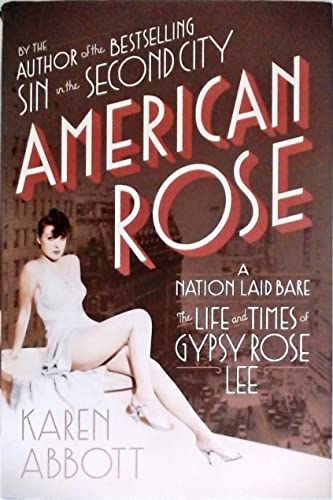
Inhaltsangabe
NEW YORK TIMES BESTSELLER
With the critically acclaimed Sin in the Second City, bestselling author Karen Abbott “pioneered sizzle history” (USA Today). Now she returns with the gripping and expansive story of America’s coming-of-age—told through the extraordinary life of Gypsy Rose Lee and the world she survived and conquered.
America in the Roaring Twenties. Vaudeville was king. Talking pictures were only a distant flicker. Speakeasies beckoned beyond dimly lit doorways; money flowed fast and free. But then, almost overnight, the Great Depression leveled everything. When the dust settled, Americans were primed for a star who could distract them from grim reality and excite them in new, unexpected ways. Enter Gypsy Rose Lee, a strutting, bawdy, erudite stripper who possessed a preternatural gift for delivering exactly what America needed.
With her superb narrative skills and eye for compelling detail, Karen Abbott brings to vivid life an era of ambition, glamour, struggle, and survival. Using exclusive interviews and never-before-published material, she vividly delves into Gypsy’s world, including her intensely dramatic triangle relationship with her sister, actress June Havoc, and their formidable mother, Rose, a petite but ferocious woman who seduced men and women alike and literally killed to get her daughters on the stage.
American Rose chronicles their story, as well as the story of the four scrappy and savvy showbiz brothers from New York City who would pave the way for Gypsy Rose Lee’s brand of burlesque. Modeling their shows after the glitzy, daring reviews staged in the theaters of Paris, the Minsky brothers relied on grit, determination, and a few tricks that fell just outside the law—and they would shape, and ultimately transform, the landscape of American entertainment.
With a supporting cast of such Jazz- and Depression-era heavyweights as Lucky Luciano, Harry Houdini, FDR, and Fanny Brice, Karen Abbott weaves a rich narrative of a woman who defied all odds to become a legend—and whose sensational tale of tragedy and triumph embodies the American Dream.
Die Inhaltsangabe kann sich auf eine andere Ausgabe dieses Titels beziehen.
Über die Autorin bzw. den Autor
Karen Abbott is the New York Times bestselling author of Sin in the Second City. A native of Philadelphia, she now lives in New York City with her husband and two African Grey parrots who do a mean Ethel Merman. Visit her online at www.karenabbott.net.
Auszug. © Genehmigter Nachdruck. Alle Rechte vorbehalten.
Chapter One
Everybody thinks it's all so easy. Sure. Mother says I'm the most beautiful naked ass-well, I'm not. I'm the smartest. -Gypsy Rose Lee
New York World's Fair, 1940
In late spring, across a stretch of former wasteland in Flushing Meadows, Queens, a quarter-million people pay 50 cents each to forget and to dream. In the last decade they lost jobs and homes and now they face bleaker losses in the years to come: fathers and sons and husbands, a fragile faith that the worst has passed, the hope that America will never again be called to save the world. They come by boat and train and trolley and bus, hitchhike across four states in as many days, engagement rings tucked deep inside pockets along with every dollar they own. Not one inch of the fair's1,216 acres betrays its inglorious past as a dump, Gatsby's valley of ashes come to life, where towering heaps of debris meandered in an ironic skyline. Instead, beyond the gates, a "World of Tomorrow" beckons, offering flamboyant distractions and bewitching sleight of hand, a glimpse of fantasy without the promise that it will ever come to pass.
They have never seen anything like the Trylon, its gaunt steel ribs stretching seven hundred feet high, carrying bodies skyward on the largest escalator in the world. They chase salty scoops of Romanian caviar with swigs of aged Italian Barolo. On one soft spring day they admire Joe DiMaggio as he accepts the Golden Laurel of Sport Award. At the Aquacade exhibition they watch comely "aqua belles" perform intricate, synchronized routines, the water kept extra cold so as to stimulate goose flesh and nipples. They hear Mayor Fiorello La Guardia boom with optimistic predictions: "We will be dedicating a fair to the hope of the people of the world. The contrast must be striking to everyone. While other countries are in the twilight of an unhappy age, we are approaching the dawn of a new day." The Westinghouse Time Capsule, to remain sealed until a.d. 6939, contains fragments of their lives: microfilm of Gone with the Wind, a kewpie doll, samples of asbestos, a dollar in change. At night, when fireworks begin, they fall silent watching the colors crisscross overhead, hot tails branding the sky, imprinting a patchwork of lovely scars.
They wait in lines for hours to glimpse a reality that seems both distant and distinctly possible. Revolving chairs equipped with individual loudspeakers transport them through General Motors' Futurama exhibit, a vast model of America in 1960, where radio-controlled cars never veer off course on fourteen-lane highways and "undesirable slum areas" are wiped out. They witness a robot named Elektro issue commands to his mechanical dog, Sparko. They marvel at an array of new inventions: the fax machine, nylon stockings, a 12-foot-long electric shaver. One thousand of themwatch the fair's opening ceremonies on NBC's experimental station, W2XBS."Sooner than you realize it," advertisements for the telecast predict, "television will play a vital part in the life of the average American."
But this World of Tomorrow can't obscure the dangers of the world of today, despite the fair committee's efforts. The new officials logan, "Peace and Freedom," is absurdly incongruous with the hourly war bulletins that blare over the public address system. Visitors who brave the foreign section find only a melancholy museum of things past. The Netherlands building is dark and vacant, the Danish exhibit downsized into smaller quarters. Poland, Norway, and Finland still have a presence, but fly their flags at half-mast and display grim galleries that show photographs of demolished historical buildings and list names of the distinguished dead. The Soviet Pavilion is razed and replaced by a space called the "American Common," complete with "I Am an American Day." Fairgoers line up at the Belgium Pavilion when that nation falls to Germany, as if waiting to pay their respects at a wake. They wish this slim wedge of time between troubles past and future could pause indefinitely, but understand that New York is capable of everything but standing still.
On May 20, thousands of them-a crowd larger than the turnout for President Franklin Delano Roosevelt and Wendell Willkie combined-find temporary solace at the Hall of Music, where they wait to see Gypsy Rose Lee in her World's Fair debut. A forty-foot-tall billboard flaunting her image looms above the entrance, those skyscraper legs and swerving hips a respite from the hard lines and stark angles of this futuristic fantasy. She wears an expression both impish and imperious, a baited half smile that summons them closer yet suggests they'll never arrive.
Inside her dressing room, Gypsy reclines on a chaise lounge and holds a glass of brandy in shaking hands. The smoky-sweet scent of knockwurst drifts over from her hot plate, but her appetite is gone. She can hear them, the dull thrum of their expectations, the drumbeat chants of her name. Gypsy Rose Lee, voted the most popular woman in America, outpolling even Eleanor Roosevelt. Gypsy Rose Lee, who boasts that her own billboard is "larger than Stalin's." Gypsy Rose Lee, the only woman in the world, according to Life magazine, "with a public body and a private mind, bothequally exciting." Gypsy Rose Lee, whose best talent-whose only talent-is becoming whatever America needs at any given time. Gypsy Rose Lee, who, at the moment, is as mysterious to herself as she is to the gathering strangers outside.
She sips her brandy, lights a Murad cigarette. The voices beyond these four tight walls grow louder still, but can't overtake her thoughts. At age twenty-nine, she stands, precisely and precariously, on her own personal midway, cluttered with roaring secrets from her past and muted fears for her future, an equal number of years ahead in her life as behind. A half-dozen scrapbooks are fat with clippings from vaudeville and burlesque, her first marriage and Hollywood career, her political activism and opening nights; a half-dozen more, blank and empty, wait for her to fill the pages. Not a day passes without her retelling, if just to her own ears, the densely woven and tightly knotted story of her own legend, and not a day passes when she doesn't wonder how its final line will read.
She senses that the next chapter might begin with Michael Todd, the man who said he'd give his right ball to hire her, who granted her the Stalin-sized billboard and a second chance with New York. Earlier that afternoon, he banged on her dressing room door, and she took her time letting him in.
"What's the matter in there?" he asked, pushing his way inside. "Can't you read?" He pointed his cigar toward a sign on the notice board: no cooking backstage.
"Of course I can read. It saves money," Gypsy said in that inimitable voice. She's worked for years on that voice, scrubbing the Seattle out of it, ironing it smooth, tolling her words like bells: "rare" became rar-er-a. It is both charming and affected and, she neither raised a decibel or compressed to a whisper, positively terrifying. It makes babies cry and one of her dogs urinate in fear.
"On your salary," Mike responded, "I can't afford to have you stinking up the theater."
Gypsy invited him to try her knockwurst, and he sat down across from her. She smiled at his singular philosophy about money and success: "I've been broke but I've never been poor," he told her. "Being poor is a state of mind. Being broke is only a temporary situation." She noted his graceful, fluid movements, strangely at odds with his features: rectangular, filet-thick hands dead-ending into tubular fingers, a head that sat atop a brick of a neck. He nearly licked the plate, and afterward ripped down the sign.
A cheapskate, Gypsy thinks, but not a hypocrite. Just like her, on both counts. She suspects they'll work well together...
„Über diesen Titel“ kann sich auf eine andere Ausgabe dieses Titels beziehen.
Suchergebnisse für American Rose: A Nation Laid Bare: The Life and Times...

Beispielbild für diese ISBN
American Rose: A Nation Laid Bare: The Life and Times of Gypsy Rose Lee
Anbieter: World of Books (was SecondSale), Montgomery, IL, USA
Verkäuferbewertung 5 von 5 Sternen

Zustand: Acceptable. Item in acceptable condition! Textbooks may not include supplemental items i.e. CDs, access codes etc. Artikel-Nr. 00106571964
Gebraucht kaufen
EUR 4,55
Versand gratis
Versand innerhalb von USA
Versand innerhalb von USA
Anzahl: 1 verfügbar
Beispielbild für diese ISBN
American Rose: A Nation Laid Bare: The Life and Times of Gypsy Rose Lee
Anbieter: World of Books (was SecondSale), Montgomery, IL, USA
Verkäuferbewertung 5 von 5 Sternen
Zustand: Good. Item in good condition. Textbooks may not include supplemental items i.e. CDs, access codes etc. Artikel-Nr. 00097620862
Gebraucht kaufen
EUR 4,55
Versand gratis
Versand innerhalb von USA
Versand innerhalb von USA
Anzahl: 4 verfügbar
Beispielbild für diese ISBN
American Rose: A Nation Laid Bare: The Life and Times of Gypsy Rose Lee
Verlag:
Random House (edition First Edition), 2010
ISBN 10: 1400066913
ISBN 13: 9781400066919
Gebraucht
Hardcover
Erstausgabe
Anbieter: BooksRun, Philadelphia, PA, USA
Verkäuferbewertung 5 von 5 Sternen
Hardcover. Zustand: Very Good. First Edition. With dust jacket. It's a well-cared-for item that has seen limited use. The item may show minor signs of wear. All the text is legible, with all pages included. It may have slight markings and/or highlighting. Artikel-Nr. 1400066913-11-1-29
Gebraucht kaufen
EUR 5,07
Versand gratis
Versand innerhalb von USA
Versand innerhalb von USA
Anzahl: 1 verfügbar
Beispielbild für diese ISBN
American Rose : A Nation Laid Bare - The Life and Times of Gypsy Rose Lee
Verlag:
Penguin Random House, 2010
ISBN 10: 1400066913
ISBN 13: 9781400066919
Gebraucht
Hardcover
Erstausgabe
Anbieter: Better World Books, Mishawaka, IN, USA
Verkäuferbewertung 5 von 5 Sternen
Zustand: Good. 1st. Pages intact with minimal writing/highlighting. The binding may be loose and creased. Dust jackets/supplements are not included. Stock photo provided. Product includes identifying sticker. Better World Books: Buy Books. Do Good. Artikel-Nr. 4348145-6
Gebraucht kaufen
EUR 6,48
Versand gratis
Versand innerhalb von USA
Versand innerhalb von USA
Anzahl: 1 verfügbar
Beispielbild für diese ISBN
American Rose : A Nation Laid Bare - The Life and Times of Gypsy Rose Lee
Verlag:
Penguin Random House, 2010
ISBN 10: 1400066913
ISBN 13: 9781400066919
Gebraucht
Hardcover
Erstausgabe
Anbieter: Better World Books: West, Reno, NV, USA
Verkäuferbewertung 5 von 5 Sternen
Zustand: Good. 1st. Former library copy. Pages intact with minimal writing/highlighting. The binding may be loose and creased. Dust jackets/supplements are not included. Includes library markings. Stock photo provided. Product includes identifying sticker. Better World Books: Buy Books. Do Good. Artikel-Nr. GRP102379287
Gebraucht kaufen
EUR 6,48
Versand gratis
Versand innerhalb von USA
Versand innerhalb von USA
Anzahl: 1 verfügbar
Beispielbild für diese ISBN
American Rose : A Nation Laid Bare - The Life and Times of Gypsy Rose Lee
Verlag:
Penguin Random House, 2010
ISBN 10: 1400066913
ISBN 13: 9781400066919
Gebraucht
Hardcover
Erstausgabe
Anbieter: Better World Books, Mishawaka, IN, USA
Verkäuferbewertung 5 von 5 Sternen
Zustand: Very Good. 1st. Former library copy. Pages intact with possible writing/highlighting. Binding strong with minor wear. Dust jackets/supplements may not be included. Includes library markings. Stock photo provided. Product includes identifying sticker. Better World Books: Buy Books. Do Good. Artikel-Nr. GRP73616318
Gebraucht kaufen
EUR 6,48
Versand gratis
Versand innerhalb von USA
Versand innerhalb von USA
Anzahl: 1 verfügbar
Beispielbild für diese ISBN
American Rose: A Nation Laid Bare: The Life and Times of Gypsy Rose Lee
Anbieter: ThriftBooks-Dallas, Dallas, TX, USA
Verkäuferbewertung 5 von 5 Sternen
Hardcover. Zustand: Very Good. No Jacket. May have limited writing in cover pages. Pages are unmarked. ~ ThriftBooks: Read More, Spend Less. Artikel-Nr. G1400066913I4N00
Gebraucht kaufen
EUR 7,06
Versand gratis
Versand innerhalb von USA
Versand innerhalb von USA
Anzahl: 1 verfügbar
Beispielbild für diese ISBN
American Rose: A Nation Laid Bare: The Life and Times of Gypsy Rose Lee
Anbieter: ThriftBooks-Dallas, Dallas, TX, USA
Verkäuferbewertung 5 von 5 Sternen
Hardcover. Zustand: Good. No Jacket. Former library book; Pages can have notes/highlighting. Spine may show signs of wear. ~ ThriftBooks: Read More, Spend Less. Artikel-Nr. G1400066913I3N10
Gebraucht kaufen
EUR 7,06
Versand gratis
Versand innerhalb von USA
Versand innerhalb von USA
Anzahl: 1 verfügbar
Beispielbild für diese ISBN
American Rose: A Nation Laid Bare: The Life and Times of Gypsy Rose Lee
Anbieter: ThriftBooks-Atlanta, AUSTELL, GA, USA
Verkäuferbewertung 5 von 5 Sternen
Hardcover. Zustand: Very Good. No Jacket. May have limited writing in cover pages. Pages are unmarked. ~ ThriftBooks: Read More, Spend Less. Artikel-Nr. G1400066913I4N00
Gebraucht kaufen
EUR 7,06
Versand gratis
Versand innerhalb von USA
Versand innerhalb von USA
Anzahl: 1 verfügbar
Beispielbild für diese ISBN
American Rose: A Nation Laid Bare: The Life and Times of Gypsy Rose Lee
Verlag:
Random House, New York, 2010
ISBN 10: 1400066913
ISBN 13: 9781400066919
Gebraucht
Hardcover
Erstausgabe
Anbieter: Abacus Bookshop, Pittsford, NY, USA
Verkäuferbewertung 5 von 5 Sternen
hardcover. Zustand: Fine copy in fine dust jacket. Illus. with photos (illustrator). 1st. 8vo, 422 pp. Artikel-Nr. 054770
Gebraucht kaufen
EUR 9,15
EUR 3,55 Versand
Versand innerhalb von USA
Versand innerhalb von USA
Anzahl: 1 verfügbar