
Verwandte Artikel zu What Terrorists Want: Understanding the Enemy, Containing...
Inhaltsangabe
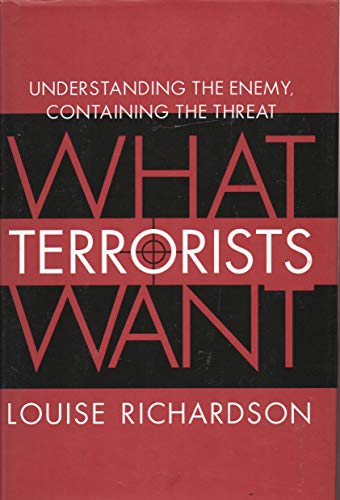
Beginning with a comprehensive definition of what terrorism is, a definitive study of the topic explores the origins of terrorism, the goals of diverse terrorist groups throughout history, the impact of 9/11 and the changing face of terrorism, the future prospects for terrorist actions, and what can be done to restore global order. 25,000 first printing.
Die Inhaltsangabe kann sich auf eine andere Ausgabe dieses Titels beziehen.
Über die Autorin bzw. den Autor
Louise Richardson is executive dean of the Radcliffe Institute for Advanced Study, a senior lecturer in government at Harvard, and a lecturer on law at Harvard Law School. She lectures widely on terrorism and international security and has appeared on CNN, the BBC, PBS, NPR, and a host of other media outlets. Born in Ireland, she is now an American citizen and a resident of Cambridge, Massachusetts.
Auszug. © Genehmigter Nachdruck. Alle Rechte vorbehalten.
One
What is Terrorism?
Terror is nothing else than justice, prompt, secure and inflexible.1
—Robespierre, 1794
Today our nation saw evil, the very worst of human nature.
—George W. Bush, September 11, 2001
The best that one can say of these people is that they are morally depraved. They champion falsehood, support the butcher against the victim, the oppressor against the innocent child.
—Osama bin Laden, October 7, 2001
Like pornography, we know terrorism when we see it. Or do we? We know we don’t like it. In fact, the only universally accepted attribute of the term “terrorism” is that it is pejorative. Terrorism is something the bad guys do. The term itself has been bandied about so much that it has practically lost all meaning. A casual glance at newspapers reveals currency speculation being labeled “economic terrorism,” domestic violence as “domestic terrorism”; crank telephone calls have even been labeled “telephone terrorism.” If you can pin the label “terrorist” on your opponent, you have gone a long way toward winning the public relations aspect of any conflict.
Even terrorists don’t like the label. An al-Qaeda statement put it this way: “When the victim tries to seek justice, he is described as a terrorist.”2 Many prefer to redefine the term first. In Osama bin Laden’s words, “If killing those who kill our sons is terrorism, then let history be witness that we are terrorists.”3 On another occasion, when asked to respond to media claims that he was a terrorist, he replied, “There is an Arabic proverb that says, she accused me of having her malady and then snuck away.”4 Other terrorist leaders have taken a similar perspective. Abimael Guzmán, the Peruvian academic turned leader of the Maoist Shining Path, declared, “They claim we’re terrorists. I would like to give the following answer so that everyone can think about it: has it or has it not been Yankee imperialism and particularly Reagan who has branded all revolutionary movements as terrorists, yes or no? This is how they attempt to discredit and isolate us in order to crush us.”5 Shamil Basayev, the Chechen leader responsible for the Beslan school siege, among other exploits, declared, “Okay. So, I’m a terrorist. But what would you call them? If they are keepers of constitutional order, if they are anti-terrorists, then I spit on all these agreements and nice words.”6
Terrorism simply means deliberately and violently targeting civilians for political purposes. It has seven crucial characteristics. First, a terrorist act is politically inspired. If not, then it is simply a crime. After the May 13, 2003, Riyadh bombings, Secretary of State Colin Powell declared, “We should not try to cloak their . . . criminal activity, their murderous activity, in any trappings of political purpose. They are terrorists.”7 In point of fact, it is precisely because they did have a political purpose that they were, indeed, terrorists.
Second, if an act does not involve violence or the threat of violence, it is not terrorism. The term “cyberterrorism” is not a useful one. The English lexicon is broad enough to provide a term for the sabotage of our IT facilities without reverting to such language.
Third, the point of terrorism is not to defeat the enemy but to send a message. Writing of the September 11 attacks, an al-Qaeda spokesman declared, “It rang the bells of restoring Arab and Islamic glory.”8
Fourth, the act and the victim usually have symbolic significance. Bin Laden referred to the Twin Towers as “icons” of America’s “military and economic power.”9 The shock value of the act is enormously enhanced by the symbolism of the target. The whole point is for the psychological impact to be greater than the actual physical act. Terrorism is indeed a weapon of the weak. Terrorist movements are invariably both outmanned and outgunned by their opponents, so they employ such tactics in an effort to gain more attention than any objective assessment of their capabilities would suggest that they warrant.
Fifth—and this is a controversial point—terrorism is the act of substate groups, not states. This is not to argue that states do not use terrorism as an instrument of foreign policy. We know they do. Many states, such as Iran, Iraq, Syria, and Libya, have sponsored terrorism abroad because they did not want to incur the risk of overtly attacking more powerful countries. Great powers have supported terrorist groups abroad as a way of engaging in proxy warfare or covertly bringing about internal change in difficult countries without openly displaying their strength. Nor do I wish to argue that states refrain from action that is the moral equivalent of terrorism. We know they don’t. The Allied bombing campaign in World War II, culminating in the bombing of Hiroshima and Nagasaki, was a deliberate effort to target civilian populations in order to force the hand of their government. The policy of collective punishment visited on communities that produce terrorists is another example of targeting civilians to achieve a political purpose. Nevertheless, if we want to have any analytical clarity in understanding the behavior of terrorist groups, we must understand them as substate actors rather than states.
A sixth characteristic of terrorism is that the victim of the violence and the audience the terrorists are trying to reach are not the same. Victims are used as a means of altering the behavior of a larger audience, usually a government. Victims are chosen either at random or as representative of some larger group. Individual victims are interchangeable. The identities of the people traveling on a bus in Tel Aviv or a train in Madrid, dancing in Bali or bond trading in New York, were of no consequence to those who killed them. They were being used to influence others. This is different from most other forms of political violence, in which security forces or state representatives are targeted in an effort to reduce the strength of an opponent.
The final and most important defining characteristic of terrorism is the deliberate targeting of civilians. This is what sets terrorism apart from other forms of political violence, even the most proximate form, guerrilla warfare. Terrorists have elevated practices that are normally seen as the excesses of warfare to routine practice, striking noncombatants not as an unintended side effect but as deliberate strategy. They insist that those who pay taxes to a government are responsible for their actions whether they are Russians or Americans. Basayev declared all Russians fair game because “They pay taxes. They give approval in word and in deed. They are all responsible.”10 Bin Laden similarly said of Americans, “He is the enemy of ours whether he fights us directly or merely pays his taxes.”11
Terrorists, Guerrillas, and Freedom Fighters
It goes without saying that in the very messy worlds of violence and politics actions don’t always fit neatly into categories. Guerrillas occasionally target civilians, and terrorists occasionally target security forces. But if the primary tactic of an organization is deliberately to target civilians, it deserves to be called a terrorist group, irrespective of the political context in which it operates or the legitimacy of the goals it seeks to achieve. There are, of course, other differences between guerillas and terrorists. Guerrillas are an irregular army fighting the...
„Über diesen Titel“ kann sich auf eine andere Ausgabe dieses Titels beziehen.
Suchergebnisse für What Terrorists Want: Understanding the Enemy, Containing...

Beispielbild für diese ISBN
What Terrorists Want: Understanding the Enemy, Containing the Threat
Verlag:
Waterbrook Press (A Division of Random House Inc), 2006
ISBN 10: 1400064813
ISBN 13: 9781400064816
Gebraucht
Hardcover
Anbieter: World of Books (was SecondSale), Montgomery, IL, USA
Verkäuferbewertung 5 von 5 Sternen

Zustand: Good. This is at the top of my list for best books on terrorism.-Jessica Stern, author of Terror in the Name of God: Why Religious Militants Kill How can the most powerful country in the world feel so threatened by an enemy infinitely weaker than we are? How can loving parents and otherwise responsible citizens join terrorist movements? How can anyone possibly believe that the cause of Islam can be advanced by murdering passengers on a bus or an airplane? In this important new book, groundbreaking scholar Louise Richardson answers these questions and more, providing an indispensable guide to the greatest challenge of our age. After defining-once and for all-what terrorism is, Richardson explores its origins, its goals, what's to come, and what is to be done about it. Having grown up in rural Ireland and watched her friends join the Irish Republican Army, Richardson knows from firsthand experience how terrorism can both unite and destroy a community. As a professor at Harvard, she has devoted her career to explaining terrorist movements throughout history and around the globe. From the biblical Zealots to the medieval Islamic Assassins to the anarchists who infiltrated the cities of Europe and North America at the turn of the last century, terrorists have struck at enemies far more powerful than themselves with targeted acts of violence. Yet Richardson understands that terrorists are neither insane nor immoral. Rather, they are rational political actors who often deploy carefully calibrated tactics in a measured and reasoned way. What is more, they invariably go to great lengths to justify their actions to themselves, their followers, and, often, the world. Richardson shows that the nature of terrorism did not change after the attacks of September 11, 2001; what changed was our response. She argues that the Bush administration's global war on terror was doomed to fail because of an ignorance of history, a refusal to learn from the experience of other governments, and a fundamental misconception about how and why terrorists act. As an alternative, Richardson offers a feasible strategy for containing the terrorist threat and cutting off its grassroots support. The most comprehensive and intellectually rigorous account of terrorism yet, What Terrorists Want is a daring intellectual tour de force that allows us, at last, to reckon fully with this major threat to today's global order. KIRKUS- starred reviewThe short answer? Fame and payback, perhaps even a thrill. The long answer? Read this essential, important primer. Terrorist groups have many motives and ideologies, notes Richardson (Executive Dean/Radcliffe Institute for Advanced Study), but they tend to similar paths: They are founded by mature, well-educated men but staffed by less learned and certainly more pliable youths; they are fueled by a sense of injustice and the conviction that only they are morally equipped to combat it; they see themselves as defenders and not aggressors; they often define the terms of battle. And, of course, this commonality: Terrorists have elevated practices that are normally seen as the excesses of warfare to routine practice, striking noncombatants not as an unintended side effect but as a deliberate strategy. Thus massacres, suicide bombings and assassinations are all in a day's work. Richardson argues against Karl Rove, who after 9/11 mocked those who tried to understand the enemy, by noting that only when authorities make efforts to get inside the minds of their terrorist enemies do they succeed in defeating them, as with the leadership of the Shining Path movement in Peru. Still, as Rove knows, if terrorists share a pathology, then so do at least some of their victims: Once attacked, people in democratic societies are more than willing to trade freedom for security. Richardson closes by offering a set of guidelines for combating terrorism, with such easily remembered rules as Live by your principles and Engage others in countering terrorists with. Artikel-Nr. 00100791621
Gebraucht kaufen
EUR 5,15
Versand gratis
Versand innerhalb von USA
Versand innerhalb von USA
Anzahl: 3 verfügbar
Beispielbild für diese ISBN
What Terrorists Want: Understanding the Enemy, Containing the Threat
Anbieter: ThriftBooks-Atlanta, AUSTELL, GA, USA
Verkäuferbewertung 5 von 5 Sternen
Hardcover. Zustand: Very Good. No Jacket. May have limited writing in cover pages. Pages are unmarked. ~ ThriftBooks: Read More, Spend Less. Artikel-Nr. G1400064813I4N00
Gebraucht kaufen
EUR 6,72
Versand gratis
Versand innerhalb von USA
Versand innerhalb von USA
Anzahl: 1 verfügbar
Beispielbild für diese ISBN
What Terrorists Want: Understanding the Enemy, Containing the Threat
Anbieter: ThriftBooks-Atlanta, AUSTELL, GA, USA
Verkäuferbewertung 5 von 5 Sternen
Hardcover. Zustand: Very Good. No Jacket. Missing dust jacket; May have limited writing in cover pages. Pages are unmarked. ~ ThriftBooks: Read More, Spend Less. Artikel-Nr. G1400064813I4N01
Gebraucht kaufen
EUR 6,72
Versand gratis
Versand innerhalb von USA
Versand innerhalb von USA
Anzahl: 1 verfügbar
Beispielbild für diese ISBN
What Terrorists Want: Understanding the Enemy, Containing the Threat
Anbieter: ThriftBooks-Reno, Reno, NV, USA
Verkäuferbewertung 5 von 5 Sternen
Hardcover. Zustand: Very Good. No Jacket. May have limited writing in cover pages. Pages are unmarked. ~ ThriftBooks: Read More, Spend Less. Artikel-Nr. G1400064813I4N00
Gebraucht kaufen
EUR 6,72
Versand gratis
Versand innerhalb von USA
Versand innerhalb von USA
Anzahl: 1 verfügbar
Beispielbild für diese ISBN
What Terrorists Want: Understanding the Enemy, Containing the Threat
Anbieter: ThriftBooks-Dallas, Dallas, TX, USA
Verkäuferbewertung 5 von 5 Sternen
Hardcover. Zustand: Very Good. No Jacket. May have limited writing in cover pages. Pages are unmarked. ~ ThriftBooks: Read More, Spend Less. Artikel-Nr. G1400064813I4N00
Gebraucht kaufen
EUR 6,72
Versand gratis
Versand innerhalb von USA
Versand innerhalb von USA
Anzahl: 1 verfügbar
Beispielbild für diese ISBN
What Terrorists Want: Understanding the Enemy, Containing the Threat
Anbieter: Wonder Book, Frederick, MD, USA
Verkäuferbewertung 5 von 5 Sternen
Zustand: Very Good. Very Good condition. Good dust jacket. A copy that may have a few cosmetic defects. May also contain light spine creasing or a few markings such as an owner's name, short gifter's inscription or light stamp. Artikel-Nr. F05F-04111
Gebraucht kaufen
EUR 7,34
Versand gratis
Versand innerhalb von USA
Versand innerhalb von USA
Anzahl: 1 verfügbar
Beispielbild für diese ISBN
What Terrorists Want: Understanding the Enemy, Containing the Threat
Anbieter: Wonder Book, Frederick, MD, USA
Verkäuferbewertung 5 von 5 Sternen
Zustand: Good. Good condition. Good dust jacket. A copy that has been read but remains intact. May contain markings such as bookplates, stamps, limited notes and highlighting, or a few light stains. Artikel-Nr. M10E-03413
Gebraucht kaufen
EUR 7,34
Versand gratis
Versand innerhalb von USA
Versand innerhalb von USA
Anzahl: 1 verfügbar
Beispielbild für diese ISBN
What Terrorists Want : Understanding the Enemy, Containing the Threat
Verlag:
Random House Publishing Group, 2006
ISBN 10: 1400064813
ISBN 13: 9781400064816
Gebraucht
Hardcover
Anbieter: Better World Books, Mishawaka, IN, USA
Verkäuferbewertung 5 von 5 Sternen
Zustand: Very Good. Former library copy. Pages intact with possible writing/highlighting. Binding strong with minor wear. Dust jackets/supplements may not be included. Includes library markings. Stock photo provided. Product includes identifying sticker. Better World Books: Buy Books. Do Good. Artikel-Nr. 2641210-6
Gebraucht kaufen
EUR 8,56
Versand gratis
Versand innerhalb von USA
Versand innerhalb von USA
Anzahl: 1 verfügbar
Beispielbild für diese ISBN
What Terrorists Want : Understanding the Enemy, Containing the Threat
Verlag:
Random House Publishing Group, 2006
ISBN 10: 1400064813
ISBN 13: 9781400064816
Gebraucht
Hardcover
Anbieter: Better World Books, Mishawaka, IN, USA
Verkäuferbewertung 5 von 5 Sternen
Zustand: Fine. Used book that is in almost brand-new condition. May contain a remainder mark. Better World Books: Buy Books. Do Good. Artikel-Nr. 12803365-6
Gebraucht kaufen
EUR 8,56
Versand gratis
Versand innerhalb von USA
Versand innerhalb von USA
Anzahl: 1 verfügbar
Beispielbild für diese ISBN
What Terrorists Want : Understanding the Enemy, Containing the Threat
Verlag:
Random House Publishing Group, 2006
ISBN 10: 1400064813
ISBN 13: 9781400064816
Gebraucht
Hardcover
Anbieter: Better World Books, Mishawaka, IN, USA
Verkäuferbewertung 5 von 5 Sternen
Zustand: Good. Pages intact with minimal writing/highlighting. The binding may be loose and creased. Dust jackets/supplements are not included. Stock photo provided. Product includes identifying sticker. Better World Books: Buy Books. Do Good. Artikel-Nr. 2641208-6
Gebraucht kaufen
EUR 8,56
Versand gratis
Versand innerhalb von USA
Versand innerhalb von USA
Anzahl: 2 verfügbar