
Verwandte Artikel zu Father Joe: The Man Who Saved My Soul
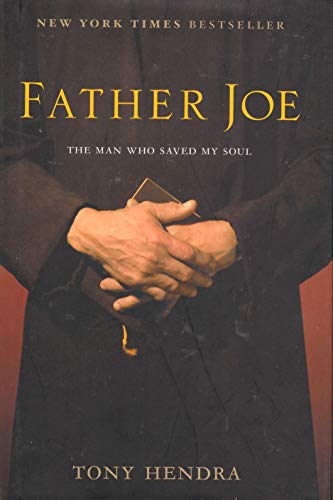
Inhaltsangabe
The popular humorist and author of Brotherhood chronicles his forty-year friendship with a Benedictine monk, the unconventional, wise, and compassionate Father Joe, from the first encounter between troubled teen and counselor, through years of perfunctory contact, to the renewal of their relationship at the end of Father Joe's life. 17,500 first printing.
Die Inhaltsangabe kann sich auf eine andere Ausgabe dieses Titels beziehen.
Über die Autorin bzw. den Autor
TONY HENDRA attended Cambridge University, where he performed frequently with friends and future Monty Pythons John Cleese and Graham Chapman. He is the author of Going Too Far, a classic history of modern American satire. He was editor in chief of Spy magazine, an original editor of the National Lampoon, and he played Ian Faith in the movie, This Is Spinal Tap. He has written frequently for New York, Harper’s, GQ, Vanity Fair, Men’s Journal, and Esquire, among other magazines. He is married to Carla Hendra; they have three young children, Lucy, Sebastian, and Nicholas.
Auszug. © Genehmigter Nachdruck. Alle Rechte vorbehalten.
chapter one
How I met Father Joe:
I was fourteen and having an affair with a married woman.
At least she called it an affair; she also said we were lovers, and on several occasions, doomed lovers. An average teen, I was quite content with these exalted terms; in practice, however, I only got to second base with her. (I didn’t yet know it was second base, as I was growing up in England.)
It was only rather later too, when I saw The Graduate, that I realized my Mrs. Robinson may have been somewhat older than she admitted to—which was twenty-two. To my unpracticed eye she could certainly pass for that; I was still young enough that any woman with breasts and a waist and her own teeth was roughly the same age as any other—which is to say a grown-up—and the mysterious repository of unimaginable pleasures deserving . . .
. . . hideous, very specific torments. The fly in the ointment of this relationship was that we were both Catholics. At least in theory (theory to me, practice to her), there was a terrible bill being racked up somewhere, calibrating the relative sinfulness of everything we did, every gesture made, every word exchanged, let alone every kiss. Should death strike, should lightning fork from one of the huge trees outside into our concupiscent bodies, should one of the experimental jets being developed over the hill at DeHavilland’s disintegrate and plummet to earth (as they often threatened to do when trying to break the sound barrier), turning her trailer into a fireball, down, down we would plunge, into the bowels of Hell, unshriven, unforgiven, damned for all eternity to indescribable suffering.
A lot of what little conversation we had—much more the norm were interminable, agonized, what she called “existential” silences—concerned whether we should even be having a conversation, should even be together for that matter, doomed lovers in the throes of a hopeless and illicit liaison, wrestling with the irresistible temptation of being in the same neighborhood, town, county, country, planet, dimension. We were so bad for one another, she said, such a monumental occasion of sin for each other, it was playing with fire; oh, if only we’d never met and plunged ourselves into this cauldron of raging emotions from which there was no escape!
These sentiments were very new to me. My instinctive response was that they were pretty goofy, but what did I know? I dimly recognized that I was going through some kind of passage out of childhood and would from now on be required to learn, without being taught, how grown-ups acted and spoke. Best not to rock the boat, by suppressing a classroom splutter. I had a good thing going. Mrs. Bootle was no slouch in the looks department. Perhaps this was the way women always spoke in extremis. Books were my only guide and so far it all seemed pretty true to form—like being in The Thorn Birds if it had been written by Christina Rossetti.
But it had been a long time since the first hesitant kiss, and we’d done lots of kissing since. I was getting restless, anxious to find out what would be the next cauldron of raging emotions from which there was no escape.
Now on a bleak Saturday morning in the damp, dank early spring of green, green Hertfordshire, England, The World, The Solar System, The Universe, in the year of our Lord 1956, I was about to find out.
She stood at the kitchen end of the trailer, where the sink was, surrounded by dirty dishes, her back to the picture window through which a waterlogged plot ran down to the river, swollen and sullen in the rain, the depressed little green caps of her higgledy-piggledy vegetable garden poking through the mud. “Should we?” she said in an agonized half-sob. “I think we should,” I replied, having no idea what she was talking about. “But . . . but” (she never used just one “but”—always at least two) “it will be the end, the point of no return, all will be lost.” “Well, then,” said the voice of proto-adult reason, “perhaps we shouldn’t.” “No! no! yes! yes!, how can we help ourselves, I’m swept away, I tell you, let’s cast all caution to the winds! Turn round.”
I did as I was bid, averting my head and closing my eyes, mad excitement welling up through my body from my heels to my eyelids. This must be it, whatever it was. From behind me came surreptitious noises: rustling clothes, eyelets popping, zippers unzipping, hot little pants of effort.
“Turn round,” she whispered hoarsely. I did. “Open your eyes.” I did. Her eyes were now closed, her head inclined to one side, long hair draped over her white, slight, naked shoulders, framed by the rain-drenched window, the Madonna of the drizzle. My eyes ratcheted nervously down to her breasts. They were quite small, of slightly different sizes, and rather flat. Well, actually very flat. Making the nipples seem somewhat larger than I would have expected. The baby—to all appearances a sweet little scrap—must have been a voracious feeder.
These were my first live breasts. The only ones I’d seen to date had been in nudist magazines. Were they all like this? I’d just read The Four Quartets for the first time: the image of Tiresias popped into my head and wouldn’t budge.
Then she kissed me. Her lips and face were hotter than usual, like my little brother’s when he had a temperature. She came closer. I could feel the warmth of her skin through my shirt and then what must have been those nipples. I put my hand inside her rolled-down dress between her hip and her belly. “No! no!” she whispered, covering my hand with hers. But she pushed it down infinitesimally. As I followed her pressure, she resisted, pulling it up even more infinitesimally. “You mustn’t!” she sobbed. “Think of the sin, the mortal sin, the eternal flames!” Then the downward pressure again. A textbook case of no-but-yes—though I was too young to grasp such psycho-sexual antics. I followed her hand down for a few millimeters. It resisted. Up we went. But not so far—we were definitely making headway. Down . . . up, down, up, down . . . My whole hand was inside her dress now, inching inexorably earthward. Her skin was silky and her flesh deliciously soft. And it kept getting softer. Where were we? Way down there, surely? Waves of—some unknown emotion—shuddered through me. I was dizzy with excitement, Tiresias having definitely taken a powder . . .
ben and Lily Bootle had first appeared at the local Catholic church a year earlier. She was petite and slender, he was big and rangy, a head or more taller than his mate. Though she was very pregnant she wore a clingy, full-length shift-like dress, emphasizing her milky breasts and bulging belly. Open leather sandals advertised tiny, shapely feet. Her outfit had a distinct bohemian flair in a Sunday congregation made up for the most part of dowdy English widows and hungover Irish laborers with the occasional large unruly family and cigarette-ashen wife.
Ben looked as though he’d just emerged from a night of electroshock. His thick wiry hair stood up in uncombed clumps and spikes, his clothes were always rumpled with at least one element undone, and he wore battered tortoiseshell-rimmed glasses of impressive thickness.
They seemed to have no friends and kept very much to themselves; no one even knew where they lived, least of all our ancient and embottled parish priest, Father B. Leary (the “B.”—for Bartholomew—leading us altar boys to call him Father Bleary).
In due course a baby Bootle appeared, which Lily carried in a rather...
„Über diesen Titel“ kann sich auf eine andere Ausgabe dieses Titels beziehen.
Suchergebnisse für Father Joe: The Man Who Saved My Soul

Beispielbild für diese ISBN
Father Joe: The Man Who Saved
Anbieter: World of Books (was SecondSale), Montgomery, IL, USA
Verkäuferbewertung 5 von 5 Sternen

Zustand: Acceptable. Item in good condition. Textbooks may not include supplemental items i.e. CDs, access codes etc. Artikel-Nr. 00052193862
Gebraucht kaufen
EUR 3,79
Versand gratis
Versand innerhalb von USA
Versand innerhalb von USA
Anzahl: 3 verfügbar
Beispielbild für diese ISBN
Father Joe
Anbieter: World of Books (was SecondSale), Montgomery, IL, USA
Verkäuferbewertung 5 von 5 Sternen
Hardback. Zustand: Very Good. A key comic writer of the past three decades has created his most heartfelt and hard-hitting book. Father Joe is Tony Hendra's inspiring true story of finding faith, friendship, and family through the decades-long influence of a surpassingly wise Benedictine monk named Father Joseph Warrillow. Like everything human, it started with sex. In 1955, fourteen-year-old Tony found himself entangled with a married Catholic woman. In Cold War England, where Catholicism was the subject of news stories and Graham Greene bestsellers, Tony was whisked off by the woman's husband to see a priest and be saved. Yet what he found was a far cry from the priests he'd known at Catholic school, where boys were beaten with belts or set upon by dogs. Instead, he met Father Joe, a gentle, stammering, ungainly Benedictine who never used the words wrong or guilt, who believed that God was in everyone and that the only sin was selfishness. During the next forty years, as his life and career drastically ebbed and flowed, Tony discovered that his visits to Father Joe remained the one constant in his life--the relationship that, in the most serious sense, saved it. From the fifties and his adolescent desire to join an abbey himself; to the sixties, when attending Cambridge and seeing the satire of Beyond the Fringe convinced him to change the world with laughter, not prayer; to the seventies and successful stints as an original editor of National Lampoon and a writer of Lemmings, the off-Broadway smash that introduced John Belushi and Chevy Chase; to professional disaster after co-creating the legendary English series Spitting Image; from drinking to drugs, from a failed first marriage to a successful second and the miracle of parenthood--the years only deepened Tony's need for the wisdom of his other and more real father, creating a bond that could not be broken, even by death. A startling departure for this acclaimed satirist, Father Joe is a sincere account of how Tony Hendra learned to love. It's the story of a whole generation looking for a way back from mockery and irony, looking for its own Father Joe, and a testament to one of the most charismatic mentors in modern literature. Artikel-Nr. 00101355434
Gebraucht kaufen
EUR 3,79
Versand gratis
Versand innerhalb von USA
Versand innerhalb von USA
Anzahl: 11 verfügbar
Beispielbild für diese ISBN
Father Joe: The Man Who Saved
Anbieter: World of Books (was SecondSale), Montgomery, IL, USA
Verkäuferbewertung 5 von 5 Sternen
Zustand: Good. Item in good condition. Textbooks may not include supplemental items i.e. CDs, access codes etc. Artikel-Nr. 00052725653
Gebraucht kaufen
EUR 3,79
Versand gratis
Versand innerhalb von USA
Versand innerhalb von USA
Anzahl: Mehr als 20 verfügbar
Beispielbild für diese ISBN
Father Joe: The Man Who Saved My Soul
Verlag:
Random House (edition ), 2004
ISBN 10: 1400061849
ISBN 13: 9781400061846
Gebraucht
Hardcover
Anbieter: BooksRun, Philadelphia, PA, USA
Verkäuferbewertung 5 von 5 Sternen
Hardcover. Zustand: Very Good. With dust jacket. It's a well-cared-for item that has seen limited use. The item may show minor signs of wear. All the text is legible, with all pages included. It may have slight markings and/or highlighting. Artikel-Nr. 1400061849-8-1-29
Gebraucht kaufen
EUR 5,03
Versand gratis
Versand innerhalb von USA
Versand innerhalb von USA
Anzahl: 1 verfügbar
Beispielbild für diese ISBN
Father Joe: The Man Who Saved My Soul
Verlag:
Random House (edition ), 2004
ISBN 10: 1400061849
ISBN 13: 9781400061846
Gebraucht
Hardcover
Anbieter: BooksRun, Philadelphia, PA, USA
Verkäuferbewertung 5 von 5 Sternen
Hardcover. Zustand: Very Good. It's a well-cared-for item that has seen limited use. The item may show minor signs of wear. All the text is legible, with all pages included. It may have slight markings and/or highlighting. Artikel-Nr. 1400061849-11-18
Gebraucht kaufen
EUR 5,34
Versand gratis
Versand innerhalb von USA
Versand innerhalb von USA
Anzahl: 1 verfügbar
Beispielbild für diese ISBN
Father Joe: The Man Who Saved My Soul
Verlag:
Random House (edition ), 2004
ISBN 10: 1400061849
ISBN 13: 9781400061846
Gebraucht
Hardcover
Anbieter: BooksRun, Philadelphia, PA, USA
Verkäuferbewertung 5 von 5 Sternen
Hardcover. Zustand: Very Good. With dust jacket. It's a well-cared-for item that has seen limited use. The item may show minor signs of wear. All the text is legible, with all pages included. It may have slight markings and/or highlighting. Artikel-Nr. 1400061849-11-1-29
Gebraucht kaufen
EUR 5,44
Versand gratis
Versand innerhalb von USA
Versand innerhalb von USA
Anzahl: 3 verfügbar
Beispielbild für diese ISBN
Father Joe: The Man Who Saved My Soul
Anbieter: ThriftBooks-Atlanta, AUSTELL, GA, USA
Verkäuferbewertung 5 von 5 Sternen
Hardcover. Zustand: Good. No Jacket. Pages can have notes/highlighting. Spine may show signs of wear. ~ ThriftBooks: Read More, Spend Less. Artikel-Nr. G1400061849I3N00
Gebraucht kaufen
EUR 5,94
Versand gratis
Versand innerhalb von USA
Versand innerhalb von USA
Anzahl: 1 verfügbar
Beispielbild für diese ISBN
Father Joe : The Man Who Saved My Soul
Verlag:
Random House Publishing Group, 2004
ISBN 10: 1400061849
ISBN 13: 9781400061846
Gebraucht
Hardcover
Anbieter: Better World Books, Mishawaka, IN, USA
Verkäuferbewertung 5 von 5 Sternen
Zustand: Good. Pages intact with minimal writing/highlighting. The binding may be loose and creased. Dust jackets/supplements are not included. Stock photo provided. Product includes identifying sticker. Better World Books: Buy Books. Do Good. Artikel-Nr. 3679772-6
Gebraucht kaufen
EUR 6,34
Versand gratis
Versand innerhalb von USA
Versand innerhalb von USA
Anzahl: 1 verfügbar
Beispielbild für diese ISBN
Father Joe : The Man Who Saved My Soul
Verlag:
Random House Publishing Group, 2004
ISBN 10: 1400061849
ISBN 13: 9781400061846
Gebraucht
Hardcover
Anbieter: Better World Books, Mishawaka, IN, USA
Verkäuferbewertung 5 von 5 Sternen
Zustand: Good. Former library copy. Pages intact with minimal writing/highlighting. The binding may be loose and creased. Dust jackets/supplements are not included. Includes library markings. Stock photo provided. Product includes identifying sticker. Better World Books: Buy Books. Do Good. Artikel-Nr. GRP85903994
Gebraucht kaufen
EUR 6,34
Versand gratis
Versand innerhalb von USA
Versand innerhalb von USA
Anzahl: 1 verfügbar
Beispielbild für diese ISBN
Father Joe : The Man Who Saved My Soul
Verlag:
Random House Publishing Group, 2004
ISBN 10: 1400061849
ISBN 13: 9781400061846
Gebraucht
Hardcover
Anbieter: Better World Books, Mishawaka, IN, USA
Verkäuferbewertung 5 von 5 Sternen
Zustand: Very Good. Pages intact with possible writing/highlighting. Binding strong with minor wear. Dust jackets/supplements may not be included. Stock photo provided. Product includes identifying sticker. Better World Books: Buy Books. Do Good. Artikel-Nr. 3679774-75
Gebraucht kaufen
EUR 6,34
Versand gratis
Versand innerhalb von USA
Versand innerhalb von USA
Anzahl: 2 verfügbar