
Verwandte Artikel zu The Shame of the Nation: The Restoration of Apartheid...
Inhaltsangabe
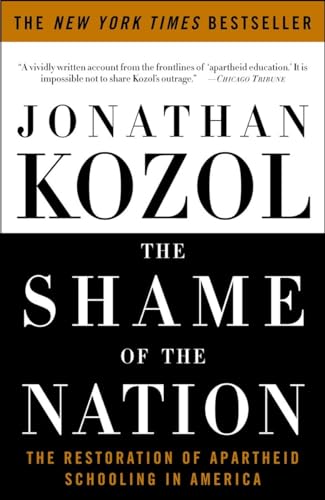
Since the early 1980s, when the federal courts began dismantling the landmark ruling in Brown v. Board of Education, segregation of black children has reverted to its highest level since 1968. In many inner-city schools, a stick-and-carrot method of behavioral control traditionally used in prisons is now used with students. Meanwhile, as high-stakes testing takes on pathological and punitive dimensions, liberal education has been increasingly replaced by culturally barren and robotic methods of instruction that would be rejected out of hand by schools that serve the mainstream of society.
Filled with the passionate voices of children, principals, and teachers, and some of the most revered leaders in the black community, The Shame of the Nation pays tribute to those undefeated educators who persist against the odds, but directly challenges the chilling practices now being forced upon our urban systems. In their place, Kozol offers a humane, dramatic challenge to our nation to fulfill at last the promise made some 50 years ago to all our youngest citizens.
Die Inhaltsangabe kann sich auf eine andere Ausgabe dieses Titels beziehen.
Über die Autorin bzw. den Autor
Jonathan Kozol is the National Book Award–winning author of Death at an Early Age, Rachel and Her Children, Savage Inequalities, and Amazing Grace. He has been working with children in inner-city schools for more than 40 years.
Von der hinteren Coverseite
"The nation needs to be confronted with the crime that we're committing and the promises we are betraying. This is a book about betrayal of the young, who have no power to defend themselves. It is not intended to make readers comfortable."
Over the past several years, Jonathan Kozol has visited nearly 60 public schools. Virtually everywhere, he finds that conditions have grown worse for inner-city children in the 15 years since federal courts began dismantling the landmark ruling in Brown v. Board of Education. First, a state of nearly absolute apartheid now prevails in thousands of our schools. The segregation of black children has reverted to a level that the nation has not seen since 1968. Few of the students in these schools know white children any longer. Second, a protomilitary form of discipline has now emerged, modeled on stick-and-carrot methods of behavioral control traditionally used in prisons but targeted exclusively at black and Hispanic children. And third, as high-stakes testing takes on pathological and punitive dimensions, liberal education in our inner-city schools has been increasingly replaced by culturally barren and robotic methods of instruction that would be rejected out of hand by schools that serve the mainstream of society.
Filled with the passionate voices of children and their teachers and some of the most revered and trusted leaders in the black community, "The Shame of the Nation is a triumph of firsthand reporting that pays tribute to those undefeated educators who persist against the odds, but directly challenges the chilling practices now being forced upon our urban systems by the Bush administration. In their place, Kozol offers a humane, dramatic challenge to our nation to fulfill at last the promise made some 50 years ago to all our youngest citizens.
From "The Shame of the Nation
"I went to Washington to challenge the soft bigotry of low expectations," the president said in his campaign for reelection in September 2004. "It's working. It's making a difference." It is one of those deadly lies, which, by sheer repetition, is at length accepted by large numbers of Americans as, perhaps, a rough approximation of the truth. But it is not the truth, and it is not an innocent misstatement of the facts. It is a devious appeasement of the heartache of the parents of the poor and, if it is not forcefully resisted and denounced, it is going to lead our nation even further in a perilous direction.
Also available as a Random House AudioBook and an eBook
Auszug. © Genehmigter Nachdruck. Alle Rechte vorbehalten.
CHAPTER 1
Dishonoring the Dead
One sunny day in April, I was sitting with my friend Pineapple at a picnic table in St. Mary’s Park in the South Bronx. I had met Pineapple six years earlier, in 1994, when I had visited her kindergarten class at P.S. 65. She was a plump and bright-eyed child who had captured my attention when I leaned over her desk and noticed that she wrote her letters in reverse. I met her again a few weeks later at an afterschool program based at St. Ann’s Church, which was close to P.S. 65, where Pineapple and a number of her friends came for tutorial instruction and for safety from the dangers of the neighborhood during the afternoons.
The next time I visited her school, it was the spring of 1997. She was in third grade now and she was having a bad year. The school was in a state of chaos because there had been a massive turnover of teachers. Of 50 members of the faculty in the preceding year, 28 had never taught before; and half of them were fired or did not return the following September. Very little teaching took place in Pineapple’s class during the time that I was there. For some reason, children in her class and other classes on her floor had to spend an awful lot of time in forming lines outside the doorways of their rooms, then waiting as long as 30 minutes for their turn to file downstairs to the cafeteria for lunch, then waiting in lines again to get their meals, then to go to recess, then to the bathroom, then return to class. Nearly two hours had elapsed between the time Pineapple’s classmates formed their line to go to lunch and finally returned.
On another day when I was visiting, before the children were allowed to have their lunch they were brought into an auditorium where old cartoons like Felix the Cat and Donald Duck and other flickering movies from the past were shown to keep them occupied before their class was called to file down into the cafeteria. The film in the film projector, which must have been very old, kept slipping from its frames. The lights would go on and kids would start to hoot and scream. I sat beside Pineapple and her classmates for three quarters of an hour while a very angry woman with a megaphone stood on a stage and tried to get the room under control by threatening the kids with dire punishments if they did not sit in perfect silence while they waited for the next cartoon.
In the following year, when she was in fourth grade, Pineapple had four different teachers in a row. One of them was apparently a maladjusted person who, Pineapple said, “used swear words” to subdue the children. (“A-S-S-E-S!” Pineapple said politely, since she did not want to speak the word itself.) One was fired for smoking in the building. Another was “only a helper-teacher,” Pineapple reported, which, a member of the faculty explained, might have been a reference to an unprepared young teacher who was not yet certified. Pineapple, who had always been a lively and resilient little girl, grew quite depressed that year.
When Pineapple used to talk to me about her school she rarely, if ever, spoke in racial terms. Going to a school in which all of her classmates were black or Hispanic must have seemed quite natural to her—“the way things are,” perhaps the way that they had always been. Since she had only the slightest knowledge of what schools were like outside her neighborhood, there would have been no reason why she would remark upon the fact that there were no white children in her class. This, at least, is how I had interpreted her silence on the matter in the past.
So it surprised me, on that pleasant day in April as the two of us were sitting in St. Mary’s Park, while Pineapple’s little sister, who is named Briana, wandered off at a slight distance from us following a squirrel that was running on the grass, when Pineapple asked me something that no other child of her age in the South Bronx had ever asked of me before. Leaning on her elbows on the picnic table, with a sudden look of serious consideration in her eyes, she seemed to hesitate a moment as if she was not quite sure whether the question in her mind might somehow be a question you are not supposed to ask, then plowed right on and asked it anyway.
“What’s it like,” she asked me, peering through the strands of beaded cornrows that came down over her eyes, “over there where you live?”
“Over where?” I asked.
“Over—you know . . . ,” she said with another bit of awkwardness and hesitation in her eyes.
I asked her, “Do you mean in Massachusetts?”
She looked at me with more determination and a bit impatiently, I thought, but maybe also recognized that I was feeling slightly awkward too.
“You know . . . ,” she said.
“I don’t know,” I replied.
“Over there—where other people are,” she finally said.
Pineapple was usually very blunt and clear—she sometimes inadvertently hurt other children’s feelings by her tendency to make unsparingly direct remarks—so her use of that ambiguous and imprecise expression “other people” didn’t seem like her at all.
I asked her if she could explain which “other people” she was thinking of. At that point a wall went up. “You know,” was all she said—“where you live . . . where the other people are. . . .”
I didn’t try to press her further about who she meant by “other people” after that. I think she felt it would be rude to say “white people,” which is what I was convinced she meant, and I have no memory of whether, or how, I tried to answer her. She and I have since had many talks in which she posed the racial question more explicitly. Pineapple is a shrewd teenager now and she has seen a good deal of the world beyond the Bronx and doesn’t feel she has to mince her words in talking to a grown-up friend whom she has known now for so many years.
That evening, however, I repeated what Pineapple said to Martha Overall, the pastor of St. Ann’s, who pointed out to me how little contact with white people, other than the principal and teachers at the school and some of the grown-ups working at the church, most of these children ever had. “They don’t have any friends who are white children. When I take them with me sometimes to Manhattan to go shopping at a store for something special that they want or to a movie maybe on one of their birthdays, and they find themselves surrounded by a lot of white kids, many of the younger ones get very scared. It’s an utterly different world for them. In racial terms, they’re almost totally cut off.”
One of the consequences of their isolation, as the pastor has observed, is that they have little knowledge of the ordinary reference points that are familiar to most children in the world that Pineapple described as “over there.” In talking with adolescents, for example, who were doing relatively well in school and said they hoped to go to college, I have sometimes mentioned colleges such as Columbia, Manhattanville, Cornell, or New York University, and found that references like these were virtually unknown to them. The state university system of New York was generally beyond their recognition too. The name of a community college in the Bronx might be familiar to them—or, for the boys, perhaps a college that was known for its athletic...
„Über diesen Titel“ kann sich auf eine andere Ausgabe dieses Titels beziehen.
Suchergebnisse für The Shame of the Nation: The Restoration of Apartheid...

Beispielbild für diese ISBN
The Shame of the Nation: The R
Anbieter: World of Books (was SecondSale), Montgomery, IL, USA
Verkäuferbewertung 5 von 5 Sternen

Zustand: Good. Item in good condition. Textbooks may not include supplemental items i.e. CDs, access codes etc. Artikel-Nr. 00078613761
Gebraucht kaufen
EUR 3,71
Versand gratis
Versand innerhalb von USA
Versand innerhalb von USA
Anzahl: 18 verfügbar
Beispielbild für diese ISBN
The Shame of the Nation: The R
Anbieter: World of Books (was SecondSale), Montgomery, IL, USA
Verkäuferbewertung 5 von 5 Sternen
Zustand: Acceptable. Item in good condition. Textbooks may not include supplemental items i.e. CDs, access codes etc. Artikel-Nr. 00060286051
Gebraucht kaufen
EUR 3,71
Versand gratis
Versand innerhalb von USA
Versand innerhalb von USA
Anzahl: 4 verfügbar
Beispielbild für diese ISBN
The Shame of the Nation: The R
Anbieter: World of Books (was SecondSale), Montgomery, IL, USA
Verkäuferbewertung 5 von 5 Sternen
Zustand: Very Good. Item in very good condition! Textbooks may not include supplemental items i.e. CDs, access codes etc. Artikel-Nr. 00101297326
Gebraucht kaufen
EUR 3,71
Versand gratis
Versand innerhalb von USA
Versand innerhalb von USA
Anzahl: 1 verfügbar
Beispielbild für diese ISBN
The Shame of the Nation: The Restoration of Apartheid Schooling in America
Verlag:
Crown (edition Reprint), 2006
ISBN 10: 1400052459
ISBN 13: 9781400052455
Gebraucht
Paperback
Anbieter: BooksRun, Philadelphia, PA, USA
Verkäuferbewertung 5 von 5 Sternen
Paperback. Zustand: Fair. Reprint. The item might be beaten up but readable. May contain markings or highlighting, as well as stains, bent corners, or any other major defect, but the text is not obscured in any way. Artikel-Nr. 1400052459-7-1
Gebraucht kaufen
EUR 4,77
Versand gratis
Versand innerhalb von USA
Versand innerhalb von USA
Anzahl: 1 verfügbar
Beispielbild für diese ISBN
The Shame of the Nation: The Restoration of Apartheid Schooling in America
Verlag:
Crown (edition Reprint), 2006
ISBN 10: 1400052459
ISBN 13: 9781400052455
Gebraucht
Paperback
Anbieter: BooksRun, Philadelphia, PA, USA
Verkäuferbewertung 5 von 5 Sternen
Paperback. Zustand: Very Good. Reprint. It's a well-cared-for item that has seen limited use. The item may show minor signs of wear. All the text is legible, with all pages included. It may have slight markings and/or highlighting. Artikel-Nr. 1400052459-11-1
Gebraucht kaufen
EUR 4,91
Versand gratis
Versand innerhalb von USA
Versand innerhalb von USA
Anzahl: 1 verfügbar
Foto des Verkäufers
The Shame of the Nation: The Restoration of Apartheid Schooling in America
Anbieter: Dream Books Co., Denver, CO, USA
Verkäuferbewertung 5 von 5 Sternen
Zustand: acceptable. This copy has clearly been enjoyedâ"expect noticeable shelf wear and some minor creases to the cover. Binding is strong, and all pages are legible. May contain previous library markings or stamps. Artikel-Nr. DBV.1400052459.A
Gebraucht kaufen
EUR 5,35
Versand gratis
Versand innerhalb von USA
Versand innerhalb von USA
Anzahl: 1 verfügbar
Beispielbild für diese ISBN
The Shame of the Nation: The Restoration of Apartheid Schooling in America
Verlag:
Crown Publishing Group (NY), 2006
ISBN 10: 1400052459
ISBN 13: 9781400052455
Gebraucht
Paperback
Anbieter: ThriftBooks-Dallas, Dallas, TX, USA
Verkäuferbewertung 5 von 5 Sternen
Paperback. Zustand: Very Good. No Jacket. May have limited writing in cover pages. Pages are unmarked. ~ ThriftBooks: Read More, Spend Less. Artikel-Nr. G1400052459I4N00
Gebraucht kaufen
EUR 5,94
Versand gratis
Versand innerhalb von USA
Versand innerhalb von USA
Anzahl: 1 verfügbar
Beispielbild für diese ISBN
The Shame of the Nation: The Restoration of Apartheid Schooling in America
Verlag:
Crown Publishing Group (NY), 2006
ISBN 10: 1400052459
ISBN 13: 9781400052455
Gebraucht
Paperback
Anbieter: ThriftBooks-Phoenix, Phoenix, AZ, USA
Verkäuferbewertung 5 von 5 Sternen
Paperback. Zustand: Very Good. No Jacket. May have limited writing in cover pages. Pages are unmarked. ~ ThriftBooks: Read More, Spend Less. Artikel-Nr. G1400052459I4N00
Gebraucht kaufen
EUR 5,94
Versand gratis
Versand innerhalb von USA
Versand innerhalb von USA
Anzahl: 1 verfügbar
Beispielbild für diese ISBN
The Shame of the Nation: The Restoration of Apartheid Schooling in America
Verlag:
Crown Publishing Group (NY), 2006
ISBN 10: 1400052459
ISBN 13: 9781400052455
Gebraucht
Paperback
Anbieter: ThriftBooks-Atlanta, AUSTELL, GA, USA
Verkäuferbewertung 5 von 5 Sternen
Paperback. Zustand: Very Good. No Jacket. May have limited writing in cover pages. Pages are unmarked. ~ ThriftBooks: Read More, Spend Less. Artikel-Nr. G1400052459I4N00
Gebraucht kaufen
EUR 5,94
Versand gratis
Versand innerhalb von USA
Versand innerhalb von USA
Anzahl: 2 verfügbar
Beispielbild für diese ISBN
The Shame of the Nation: The Restoration of Apartheid Schooling in America
Verlag:
Crown Publishing Group (NY), 2006
ISBN 10: 1400052459
ISBN 13: 9781400052455
Gebraucht
Paperback
Anbieter: ThriftBooks-Reno, Reno, NV, USA
Verkäuferbewertung 5 von 5 Sternen
Paperback. Zustand: Very Good. No Jacket. May have limited writing in cover pages. Pages are unmarked. ~ ThriftBooks: Read More, Spend Less. Artikel-Nr. G1400052459I4N00
Gebraucht kaufen
EUR 5,94
Versand gratis
Versand innerhalb von USA
Versand innerhalb von USA
Anzahl: 1 verfügbar