
Verwandte Artikel zu I Know Why We're Here: The True Story of an Ordinary...
Inhaltsangabe
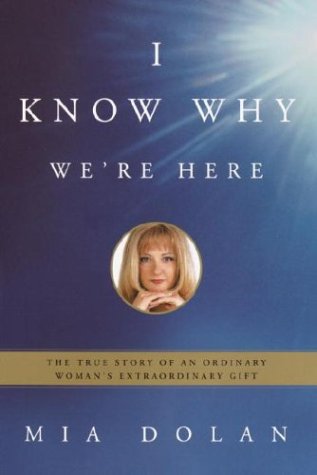
The personal story of a well-known British psychic recounts the onset of her abilities in her early twenties, her decision to help others to contact the spirits of the dead, and her own tragic losses, which included the deaths of her brother and young son. 25,000 first printing.
Die Inhaltsangabe kann sich auf eine andere Ausgabe dieses Titels beziehen.
Über die Autorin bzw. den Autor
MIA DOLAN, one of England's best-known psychics, works full time as a clairvoyant specializing in psychic predictions, hauntings, and police investigations. This is her first book.
Aus dem Klappentext
"Why me?" I said aloud.<br>There was no answer, so I carried on.<br>"Why not pick on a nun, or someone really spiritual?"<br>The answer, when it came, was dry.<br>"Your guess," he said, "is as good as mine."<br><br>Mia Dolan was twenty-two when she first heard a voice she could not explain. She had always considered herself to be a down-to-earth person and certainly never believed in psychic phenomena. But now that this voice had spoken to Mia, strange things began to happen: she "left" her body and walked through the house; she "saw" a plane crash in horrific detail, then witnessed the same scene on the news that evening. She thought she was going insane.<br><br>Finally, Mia discovered that she had a rare psychic gift and learned how to control and use it. Though she realized that she could not cure grief, she decided to use her gift to connect loved ones to those they had lost. This power took on a new, deeply personal dimension when, a few years later, Mia tragically foresaw the murder of her own brother and had to endure the loss of her young son.<br><br><b>I Know Why We’re Here</b> is the fascinating story of an ordinary woman’s extraordinary gift--an inspirational life lived with raw honesty, humor, and compassion.
Auszug. © Genehmigter Nachdruck. Alle Rechte vorbehalten.
In my earliest memory, I am standing on the doorstep of our house on the Isle of Sheppey, looking out at a group of children playing in the driveway. There is my older brother, Jed, my kid brother, Peter, and our neighbors' children--six of them--all noisily absorbed in games with balls and a scooter. I am watching them and I am thinking: "I am old enough now to look after you all." The thought fills me with contentment. I am four years old.
Mum says I was never a child--always a protector. She tells a story of how, at the age of three, I saw an older boy picking on my brother Jed and ran after him with a large stick. I can't remember a time when I didn't want to be taking care of people. It's the way that I am.
I was a quiet child, an observer. Lanky, skinny, and very pale, I was always daydreaming. At Sheerness Catholic Primary School, I did not join in much until Peter's first day. It was break time and I was playing on the steps in the playground when I heard a commotion. Looking up, I saw a gang of boys on the grass with Peter trapped in the middle.
I ran over and pushed my way in.
"Leave him alone," I shouted. "He's my brother."
One of the boys turned and looked at me derisively.
"What are you going to do about it?"
I smacked him round the face. Then I kicked one of the other boys in the shins and grabbed hold of Peter's hand. As we walked toward the drinking fountain, one of the "it" girls--the one with the most sarcastic tongue and the best clothes--said, "Well done."
Well done? I don't know whether I hurt the bullies or they were just amazed to see a seven-year-old girl up for a fight, but they left Peter alone. After that, all the coolest people in the school wanted to be around me. I was happy in my skin and that seemed to draw others toward me. I became a ringleader without ever intending to.
I was born into a family that stretched its roots between Italy and Lancashire. My maternal grandmother, Grace Smith, was born and brought up in Malta. Half Italian, she fell in love with Jack Armstrong, an English army officer and, against her mother's advice, married him and came to England. She thought (and he led her to believe) she was en route to a life of luxury. Instead, Jack took her to a mining village in the north of England and life in a two-up two-down, with a lavatory shared with six other houses. It was cold and it rained constantly. She had no use for the ball gowns she had brought with her.
Grace had three children in quick succession--Robert, my mum, Kathleen Patricia, and John. She spent most of the war years living in attics in London, working in the ammunitions factory and scrubbing other people's floors. At the end of the war, her husband wrote to say he was not coming home. In barely legible scrawl, he told her he had fallen in love with a female army officer and the two of them were being posted to Germany together.
Grace was furious. The government was keen to reunite families so she wrote to the Home Office, detailing the hardships of a single life with three children and seeking assistance. Her husband was duly threatened with loss of his officer status and, within weeks, tickets arrived for her and the children to join him in Hamburg.
It was a violent sea crossing; everyone was sick. My grandmother was the only passenger on board to sit down to a full cooked breakfast. She was a four-foot-eleven dynamo.
Four years later, Grace, Jack, and their three children were posted to army barracks on the Isle of Sheppey. Barren, flat, and marshy--the island appeared to Grace to be in the middle of nowhere. The docks and army barracks were busy, but apart from a few small densely populated villages, the island seemed empty. Only a third of it was built on.
My mother, Pat, was twelve years old. A few years later, when Jack started managing the Britannia pub in the biggest of the island's villages, Sheerness, she was often seen in there helping Grace run the restaurant.
It was there my father, Gerry Dolan, first saw her.
Pat was a twenty-year-old quarter-Italian beauty with shoulder-length black hair and an hourglass figure. Gerry told his friend, "That is the girl I am going to marry."
"Really?" his mate, George, asked, impressed. "Do you know her?"
"No," my father said, "not yet."
At the disco at the Territorial Army Drill Hall later that night, he asked Pat to dance and then walked her home. Gerry Dolan had just come out of the Merchant Navy--he was thirty-one and had traveled the world. Pat was a shy homebody, but she was quick-witted and known for her wicked sense of humor. They married a year later and, to anyone who ever spent any time with them, it was clearly a marriage of love.
After two years, Jed was born; then I arrived--Marie Elisabeth--and then Peter--all two years apart. We moved around in the very early years--Sheerness, Manchester, back to Sheerness and then St. Helens in Lancashire. When I was three years old, we came back to the island and we stayed there--setting up camp at 55 Darlington Drive.
The Isle of Sheppey is eleven miles long and nine miles wide. Thirty-five thousand people live there but, during the summer, that figure doubles. There are holiday camps and caravan sites near the water. Apart from tourism, the main trade on the island comes from the docks and the steel mill.
Two-thirds of the island is green--and it is flat, very flat. The horizons are enormous. The sunsets fill the sky. King's Ferry is the link to the mainland. Once islanders are on that, they know they're home.
My early years were very happy. My favorite pastime was listening to my parents' record of "The Blue Danube" and making up dance routines. I was tall for my age and agile. At the age of five, I started to learn ballet at Yvonne West's School of Dance and I became her protege. "I had a student before you who went on to be very successful," she used to say. "You remind me of her."
My parents did not really have the money to spare, but they paid for dance classes in church halls several nights a week and scraped together money for the tutus I needed for my exams. Most evenings I took over the front room, pushed the coffee table against the wall, put music on and danced. My parents never coerced me into doing anything--but they did support me, always.
My father, Gerald, was a salesman--a good salesman. Slim and dark-haired, he had incredible charm and gentleness--and he always wore a shirt and tie whenever he left the house. Dad sold everything from central heating and double-glazing to burglar and fire alarms. One year he won the Salesman of the Year award when he sold more books than anybody else at Caxton Books. The prizes on offer were a new washing machine or a holiday in the Bahamas.
Dad said to Mum, "You choose."
Mum was still a beauty, with her wavy brown hair and flowery dresses, but she was always, always busy. She looked round the kitchen at the nappies soaking in buckets and said, "I want the washing machine."
Dad's income was sporadic. Many evenings Mum ran out of shillings to put in the electric meter and resorted to inserting curtain rings. Many evenings, we ran out of those too and so we lit candles and played alphabet games waiting for Dad to come home.
"Animals beginning with A . . ."
"Ant, armadillo . . ."
"B."
"Bear, beaver . . ."
We would go through the whole alphabet with animals, then move on to countries and films, making a joke of it until Dad came in with the deposit for his next job. Then the lights went back on, Dad opened bottles of beer and Mum went down the...
„Über diesen Titel“ kann sich auf eine andere Ausgabe dieses Titels beziehen.
Suchergebnisse für I Know Why We're Here: The True Story of an Ordinary...

Beispielbild für diese ISBN
I Know Why We're Here: The True Story of an Ordinary Woman's Extraordinary Gift
Anbieter: World of Books (was SecondSale), Montgomery, IL, USA
Verkäuferbewertung 5 von 5 Sternen

Hardback. Zustand: Very Good. Artikel-Nr. 00107729706
Gebraucht kaufen
EUR 3,85
Versand gratis
Versand innerhalb von USA
Versand innerhalb von USA
Anzahl: 1 verfügbar
Beispielbild für diese ISBN
I Know Why We're Here: The True Story of an Ordinary Woman's Extraordinary Gift
Anbieter: World of Books (was SecondSale), Montgomery, IL, USA
Verkäuferbewertung 5 von 5 Sternen
Hardback. Zustand: Fair. Artikel-Nr. 00106724967
Gebraucht kaufen
EUR 3,85
Versand gratis
Versand innerhalb von USA
Versand innerhalb von USA
Anzahl: 1 verfügbar
Beispielbild für diese ISBN
I Know Why We're Here : The True Story of an Ordinary Woman's Extraordinary Gift
Verlag:
Crown Publishing Group, The, 2004
ISBN 10: 1400052165
ISBN 13: 9781400052165
Gebraucht
Hardcover
Anbieter: Better World Books, Mishawaka, IN, USA
Verkäuferbewertung 5 von 5 Sternen
Zustand: Good. Former library copy. Pages intact with minimal writing/highlighting. The binding may be loose and creased. Dust jackets/supplements are not included. Includes library markings. Stock photo provided. Product includes identifying sticker. Better World Books: Buy Books. Do Good. Artikel-Nr. GRP57876322
Gebraucht kaufen
EUR 6,19
Versand gratis
Versand innerhalb von USA
Versand innerhalb von USA
Anzahl: 1 verfügbar
Beispielbild für diese ISBN
I Know Why We're Here : The True Story of an Ordinary Woman's Extraordinary Gift
Verlag:
Crown Publishing Group, The, 2004
ISBN 10: 1400052165
ISBN 13: 9781400052165
Gebraucht
Hardcover
Anbieter: Better World Books, Mishawaka, IN, USA
Verkäuferbewertung 5 von 5 Sternen
Zustand: Fine. Used book that is in almost brand-new condition. May contain a remainder mark. Better World Books: Buy Books. Do Good. Artikel-Nr. 40062720-6
Gebraucht kaufen
EUR 6,19
Versand gratis
Versand innerhalb von USA
Versand innerhalb von USA
Anzahl: 1 verfügbar
Beispielbild für diese ISBN
I Know Why We're Here : The True Story of an Ordinary Woman's Extraordinary Gift
Verlag:
Crown Publishing Group, The, 2004
ISBN 10: 1400052165
ISBN 13: 9781400052165
Gebraucht
Hardcover
Anbieter: Better World Books, Mishawaka, IN, USA
Verkäuferbewertung 5 von 5 Sternen
Zustand: Very Good. Pages intact with possible writing/highlighting. Binding strong with minor wear. Dust jackets/supplements may not be included. Stock photo provided. Product includes identifying sticker. Better World Books: Buy Books. Do Good. Artikel-Nr. 5451925-6
Gebraucht kaufen
EUR 6,19
Versand gratis
Versand innerhalb von USA
Versand innerhalb von USA
Anzahl: 2 verfügbar
Beispielbild für diese ISBN
I Know Why We're Here: The True Story of an Ordinary Woman's Extraordinary Gift
Anbieter: Wonder Book, Frederick, MD, USA
Verkäuferbewertung 5 von 5 Sternen
Zustand: Good. Good condition. Acceptable dust jacket. With remainder mark. A copy that has been read but remains intact. May contain markings such as bookplates, stamps, limited notes and highlighting, or a few light stains. Artikel-Nr. Q13A-03156
Gebraucht kaufen
EUR 6,43
Versand gratis
Versand innerhalb von USA
Versand innerhalb von USA
Anzahl: 1 verfügbar
Beispielbild für diese ISBN
I Know Why We're Here: The True Story of an Ordinary Woman's Extraordinary Gift
Anbieter: Wonder Book, Frederick, MD, USA
Verkäuferbewertung 5 von 5 Sternen
Zustand: Very Good. Very Good condition. Good dust jacket. With remainder mark. A copy that may have a few cosmetic defects. May also contain light spine creasing or a few markings such as an owner's name, short gifter's inscription or light stamp. Artikel-Nr. B20A-04755
Gebraucht kaufen
EUR 6,43
Versand gratis
Versand innerhalb von USA
Versand innerhalb von USA
Anzahl: 1 verfügbar
Beispielbild für diese ISBN
I Know Why We're Here: The True Story of an Ordinary Woman's Extraordinary Gift
Anbieter: Wonder Book, Frederick, MD, USA
Verkäuferbewertung 5 von 5 Sternen
Zustand: As New. Like New condition. Very Good dust jacket. A near perfect copy that may have very minor cosmetic defects. Artikel-Nr. H06M-01616
Gebraucht kaufen
EUR 6,43
Versand gratis
Versand innerhalb von USA
Versand innerhalb von USA
Anzahl: 1 verfügbar
Beispielbild für diese ISBN
I Know Why We're Here: The True Story of an Ordinary Woman's Extraordinary Gift
Anbieter: ThriftBooks-Atlanta, AUSTELL, GA, USA
Verkäuferbewertung 5 von 5 Sternen
Hardcover. Zustand: Very Good. No Jacket. May have limited writing in cover pages. Pages are unmarked. ~ ThriftBooks: Read More, Spend Less. Artikel-Nr. G1400052165I4N00
Gebraucht kaufen
EUR 6,87
Versand gratis
Versand innerhalb von USA
Versand innerhalb von USA
Anzahl: 1 verfügbar
Beispielbild für diese ISBN
I Know Why We're Here: The True Story of an Ordinary Woman's Extraordinary Gift
Anbieter: ThriftBooks-Dallas, Dallas, TX, USA
Verkäuferbewertung 5 von 5 Sternen
Hardcover. Zustand: Very Good. No Jacket. May have limited writing in cover pages. Pages are unmarked. ~ ThriftBooks: Read More, Spend Less. Artikel-Nr. G1400052165I4N00
Gebraucht kaufen
EUR 6,87
Versand gratis
Versand innerhalb von USA
Versand innerhalb von USA
Anzahl: 1 verfügbar