
Verwandte Artikel zu The Devil's Tickets: A Night of Bridge, A Fatal...
Inhaltsangabe
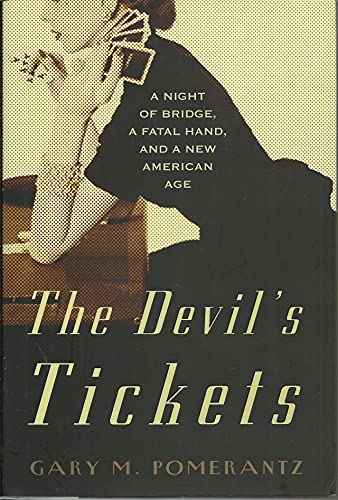
Tells the true story of Myrtle Bennett who murdered her philandering husband over a game of bridge in 1929, and the dramatic courtroom trial that made Ely Culbertson, who provided color commentary of the proceedings, a card game celebrity.
Die Inhaltsangabe kann sich auf eine andere Ausgabe dieses Titels beziehen.
Über die Autorin bzw. den Autor
GARY M. POMERANTZ is an author and journalist and serves as a visiting lecturer in the Department of Communication at Stanford University. His first book, Where Peachtree Meets Sweet Auburn, was named a 1996 Notable Book of the Year by the New York Times. He also earned acclaim for Nine Minutes, Twenty Seconds and Wilt, 1962. A graduate of the University of California, Berkeley, Pomerantz lives in the San Francisco Bay Area with his wife and their three children.
Auszug. © Genehmigter Nachdruck. Alle Rechte vorbehalten.
ONE
Ely and Jo
I.
New York City in the twenties was a melting pot of seven million, full of show, big and brawling, an industrial behemoth with enough smokestacks and skyscrapers to fill the skylines of a dozen cities. F. Scott Fitzgerald, who wrote of young love and glittery tea dances, as the twenties dawned, suggested New York City had "all the iridescence of the beginning of the world." Its streets swelled with noises of the Old World mixing with the New: gramophones, gangster gunfire, European accents, tinkling champagne glasses, backfiring Model Ts, and tabloid newsboys hawking the sensational. In these high times, New Yorkers could rush to Broadway to see Al Jolson and Eddie Cantor--known to their Eastern European parents as Asa Yoelson and Israel Iskowitz--or thrill to the last acts of the amazing Harry Houdini, born in Hungary as Erik Weisz. They could read a dozen and more local dailies, choose from among thirty thousand speakeasies, marvel as the big-bellied Babe Ruth launched home runs at Yankee Stadium, and see their Democratic governor, the derby-hatted Al Smith, passing through the five boroughs on his way (he hoped) to the White House. Alive and thrumming at street level, the city teemed with gangsters, ad agency pitchmen (selling sex, Sex, SEX!), Wall Street fat cats, socialists and garment district workers, cafe society personalities and cynical, self-absorbed writers sitting at the Algonquin Round Table thinking up laugh lines. A constellation of celebrities brightened the Prohibition-era night, from the brassy hostess Texas Guinan, who with her pancake makeup and jangling jewelry, greeted nightclub guests with "Hello, sucker!"; to the waiters at Small's Paradise in Harlem, who roller-skated the Charleston across the dance floor with trays overhead; to Jimmy (Beau James) Walker, the dapper mayor of the Tammany Hall machine, who so frequently courted his showgirl all over town that many New Yorkers--not including, of course, Walker's wife--assumed the two were married. In the spirit of the times, Walker later divorced his wife and married the showgirl.
In 1923 Ben Hecht, the writer and playwright, arrived in New York from Chicago and discovered an adventurous city running from the dark memory of war and hedonistically giving itself to the _pleasures of the hour, including, he wrote, "the pleasure of not giving a damn." "It was a bold town," Hecht wrote, "indeed, sharp-tongued, and individualistic. Its credo had it that New Yorkers were a master race."
We busied ourselves putting up the only show possible against doom, which is to seize all the fun there is. Thus people sang louder, drank deeper, danced longer and squandered themselves in every direction. . . . Its finest ladies, including happily married ones, engaged in promiscuous sex as if they were college boys on a spree. . . . New York insisted all its idols wear a grin. It regarded all foreign events, including the first World War, as entertainment. It believed that any war could be won by writing the right songs for it, and not losing your sense of humor. Its patriotism consisted of admiring itself ardently.
In the daily frenzy of New York City, twin journalistic revolutions thundered like elephants down Forty second Street: the tabloids and Walter Winchell. The New York Daily News, America's first tabloid, or half sheet, wailed into existence like a colicky infant in June 1919 with bold headlines and an eye-catching array of photos and illustrations. Within five years, it claimed a readership of nearly one million, easily the largest circulation in the nation. Its success begat another tabloid, the Daily Mirror, which arrived in 1922 promising "90 percent entertainment, 10 percent information"; a few years later came the next, the New York Evening Graphic. These tabloids took the bygone yellow journalism of Hearst and Pulitzer, Spanish-American War vintage, circa 1898, and ripened it. New York pulsed with a thousand wars in miniature--social, cultural, legal, and, best of all, marital--and the tabloids used them all to their advantage. They reveled in stories of debauchery, extramarital affairs, abortions, murders, union battles along the Bowery, mob violence, heroism, hedonism, mayhem, threats, controversies, and dynamic courtroom trials.
Winchell was an indefatigable, ink-stained gadfly who, as a columnist first for the Evening Graphic (a lowbrow daily ridiculed by competitors as the "Pornographic") and then for Hearst's Daily Mirror, seized upon gossip and turned it into his own high art of ballyhoo. Like the tabloids that launched him, Winchell was abrupt, catty, and always hustling. A _night owl, he wrote about Broadway personalities and turned his flashlight upon their tangled, often secretive romances. He challenged the traditional standards of journalistic good taste, maddening competing newspapers and his own editors, who were often unsure whether to publish his latest unverified piece of gossip. Winchell finessed his way around potential libel suits by creating his own "slanguage," a vernacular of the streets, breezy and colloquial. He wrote of secret lovebirds who were "Adam-and-Eveing it" and of a man who felt "that way" about a woman as they awaited "the blessed event." A mention in Winchell's column was greatly coveted, and feared. The column had a chatty cadence, a rapid song-and-dance-man's beat. He dropped names, often of celebrity writers, when possible: "At the opening of a play recently Baird Leonard turned to Dorothy Parker and said, 'Are you Dorothy Parker?' and Dorothy replied, 'Yes--do you mind?' " Winchell reacted physically to gossip, and one observer noted that he "seemed to purr with delight when he had a particularly juicy item... He was as fascinated and unself-conscious as a four-year-old making mudpies." Ben Hecht thought Winchell wrote "like a man honking in a traffic jam." There were other gossip artists at work in New York, but none so widely read, or so intensely despised. The actress Ethel Barrymore, who feuded with Winchell, would say, "It is a sad commentary on American manhood that Walter Winchell is allowed to exist."
Amid this cacophony was the Knickerbocker Whist Club, a noiseless oasis at 26 West Fortieth Street. Here the self-satisfied elites of American auction bridge, the reigning card game of the era, built and burnished their reputations. By requirement, the Knickerbocker's more than 250 members exhibited good temper and a strict adherence to an honor code of card play nearly two centuries old, as attendants, moving with stealth, placed fresh glasses of water at their elbows every half hour or so. Some of the club's older members had been wearing their eyeshades and stroking their chins, deep in thought, since the Cleveland and McKinley administrations. Women were not allowed as members--as bridge players, they were considered conservative and easily intimidated--though club rules permitted them in Thursday night games.
By 1915, auction bridge had forged two world capitals, London and New York, and the most prestigious gentlemen's bridge clubs in both became like fortresses, where wealthy members in evening attire shared stiff drinks with men of their own stature, and tried to take their money at cards. The Portland Club in London was the recognized rule maker of British bridge, a role held in America by the Whist Club of New York, at 38 East Thirty-ninth Street, with its small, exclusive membership (well heeled enough to play auction bridge at fifty cents a point), which included sportsman Harold S. Vanderbilt and club president Charles Schwab, the steel titan who was once Andrew Carnegie's right-hand man.
But for most of the East's leading players, the Knickerbocker was the bridge club of choice....
„Über diesen Titel“ kann sich auf eine andere Ausgabe dieses Titels beziehen.
Suchergebnisse für The Devil's Tickets: A Night of Bridge, A Fatal...

Beispielbild für diese ISBN
The Devil's Tickets: A Night of Bridge, a Fatal Hand, and a New American Age
Anbieter: World of Books (was SecondSale), Montgomery, IL, USA
Verkäuferbewertung 5 von 5 Sternen

Zustand: Very Good. Item in very good condition! Textbooks may not include supplemental items i.e. CDs, access codes etc. Artikel-Nr. 00100346191
Gebraucht kaufen
EUR 4,57
Versand gratis
Versand innerhalb von USA
Versand innerhalb von USA
Anzahl: 1 verfügbar
Beispielbild für diese ISBN
The Devil's Tickets: A Night of Bridge, a Fatal Hand, and a New American Age
Anbieter: World of Books (was SecondSale), Montgomery, IL, USA
Verkäuferbewertung 5 von 5 Sternen
Zustand: Acceptable. Item in acceptable condition! Textbooks may not include supplemental items i.e. CDs, access codes etc. Artikel-Nr. 00107366202
Gebraucht kaufen
EUR 4,57
Versand gratis
Versand innerhalb von USA
Versand innerhalb von USA
Anzahl: 1 verfügbar
Beispielbild für diese ISBN
The Devil's Tickets: A Night of Bridge, a Fatal Hand, and a New American Age
Anbieter: World of Books (was SecondSale), Montgomery, IL, USA
Verkäuferbewertung 5 von 5 Sternen
Zustand: Good. Item in good condition. Textbooks may not include supplemental items i.e. CDs, access codes etc. Artikel-Nr. 00106082840
Gebraucht kaufen
EUR 4,57
Versand gratis
Versand innerhalb von USA
Versand innerhalb von USA
Anzahl: 2 verfügbar
Beispielbild für diese ISBN
The Devil's Tickets: A Night of Bridge, a Fatal Hand, and a New American Age
Anbieter: BooksRun, Philadelphia, PA, USA
Verkäuferbewertung 5 von 5 Sternen
Hardcover. Zustand: Very Good. With dust jacket. It's a well-cared-for item that has seen limited use. The item may show minor signs of wear. All the text is legible, with all pages included. It may have slight markings and/or highlighting. Artikel-Nr. 1400051622-11-1-29
Gebraucht kaufen
EUR 6,11
Versand gratis
Versand innerhalb von USA
Versand innerhalb von USA
Anzahl: 1 verfügbar
Beispielbild für diese ISBN
The Devil's Tickets: A Night of Bridge, a Fatal Hand, and a New American Age
Anbieter: ThriftBooks-Dallas, Dallas, TX, USA
Verkäuferbewertung 5 von 5 Sternen
Hardcover. Zustand: Very Good. No Jacket. Former library book; May have limited writing in cover pages. Pages are unmarked. ~ ThriftBooks: Read More, Spend Less. Artikel-Nr. G1400051622I4N10
Gebraucht kaufen
EUR 6,26
Versand gratis
Versand innerhalb von USA
Versand innerhalb von USA
Anzahl: 1 verfügbar
Beispielbild für diese ISBN
The Devil's Tickets: A Night of Bridge, a Fatal Hand, and a New American Age
Anbieter: ThriftBooks-Atlanta, AUSTELL, GA, USA
Verkäuferbewertung 5 von 5 Sternen
Hardcover. Zustand: Very Good. No Jacket. Former library book; May have limited writing in cover pages. Pages are unmarked. ~ ThriftBooks: Read More, Spend Less. Artikel-Nr. G1400051622I4N10
Gebraucht kaufen
EUR 6,26
Versand gratis
Versand innerhalb von USA
Versand innerhalb von USA
Anzahl: 1 verfügbar
Beispielbild für diese ISBN
The Devil's Tickets: A Night of Bridge, a Fatal Hand, and a New American Age
Anbieter: ThriftBooks-Atlanta, AUSTELL, GA, USA
Verkäuferbewertung 5 von 5 Sternen
Hardcover. Zustand: Very Good. No Jacket. May have limited writing in cover pages. Pages are unmarked. ~ ThriftBooks: Read More, Spend Less. Artikel-Nr. G1400051622I4N00
Gebraucht kaufen
EUR 6,26
Versand gratis
Versand innerhalb von USA
Versand innerhalb von USA
Anzahl: 1 verfügbar
Beispielbild für diese ISBN
The Devil's Tickets: A Night of Bridge, a Fatal Hand, and a New American Age
Anbieter: Wonder Book, Frederick, MD, USA
Verkäuferbewertung 5 von 5 Sternen
Zustand: Very Good. Very Good condition. Very Good dust jacket. A copy that may have a few cosmetic defects. May also contain light spine creasing or a few markings such as an owner's name, short gifter's inscription or light stamp. Artikel-Nr. E07I-01574
Gebraucht kaufen
EUR 6,41
Versand gratis
Versand innerhalb von USA
Versand innerhalb von USA
Anzahl: 1 verfügbar
Beispielbild für diese ISBN
The Devil's Tickets : A Night of Bridge, a Fatal Hand, and a New American Age
Verlag:
Crown Publishing Group, The, 2009
ISBN 10: 1400051622
ISBN 13: 9781400051625
Gebraucht
Hardcover
Erstausgabe
Anbieter: Better World Books, Mishawaka, IN, USA
Verkäuferbewertung 5 von 5 Sternen
Zustand: Good. 1ST. Former library copy. Pages intact with minimal writing/highlighting. The binding may be loose and creased. Dust jackets/supplements are not included. Includes library markings. Stock photo provided. Product includes identifying sticker. Better World Books: Buy Books. Do Good. Artikel-Nr. 2641422-6
Gebraucht kaufen
EUR 7,17
Versand gratis
Versand innerhalb von USA
Versand innerhalb von USA
Anzahl: 1 verfügbar
Beispielbild für diese ISBN
The Devil's Tickets : A Night of Bridge, a Fatal Hand, and a New American Age
Verlag:
Crown Publishing Group, The, 2009
ISBN 10: 1400051622
ISBN 13: 9781400051625
Gebraucht
Hardcover
Erstausgabe
Anbieter: Better World Books, Mishawaka, IN, USA
Verkäuferbewertung 5 von 5 Sternen
Zustand: Very Good. 1ST. Former library copy. Pages intact with possible writing/highlighting. Binding strong with minor wear. Dust jackets/supplements may not be included. Includes library markings. Stock photo provided. Product includes identifying sticker. Better World Books: Buy Books. Do Good. Artikel-Nr. 10859658-75
Gebraucht kaufen
EUR 7,17
Versand gratis
Versand innerhalb von USA
Versand innerhalb von USA
Anzahl: 1 verfügbar