
Verwandte Artikel zu Confronting Reality: Doing What Matters to Get Things...
Inhaltsangabe
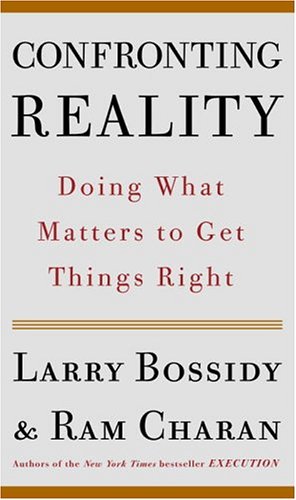
Looks at the dramatic changes confronting the new world of modern-day business and furnishes a series of tools, techniques, and strategies to help companies redefine corporate management theory and practice to meet the challenges of the era and help companies become successful. By the authors of Execution. 250,000 first printing.
Die Inhaltsangabe kann sich auf eine andere Ausgabe dieses Titels beziehen.
Über die Autorin bzw. den Autor
LARRY BOSSIDY is the retired chairman of the board and CEO of Honeywell International, a global $24 billion advanced technology, controls, and manufacturing company. He began his career at General Electric, where he served in a number of executive and financial positions, including COO of GE Capital, executive vice president and president of GE’s Services and Materials Sector, and vice chairman and executive officer. In 1991 Mr. Bossidy joined AlliedSignal Inc. as chairman and CEO and merged the company with Honeywell in 1999.
RAM CHARAN is a highly acclaimed business advisor, speaker, and author, well known for his practical, real-world perspective. He was a Baker Scholar at Harvard Business School where he earned his MBA degree with Distinction, as well as his DBA. Dr. Charan is also the author of What the CEO Wants You to Know, Profitable Growth Is Everyone’s Business, The Leadership Pipeline, and Boards at Work. His articles have appeared in Fortune and Harvard
Business Review.
Auszug. © Genehmigter Nachdruck. Alle Rechte vorbehalten.
CHAPTER 1
When Reality Bites: The Stories of John P. and Lou G.
The most widespread unrealistic behavior when the game changes drastically is to violate the First Law of Holes (when you're in one, stop digging). People redouble their efforts to do what they know best. They often achieve heroic results-which are, alas, almost as often pointless, because they fail to confront the new realities.
For example, many managers facing competition from abroad are still fighting yesterday's war. That's the one the Japanese started with their efficient manufacturing processes. Today even the Japanese can't win it. Doubling your productivity is a wonderful accomplishment, but it does not confront reality because it won't save you when your competitors have global supply chains with costs that are a small fraction of what you can hope to achieve in your home country. Services are now in the equation too. Customer support, back-office operations, product development, and even some segments of R&D can be as outsourceable as factories.
Consider John P., a business unit leader we know. In mid-2003, John and his top managers were preparing the 2004 strategic plan for their $500 million division, which made protective coatings for a highly specialized industrial market. John had run the division superbly for more than five years, and was considered a candidate for senior leadership of the parent company. He knew operations, and had good relationships with his customers.
Recently those customers had been telling him that their sales were down because of competition from abroad. They allowed that John's products were the best on the market, but they were under tremendous pressure to reduce their costs, and they expected all their suppliers to do the same. John took their message seriously, and told his people what he'd heard.
John's team agreed they could do a number of things to cut costs. They worked out a plan to close one of their four U.S. plants, consolidate three European plants into two, tighten other expenses wherever they could, and increase R&D spending to further distance their product from the competition's. Based on past experience and on what everyone present at the meeting knew, the plan looked realistic.
Then the new CFO spoke up. He'd joined the company only recently and was seeing the issue from a broader perspective. "From my point of view, you appear to be heading down the wrong track," he said. "Your recommendations would be good if the problem was our traditional domestic competition. They might satisfy the customers in the short term. But I know for a fact that two of those customers have already started moving to China. The others will undoubtedly be doing the same soon. Don't they expect us to reduce our costs just as significantly? Closing a U.S. plant, consolidating in Europe, and cutting costs by a few percentage points won't do that."
John looked around the room and noted that the other members of his team seemed just as uncomfortable as he felt. "I'm not sure what to do," the CFO continued, "but I urge you to consider the pros and cons of moving the whole operation to China or licensing our technology to a China-based supplier."
John knew that lots of businesses were outsourcing to China these days. Still, the idea stunned him. It just didn't make sense for this company.
"Mike," he said to the CFO. "This is not something we need to do-or even necessarily can do. You surely know that a lot of our differentiation comes from the application process. That's all about proprietary techniques and human experience. How could anybody duplicate that elsewhere?
"But let's suppose we did move production to China. We'd have to take a huge write-oV on our plant here. The unions would raise hell. Morale in the whole division would be hurt. And while you can't necessarily take this to the bank, we'd get a huge black eye in the community. I've been part of this town for years, I'm on the school board and coach in the Little League. I don't know how I could look my friends and neighbors in the face if we did this.
"We can cut our costs significantly with our plan. Maybe they won't be as low as they would be in China. But we're the leader in this technology, and that's got to be worth a premium to our customers."
"You could do all the things you plan to do, but they're probably not enough," said the CFO. "Our differentiation is real enough, but frankly it's not worth it to people who can save a lot of money from another supplier. Besides, our customers will expect us to be located in close proximity to their operations. If you don't make the move, they'll sooner or later find somebody who will."
In the quiet that followed, John thought back to something one of his customers had said a few weeks before. Talking about his costs, the customer had remarked almost casually that he'd reduced a big chunk of them by dropping a longstanding component supplier in favor of one based in China. Could that have been a hint John didn't want to hear? In light of what Mike was saying, it sure looked like one now.
As he pondered, he gazed out the window. The first shift was leaving the plant for the day. He saw the faces of people he knew-guys and gals he'd talked to on the plant floor. They were as dedicated a bunch of workers as you could find anywhere in the world. Many of their kids went to the same school as his kids.
Life really isn't fair, John thought to himself. Nobody should have to make decisions like this. Finally he turned back to the CFO and looked at him bleakly. "Okay," he said. "I hate the idea, but you've convinced me that we'll have to do this at some point. But our current plan will buy us enough time to do that in an orderly fashion-won't it?"
The CFO responded sympathetically but firmly. "Let me rephrase my thoughts," he said. "You're looking at the world from the American Midwest, and you're looking at it as you've seen it for your whole life.
"These days, later is a lot closer to sooner than it used to be. There's big change going on, and it's happening fast because the global economy has gone real-time. It's not cyclical change. It's structural change, and it means total change in how this business will make money in the future. By the way, your customer is also probably going through similar structural change. And it begins with one simple fact in this case: You've got to have global cost parity, meaning that you cannot be out of line with the lowest-cost source, no matter how fine your product may be.
"Now, you can't just pick up and relocate to China overnight. You've got to integrate vertically, which means not only getting a plant built but getting acclimated to the new environment, selecting suppliers, and picking and training the right people. This requires a knowledge of China, and nobody in this company has it. If you do bite the bullet, you've got a lot of work to do before you even start to build an operation there."
Within a week, John's team had a new message for the CEO. They wouldn't present the strategic plan he was expecting. Instead, they'd be back in six weeks with a fully-detailed China proposal-including the names of experts to engage, along with plans and a budget for a new plant and a plan for structuring the necessary write-offs in the United States.
John handed the report over with mixed emotions. He suspected the pain of making the decision would never entirely go away. But he also recognized that he'd been lucky. He and his team thought they were being realistic about their situation, and that they had taken the necessary hard actions to correct it. A person with a fresh viewpoint had shown him realities that would have sunk his...
„Über diesen Titel“ kann sich auf eine andere Ausgabe dieses Titels beziehen.
Suchergebnisse für Confronting Reality: Doing What Matters to Get Things...

Beispielbild für diese ISBN
Confronting Reality: Doing Wha
Anbieter: World of Books (was SecondSale), Montgomery, IL, USA
Verkäuferbewertung 5 von 5 Sternen

Zustand: Very Good. Item in very good condition! Textbooks may not include supplemental items i.e. CDs, access codes etc. Artikel-Nr. 00081562152
Gebraucht kaufen
EUR 4,26
Versand gratis
Versand innerhalb von USA
Versand innerhalb von USA
Anzahl: 9 verfügbar
Beispielbild für diese ISBN
Confronting Reality: Doing Wha
Anbieter: World of Books (was SecondSale), Montgomery, IL, USA
Verkäuferbewertung 5 von 5 Sternen
Zustand: Good. Item in good condition. Textbooks may not include supplemental items i.e. CDs, access codes etc. Artikel-Nr. 00094442268
Gebraucht kaufen
EUR 4,26
Versand gratis
Versand innerhalb von USA
Versand innerhalb von USA
Anzahl: 11 verfügbar
Beispielbild für diese ISBN
Confronting Reality: Doing What Matters to Get Things Right
Verlag:
Crown Business (edition First Edition), 2004
ISBN 10: 1400050847
ISBN 13: 9781400050840
Gebraucht
Hardcover
Erstausgabe
Anbieter: BooksRun, Philadelphia, PA, USA
Verkäuferbewertung 5 von 5 Sternen
Hardcover. Zustand: Fair. First Edition. With dust jacket. The item might be beaten up but readable. May contain markings or highlighting, as well as stains, bent corners, or any other major defect, but the text is not obscured in any way. Ex-Library. Artikel-Nr. 1400050847-7-18-12_29
Gebraucht kaufen
EUR 5,64
Versand gratis
Versand innerhalb von USA
Versand innerhalb von USA
Anzahl: 1 verfügbar
Beispielbild für diese ISBN
Confronting Reality: Doing What Matters to Get Things Right
Verlag:
Crown Business (edition First Edition), 2004
ISBN 10: 1400050847
ISBN 13: 9781400050840
Gebraucht
Hardcover
Erstausgabe
Anbieter: BooksRun, Philadelphia, PA, USA
Verkäuferbewertung 5 von 5 Sternen
Hardcover. Zustand: Very Good. First Edition. With dust jacket. It's a well-cared-for item that has seen limited use. The item may show minor signs of wear. All the text is legible, with all pages included. It may have slight markings and/or highlighting. Artikel-Nr. 1400050847-11-1-29
Gebraucht kaufen
EUR 5,94
Versand gratis
Versand innerhalb von USA
Versand innerhalb von USA
Anzahl: 1 verfügbar
Beispielbild für diese ISBN
Confronting Reality: Doing What Matters to Get Things Right
Anbieter: ThriftBooks-Phoenix, Phoenix, AZ, USA
Verkäuferbewertung 5 von 5 Sternen
Hardcover. Zustand: As New. No Jacket. Pages are clean and are not marred by notes or folds of any kind. ~ ThriftBooks: Read More, Spend Less. Artikel-Nr. G1400050847I2N00
Gebraucht kaufen
EUR 6,17
Versand gratis
Versand innerhalb von USA
Versand innerhalb von USA
Anzahl: 1 verfügbar
Beispielbild für diese ISBN
Confronting Reality: Doing What Matters to Get Things Right
Anbieter: ThriftBooks-Dallas, Dallas, TX, USA
Verkäuferbewertung 5 von 5 Sternen
Hardcover. Zustand: As New. No Jacket. Pages are clean and are not marred by notes or folds of any kind. ~ ThriftBooks: Read More, Spend Less. Artikel-Nr. G1400050847I2N00
Gebraucht kaufen
EUR 6,17
Versand gratis
Versand innerhalb von USA
Versand innerhalb von USA
Anzahl: 1 verfügbar
Beispielbild für diese ISBN
Confronting Reality : Doing What Matters to Get Things Right
Verlag:
Crown Publishing Group, The, 2004
ISBN 10: 1400050847
ISBN 13: 9781400050840
Gebraucht
Hardcover
Erstausgabe
Anbieter: Better World Books, Mishawaka, IN, USA
Verkäuferbewertung 5 von 5 Sternen
Zustand: Very Good. 1st. Pages intact with possible writing/highlighting. Binding strong with minor wear. Dust jackets/supplements may not be included. Stock photo provided. Product includes identifying sticker. Better World Books: Buy Books. Do Good. Artikel-Nr. 11224030-6
Gebraucht kaufen
EUR 6,35
Versand gratis
Versand innerhalb von USA
Versand innerhalb von USA
Anzahl: 1 verfügbar
Beispielbild für diese ISBN
Confronting Reality : Doing What Matters to Get Things Right
Verlag:
Crown Publishing Group, The, 2004
ISBN 10: 1400050847
ISBN 13: 9781400050840
Gebraucht
Hardcover
Erstausgabe
Anbieter: Better World Books, Mishawaka, IN, USA
Verkäuferbewertung 5 von 5 Sternen
Zustand: Good. 1st. Pages intact with minimal writing/highlighting. The binding may be loose and creased. Dust jackets/supplements are not included. Stock photo provided. Product includes identifying sticker. Better World Books: Buy Books. Do Good. Artikel-Nr. GRP97914815
Gebraucht kaufen
EUR 6,35
Versand gratis
Versand innerhalb von USA
Versand innerhalb von USA
Anzahl: 1 verfügbar
Beispielbild für diese ISBN
Confronting Reality : Doing What Matters to Get Things Right
Verlag:
Crown Publishing Group, The, 2004
ISBN 10: 1400050847
ISBN 13: 9781400050840
Gebraucht
Hardcover
Erstausgabe
Anbieter: Better World Books: West, Reno, NV, USA
Verkäuferbewertung 5 von 5 Sternen
Zustand: Good. 1st. Former library copy. Pages intact with minimal writing/highlighting. The binding may be loose and creased. Dust jackets/supplements are not included. Includes library markings. Stock photo provided. Product includes identifying sticker. Better World Books: Buy Books. Do Good. Artikel-Nr. GRP82024746
Gebraucht kaufen
EUR 6,35
Versand gratis
Versand innerhalb von USA
Versand innerhalb von USA
Anzahl: 1 verfügbar
Beispielbild für diese ISBN
Confronting Reality: Doing What Matters to Get Things Right
Anbieter: Wonder Book, Frederick, MD, USA
Verkäuferbewertung 5 von 5 Sternen
Zustand: Very Good. Very Good condition. Very Good dust jacket. A copy that may have a few cosmetic defects. May also contain light spine creasing or a few markings such as an owner's name, short gifter's inscription or light stamp. Artikel-Nr. D05N-00365
Gebraucht kaufen
EUR 6,53
Versand gratis
Versand innerhalb von USA
Versand innerhalb von USA
Anzahl: 3 verfügbar