
Verwandte Artikel zu Catch a Fish, Throw a Ball, Fly a Kite: 21 Timeless...
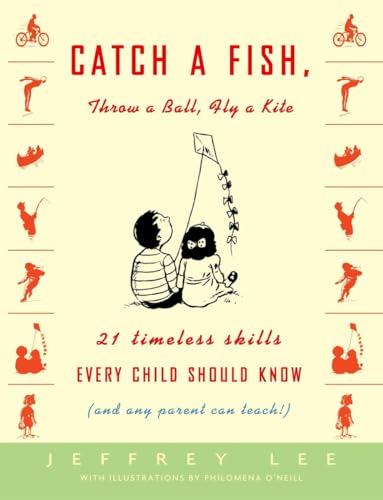
Catch a Fish, Throw a Ball, Fly a Kite: 21 Timeless Skills Every Child Should Know (and Any Parent Can Teach!) - Softcover
Inhaltsangabe
Knowing how to fold a paper airplane can make you a better parent!
Well, maybe not better, but you’ll certainly have more fun with your children, who understandably assume that you know how to do just about everything. If they only knew!
Catch a Fish, Throw a Ball, Fly a Kite is for parents who want to teach their children what they really want to learn--even the skills you never mastered or haven't practiced in a few decades. This book contains clear, simple, step-by-step instructions for teaching more than twenty little life skills that every child should know, including how to:
• Work a yo-yo
• Build a fire
• Eat with chopsticks
• Skip a stone
• Fly a homemade kite
• Throw a Frisbee
While you teach your children, you get to learn the skills too, or at the very least improve on them. Activities range from practical, like locating the constellations, to completely frivolous fun, like turning a blade of grass into a musical instrument. Some are simple enough for four-year-olds, and others will appeal to the most jaded adolescent. Each skill is illustrated and is rounded out with fascinating trivia (did you know that the world’s largest sand castle measured six stories high?) or funny jokes. Age-appropriate information is given for each skill, but they all have one thing in common: You and your kids can do them together!
Die Inhaltsangabe kann sich auf eine andere Ausgabe dieses Titels beziehen.
Über die Autorin bzw. den Autor
JEFFREY LEE, M.D., graduated from Harvard Medical School, trained in family medicine at the University of Washington, and now lives in Seattle. Dr. Lee is the author of the young adult novel True Blue. He has taught every one of the skills in Catch a Fish, Throw a Ball, Fly a Kite to his children Madeline (age ten) and Juliana (age five).
Von der hinteren Coverseite
Knowing how to fold a paper airplane can make you a better parent!
Well, maybe not better, but you'll certainly have more fun with your children, who understandably assume that you know how to do just about everything. If they only knew!
Catch a Fish, Throw a Ball, Fly a Kite is for parents who want to teach their children what they really want to learn--even the skills you never mastered or haven't practiced in a few decades. This book contains clear, simple, step-by-step instructions for teaching more than twenty little life skills that every child should know, including how to:
- Work a yo-yo
- Build a fire
- Eat with chopsticks
- Skip a stone
- Fly a homemade kite
- Throw a Frisbee
While you teach your children, you get to learn the skills too, or at the very least improve on them. Activities range from practical, like locating the constellations, to completely frivolous fun, like turning a blade of grass into a musical instrument. Some are simple enough for four-year-olds, and others will appeal to the most jaded adolescent. Each skill is illustrated and is rounded out with fascinating trivia (did you know that the world's largest sand castle measured six stories high?) or funny jokes. Age-appropriate information is given for each skill, but they all have one thing in common: You and your kids can do them together!
Auszug. © Genehmigter Nachdruck. Alle Rechte vorbehalten.
CATCH A FISH
"Give a man a fish, and he eats for a day. Teach a man to fish, and you're lucky if he even comes home for dinner."
--Anonymous
When I was growing up, the only time I had my father all to myself was when we were fishing. My brothers fished too, but they weren't obsessed with it, like my dad and I. He'd creep into my room before dawn to tap me on the shoulder, and I'd wake up instantly, as if I'd been waiting for that moment all night long. Then we'd sneak out of the house together and load up the car in the dark.
We'd reach the lake with the sky aglow in the east and the birds just beginning to sing. Often, we'd hear the faint sound of a splash across the cove.
"You hear that?" my dad would whisper. "They're hungry!"
After that he wouldn't say much. That's how he was--more comfortable with silence than conversation. That was fine with me. I was happy just to sit with him by the water and watch the sun come up over the trees.
Years later, when I was in medical school, I came home one weekend for a visit. Since my brothers and I had moved out, my father had gone on to new interests, and our little rowboat hadn't gotten much use. On a whim I asked him to go fishing with me.
He came to wake me an hour before dawn, and I was up as soon as he tapped my shoulder. That morning the fish really were hungry. In just a couple of hours we caught a stringer-full of fat bass. We headed home early, triumphant hunters, with the quiet of early morning still hanging in the air.
I was surprised when my father broke the silence.
"You know," he said, "we probably didn't tell you this enough, but your mom and I have always been very proud of you and the things you've done."
I turned to look at him, but he was staring straight ahead. Behind him the sun flashed and flickered on the lake as we drove along the shore.
"That's okay," I said. "I knew."
WHEN TO START
There's no easy answer to this one. Mostly, it depends on your kids. If they love being outdoors and they're fascinated by little critters, fishing is an easy sell. But remember, the younger they are, the shorter their attention spans. Fishing can involve a lot of waiting, and some kids aren't good at that. Later on I'll give you some tricks to keep their interest, but you still have to be realistic about how long they can sit in one place. If you think they can hang in there for at least an hour, then give it a try.
WHAT YOU NEED BEFORE YOU START
A Place to Fish
This is the most important part of your preparation. When you take a kid fishing for the first time, you're looking for one thing, and one thing only: action! What you want is a place where there are lots of hungry little fish to gobble up anything you dangle in front of them. The key is to go after the fish that serious fishermen ignore. These are called "panfish."
Panfish are the little fish that gather in the shallows of lakes and ponds. They're the perfect quarry for beginners. The most common are little members of the bass family, known collectively as "sunfish." They all have the same rounded shape and seldom grow much larger than eight inches. Also common is the yellow perch. There may be others in your particular region, but sunfish and perch can be found almost anywhere. They're good eating and easy to catch.
Some ponds and lakes are stocked heavily with hatchery fish, usually trout. This is a good choice too, especially at the beginning of the fishing season, but you may have to fight the crowds.
To locate a good fishing spot, call up a local bait shop or fishing tackle store. You can also try your state Fish and Game Department. Tell them you want to take your kid where it's easy to catch small fish. Ask if there's a dock or a clear stretch of shoreline where a beginner can cast without getting hung up in the trees. You probably want to stay away from boats with younger kids, both for safety's sake and to allow a quick getaway if they get cranky and want to go home.
I've suggested ponds and lakes because rivers and saltwater are often harder to fish, but there may be exceptions where you live. In any case, check out whatever spot you choose before you actually go fishing, to make sure it's both safe and accessible.
One last alternative is to find a local "U-Fish" place. These are private ponds where you pay to catch stocked fish. They can be expensive and crowded, and they won't give you much of an outdoor experience. On the other hand, you'll usually catch something--and your first time out with a kid, that's a big advantage.
Fishing License
Every state has its own regulations on who needs a license, where and when they can fish, and what they can fish for. You can buy a license at most tackle or bait shops, but call ahead to make sure. A booklet with your state's regulations should come with the license.
Equipment
There's no end to the amount of equipment you can buy in the name of catching fish. For diehards like me, that's half the fun. But to start with, you need only a few basics.
*Rods and reels. These come in a dizzying range of shapes, sizes, and prices. As you get into bigger fish and special conditions, you'll need better equipment. But for little fish and quiet water, it almost doesn't matter. For your first attempt at fishing, this is what you should do.
Walk into any discount department store that carries fishing equipment. Buy a couple of cheap, lightweight rods and spinning reels with the fishing line already on them. The rod and reel are often sold together as a "combo." Get one of the shorter, thinner rods--it should be flexible and whippy, so even little fish will give it a good bend. Don't get the really cheap one that looks like a toy. Get the next cheapest one that looks like a real fishing rod.
If your kid is younger than six, you might get a combo with a spin-cast reel. The push-button mechanism is a little easier to handle, and the covering over the spool is supposed the keep the line from getting tangled. On the other hand, regular spinning reels cast much farther and aren't that much harder to use. And with a child that young, you'll probably end up casting for him anyway.
*Hooks. Get a box of number 10 hooks. The larger the number, the smaller the hook, and these are pretty small. Remember, little fish have little mouths.
*Sinkers. Buy a box of small, round, split-shot sinkers. Get the ones that are about the size of small green peas, with the little wings on the back that make them easier to open and close.
*Bobbers. Get at least four red-and-white plastic floats, also known as "bobbers." The bigger the bobber, the harder it is for a fish to pull it under, so get small ones. About an inch in diameter should do.
*Extra line. Get a spool of cheap replacement line. Four-pound test strength would be more than enough for little fish, but six-pound will help you pull free from weeds and snags.
*Tackle box. Actually, a shoe box would be sufficient, but a small plastic tackle box doesn't cost much. It helps keep your stuff organized, it has a handle for easy carrying, and it makes you feel like a fisherman.
*Other stuff. All of the following will come in handy: nail clippers, needle-nosed pliers, a pocketknife, a bucket with a handle, a few rags. If you live in an area with lots of mosquitoes or black flies, bring some bug juice that's safe for kids. And don't forget a camera to record the first catch for posterity.
Bait
There are lots of artificial lures that will catch fish, but they all require repeated casting. When kids first start fishing, casting is the source of most problems. Lines get tangled, people get impaled,...
„Über diesen Titel“ kann sich auf eine andere Ausgabe dieses Titels beziehen.
Suchergebnisse für Catch a Fish, Throw a Ball, Fly a Kite: 21 Timeless...

Beispielbild für diese ISBN
Catch a Fish, Throw a Ball, Fly a Kite: 21 Timeless Skills Every Child Should Know (and Any Parent Can Teach!)
Verlag:
Crown (edition Illustrated), 2004
ISBN 10: 1400048109
ISBN 13: 9781400048106
Gebraucht
Paperback
Anbieter: BooksRun, Philadelphia, PA, USA
Verkäuferbewertung 5 von 5 Sternen

Paperback. Zustand: Fair. Philomena O'Neill (illustrator). Illustrated. The item might be beaten up but readable. May contain markings or highlighting, as well as stains, bent corners, or any other major defect, but the text is not obscured in any way. Artikel-Nr. 1400048109-7-1
Gebraucht kaufen
EUR 4,78
Versand gratis
Versand innerhalb von USA
Versand innerhalb von USA
Anzahl: 1 verfügbar
Beispielbild für diese ISBN
Catch a Fish, Throw a Ball, Fly a Kite: 21 Timeless Skills Every Child Should Know (and Any Parent Can Teach!)
Anbieter: World of Books (was SecondSale), Montgomery, IL, USA
Verkäuferbewertung 5 von 5 Sternen
Zustand: Good. Philomena O'Neill (illustrator). Item in good condition. Textbooks may not include supplemental items i.e. CDs, access codes etc. Artikel-Nr. 00105952318
Gebraucht kaufen
EUR 5,51
Versand gratis
Versand innerhalb von USA
Versand innerhalb von USA
Anzahl: 1 verfügbar
Beispielbild für diese ISBN
Catch a Fish, Throw a Ball, Fly a Kite: 21 Timeless Skills Every Child Should Know (and Any Parent Can Teach!)
Verlag:
Crown Publishing Group (NY), 2004
ISBN 10: 1400048109
ISBN 13: 9781400048106
Gebraucht
Paperback
Anbieter: ThriftBooks-Atlanta, AUSTELL, GA, USA
Verkäuferbewertung 5 von 5 Sternen
Paperback. Zustand: Good. No Jacket. Philomena O'Neill (illustrator). Pages can have notes/highlighting. Spine may show signs of wear. ~ ThriftBooks: Read More, Spend Less. Artikel-Nr. G1400048109I3N00
Gebraucht kaufen
EUR 6,13
Versand gratis
Versand innerhalb von USA
Versand innerhalb von USA
Anzahl: 1 verfügbar
Beispielbild für diese ISBN
Catch a Fish, Throw a Ball, Fly a Kite: 21 Timeless Skills Every Child Should Know (and Any Parent Can Teach!)
Anbieter: Wonder Book, Frederick, MD, USA
Verkäuferbewertung 5 von 5 Sternen
Zustand: Very Good. Philomena O'Neill (illustrator). Very Good condition. A copy that may have a few cosmetic defects. May also contain light spine creasing or a few markings such as an owner's name, short gifter's inscription or light stamp. Artikel-Nr. H01C-00708
Gebraucht kaufen
EUR 6,43
Versand gratis
Versand innerhalb von USA
Versand innerhalb von USA
Anzahl: 2 verfügbar
Beispielbild für diese ISBN
Catch a Fish, Throw a Ball, Fly a Kite : 21 Timeless Skills Every Child Should Know (and Any Parent Can Teach!)
Verlag:
Crown Publishing Group, The, 2004
ISBN 10: 1400048109
ISBN 13: 9781400048106
Gebraucht
Softcover
Anbieter: Better World Books, Mishawaka, IN, USA
Verkäuferbewertung 5 von 5 Sternen
Zustand: Good. Philomena O'Neill (illustrator). Former library copy. Pages intact with minimal writing/highlighting. The binding may be loose and creased. Dust jackets/supplements are not included. Includes library markings. Stock photo provided. Product includes identifying sticker. Better World Books: Buy Books. Do Good. Artikel-Nr. GRP73176612
Gebraucht kaufen
EUR 7,02
Versand gratis
Versand innerhalb von USA
Versand innerhalb von USA
Anzahl: 4 verfügbar
Beispielbild für diese ISBN
Catch a Fish, Throw a Ball, Fly a Kite : 21 Timeless Skills Every Child Should Know (and Any Parent Can Teach!)
Verlag:
Crown Publishing Group, The, 2004
ISBN 10: 1400048109
ISBN 13: 9781400048106
Gebraucht
Softcover
Anbieter: Better World Books, Mishawaka, IN, USA
Verkäuferbewertung 5 von 5 Sternen
Zustand: Very Good. Philomena O'Neill (illustrator). Former library copy. Pages intact with possible writing/highlighting. Binding strong with minor wear. Dust jackets/supplements may not be included. Includes library markings. Stock photo provided. Product includes identifying sticker. Better World Books: Buy Books. Do Good. Artikel-Nr. GRP72649166
Gebraucht kaufen
EUR 7,02
Versand gratis
Versand innerhalb von USA
Versand innerhalb von USA
Anzahl: 1 verfügbar
Beispielbild für diese ISBN
Catch a Fish, Throw a Ball, Fly a Kite : 21 Timeless Skills Every Child Should Know (and Any Parent Can Teach!)
Verlag:
Crown Publishing Group, The, 2004
ISBN 10: 1400048109
ISBN 13: 9781400048106
Gebraucht
Softcover
Anbieter: Better World Books, Mishawaka, IN, USA
Verkäuferbewertung 5 von 5 Sternen
Zustand: Very Good. Philomena O'Neill (illustrator). Pages intact with possible writing/highlighting. Binding strong with minor wear. Dust jackets/supplements may not be included. Stock photo provided. Product includes identifying sticker. Better World Books: Buy Books. Do Good. Artikel-Nr. 4868379-6
Gebraucht kaufen
EUR 7,02
Versand gratis
Versand innerhalb von USA
Versand innerhalb von USA
Anzahl: 1 verfügbar
Beispielbild für diese ISBN
Catch a Fish, Throw a Ball, Fly a Kite: 21 Timeless Skills Every Child Should Know (and Any Parent Can Teach!)
Anbieter: Robinson Street Books, IOBA, Binghamton, NY, USA
Verkäuferbewertung 4 von 5 Sternen

Paperback. Zustand: Very Good. Philomena O'Neill (illustrator). Prompt Shipment, shipped in Boxes, Tracking PROVIDEDlittle creased, else clean very good copy. Artikel-Nr. ware390rm1258
Gebraucht kaufen
EUR 12,42
EUR 8,48 Versand
Versand innerhalb von USA
Versand innerhalb von USA
Anzahl: 1 verfügbar
Beispielbild für diese ISBN
Catch a Fish, Throw a Ball, Fly a Kite: 21 Timeless Skills Every Child Should Know (and Any Parent Can Teach!) [Paperback] Jeffrey Lee and Philomena O'Neill
Anbieter: GridFreed, San Diego, CA, USA
Verkäuferbewertung 5 von 5 Sternen
Paperback. Zustand: New. Philomena O'Neill (illustrator). In shrink wrap. Artikel-Nr. 50-01603
Neu kaufen
EUR 17,43
EUR 6,20 Versand
Versand innerhalb von USA
Versand innerhalb von USA
Anzahl: 1 verfügbar
Beispielbild für diese ISBN
Catch a Fish, Throw a Ball, Fly a Kite: 21 Timeless Skills Every Child Should Know (and any Parent Can Teach!)
Anbieter: Revaluation Books, Exeter, Vereinigtes Königreich
Verkäuferbewertung 5 von 5 Sternen
Paperback. Zustand: Brand New. Philomena O'Neill (illustrator). 273 pages. 8.25x6.25x0.75 inches. In Stock. Artikel-Nr. x-1400048109
Neu kaufen
EUR 20,56
EUR 11,84 Versand
Versand von Vereinigtes Königreich nach USA
Versand von Vereinigtes Königreich nach USA
Anzahl: 2 verfügbar