
Verwandte Artikel zu The 5 Patterns of Extraordinary Careers: The Guide...
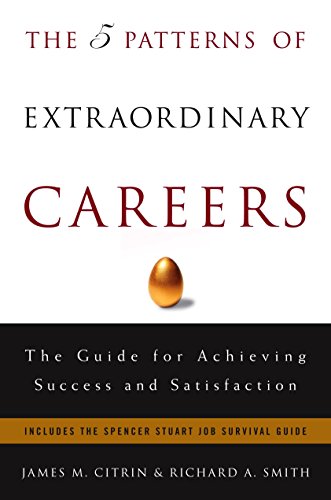
The 5 Patterns of Extraordinary Careers: The Guide for Achieving Success and Satisfaction - Hardcover
Inhaltsangabe
Draws on the expertise of Spencer Stuart, the world's leading executive recruiting firm, to explain what it takes to become a success in today's volatile business environment, examining the patterns of success exhibited by notable corporate leaders to provide practical guidelines for individuals in diverse stages of their career paths. 25,000 first printing.
Die Inhaltsangabe kann sich auf eine andere Ausgabe dieses Titels beziehen.
Über die Autorin bzw. den Autor
JAMES M. CITRIN, a prominent CEO and board director recruiter, leads Spencer Stuart’s Global Technology, Communications, and Media practice and is a member of the firm’s worldwide board of directors. He is the author of Zoom: How 12 Exceptional Companies Are Navigating the Road to the Next Economy and coauthor of Lessons from the Top: The 50 Most Successful Business Leaders in America—and What You Can Learn from Them.
RICHARD A. SMITH is a respected thought leader and recruiter of CEOs for both public and private corporations and a core member of Spencer Stuart’s Strategic Leadership practice. He has authored numerous articles on leadership and talent resource management, including the widely cited white paper, Tier One Talent: Investment Strategies for Human Capital.
Aus dem Klappentext
What is different about the careers of people like Lou Gerstner, the acclaimed, recently retired chairman and CEO of IBM? Or Senator Elizabeth Dole, Yahoo! COO Dan Rosensweig, and Tom Freston, chairman and CEO of MTV Networks?
Why did they ascend to the top and prosper why did they have extraordinary careers while others equally talented never reached their potential or aspirations?
Jim Citrin and Rick Smith of Spencer Stuart, the world s most influential executive search firm, set out to explore this question. The result based on in-depth, original research is sure to be the most important and useful book for anyone seeking to crack the code of how to build a rewarding, personally satisfying career.
Like weather systems and financial markets, careers contain patterns. What Citrin and Smith found from their research and extensive experience is that people with extraordinary careers are guided by five straightforward patterns that can be harnessed and used by everyone. These individuals:
Understand the value of you by translating their knowledge and experience into action, building their personal value over each phase of their career
Practice benevolent leadership by not clawing their way to the top but by being carried there
Solve the permission paradox, the dilemma of not being able to get a job without experience and not getting the experience without the job
Differentiate using the 20/80 principle of performance by storming past their defined jobs to create breakthrough ideas and deliver unexpected impact
Do not micromanage their careers, but macromanage them by gravitating toward the things they are best at and have a passion for, and working with people they like and respect
No one manages your career for you. But with Citrin and Smith as your guide, you ll be able to understand and act on the root causes of success. And what better source for strategic career advice than Spencer Stuart, the firm that over the past ten years has conducted more than 60 percent of the searches for Fortune 1000 CEOs?
Auszug. © Genehmigter Nachdruck. Alle Rechte vorbehalten.
Pattern 1
Understand the Value of You
I conceive that the great part of the miseries of mankind are brought upon them by false estimates they have made of the value of things. —Benjamin Franklin
Value is not intrinsic; it is not in things. It is within us; it is the way in which man reacts to the conditions of his environment. —Ludwig von Mises
The Power of Career Knowledge
Before he was diagnosed with testicular cancer, Lance Armstrong thought he had all that he needed to be a champion cyclist. He had oversized lung capacity, explosive power in his legs, and fiery ambition stoked by a tormented youth. So when he began racing as a professional on the European circuit, he expected to win and quickly emerge as the best rider in the world.
But he soon learned about the peleton, a swarm of cyclists that makes up the mass of road racers. To the spectator, it seems like a colorful blur of riders storming by. But inside the pack, there are subtle forces at play and a culture that governs how things really work. One rider helps another one day and gets the favor returned the next. The deans of the sport, who have worked their way up the hierarchy by paying their dues, demand—and are accorded—respect and recognition. For one without an understanding of how the game is really played, the peleton could prevent you from winning by blocking you out, slowing you down, even running you off the road. Why? Because in racing, the peleton is often more powerful than the individual.
In his book It's Not About the Bike, Armstrong said, "As an American, I was a gate-crasher in a revered and time-honored sport, and I had little concept of its rules, written and unwritten, or its etiquette." Since he raced with no deference to the elders and never backed down, he was making enemies. It wasn't until after his miraculous recovery and the maturation and self-awareness that went along with it that Armstrong truly understood all the elements required to win in cycling. It was not all about bulldozing straight ahead, pushing aside everyone else. It was not about parading, mouthing off, and shoving his fists in the air after winning a stage. It was about respect, a continuous give-and-take between competing riders, an appreciation of the proud history and traditions of the sport. And, of course, it was also about ferocious competition, explosive speed, and lung-bursting endurance. When he coupled his talents and his drive with knowledge and experience, Armstrong went on to win four consecutive Tours de France and become the unassailable best rider in the world.
What's the moral of the Armstrong story for you? Careers, like other important activities in life, are governed by subtle yet pervasive dynamics that significantly influence your value in the marketplace for professional talent. Once you truly understand them, you are bound for glory. Remain ignorant of them at your own peril. Many talented professionals come unmoored from the path they set by failing to appreciate what really determines their professional value, never achieving the level of success and fulfillment attainable to them. The most successful professionals have come to understand the underlying factors that determine value in the job market, how to maximize their market value at different stages of professional life, and why some careers prosper while others peak and decline.
Does the fact that some professionals have a much better understanding of how value is created in the workforce really make a difference? You bet it does. Our survey asked this question: "Do you have a strong understanding of what drives value in the marketplace for professional talent?" When we analyzed the responses, we were stunned by the results. When professionals answered "strongly agree" to this question, they were more likely—by a factor of two to one—to have the degree of success to which the vast majority of people aspire. They are extremely satisfied with their career and compensation, passionate about their job, and optimistic about their future. In addition, those with the greatest self-reported knowledge about the dynamics of careers were 35 percent more likely to be performing at or near peak productivity levels, believe their value within the organization is growing at above average rates, and are much less likely to consider external job opportunities. For both the aspiring professional and the organizations they work for, an understanding of the drivers of professional value turns out to be a most critical asset.
What are the underlying factors that determine value in the job market? How do you maximize your market value at the different stages of your professional life? Why do some careers prosper, while others peak and then decline?
The Value of You
What are you worth? For many, the answer to this question may seem a matter of simple math. Just take your total annual compensation, add benefits, and voilà—you've got your answer. Not so fast. Placing a monetary figure on your talents may be correct for a static moment in time. However, the equation for determining your true worth over time is more nuanced than you might first imagine. In addition to the critically important characteristics about you as an individual—intelligence, interpersonal skills, leadership, and ambition—there are key macro factors at play as well. Age matters, influencing where you fit into the demographic trends of the population at large. So too does the demand for professional positions similar to yours at any given point in time. And all that volatility among companies is not necessarily a bad thing—increasing fluctuations in corporate valuations turns out to actually enhance your value in the marketplace as well. Finally, recognize that this is the age of intellectual capital. With technology-enhanced productivity improvements working their way across the economy, the value of specialized knowledge is at a premium.
These factors together constitute the foundation of the job market—or more accurately stated, the human capital market. While most workers don't understand their worth in the broader job market, our research suggests the extraordinary executive is instinctively aware of the forces that drive her value at each and every stage of her career, and single-mindedly focuses her energies and actions on maximizing that value over time. But most have gained their knowledge through trial and error, often over many years.
What we will do in the remainder of this chapter is help you understand what determines value in the marketplace and how you can influence it, thereby avoiding the difficult process of the hit-or-miss approach.
Solving the talent-worth equation is partly a matter of testing the job market waters, in much the same way that you might market-test a product to gauge consumer acceptance. But while this will give you some information, it is not the most complete measure of your true value. To do this, you will need to get beyond short-term compensation data and look at the underlying factors that determine real value in the employment market.
Specifically, you must first understand four key macro factors:
*Demographics. You need to assess where you fit in the aggregate supply and demand of professional talent.
*Market liquidity. Is your supply in demand? You need to gauge the number of professionals seeking positions versus the number of open positions seeking professionals.
*Company volatility. You need to evaluate how fluctuations in corporate valuations enhance or diminish your value in the marketplace.
*Intellectual capital. You need to consider how the financial markets value intangible assets, notably intellectual capital, relative to hard assets, or book value.
To help...
„Über diesen Titel“ kann sich auf eine andere Ausgabe dieses Titels beziehen.
Suchergebnisse für The 5 Patterns of Extraordinary Careers: The Guide...

Beispielbild für diese ISBN
The 5 Patterns of Extraordinary Careers: The Guide for Achieving Success and Satisfaction
Anbieter: World of Books (was SecondSale), Montgomery, IL, USA
Verkäuferbewertung 5 von 5 Sternen

Hardback. Zustand: Very Good. What is different about the careers of people like Lou Gerstner, the acclaimed, recently retired chairman and CEO of IBM? Or Senator Elizabeth Dole, Yahoo COO Dan Rosensweig, and Tom Freston, chairman and CEO of MTV Networks? Why did they ascend to the top and prosper--why did they have extraordinary careers--while others equally talented never reached their potential or aspirations? Jim Citrin and Rick Smith of Spencer Stuart, the world's most influential executive search firm, set out to explore this question. The result--based on in-depth, original research--is sure to be the most important and useful book for anyone seeking to crack the code of how to build a rewarding, personally satisfying career. Like weather systems and financial markets, careers contain patterns. What Citrin and Smith found from their research and extensive experience is that people with extraordinary careers are guided by five straightforward patterns that can be harnessed and used by everyone. These individuals: - Understand the value of you by translating their knowledge and experience into action, building their personal value over each phase of their career- Practice benevolent leadership by not clawing their way to the top but by being carried there- Solve the permission paradox, the dilemma of not being able to get a job without experience and not getting the experience without the job- Differentiate using the 20/80 principle of performance by storming past their defined jobs to create breakthrough ideas and deliver unexpected impact- Do not micromanage their careers, but macromanage them by gravitating toward the things they are best at and have a passion for, and working with people they like and respect No one manages your career for you. But with Citrin and Smith as your guide, you'll be able to understand--and act on--the root causes of success. And what better source for strategic career advice than Spencer Stuart, the firm that over the past ten years has conducted more than 60 percent of the searches for Fortune 1000 CEOs? Artikel-Nr. 00100934477
Gebraucht kaufen
EUR 4,04
Versand gratis
Versand innerhalb von USA
Versand innerhalb von USA
Anzahl: 6 verfügbar
Beispielbild für diese ISBN
The 5 Patterns of Extraordinary Careers: The Guide for Achieving Success and Satisfaction
Anbieter: World of Books (was SecondSale), Montgomery, IL, USA
Verkäuferbewertung 5 von 5 Sternen
Hardback. Zustand: Good. What is different about the careers of people like Lou Gerstner, the acclaimed, recently retired chairman and CEO of IBM? Or Senator Elizabeth Dole, Yahoo COO Dan Rosensweig, and Tom Freston, chairman and CEO of MTV Networks? Why did they ascend to the top and prosper--why did they have extraordinary careers--while others equally talented never reached their potential or aspirations? Jim Citrin and Rick Smith of Spencer Stuart, the world's most influential executive search firm, set out to explore this question. The result--based on in-depth, original research--is sure to be the most important and useful book for anyone seeking to crack the code of how to build a rewarding, personally satisfying career. Like weather systems and financial markets, careers contain patterns. What Citrin and Smith found from their research and extensive experience is that people with extraordinary careers are guided by five straightforward patterns that can be harnessed and used by everyone. These individuals: - Understand the value of you by translating their knowledge and experience into action, building their personal value over each phase of their career- Practice benevolent leadership by not clawing their way to the top but by being carried there- Solve the permission paradox, the dilemma of not being able to get a job without experience and not getting the experience without the job- Differentiate using the 20/80 principle of performance by storming past their defined jobs to create breakthrough ideas and deliver unexpected impact- Do not micromanage their careers, but macromanage them by gravitating toward the things they are best at and have a passion for, and working with people they like and respect No one manages your career for you. But with Citrin and Smith as your guide, you'll be able to understand--and act on--the root causes of success. And what better source for strategic career advice than Spencer Stuart, the firm that over the past ten years has conducted more than 60 percent of the searches for Fortune 1000 CEOs? Artikel-Nr. 00100380460
Gebraucht kaufen
EUR 4,04
Versand gratis
Versand innerhalb von USA
Versand innerhalb von USA
Anzahl: 7 verfügbar
Beispielbild für diese ISBN
The 5 Patterns of Extraordinary Careers: The Guide for Achieving Success and Satisfaction (Crown Business Briefings)
Anbieter: ThriftBooks-Reno, Reno, NV, USA
Verkäuferbewertung 5 von 5 Sternen
Hardcover. Zustand: As New. No Jacket. Pages are clean and are not marred by notes or folds of any kind. ~ ThriftBooks: Read More, Spend Less. Artikel-Nr. G1400047943I2N00
Gebraucht kaufen
EUR 6,16
Versand gratis
Versand innerhalb von USA
Versand innerhalb von USA
Anzahl: 1 verfügbar
Beispielbild für diese ISBN
The 5 Patterns of Extraordinary Careers: The Guide for Achieving Success and Satisfaction (Crown Business Briefings)
Anbieter: ThriftBooks-Dallas, Dallas, TX, USA
Verkäuferbewertung 5 von 5 Sternen
Hardcover. Zustand: As New. No Jacket. Pages are clean and are not marred by notes or folds of any kind. ~ ThriftBooks: Read More, Spend Less. Artikel-Nr. G1400047943I2N00
Gebraucht kaufen
EUR 6,16
Versand gratis
Versand innerhalb von USA
Versand innerhalb von USA
Anzahl: 1 verfügbar
Beispielbild für diese ISBN
The 5 Patterns of Extraordinary Careers: The Guide for Achieving Success and Satisfaction (Crown Business Briefings)
Anbieter: ThriftBooks-Atlanta, AUSTELL, GA, USA
Verkäuferbewertung 5 von 5 Sternen
Hardcover. Zustand: As New. No Jacket. Pages are clean and are not marred by notes or folds of any kind. ~ ThriftBooks: Read More, Spend Less. Artikel-Nr. G1400047943I2N00
Gebraucht kaufen
EUR 6,16
Versand gratis
Versand innerhalb von USA
Versand innerhalb von USA
Anzahl: 1 verfügbar
Beispielbild für diese ISBN
The 5 Patterns of Extraordinary Careers : The Guide for Achieving Success and Satisfaction
Verlag:
Crown Publishing Group, The, 2003
ISBN 10: 1400047943
ISBN 13: 9781400047949
Gebraucht
Hardcover
Erstausgabe
Anbieter: Better World Books, Mishawaka, IN, USA
Verkäuferbewertung 5 von 5 Sternen
Zustand: Good. 1st Edition. Former library copy. Pages intact with minimal writing/highlighting. The binding may be loose and creased. Dust jackets/supplements are not included. Includes library markings. Stock photo provided. Product includes identifying sticker. Better World Books: Buy Books. Do Good. Artikel-Nr. GRP9405679
Gebraucht kaufen
EUR 6,17
Versand gratis
Versand innerhalb von USA
Versand innerhalb von USA
Anzahl: 1 verfügbar
Beispielbild für diese ISBN
The 5 Patterns of Extraordinary Careers : The Guide for Achieving Success and Satisfaction
Verlag:
Crown Publishing Group, The, 2003
ISBN 10: 1400047943
ISBN 13: 9781400047949
Gebraucht
Hardcover
Erstausgabe
Anbieter: Better World Books: West, Reno, NV, USA
Verkäuferbewertung 5 von 5 Sternen
Zustand: Good. 1st Edition. Former library copy. Pages intact with minimal writing/highlighting. The binding may be loose and creased. Dust jackets/supplements are not included. Includes library markings. Stock photo provided. Product includes identifying sticker. Better World Books: Buy Books. Do Good. Artikel-Nr. GRP9405679
Gebraucht kaufen
EUR 6,17
Versand gratis
Versand innerhalb von USA
Versand innerhalb von USA
Anzahl: 1 verfügbar
Beispielbild für diese ISBN
The 5 Patterns of Extraordinary Careers: The Guide for Achieving Success and Satisfaction (Crown Business Briefings)
Anbieter: Wonder Book, Frederick, MD, USA
Verkäuferbewertung 5 von 5 Sternen
Zustand: As New. Like New condition. Like New dust jacket. A near perfect copy that may have very minor cosmetic defects. Artikel-Nr. S18A-03776
Gebraucht kaufen
EUR 6,41
Versand gratis
Versand innerhalb von USA
Versand innerhalb von USA
Anzahl: 2 verfügbar
Beispielbild für diese ISBN
The 5 Patterns of Extraordinary Careers: The Guide for Achieving Success and Satisfaction (Crown Business Briefings)
Anbieter: Wonder Book, Frederick, MD, USA
Verkäuferbewertung 5 von 5 Sternen
Zustand: Good. Good condition. Good dust jacket. A copy that has been read but remains intact. May contain markings such as bookplates, stamps, limited notes and highlighting, or a few light stains. Artikel-Nr. U11C-06338
Gebraucht kaufen
EUR 6,41
Versand gratis
Versand innerhalb von USA
Versand innerhalb von USA
Anzahl: 1 verfügbar
Beispielbild für diese ISBN
Five Patterns/Extraordinary (Crown Business Briefings)
Anbieter: AwesomeBooks, Wallingford, Vereinigtes Königreich
Verkäuferbewertung 5 von 5 Sternen
Hardcover. Zustand: Very Good. Five Patterns/Extraordinary (Crown Business Briefings) This book is in very good condition and will be shipped within 24 hours of ordering. The cover may have some limited signs of wear but the pages are clean, intact and the spine remains undamaged. This book has clearly been well maintained and looked after thus far. Money back guarantee if you are not satisfied. See all our books here, order more than 1 book and get discounted shipping. Artikel-Nr. 7719-9781400047949
Gebraucht kaufen
EUR 8,70
EUR 4,91 Versand
Versand von Vereinigtes Königreich nach USA
Versand von Vereinigtes Königreich nach USA
Anzahl: 2 verfügbar