
Verwandte Artikel zu The Ten Commandments of Character: Essential Advice...
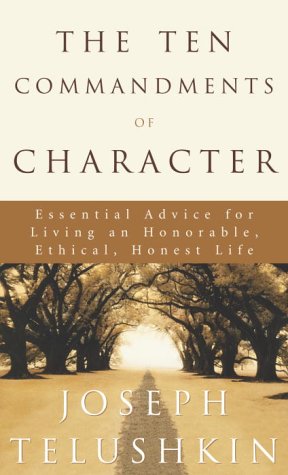
The Ten Commandments of Character: Essential Advice for Living an Honorable, Ethical, Honest Life - Hardcover
Inhaltsangabe
A companion volume to The Book of Jewish Values outlines ten important commandments of character--ranging from being kind and showing gratitude to exercising self-control--that can be used to make the ethical choice in issues regarding marriage and family, friendship, community, work, financial affairs, and more. 30,000 first printing.
Die Inhaltsangabe kann sich auf eine andere Ausgabe dieses Titels beziehen.
Über die Autorin bzw. den Autor
RABBI JOSEPH TELUSHKIN, spiritual leader and scholar, is the acclaimed author of nine other nonfiction books, including <b>The Book of Jewish Values, The Golden Land: The Story of Jewish Immigration to America</b>, and <b>Jewish Literacy</b>, the most widely read book on Judaism of the past two decades. He is a senior associate of CLAL, the National Jewish Center for Learning and Leadership, serves on the board of the Jewish Book Council, and is the rabbi of the Los Angeles–based Synagogue for the Performing Arts. He lives with his family in New York City and lectures regularly throughout the United States.
Aus dem Klappentext
Here is a wealth of astute and warmhearted counsel on many of life’s most difficult ethical dilemmas. Joseph Telushkin outlines his ten commandments of character, explaining why each one is so vital, and then addresses perplexing issues that can and often do crop up in our lives relating to family, friends, work, community, medical ethics, and money, such as:<br><br>• How honest should you be when you are asked to give a reference?<br>• How much assistance should you give your son with his college application essay?<br>• Is it wrong to receive a kidney from an executed prisoner in China?<br>• What should you do if your father begs you to end his life rather than allow him to descend into the hell of Alzheimer’s?<br>• Should a brother give up part of his inheritance if his sister has children and considerable expenses and he doesn’t?<br>• Should a dying woman reveal to her husband that their son is not really his?<br><br>Many of us are finding it increasingly hard to tread the fine line between right and wrong. In <b>The Ten Commandments of Character</b>, Telushkin faces these issues squarely and shows us how to live a life of true integrity.<br><br>“At a time when so many people are looking for moral guidance, we are lucky to have Joseph Telushkin as our guide and teacher. I am thoroughly impressed by his wisdom and good sense.”―Rabbi Harold Kushner, author of <b>When Bad Things Happen to Good People</b>
Auszug. © Genehmigter Nachdruck. Alle Rechte vorbehalten.
Family
Dear Joseph,
My boyfriend is a Catholic, and I am a Buddhist. To me, this is absolutely no problem. Recently, however, he told me that we cannot get married unless I get baptized. I am more than willing to do so, but isn't that hypocritical? The more I think about this, the more I wonder: What sort of religion is it that decrees that two people who love each other so much should not be allowed to marry based on their feelings? I could really use some guidance.
Annoyed
Dear Annoyed,
There are many considerations that people make in deciding whether they want to marry someone. For example, a man might think that a woman is the best friend he's ever had, a wonderful person, and potentially a great mother, but conclude that he's not sufficiently attracted to her to marry her. Is such a decision immoral or hypocritical? I don't think so, even thought the woman might be a lovely person.
For your boyfriend, to share a religious faith with his wife seems to be as critical as being sexually attracted to her, and I therefore don't see his demand as necessarily hypocritical. But I find it disturbing that he focuses purely on the act of baptism, the implication being that you should go through a mechanical act in which you don't believe. It would make more sense if he asked you to study Catholicism, then decide whether or not you want to convert.
If you choose not to, then it's a good thing he made you aware now of how much this issue matters to him. And if you choose to end the relationship, it probably would be wise for your boyfriend to date only Catholic women in the future rather than to go out with women to whom he is attracted and then spring this demand on them. (To be fair to him, it is possible that he might not have realized, until your relationship had progressed this far, how important his Catholic faith was to him.)
Dear Joseph,
I'm a Jewish woman married to a Christian man. When we met eight years ago, it became clear that I was not going to convert to Christianity, and he had no intention of becoming a Jew. His religion matters to him a great deal, as mine does to me. He did agree, however, that our children would be raised as Jews. With that understanding in mind, I happily agreed to marry him. Now, we have three children. The oldest, a girl, turned six, and I brought her to register at the Hebrew school of a local synagogue. My husband became very upset and told me that what I was doing was destroying him; he feels, he said, like an outsider in his own home. In other words, he wants to go back on our agreement and not have us favor either religion. "When they grow up, they'll choose" is his new attitude. Now I'm the one who's very upset. Shouldn't he be bound by what he told me before we married? I feel cheated and . . .
Betrayed
Dear Betrayed,
I suspect that intermarriages are most apt to succeed when a noncommitted Christian marries a noncommitted Jew. In such a case, because religion is not particularly important to either parent, it is unlikely to become a source of conflict and distress; whatever religion or nonreligion their children choose won't usually be emotionally disturbing to the couple.
A second type of intermarriage that has a better-than-average chance of succeeding is when one of the partners is committed to his/her religion, and the other is not religious. Thus, a noncommitted Jew or Christian might not be upset to see his or her child raised in another religion, since that person has little, if any, connection to the religion in which he or she was reared.
But your situation presents a built-in difficulty. Each of your religious commitments matter to you, and so you're going to care that your children share in a tradition that you find meaningful. That your husband agreed, prior to your marriage, to raise your children as Jews only suggests to me that he probably didn't think through how important having children would be to him, and how vital it would be for them to share holidays, faith, and church with him. When he made the agreement, he loved you and wanted to satisfy your need. Now, eight years later, he finds that the agreement is too painful, and that it runs the risk of making him feel alienated from his children.
Do you have the right to insist that he abide by what he said? I suppose so, but if you do, your marriage may be fraught with increasing tension. As I'm sure you are aware, your children are Jewish (according to Jewish law) since, in Judaism, the religious identity of the mother determines that of the children. But if having your children strongly identify as Jews is important to you, then following your husband's suggestion will be upsetting for you, since it is likely to lead to your children becoming Christian. It has been repeatedly noted that if there is no preference expressed in the household for one religion, when children mature, they tend to follow the religion more dominant in their society. If you and your children lived in Israel, your children would most probably opt to identify as Jews; in the United States, as Christians. Except, perhaps, if they have a stronger sense of identification with the parent who belongs to the minority religion. But do you really want to try and create a situation where your children love and identify with you more than with your husband, and therefore choose Judaism?
In short, I know of no good solution to your dilemma other than to note that when people with different and strongly held religious commitments marry and have a family, they often add an unresolvable tension to their marriage.
Dear Joseph,
I'm a twenty-two-year-old woman dating a man who is five years older than me. He works in money management and is very successful. He's generous and showers me with gifts. He also listens carefully and seems to take me seriously. But he has one trait that annoys me: He's not nice to service people, such as waiters, taxi drivers, or doormen. For example, when he orders in a restaurant, his tone is very demanding, and he doesn't say "please" or "thank you." I challenged him on it once, and he said that you don't have to say "please" and "thank you" when a person's just doing his job. My mother and a few of my friends think I'm exaggerating the significance of this, but this behavior concerns me.
Worried in Brooklyn
Dear Worried in Brooklyn,
It should concern you. There's a good chance that if you marry this man--three years from now; five, if you're lucky--you'll find out that when you do what he expects his wife to do, like beautifully decorating your home or preparing an excellent dinner, you won't be entitled to a thank-you, either. Years ago, my friend Dennis Prager started advising listeners to his talk show thus: "When you go out on a date, it's more important to see how your date treats the waitress than how he [or she] treats you. Since it's important at a relationship's beginning for your date to make a good impression on you, he will treat you well. But how he treats the waitress will reflect how he's going to treat you once he can take your love for granted."
I believe that the best guideline on what character trait to look for first in a spouse was set down more than three thousand years ago in the Book of Genesis. In chapter 24, Eliezer, Abraham's trusted servant, is dispatched to the town of Nahor to find a wife for Abraham's son, Isaac. When Eliezer arrives, he stops at the town's well just as the local women are coming out to draw water. Eliezer prays for a divine sign by which he can choose the right bride for Isaac: "Let the maiden to whom I say, 'Please, lower your jar that I may drink,' and who replies, 'Drink, and I will also water your camels,' let her be the one whom You have decreed for Your...
„Über diesen Titel“ kann sich auf eine andere Ausgabe dieses Titels beziehen.
Suchergebnisse für The Ten Commandments of Character: Essential Advice...

Beispielbild für diese ISBN
The Ten Commandments of Character: Essential Advice for Living an Honorable, Ethical, Honest Life
Anbieter: World of Books (was SecondSale), Montgomery, IL, USA
Verkäuferbewertung 5 von 5 Sternen

Zustand: Very Good. Item in very good condition! Textbooks may not include supplemental items i.e. CDs, access codes etc. Artikel-Nr. 00100522159
Gebraucht kaufen
EUR 4,61
Versand gratis
Versand innerhalb von USA
Versand innerhalb von USA
Anzahl: 2 verfügbar
Beispielbild für diese ISBN
The Ten Commandments of Character: Essential Advice for Living an Honorable, Ethical, Honest Life
Anbieter: World of Books (was SecondSale), Montgomery, IL, USA
Verkäuferbewertung 5 von 5 Sternen
Zustand: Good. Item in good condition. Textbooks may not include supplemental items i.e. CDs, access codes etc. Artikel-Nr. 00094471706
Gebraucht kaufen
EUR 4,61
Versand gratis
Versand innerhalb von USA
Versand innerhalb von USA
Anzahl: 3 verfügbar
Beispielbild für diese ISBN
The Ten Commandments of Character: Essential Advice for Living an Honorable, Ethical, Honest Life
Verlag:
Harmony/Bell Tower (edition 1), 2003
ISBN 10: 1400045096
ISBN 13: 9781400045099
Gebraucht
Hardcover
Anbieter: BooksRun, Philadelphia, PA, USA
Verkäuferbewertung 5 von 5 Sternen
Hardcover. Zustand: Very Good. 1. With dust jacket. It's a well-cared-for item that has seen limited use. The item may show minor signs of wear. All the text is legible, with all pages included. It may have slight markings and/or highlighting. Artikel-Nr. 1400045096-11-1-29
Gebraucht kaufen
EUR 4,90
Versand gratis
Versand innerhalb von USA
Versand innerhalb von USA
Anzahl: 1 verfügbar
Beispielbild für diese ISBN
The Ten Commandments of Character : Essential Advice for Living an Honorable, Ethical, Honest Life
Verlag:
Crown Publishing Group, The, 2003
ISBN 10: 1400045096
ISBN 13: 9781400045099
Gebraucht
Hardcover
Erstausgabe
Anbieter: Better World Books, Mishawaka, IN, USA
Verkäuferbewertung 5 von 5 Sternen
Zustand: Very Good. 1st Edition. Former library copy. Pages intact with possible writing/highlighting. Binding strong with minor wear. Dust jackets/supplements may not be included. Includes library markings. Stock photo provided. Product includes identifying sticker. Better World Books: Buy Books. Do Good. Artikel-Nr. 10332611-6
Gebraucht kaufen
EUR 6,25
Versand gratis
Versand innerhalb von USA
Versand innerhalb von USA
Anzahl: 2 verfügbar
Beispielbild für diese ISBN
The Ten Commandments of Character : Essential Advice for Living an Honorable, Ethical, Honest Life
Verlag:
Crown Publishing Group, The, 2003
ISBN 10: 1400045096
ISBN 13: 9781400045099
Gebraucht
Hardcover
Erstausgabe
Anbieter: Better World Books, Mishawaka, IN, USA
Verkäuferbewertung 5 von 5 Sternen
Zustand: Fine. 1st Edition. Used book that is in almost brand-new condition. May contain a remainder mark. Better World Books: Buy Books. Do Good. Artikel-Nr. 15903054-6
Gebraucht kaufen
EUR 6,25
Versand gratis
Versand innerhalb von USA
Versand innerhalb von USA
Anzahl: 1 verfügbar
Beispielbild für diese ISBN
The Ten Commandments of Character: Essential Advice for Living an Honorable, Ethical, Honest Life
Anbieter: Wonder Book, Frederick, MD, USA
Verkäuferbewertung 5 von 5 Sternen
Zustand: Good. Good condition. Very Good dust jacket. A copy that has been read but remains intact. May contain markings such as bookplates, stamps, limited notes and highlighting, or a few light stains. Bundled media such as CDs, DVDs, floppy disks or access codes may not be included. Artikel-Nr. R06O-01823
Gebraucht kaufen
EUR 6,32
Versand gratis
Versand innerhalb von USA
Versand innerhalb von USA
Anzahl: 1 verfügbar
Beispielbild für diese ISBN
The Ten Commandments of Character: Essential Advice for Living an Honorable, Ethical, Honest Life
Anbieter: Wonder Book, Frederick, MD, USA
Verkäuferbewertung 5 von 5 Sternen
Zustand: Very Good. Very Good condition. Good dust jacket. A copy that may have a few cosmetic defects. May also contain light spine creasing or a few markings such as an owner's name, short gifter's inscription or light stamp. Artikel-Nr. U14B-05281
Gebraucht kaufen
EUR 6,32
Versand gratis
Versand innerhalb von USA
Versand innerhalb von USA
Anzahl: 1 verfügbar
Beispielbild für diese ISBN
The Ten Commandments of Character: Essential Advice for Living an Honorable, Ethical, Honest Life
Anbieter: ThriftBooks-Reno, Reno, NV, USA
Verkäuferbewertung 5 von 5 Sternen
Hardcover. Zustand: Very Good. No Jacket. Former library book; May have limited writing in cover pages. Pages are unmarked. ~ ThriftBooks: Read More, Spend Less. Artikel-Nr. G1400045096I4N10
Gebraucht kaufen
EUR 6,46
Versand gratis
Versand innerhalb von USA
Versand innerhalb von USA
Anzahl: 1 verfügbar
Beispielbild für diese ISBN
The Ten Commandments of Character: Essential Advice for Living an Honorable, Ethical, Honest Life
Anbieter: ThriftBooks-Atlanta, AUSTELL, GA, USA
Verkäuferbewertung 5 von 5 Sternen
Hardcover. Zustand: Very Good. No Jacket. Former library book; May have limited writing in cover pages. Pages are unmarked. ~ ThriftBooks: Read More, Spend Less. Artikel-Nr. G1400045096I4N10
Gebraucht kaufen
EUR 6,49
Versand gratis
Versand innerhalb von USA
Versand innerhalb von USA
Anzahl: 1 verfügbar
Beispielbild für diese ISBN
The Ten Commandments of Character: Essential Advice for Living an Honorable, Ethical, Honest Life
Anbieter: ThriftBooks-Dallas, Dallas, TX, USA
Verkäuferbewertung 5 von 5 Sternen
Hardcover. Zustand: Very Good. No Jacket. May have limited writing in cover pages. Pages are unmarked. ~ ThriftBooks: Read More, Spend Less. Artikel-Nr. G1400045096I4N00
Gebraucht kaufen
EUR 6,49
Versand gratis
Versand innerhalb von USA
Versand innerhalb von USA
Anzahl: 1 verfügbar