
Verwandte Artikel zu The Magic Mountain
Inhaltsangabe
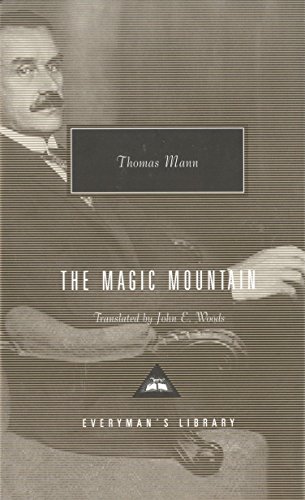
A monumental work of erudition and irony, sexual tension and intellectual ferment, The Magic Mountain is an enduring classic • Acclaimed translator John E. Woods has given us the definitive English version of Mann’s masterpiece, presented here in a stunning hardcover edition.
With this dizzyingly rich novel of ideas, Thomas Mann rose to the front ranks of the great modern novelists, winning the Nobel Prize in Literature in 1929. The Magic Mountain takes place in an exclusive tuberculosis sanatorium in the Swiss Alps—a community devoted to sickness that serves as a fictional microcosm for Europe in the days before the First World War.
To this hermetic and otherworldly realm comes Hans Castorp, an “ordinary young man” who arrives for a short visit and ends up staying for seven years, during which he succumbs both to the lure of eros and to the intoxication of ideas.
Everyman's Library pursues the highest production standards, printing on acid-free cream-colored paper, with full-cloth cases with two-color foil stamping, decorative endpapers, silk ribbon markers, European-style half-round spines, and a full-color illustrated jacket. Contemporary Classics include an introduction, a select bibliography, and a chronology of the author's life and times.
Die Inhaltsangabe kann sich auf eine andere Ausgabe dieses Titels beziehen.
Über die Autorin bzw. den Autor
Thomas Mann was born in 1875 in Germany. He was only twenty-five when his first novel, Buddenbrooks, was published. In 1924 The Magic Mountain was published, and, five years later, Mann was awarded the Nobel Prize for Literature. Following the rise of the Nazis to power, he left Germany for good in 1933 to live in Switzerland and then in California, where he wrote Doctor Faustus (first published in the United States in 1948). He died in 1955.
Auszug. © Genehmigter Nachdruck. Alle Rechte vorbehalten.
Introduction
In 1912 Thomas Mann’s wife, Katja, stayed in Dr Friedrich Jessen’s ‘Waldsanatorium’ from March to September, suffering from a lung complaint. Mann himself visited her for four weeks in May and June. During that time, he said, he suffered a troublesome catarrh of the upper air passages, owing to the damp, cold atmosphere on the balcony. The consultant diagnosed a ‘moist spot’ of tubercular infection, just as Dr Behrens in the novel diagnoses Hans Castorp. Mann, however, did not stay in the magic mountain, but hastened back to Flatland and Munich, where his own doctor advised him to pay no attention. There is an ironic twist to this story which would have amused the novelist — Katja, it appears was misdiagnosed, whereas Mann himself, in his post-mortem, was indeed seen to bear the marks of an earlier tubercular illness.
This is the biographical germ of the novel. Its intellectual germ is related to Mann’s great novella, Death in Venice. Death in Venice was a classically constructed tragedy of the fall of a great artist and intellectual. The Magic Mountain was to be the satyr play that accompanied the tragedy — the comic and parodic tale of a jeune homme moyen sensuel, caught up in the dance of death, amongst the macabre crew of the sanatorium. Both tales represented the fate of someone out of context, on a holiday visit, encountering love, sickness and death with a peculiarly German mixture of fascination and resignation.
Work on the novella was interrupted by the First World War. Mann spent the war years writing passionately in support of the German cause. His ‘Thoughts in War’, his praise of Frederick the Great as a man of action, his Reflections of an Unpolitical Man, are definitions of the German genius which, he asserts, is concerned with Nature, not Mind, with Culture as opposed to Civilization, with military organization and soldierly virtues. Culture is
compatible with all kinds of horrors — oracles, magic, pederasty, human sacrifice, orgiastic cults, inquisition, witch-trials etc. — by which civilization would be repelled; for civilization is Reason, Enlightenment, moderation, manners, scepticism, disintegration — Mind (Geist).*
*T. J. Reed, Thomas Mann: The Uses of Tradition.
Culture is German. Civilization is predominantly French. Mann opposes Frederick the Great and Voltaire as archetypes of the opposition. Voltaire is a man of thought; Frederick, a greater hero, is a man of action. What Mann was arguing was very much what most German artists and writers were arguing — the ‘decadent’ took strength from a sudden nationalist identification. There was, also, a personal battle furiously pursued through the battle of ideas. Thomas Mann’s brother, Heinrich, was against the war, and in favour of socialism, civilization and reason. In November 1915 Heinrich Mann published an essay on Zola, praising Zola’s defence of Dreyfus, praising Zola as a civilized ‘intellectual’, castigating those in France (and by implication those in Germany) who compromised themselves by supporting unjust rulers and warmongers. There is a sense in which the wartime attitudes of the brothers mirror the conflict between the civilized Settembrini and the spiritual nihilist Naphta, in the novel as we read it. And in Thomas Mann’s Unpolitical Reflections (published in October 1918) he makes a direct attack on his brother, in the figure of the Zivilisationsliterat, who claims that he sides with Life, Reason, Progress, and is against death and decay. He quotes the author of ‘that lyrical-political poem which has Emile Zola as its hero’ as saying he himself has ‘the gift of life . . . the deepest sympathy with life’. Mann the ironist observes that ‘the problem of what ‘‘health’’ is, is not a simple problem’.
In August 1915 Mann wrote to Paul Amann:
Before the war I had begun a longish tale, set in a lung-disease sanatorium — a story with basic pedagogic-political intentions, in which a young man has to come to terms with the most seductive power, death, and is led in a comic-horrid manner through the spiritual oppositions of Humanism and Romanticism, Progress and Reaction, Health and Sickness, but more for the sake of finding his way and acquiring knowledge than for the sake of making decisions.
The spirit of the whole thing is humorous-nihilistic, and on the whole the story inclines towards sympathy with death. It is called The Magic Mountain and has a touch of the dwarf Nase for whom seven years passed like seven days, and the ending, the resolution — I can see no alternative to the outbreak of war.
In March 1917 Mann wrote again to Amman about the novel, this time describing the opposed figures of a ‘disciple of work and progress, a disciple of Carducci’ and a ‘doubting, brilliantly clever reactionary’, and qualifying his hero’s sympathy with death as ‘unvirtuous’. He has to write his unpolitical reflections, he claims, to avoid overloading the novel with ideas.
When the thousand-page novel was finally published in November 1924, Mann was reconciled with his brother after a bitter rift, and his attitudes to German culture and the justification of war had changed. The Magic Mountain itself was now a large and complicated work of art, working as a mixture of Dantesque allegory and modern European realism, of German mythic culture and intellectual debate, of Bildungsroman and farce.
The magic mountain itself is a myth and a symbol with multiple meanings and charms. The German magic mountain is the Brocken, up whose dangerous paths Goethe’s Mephistopheles leads the delinquent Faust, to join in the lawless and phantasmagoric delights of the Witches’ Sabbath, or Walpurgisnacht. In the Walpurgisnacht chapter of the novel Settembrini quotes Faust (as he often does):
Allein bedenkt! Der Berg ist heute zaubertoll,
Und wenn ein Irrlicht Euch die Wege weisen soll,
So mu¨ sst Ihr’s so genau nicht nehmen.
But bear in mind the mountain’s mad with spells tonight
And should a will-o’-the-wisp decide your way to light,
Beware — its lead may prove deceptive.
The Walpurgisnacht of the novel is Shrove Tuesday — the Munich ‘Fasching’ or licentious carnival feast of disorder. Mann marks the curiously timeless passing of time in the magic mountain with feast days like Midsummer, as well as fleeting seasonal weather. The hectic patients become phantasms and apparitions — Behrens, the superintendant is compared by Settembrini to Goethe’s leading warlock, Herr Urian.
But there are other, equally powerful magic mountains. There is the Venusberg of Wagner’s Tannha¨}user, in which the Thuringian Wartburg becomes the secret dwelling of Venus, who entices young knights into its depths, and surrounds them with sensuous delights, amongst nymphs and sirens. This Venus is a descendant of an ancient German goddess Holda, originally the white lady of spring, a figure not unlike the fairy queen who in British fairy story lures True Thomas into the hillside, where, also, seven years appear to be only one day. The dwarf, Nase (Nose), of Mann’s letter to Amann is also a fairy-tale figure, in a Romantic tale by Wilhelm Hauff — a little boy imprisoned by an enchantress and transformed into a dwarf — for whom also time passes at seven years in a day. The mysterious Clavdia Chauchat, and Castorp’s increasing erotic obsession with her, are part of these Venus-dreams, which shrivel...
„Über diesen Titel“ kann sich auf eine andere Ausgabe dieses Titels beziehen.
Suchergebnisse für The Magic Mountain

Beispielbild für diese ISBN
The Magic Mountain (Everyman's Library)
Anbieter: Books From California, Simi Valley, CA, USA
Verkäuferbewertung 4 von 5 Sternen

Hardcover. Zustand: Very Good. Artikel-Nr. mon0004252132
Gebraucht kaufen
EUR 13,69
EUR 4,39 Versand
Versand innerhalb von USA
Versand innerhalb von USA
Anzahl: 1 verfügbar
Beispielbild für diese ISBN
The Magic Mountain (Everyman's Library)
Verlag:
Everyman's Library (edition ), 2005
ISBN 10: 1400044219
ISBN 13: 9781400044214
Gebraucht
Hardcover
Anbieter: BooksRun, Philadelphia, PA, USA
Verkäuferbewertung 5 von 5 Sternen

Hardcover. Zustand: Very Good. With dust jacket. It's a well-cared-for item that has seen limited use. The item may show minor signs of wear. All the text is legible, with all pages included. It may have slight markings and/or highlighting. Artikel-Nr. 1400044219-11-1-29
Gebraucht kaufen
EUR 20,22
Versand gratis
Versand innerhalb von USA
Versand innerhalb von USA
Anzahl: 1 verfügbar
Beispielbild für diese ISBN
The Magic Mountain : Introduction by A. S. Byatt
Verlag:
Knopf Doubleday Publishing Group, 2005
ISBN 10: 1400044219
ISBN 13: 9781400044214
Gebraucht
Hardcover
Anbieter: Better World Books, Mishawaka, IN, USA
Verkäuferbewertung 5 von 5 Sternen
Zustand: Good. Former library copy. Pages intact with minimal writing/highlighting. The binding may be loose and creased. Dust jackets/supplements are not included. Includes library markings. Stock photo provided. Product includes identifying sticker. Better World Books: Buy Books. Do Good. Artikel-Nr. 4089145-6
Gebraucht kaufen
EUR 26,85
Versand gratis
Versand innerhalb von USA
Versand innerhalb von USA
Anzahl: 1 verfügbar
Beispielbild für diese ISBN
The Magic Mountain: Introduction by A. S. Byatt
Anbieter: Kennys Bookstore, Olney, MD, USA
Verkäuferbewertung 5 von 5 Sternen
Zustand: New. 2005. hardcover. . . . . . Books ship from the US and Ireland. Artikel-Nr. V9781400044214
Neu kaufen
EUR 43,71
EUR 9,23 Versand
Versand innerhalb von USA
Versand innerhalb von USA
Anzahl: 1 verfügbar
Beispielbild für diese ISBN
The Magic Mountain: Introduction by A. S. Byatt (Everyman's Library Contemporary Classics)
Anbieter: Majestic Books, Hounslow, Vereinigtes Königreich
Verkäuferbewertung 4 von 5 Sternen
Zustand: New. pp. 904. Artikel-Nr. 6789907
Neu kaufen
EUR 45,62
EUR 7,56 Versand
Versand von Vereinigtes Königreich nach USA
Versand von Vereinigtes Königreich nach USA
Anzahl: 3 verfügbar
Beispielbild für diese ISBN
The Magic Mountain
Anbieter: Revaluation Books, Exeter, Vereinigtes Königreich
Verkäuferbewertung 5 von 5 Sternen
Hardcover. Zustand: Brand New. 904 pages. 8.25x5.25x1.75 inches. In Stock. Artikel-Nr. __1400044219
Neu kaufen
EUR 39,44
EUR 14,53 Versand
Versand von Vereinigtes Königreich nach USA
Versand von Vereinigtes Königreich nach USA
Anzahl: 1 verfügbar
Beispielbild für diese ISBN
The Magic Mountain
Anbieter: Revaluation Books, Exeter, Vereinigtes Königreich
Verkäuferbewertung 5 von 5 Sternen
Hardcover. Zustand: Brand New. 904 pages. 8.25x5.25x1.75 inches. In Stock. Artikel-Nr. xr1400044219
Neu kaufen
EUR 42,67
EUR 14,53 Versand
Versand von Vereinigtes Königreich nach USA
Versand von Vereinigtes Königreich nach USA
Anzahl: 2 verfügbar
Beispielbild für diese ISBN
The Magic Mountain
Anbieter: Revaluation Books, Exeter, Vereinigtes Königreich
Verkäuferbewertung 5 von 5 Sternen
Hardcover. Zustand: Brand New. 904 pages. 8.25x5.25x1.75 inches. In Stock. Artikel-Nr. 1400044219
Neu kaufen
EUR 53,14
EUR 14,53 Versand
Versand von Vereinigtes Königreich nach USA
Versand von Vereinigtes Königreich nach USA
Anzahl: 1 verfügbar
Foto des Verkäufers
The Magic Mountain: Introduction by A. S. Byatt
Anbieter: moluna, Greven, Deutschland
Verkäuferbewertung 5 von 5 Sternen
Gebunden. Zustand: New. Über den AutorThomas Mann was born in 1875 in Germany. He was only twenty-five when his first novel, Buddenbrooks, was published. In 1924 The Magic Mountain was published, and, five years later, Mann was awarded the No. Artikel-Nr. 902379456
Neu kaufen
EUR 34,64
EUR 48,99 Versand
Versand von Deutschland nach USA
Versand von Deutschland nach USA
Anzahl: Mehr als 20 verfügbar