
Verwandte Artikel zu Lion of Jordan: The Life of King Hussein in War and...
Inhaltsangabe
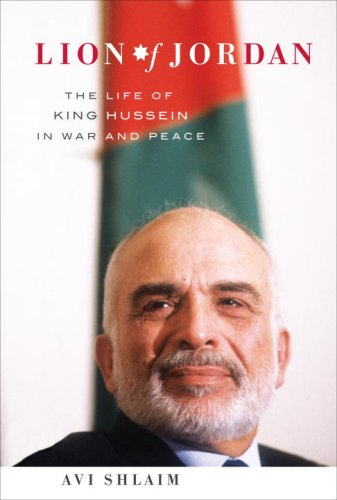
During his long reign (1953–1999), King Hussein of Jordan was one of the most dominant figures in Middle Eastern politics and a consistent proponent of peace with Israel. This is the first major account of his life, written with access to his official documents and with the cooperation (but not approval) of his family and staff, and also extensive interviews with international policy makers.
For more than forty years, Hussein walked a tightrope between the Palestinians and Arab radicals on the one hand and Israel on the other. Avi Shlaim reveals that, for the sake of dynastic and national survival, Hussein initiated a secret dialogue with Israel in 1963 that encompassed more than one thousand hours with Golda Meir, Shimon Peres, Yitzhak Shamir, Yitzhak Rabin, and countless others. Shlaim reconstructs this dialogue across battle lines from previously untapped Israeli records and the firsthand accounts of key participants, and makes clear that it was Israeli intransigence that was largely responsible for the failure to achieve a peaceful settlement between 1967 and 1994.
At Hussein’s memorial service at St. Paul’s Cathedral, the Prince of Wales hailed him as “a man amongst men, a king amongst kings.” Lion of Jordan illuminates the triumphs and disappointments, the qualities and character of this extraordinary soldier and statesman, and significantly rewrites the history of the Middle East over the past fifty years.
Die Inhaltsangabe kann sich auf eine andere Ausgabe dieses Titels beziehen.
Über die Autorin bzw. den Autor
Avi Shlaim was born in Baghdad in 1945, grew up in Israel, and studied at Cambridge University and the London School of Economics. He is a Fellow of St. Anthony's College and a professor of international relations at the University of Oxford. He was elected a Fellow of the British Academy in 2006. His books include Collusion Across the Jordan: King Abdullah, the Zionist Movement, and the Partition of Palestine (winner of the Political Studies Association’s 1988 WJM Mackenzie Prize); The Politics of Partition; War and Peace in the Middle East: A Concise History; and The Iron Wall: Israel and the Arab World. He lives in Oxford.
Auszug. © Genehmigter Nachdruck. Alle Rechte vorbehalten.
1. The Hashemite Heritage
King Hussein of Jordan was a man of slight build who possessed a powerful personality and immense political stature. He was in every respect except the physical a towering figure whose courage helped to earn him the popular title "Lion of Jordan." Hussein bin Talal was born on 14 November 1935 in Amman. He ruled over Jordan as an absolute monarch from 1953, when he was only seventeen years old, until his death in 1999 at the age of sixty-three. Throughout his long reign Jordan was in the eye of the storm of Middle Eastern politics, constantly caught up in the turmoil and violence of the region, and Hussein himself emerged as a major player in regional and international politics. He was also a leading actor in the Arab-Israeli conflict, one of the most bitter, protracted and intractable of modern times. Hussein's cardinal objective was the stability and survival of the Hashemite monarchy in Jordan, and in this he was successful against all the odds. His other major objective was to find a peaceful solution to the Arab-Israeli conflict, but in this his record is much more controversial. Hussein's supporters see him as a man who consistently pursued a strategy of peace and ultimately succeeded in bridging the historic gulf by concluding a peace treaty with Israel. His critics take a radically different view of his legacy of accommodation with Israel, seeing it as a surrender and a betrayal of the Palestinians. In a region where the past is so powerful and ever-present, the question of whether Jordan's rulers have betrayed or championed the Palestinians has been at the heart of a heated, ongoing dispute. It is one of the tasks of this book to explore the realities behind these two positions thoroughly for the first time.
Whatever opinion one takes of Hussein, the starting point for understanding his foreign policy is the Hashemite legacy. The Hashemites are an aristocratic Arab family whose ancestral home was in the Hijaz in the western part of the Arabian Peninsula, along the Red Sea littoral. They are descendants of the prophet Muhammad through his daughter Fatima, whose husband Ali was fourth of the caliphs. The family took its name from Hashem, the great-grandfather of the prophet and a prominent member of the Kureish tribe. The Hashemites were religious, rather than temporal, leaders, the guardians of the Muslim holy places in Mecca and Medina during the centuries of Ottoman rule. The title "sharif of Mecca" passed to the next in line within the family. In Arabic the adjective "sharif" means distinguished, eminent, illustrious or noble, and the title "sharif" is reserved for the descendants of the prophet.
In the early twentieth century, however, the Hashemites sought to translate their noble lineage into political power and gradually assumed the leadership of an Arab nationalist bid for freedom from the Ottoman Empire. The break between the Hashemites and their fellow Muslim overlords in Istanbul began with the Young Turks' Revolution of 1908. The Young Turks were a group of officers, officials and intellectuals who ruled the Ottoman Empire from the time of the revolution until the end of the First World War. The shift they brought about in the ideology of the ramshackle empire from Islam to Turkish nationalism displeased and disturbed the Hashemites. The decision of the Young Turks to join the war on the side of Germany then created an opportunity for a Hashemite alliance with Britain in accordance with the Arab adage "My enemy's enemy is my friend." This dramatic renversement des alliances transformed the Hashemites from Arab aristocracy into actors on the international stage.
Hussein bin Ali (1852-1931) was an unlikely candidate to lead a nationalist Arab revolt against Ottoman rule. He was fifty-five by the time he was appointed sharif of Mecca in 1908. His main concern was to secure his own position and that of his family, and he was robust in resisting Ottoman attempts to encroach on their traditional authority. There is no evidence to suggest that he was attracted to the ideas of Arab nationalism before the war: on the contrary, by temperament and upbringing he was a conservative and inclined to view nationalist ideology as an unwelcome innovation, inconsistent with the principles of Islam. Nor was the Hijaz a particularly fertile ground for the growth of nationalism. A traditional society, bound by religious and tribal identities, it was short on the kind of intellectuals and radical army officers who are normally to be found in the vanguard of nationalist movements.
Hussein bin Ali had four sons: Ali, Abdullah, Faisal and Zaid. The two middle sons were more politically ambitious than the other two and they played a major part in persuading their father to assume the leadership of the Arab Revolt. Faisal was the principal commander of the Arab Army, and his association with the legendary T. E. Lawrence ("Lawrence of Arabia") helped to spread his fame beyond Arabia. Abdullah, however, was the chief architect, planner, schemer and driving force behind the revolt. As Faisal himself confided to Lawrence, his liaison officer and the most renowned chronicler of "the revolt in the desert," the idea of an Arab uprising against the Turks was first conceived by Abdullah. As a small boy Abdullah had acquired the nickname "Ajlan"-"the hurried one"-and he remained true to this name for the rest of his life.
A profound faith that the Hashemites were destined to rule over the entire Arab world inspired Abdullah throughout a long and eventful political career that started in the Hijaz and later saw him amir of Transjordan and finally king of Jordan. Born in Mecca in 1880, Abdullah received his education and his military training in Istanbul and in the Hijaz. Between 1912 and 1914 he was the deputy for Mecca in the Ottoman parliament, where he promoted his father's interests with energy and enthusiasm. It was during this period that Abdullah was exposed to ideas of Arab nationalism and began to link his father's desire for autonomy in the Hijaz to the broader and more radical ideas of Arab emancipation from Ottoman rule. In February 1914 Abdullah returned to Mecca by way of Cairo, where he met Lord Kitchener, the British minister plenipotentiary, and tentatively explored the possibility of support in the event of an uprising against the Ottomans. Soon after his return home, Abdullah became his father's political adviser and foreign minister.
It was only gradually, and under constant prodding from Abdullah, that the conservative sharif of Mecca raised his sights from the idea of home rule in his corner of Arabia inside the Ottoman Empire to complete independence for all its Arab provinces from Yemen to Syria. While Abdullah became convinced of the necessity to break up the empire at the beginning of 1914, Hussein would become a separatist only after he had tried and failed to attain his limited political objectives within the framework of the Ottoman Empire. A further difference, one of ideology, separated father from son: Hussein's idea of nationalism was based on the traditional concept of tribal and family unity whereas Abdullah's was based on the theory of Arab pre-eminence among Muslims. Whatever the source of their aspirations or their ultimate aims, the indigent rulers of the Hijaz province had to have the backing of a great power to have any chance of success in mounting an open rebellion against the mighty Ottoman Empire. That power could only be the British Empire, which had its own designs on Arabia. This posed a problem. The guardian of the Muslim holy places in Mecca could not easily bring himself to embrace a Christian power in his struggle against fellow Muslims. Divided counsels within his own family did nothing to ease his predicament....
„Über diesen Titel“ kann sich auf eine andere Ausgabe dieses Titels beziehen.
Suchergebnisse für Lion of Jordan: The Life of King Hussein in War and...

Beispielbild für diese ISBN
Lion of Jordan The Life of Kin
Anbieter: World of Books (was SecondSale), Montgomery, IL, USA
Verkäuferbewertung 5 von 5 Sternen

Zustand: Good. Item in good condition. Textbooks may not include supplemental items i.e. CDs, access codes etc. Artikel-Nr. 00105709877
Gebraucht kaufen
EUR 3,15
Versand gratis
Versand innerhalb von USA
Versand innerhalb von USA
Anzahl: 5 verfügbar
Beispielbild für diese ISBN
Lion of Jordan: The Life of King Hussein in War and Peace
Anbieter: ThriftBooks-Dallas, Dallas, TX, USA
Verkäuferbewertung 5 von 5 Sternen
Hardcover. Zustand: Good. No Jacket. Pages can have notes/highlighting. Spine may show signs of wear. ~ ThriftBooks: Read More, Spend Less. Artikel-Nr. G1400043050I3N00
Gebraucht kaufen
EUR 6,32
Versand gratis
Versand innerhalb von USA
Versand innerhalb von USA
Anzahl: 1 verfügbar
Beispielbild für diese ISBN
Lion of Jordan: The Life of King Hussein in War and Peace
Anbieter: ThriftBooks-Dallas, Dallas, TX, USA
Verkäuferbewertung 5 von 5 Sternen
Hardcover. Zustand: Fair. No Jacket. Missing dust jacket; Readable copy. Pages may have considerable notes/highlighting. ~ ThriftBooks: Read More, Spend Less. Artikel-Nr. G1400043050I5N01
Gebraucht kaufen
EUR 6,32
Versand gratis
Versand innerhalb von USA
Versand innerhalb von USA
Anzahl: 1 verfügbar
Beispielbild für diese ISBN
Lion of Jordan: The Life of King Hussein in War and Peace
Anbieter: ThriftBooks-Dallas, Dallas, TX, USA
Verkäuferbewertung 5 von 5 Sternen
Hardcover. Zustand: Good. No Jacket. Missing dust jacket; Pages can have notes/highlighting. Spine may show signs of wear. ~ ThriftBooks: Read More, Spend Less. Artikel-Nr. G1400043050I3N01
Gebraucht kaufen
EUR 6,32
Versand gratis
Versand innerhalb von USA
Versand innerhalb von USA
Anzahl: 1 verfügbar
Beispielbild für diese ISBN
Lion of Jordan: The Life of King Hussein in War and Peace
Verlag:
Knopf (edition First Edition), 2008
ISBN 10: 1400043050
ISBN 13: 9781400043057
Gebraucht
Hardcover
Erstausgabe
Anbieter: BooksRun, Philadelphia, PA, USA
Verkäuferbewertung 5 von 5 Sternen
Hardcover. Zustand: Very Good. First Edition. With dust jacket. It's a well-cared-for item that has seen limited use. The item may show minor signs of wear. All the text is legible, with all pages included. It may have slight markings and/or highlighting. Artikel-Nr. 1400043050-11-1-29
Gebraucht kaufen
EUR 6,84
Versand gratis
Versand innerhalb von USA
Versand innerhalb von USA
Anzahl: 1 verfügbar
Beispielbild für diese ISBN
Lion of Jordan : The Life of King Hussein in War and Peace
Verlag:
Knopf Doubleday Publishing Group, 2008
ISBN 10: 1400043050
ISBN 13: 9781400043057
Gebraucht
Hardcover
Anbieter: Better World Books: West, Reno, NV, USA
Verkäuferbewertung 5 von 5 Sternen
Zustand: Very Good. 1st US Edition. Former library copy. Pages intact with possible writing/highlighting. Binding strong with minor wear. Dust jackets/supplements may not be included. Includes library markings. Stock photo provided. Product includes identifying sticker. Better World Books: Buy Books. Do Good. Artikel-Nr. 4262766-75
Gebraucht kaufen
EUR 9,00
Versand gratis
Versand innerhalb von USA
Versand innerhalb von USA
Anzahl: 1 verfügbar
Beispielbild für diese ISBN
Lion of Jordan : The Life of King Hussein in War and Peace
Verlag:
Knopf Doubleday Publishing Group, 2008
ISBN 10: 1400043050
ISBN 13: 9781400043057
Gebraucht
Hardcover
Anbieter: Better World Books, Mishawaka, IN, USA
Verkäuferbewertung 5 von 5 Sternen
Zustand: Very Good. 1st US Edition. Former library copy. Pages intact with possible writing/highlighting. Binding strong with minor wear. Dust jackets/supplements may not be included. Includes library markings. Stock photo provided. Product includes identifying sticker. Better World Books: Buy Books. Do Good. Artikel-Nr. 4262766-75
Gebraucht kaufen
EUR 9,00
Versand gratis
Versand innerhalb von USA
Versand innerhalb von USA
Anzahl: 1 verfügbar
Beispielbild für diese ISBN
Lion of Jordan : The Life of King Hussein in War and Peace
Verlag:
Knopf Doubleday Publishing Group, 2008
ISBN 10: 1400043050
ISBN 13: 9781400043057
Gebraucht
Hardcover
Anbieter: Better World Books, Mishawaka, IN, USA
Verkäuferbewertung 5 von 5 Sternen
Zustand: Good. 1st US Edition. Former library copy. Pages intact with minimal writing/highlighting. The binding may be loose and creased. Dust jackets/supplements are not included. Includes library markings. Stock photo provided. Product includes identifying sticker. Better World Books: Buy Books. Do Good. Artikel-Nr. 2067181-75
Gebraucht kaufen
EUR 9,00
Versand gratis
Versand innerhalb von USA
Versand innerhalb von USA
Anzahl: 1 verfügbar
Beispielbild für diese ISBN
Lion of Jordan : The Life of King Hussein in War and Peace
Verlag:
Knopf Doubleday Publishing Group, 2008
ISBN 10: 1400043050
ISBN 13: 9781400043057
Gebraucht
Hardcover
Anbieter: Better World Books, Mishawaka, IN, USA
Verkäuferbewertung 5 von 5 Sternen
Zustand: Good. 1st US Edition. Pages intact with minimal writing/highlighting. The binding may be loose and creased. Dust jackets/supplements are not included. Stock photo provided. Product includes identifying sticker. Better World Books: Buy Books. Do Good. Artikel-Nr. 5778910-6
Gebraucht kaufen
EUR 9,00
Versand gratis
Versand innerhalb von USA
Versand innerhalb von USA
Anzahl: 2 verfügbar
Beispielbild für diese ISBN
Lion of Jordan: The Life of King Hussein in War and Peace
Anbieter: WorldofBooks, Goring-By-Sea, WS, Vereinigtes Königreich
Verkäuferbewertung 5 von 5 Sternen
Paperback. Zustand: Very Good. The book has been read, but is in excellent condition. Pages are intact and not marred by notes or highlighting. The spine remains undamaged. Artikel-Nr. GOR008683280
Gebraucht kaufen
EUR 26,34
EUR 6,53 Versand
Versand von Vereinigtes Königreich nach USA
Versand von Vereinigtes Königreich nach USA
Anzahl: 1 verfügbar