
Verwandte Artikel zu Stumbling on Happiness (Rough Cut)
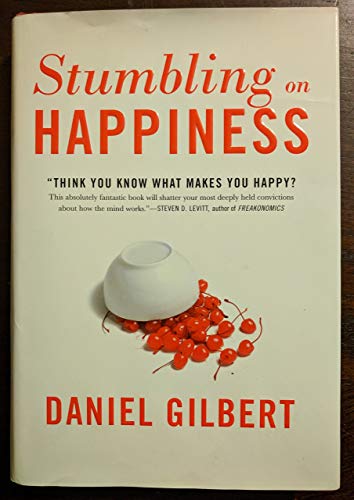
Inhaltsangabe
Why are lovers quicker to forgive their partners for infidelity than for leaving dirty dishes in the sink? Why will sighted people pay more to avoid going blind than blind people will pay to regain their sight? Why do dining companions insist on ordering different meals instead of getting what they really want? Why do patients remember long medical procedures as being less painful than short ones? Why do home sellers demand prices they wouldn’t dream of paying if they were home buyers? Why are shoppers happier when they can’t get refunds? Why do pigeons seem to have such excellent aim; why can’t we remember one song while listening to another; and why does the line at the grocery store always slow down the moment we join it?
In this brilliant, witty, and accessible book, renowned Harvard psychologist Daniel Gilbert describes the foibles of imagination and illusions of foresight that cause each of us to misconceive our tomorrows and misestimate our satisfactions. Vividly bringing to life the latest scientific research in psychology, cognitive neuroscience, philosophy, and behavioral economics, Gilbert reveals what scientists have discovered about the uniquely human ability to imagine the future, and about our capacity to predict how much we will like it when we get there. With penetrating insight and sparkling prose, Gilbert explains why we seem to know so little about the hearts and minds of the people we are about to become.
Die Inhaltsangabe kann sich auf eine andere Ausgabe dieses Titels beziehen.
Über die Autorin bzw. den Autor
Daniel Gilbert is the Harvard College Professor of Psychology at Harvard University. He has won numerous awards for his teaching and research, and his scientific research has been covered by The New York Times Magazine, Forbes, Money, CNN, U.S. News & World Report, The New Yorker, Scientific American, Science, O: The Oprah Magazine, Psychology Today and others. He lives in Cambridge, Massachusetts.
Auszug. © Genehmigter Nachdruck. Alle Rechte vorbehalten.
Journey to Elsewhen
O, that a man might know The end of this day’s business ere it come! Shakespeare, Julius Caesar Priests vow to remain celibate, physicians vow to do no harm, and letter carriers vow to swiftly complete their appointed rounds despite snow, sleet, and split infinitives. Few people realize that psychologists also take a vow, promising that at some point in their professional lives they will publish a book, a chapter, or at least an article that contains this sentence: “The human being is the only animal that . . .” We are allowed to finish the sentence any way we like, of course, but it has to start with those eight words. Most of us wait until relatively late in our careers to fulfill this solemn obligation because we know that successive generations of psychologists will ignore all the other words that we managed to pack into a lifetime of well-intentioned scholarship and remem- ber us mainly for how we finished The Sentence. We also know that the worse we do, the better we will be remembered. For instance, those psychologists who finished The Sentence with “can use language” were particularly well remembered when chimpanzees were taught to communicate with hand signs. And when researchers discovered that chimps in the wild use sticks to extract tasty ter- mites from their mounds (and to bash one another over the head now and then), the world suddenly remembered the full name and mailing address of every psychologist who had ever finished The Sentence with “uses tools.” So it is for good reason that most psychologists put off completing The Sentence for as long as they can, hoping that if they wait long enough, they just might die in time to avoid being publicly humiliated by a monkey.
I have never before written The Sentence, but I’d like to do so now, with you as my witness. The human being is the only animal that thinks about the future. Now, let me say up front that I’ve had cats, I’ve had dogs, I’ve had gerbils, mice, goldfish, and crabs (no, not that kind), and I do recognize that nonhuman animals often act as though they have the capacity to think about the future. But as bald men with cheap hairpieces always seem to forget, act- ing as though you have something and actually having it are not the same thing, and anyone who looks closely can tell the difference. For example, I live in an urban neighborhood, and every autumn the squirrels in my yard (which is approximately the size of two squirrels) act as though they know that they will be unable to eat later unless they bury some food now. My city has a relatively well-educated citizenry, but as far as anyone can tell its squirrels are not particularly distinguished. Rather, they have regular squirrel brains that run food-burying programs when the amount of sun- light that enters their regular squirrel eyes decreases by a critical amount. Shortened days trigger burying behavior with no intervening contemplation of tomorrow, and the squirrel that stashes a nut in my yard “knows” about the future in approximately the same way that a falling rock “knows” about the law of gravity—which is to say, not really. Until a chimp weeps at the thought of growing old alone, or smiles as it contemplates its summer vacation, or turns down a taffy apple because it already looks too fat in shorts, I will stand by my version of The Sentence. We think about the future in a way that no other animal can, does, or ever has, and this simple, ubiquitous, ordinary act is a defining feature of our humanity.
The Joy of Next
If you were asked to name the human brain’s greatest achievement, you might think first of the impressive artifacts it has produced—the Great Pyramid of Giza, the International Space Station, or perhaps the Golden Gate Bridge. These are great achievements indeed, and our brains deserve their very own ticker-tape parade for producing them. But they are not the greatest. A sophisticated machine could design and build any one of these things because designing and building require knowledge, logic, and patience, of which sophisticated machines have plenty. In fact, there’s really only one achievement so remarkable that even the most sophisticated machine cannot pretend to have accomplished it, and that achievement is conscious experience. Seeing the Great Pyramid or remembering the Golden Gate or imagining the Space Station are far more remarkable acts than is building any one of them. What’s more, one of these remarkable acts is even more remarkable than the others. To see is to experience the world as it is, to remember is to experience the world as it was, but to imagine—ah, to imagine is to experience the world as it isn’t and has never been, but as it might be. The greatest achievement of the human brain is its ability to imagine objects and episodes that do not exist in the realm of the real, and it is this ability that allows us to think about the future. As one philosopher noted, the human brain is an “anticipation machine,” and “making future” is the most important thing it does.
But what exactly does “making future” mean? There are at least two ways in which brains might be said to make future, one of which we share with many other animals, the other of which we share with none. All brains—human brains, chimpanzee brains, even regular food-burying squirrel brains—make predictions about the immediate, local, personal, future. They do this by using information about current events (“I smell something”) and past events (“Last time I smelled this smell, a big thing tried to eat me”) to anticipate the event that is most likely to happen to them next (“A big thing is about to ———”). ut notice two features of this so-called prediction. First, despite the comic quips inside the parentheses, predictions such as these do not require the brain making them to have anything even remotely resembling a conscious thought. Just as an abacus can put two and two together to produce four without having thoughts about arithmetic, so brains can add past to present to make future without ever thinking about any of them. In fact, it doesn’t even require a brain to make predictions such as these. With just a little bit of training, the giant sea slug known as Aplysia parvula can learn to predict and avoid an electric shock to its gill, and as anyone with a scalpel can easily demonstrate, sea slugs are inarguably brainless. Computers are also brainless, but they use precisely the same trick the sea slug does when they turn down your credit card because you were trying to buy dinner in Paris after buying lunch in Hoboken. In short, machines and invertebrates prove that it doesn’t take a smart, self-aware, conscious, brain to make simple predictions about the future.
The second thing to notice is that predictions such as these are not particularly far-reaching. They are not predictions in the same sense that we might predict the annual rate of inflation, the intellectual impact of postmodernism, the heat death of the universe, or Madonna’s next hair color. Rather, these are predictions about what will happen in precisely this spot, precisely next, to precisely me, and we call them predictions only because there is no better word for them in the English language. But the use of that term—with its inescapable connotations of calculated, thoughtful reflection about events that may occur anywhere, to anyone, at any time—risks ob- scuring the fact that brains are continuously making predictions about the immediate, local, personal, future of their owners...
„Über diesen Titel“ kann sich auf eine andere Ausgabe dieses Titels beziehen.
Suchergebnisse für Stumbling on Happiness (Rough Cut)

Beispielbild für diese ISBN
Stumbling on Happiness
Anbieter: World of Books (was SecondSale), Montgomery, IL, USA
Verkäuferbewertung 5 von 5 Sternen

Zustand: Good. Item in good condition. Textbooks may not include supplemental items i.e. CDs, access codes etc. Artikel-Nr. 00102319862
Gebraucht kaufen
EUR 3,69
Versand gratis
Versand innerhalb von USA
Versand innerhalb von USA
Anzahl: Mehr als 20 verfügbar
Beispielbild für diese ISBN
Stumbling on Happiness
Anbieter: World of Books (was SecondSale), Montgomery, IL, USA
Verkäuferbewertung 5 von 5 Sternen
Zustand: Acceptable. Item in acceptable condition! Textbooks may not include supplemental items i.e. CDs, access codes etc. Artikel-Nr. 00098428555
Gebraucht kaufen
EUR 3,69
Versand gratis
Versand innerhalb von USA
Versand innerhalb von USA
Anzahl: 4 verfügbar
Beispielbild für diese ISBN
Stumbling on Happiness
Anbieter: World of Books (was SecondSale), Montgomery, IL, USA
Verkäuferbewertung 5 von 5 Sternen
Zustand: Acceptable. Item in good condition. Textbooks may not include supplemental items i.e. CDs, access codes etc. Artikel-Nr. 00071160973
Gebraucht kaufen
EUR 4,73
Versand gratis
Versand innerhalb von USA
Versand innerhalb von USA
Anzahl: 1 verfügbar
Beispielbild für diese ISBN
Stumbling on Happiness
Verlag:
Knopf (edition First Edition), 2006
ISBN 10: 1400042666
ISBN 13: 9781400042661
Gebraucht
Hardcover
Erstausgabe
Anbieter: BooksRun, Philadelphia, PA, USA
Verkäuferbewertung 5 von 5 Sternen
Hardcover. Zustand: Fair. First Edition. With dust jacket. The item might be beaten up but readable. May contain markings or highlighting, as well as stains, bent corners, or any other major defect, but the text is not obscured in any way. Artikel-Nr. 1400042666-7-1-29
Gebraucht kaufen
EUR 4,81
Versand gratis
Versand innerhalb von USA
Versand innerhalb von USA
Anzahl: 1 verfügbar
Beispielbild für diese ISBN
Stumbling on Happiness
Anbieter: ThriftBooks-Dallas, Dallas, TX, USA
Verkäuferbewertung 5 von 5 Sternen
Hardcover. Zustand: Good. No Jacket. Pages can have notes/highlighting. Spine may show signs of wear. ~ ThriftBooks: Read More, Spend Less. Artikel-Nr. G1400042666I3N00
Gebraucht kaufen
EUR 5,76
Versand gratis
Versand innerhalb von USA
Versand innerhalb von USA
Anzahl: 2 verfügbar
Beispielbild für diese ISBN
Stumbling on Happiness
Anbieter: ThriftBooks-Dallas, Dallas, TX, USA
Verkäuferbewertung 5 von 5 Sternen
Hardcover. Zustand: Good. No Jacket. Missing dust jacket; Pages can have notes/highlighting. Spine may show signs of wear. ~ ThriftBooks: Read More, Spend Less. Artikel-Nr. G1400042666I3N01
Gebraucht kaufen
EUR 5,76
Versand gratis
Versand innerhalb von USA
Versand innerhalb von USA
Anzahl: 1 verfügbar
Beispielbild für diese ISBN
Stumbling on Happiness
Anbieter: ThriftBooks-Reno, Reno, NV, USA
Verkäuferbewertung 5 von 5 Sternen
Hardcover. Zustand: Good. No Jacket. Missing dust jacket; Pages can have notes/highlighting. Spine may show signs of wear. ~ ThriftBooks: Read More, Spend Less. Artikel-Nr. G1400042666I3N01
Gebraucht kaufen
EUR 5,76
Versand gratis
Versand innerhalb von USA
Versand innerhalb von USA
Anzahl: 1 verfügbar
Beispielbild für diese ISBN
Stumbling on Happiness
Anbieter: ThriftBooks-Atlanta, AUSTELL, GA, USA
Verkäuferbewertung 5 von 5 Sternen
Hardcover. Zustand: Very Good. No Jacket. Former library book; May have limited writing in cover pages. Pages are unmarked. ~ ThriftBooks: Read More, Spend Less. Artikel-Nr. G1400042666I4N10
Gebraucht kaufen
EUR 5,76
Versand gratis
Versand innerhalb von USA
Versand innerhalb von USA
Anzahl: 1 verfügbar
Beispielbild für diese ISBN
Stumbling on Happiness
Anbieter: ThriftBooks-Atlanta, AUSTELL, GA, USA
Verkäuferbewertung 5 von 5 Sternen
Hardcover. Zustand: Very Good. No Jacket. May have limited writing in cover pages. Pages are unmarked. ~ ThriftBooks: Read More, Spend Less. Artikel-Nr. G1400042666I4N00
Gebraucht kaufen
EUR 5,76
Versand gratis
Versand innerhalb von USA
Versand innerhalb von USA
Anzahl: 1 verfügbar
Beispielbild für diese ISBN
Stumbling on Happiness
Anbieter: ThriftBooks-Dallas, Dallas, TX, USA
Verkäuferbewertung 5 von 5 Sternen
Hardcover. Zustand: Very Good. No Jacket. Missing dust jacket; May have limited writing in cover pages. Pages are unmarked. ~ ThriftBooks: Read More, Spend Less. Artikel-Nr. G1400042666I4N01
Gebraucht kaufen
EUR 5,76
Versand gratis
Versand innerhalb von USA
Versand innerhalb von USA
Anzahl: 1 verfügbar