
Verwandte Artikel zu Tearing Down the Wall of Sound: The Rise and Fall of...
Inhaltsangabe
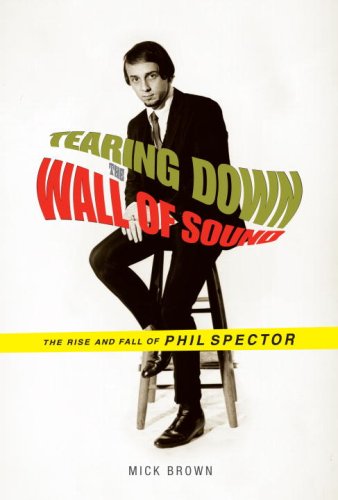
Drawing on the first major interview with the legendary record producer, control freak, and recluse, a journalist offers a unique portrait inside the world of troubled genius Phil Spector, from his integral involvement in the early years of such rock legends as Ike and Tina Turner, the Ronettes, and the Beatles to his 2007 trial for the murder of actress Lana Clarkson. 60,000 first printing.
Die Inhaltsangabe kann sich auf eine andere Ausgabe dieses Titels beziehen.
Über die Autorin bzw. den Autor
Born in London in 1950, Mick Brown is a journalist, broadcaster, and the author of four previous books. His article on Phil Spector was published in The Telegraph just two days before Lana Clarkson was found dead in the “castle” where he’d interviewed him only two months earlier.
Auszug. © Genehmigter Nachdruck. Alle Rechte vorbehalten.
Chapter 1: “Mr. Spector Likes People to Walk Up”
On an unseasonably warm day in December 2002 I found myself sitting in a room at the Hyatt Hotel on Sunset Strip in Los Angeles, waiting for Phil Spector to call.
It had been thirty-six hours since I’d arrived in Los Angeles, to find a message telling me that my meeting with Spector, which had taken some three months to arrange, and was scheduled to take place the following day, had been “postponed.” It was as if all my worst fears had come to pass.
Between 1961 and 1966, Spector’s so-called Wall of Sound made him the most successful pop-record producer in the world, with more than twenty Top 40 hits by such artists as the Crystals, the Ronettes and the Righteous Brothers. In the words of the writer Tom Wolfe, Spector was the “first tycoon of teen”—a mercurial and combustible mixture of genius and hustler, a precocious, brilliant and off-the-wall visionary who would change the face of pop music forever.
In a period when most people, even those who made it, regarded pop as disposable ephemera, Phil Spector alone dared to believe it could be art. Marshaling armies of guitars and keyboards and brass and drums, celestial sleighbells, and voices keening like angels, he made records of a hitherto unconceived-of grandeur and majesty, elevating the themes of teenage love and heartache to the epic proportions of Wagnerian opera—“little symphonies for the kids,” as he put it. Spector crammed emotion into a bottle and uncorked it—the clamorous, joyous noise of a small tyrant unleashing his vision, his revenge, on the world. When, in the late ’60s, musical fashion overtook his Wall of Sound, Spector moved on to the biggest pop group in the world, the Beatles. He rescued their valedictory album, Let It Be. He produced Imagine for John Lennon, and “My Sweet Lord” for George Harrison. Then began the long, slow retreat. In 1979 Spector produced his last album, for the punk rock group the Ramones. And then he was gone. The architect of the Wall of Sound vanished behind another wall—of barbed-wire fences, guard dogs and Keep Out: Armed Response signs, of stories about guns and craziness, rumor, half-truth and legend—much of it, it seemed, of Spector’s own creation. The “tycoon of teen” became rock and roll’s most enigmatic recluse.
When in the autumn of 2002 I first contacted Spector, he had not given a major interview in some twenty-five years, and to arrange a meeting involved delicate and protracted negotiations. Letters were dispatched back and forth. Michelle Blaine, Spector’s personal assistant, and the daughter of Hal Blaine, the drummer who had played on all of Spector’s greatest hits through the ’60s, happened to be passing through London, and we met for tea at a Mayfair hotel. She was fiercely protective of her employer. What exactly would be the thrust of the interview? Was I familiar with Mr. Spector’s records? How familiar? What had I read about Mr. Spector? I would be aware that there had been a great deal of misreporting about Mr. Spector’s life and affairs—gossip, scandal; talk of guns, of craziness—all of it exaggeration, myth and lies. Mr. Spector would not countenance any interview that proceeded along those lines.
A week later I was informed that Spector had agreed to talk. My elation was immediately tempered by a deep foreboding that the interview would almost certainly never happen. It was almost to be expected, then, that I should be told on my arrival in Los Angeles that our meeting had been “postponed.” I sat in my room, awaiting the call that I was now convinced would never come. And then the telephone rang. A car, I was informed, would be collecting me from my hotel at noon. At the appointed hour, a white 1965 Rolls-Royce Silver Cloud, license plate PHIL 500, drew up outside the hotel. A uniformed chauffeur held open the door. Encased in leather and walnut and hidden behind black curtains—a car that could tell stories—we turned onto the Hollywood Freeway, keeling slightly like some stately ocean liner, and headed east.
After some thirty minutes, we turned off the freeway, following the signs for Alhambra, a nondescript, working-class neighborhood of strip malls and scrubby bungalows. The road wound upwards, and further upwards still, ending at last at a set of high wrought-iron gates, posted with Keep Out signs. The chauffeur stepped out to open them, drove through and pulled to a halt at the bottom of a flight of stone steps, the gates closing behind us. “Mr. Spector,” he said, “likes people to walk up.” The steps led up through an avenue of lowering pines, the castle visible through the trees.
It was up these same steps that just a few weeks later, in the early hours of Monday, February 3, 2003, Spector would stagger with Lana Clarkson, a sometime actress and model, whom Spector had met just two hours earlier in a Hollywood nightclub. According to the testimony given to the police by Spector’s chauffeur Adriano De Souza—the same chauffeur who had driven me from my hotel—Spector was apparently inebriated, and Lana Clarkson was “like grabbing his arm and shoulder and helping him up the stairs.” Now, as I climbed, I had the distinct sense that I was being watched, although I might have been imagining this.
Michelle Blaine was waiting for me at the top. She led me through the front door into a cavernous hallway, wood-paneled and red-carpeted. Later, I would try to bring the details of this hall to mind, to match it with the account of the affidavit filed by Detective Mark Lillienfeld of the Los Angeles Sheriff’s Department, reporting the scene that he and other officers had found there in the early hours of February 3:
"Your affiant saw the victim slumped in a chair in the foyer of the home. She was wearing a black nylon slip/dress, black nylons, and black shoes. A leopard-print purse with a black strap was slung over her right shoulder, with the purse hanging down on her right side by her right arm. She had what appeared to be a single-entry gunshot wound to the mouth. Broken teeth from the victim were scattered about the foyer and an adjacent stairway. Lying under the victim’s left leg was a Colt, 2-inch, blue-steel, .38-caliber, six-shot revolver. This weapon had five live cartridges in the cylinder, and under the hammer, a spent cartridge."
I struggle to remember now exactly where in the hall that chair was placed. The affidavit makes no mention of the two suits of armor that I vividly recall, standing sentinel—stage props for a fantasy of baronial splendor. Spector was nowhere to be seen. Michelle Blaine led me on a tour of the ground-floor rooms. In the music room there was hi-fi equipment, and a guitar that had once belonged to John Lennon, resting on a stand, like a museum exhibit. A narrow room led off it, a bar lined with framed photographs of Spector with various music business luminaries.
In the sitting room a Picasso drawing hung on the wall beside an original John Lennon sketch. A uniformed maid brought iced water and I settled myself on a sofa beside a coffee table. The affidavit describes the scene that Detective Lillienfeld found in this room:
"In a living room just east of the foyer, your affiant saw that candles had been lit atop a fireplace mantel. The coffee table between two couches had a brandy glass partially filled with alcohol, and atop the table was a Jose Cuervo tequila bottle and a partially empty Canada Dry soft drink."
I waited, suddenly aware that classical music was eddying softly around the room. At length, Michelle Blaine’s mobile telephone rang. It...
„Über diesen Titel“ kann sich auf eine andere Ausgabe dieses Titels beziehen.
Suchergebnisse für Tearing Down the Wall of Sound: The Rise and Fall of...

Beispielbild für diese ISBN
Tearing Down the Wall of Sound: The Rise and Fall of Phil Spector
Verlag:
Knopf (edition First Edition), 2007
ISBN 10: 1400042194
ISBN 13: 9781400042197
Gebraucht
Hardcover
Erstausgabe
Anbieter: BooksRun, Philadelphia, PA, USA
Verkäuferbewertung 5 von 5 Sternen

Hardcover. Zustand: Very Good. First Edition. With dust jacket. It's a well-cared-for item that has seen limited use. The item may show minor signs of wear. All the text is legible, with all pages included. It may have slight markings and/or highlighting. Artikel-Nr. 1400042194-11-1-29
Gebraucht kaufen
EUR 5,96
Versand gratis
Versand innerhalb von USA
Versand innerhalb von USA
Anzahl: 1 verfügbar
Beispielbild für diese ISBN
Tearing Down the Wall of Sound: The Rise and Fall of Phil Spector
Anbieter: ThriftBooks-Atlanta, AUSTELL, GA, USA
Verkäuferbewertung 5 von 5 Sternen
Hardcover. Zustand: Fair. No Jacket. Readable copy. Pages may have considerable notes/highlighting. ~ ThriftBooks: Read More, Spend Less. Artikel-Nr. G1400042194I5N00
Gebraucht kaufen
EUR 7,96
Versand gratis
Versand innerhalb von USA
Versand innerhalb von USA
Anzahl: 1 verfügbar
Beispielbild für diese ISBN
Tearing Down the Wall of Sound: The Rise and Fall of Phil Spector
Anbieter: ThriftBooks-Atlanta, AUSTELL, GA, USA
Verkäuferbewertung 5 von 5 Sternen
Hardcover. Zustand: Good. No Jacket. Pages can have notes/highlighting. Spine may show signs of wear. ~ ThriftBooks: Read More, Spend Less. Artikel-Nr. G1400042194I3N00
Gebraucht kaufen
EUR 7,96
Versand gratis
Versand innerhalb von USA
Versand innerhalb von USA
Anzahl: 1 verfügbar
Beispielbild für diese ISBN
Tearing Down the Wall of Sound: The Rise and Fall of Phil Spector
Anbieter: ThriftBooks-Dallas, Dallas, TX, USA
Verkäuferbewertung 5 von 5 Sternen
Hardcover. Zustand: Fair. No Jacket. Missing dust jacket; Readable copy. Pages may have considerable notes/highlighting. ~ ThriftBooks: Read More, Spend Less. Artikel-Nr. G1400042194I5N01
Gebraucht kaufen
EUR 7,96
Versand gratis
Versand innerhalb von USA
Versand innerhalb von USA
Anzahl: 1 verfügbar
Beispielbild für diese ISBN
Tearing down the Wall of Sound : The Rise and Fall of Phil Spector
Verlag:
Knopf Doubleday Publishing Group, 2007
ISBN 10: 1400042194
ISBN 13: 9781400042197
Gebraucht
Hardcover
Erstausgabe
Anbieter: Better World Books, Mishawaka, IN, USA
Verkäuferbewertung 5 von 5 Sternen
Zustand: Good. 1st. Pages intact with minimal writing/highlighting. The binding may be loose and creased. Dust jackets/supplements are not included. Stock photo provided. Product includes identifying sticker. Better World Books: Buy Books. Do Good. Artikel-Nr. 1295287-6
Gebraucht kaufen
EUR 8,75
Versand gratis
Versand innerhalb von USA
Versand innerhalb von USA
Anzahl: 1 verfügbar
Beispielbild für diese ISBN
Tearing down the Wall of Sound : The Rise and Fall of Phil Spector
Verlag:
Knopf Doubleday Publishing Group, 2007
ISBN 10: 1400042194
ISBN 13: 9781400042197
Gebraucht
Hardcover
Erstausgabe
Anbieter: Better World Books, Mishawaka, IN, USA
Verkäuferbewertung 5 von 5 Sternen
Zustand: Good. 1st. Former library copy. Pages intact with minimal writing/highlighting. The binding may be loose and creased. Dust jackets/supplements are not included. Includes library markings. Stock photo provided. Product includes identifying sticker. Better World Books: Buy Books. Do Good. Artikel-Nr. 1295288-6
Gebraucht kaufen
EUR 8,75
Versand gratis
Versand innerhalb von USA
Versand innerhalb von USA
Anzahl: 1 verfügbar
Beispielbild für diese ISBN
Tearing Down the Wall of Sound: The Rise and Fall of Phil Spector
Anbieter: Books From California, Simi Valley, CA, USA
Verkäuferbewertung 4 von 5 Sternen

hardcover. Zustand: Good. Artikel-Nr. mon0003239991
Gebraucht kaufen
EUR 5,23
EUR 4,43 Versand
Versand innerhalb von USA
Versand innerhalb von USA
Anzahl: 1 verfügbar
Beispielbild für diese ISBN
Tearing Down the Wall of Sound: The Rise and Fall of Phil Spector
Anbieter: WorldofBooks, Goring-By-Sea, WS, Vereinigtes Königreich
Verkäuferbewertung 5 von 5 Sternen
Paperback. Zustand: Very Good. The book has been read, but is in excellent condition. Pages are intact and not marred by notes or highlighting. The spine remains undamaged. Artikel-Nr. GOR001908838
Gebraucht kaufen
EUR 24,29
EUR 6,60 Versand
Versand von Vereinigtes Königreich nach USA
Versand von Vereinigtes Königreich nach USA
Anzahl: 1 verfügbar
Beispielbild für diese ISBN
Tearing Down the Wall of Sound: The Rise and Fall of Phil Spector
Anbieter: Revaluation Books, Exeter, Vereinigtes Königreich
Verkäuferbewertung 5 von 5 Sternen
Hardcover. Zustand: Brand New. 464 pages. 9.75x6.75x1.50 inches. In Stock. Artikel-Nr. 1400042194
Neu kaufen
EUR 28,46
EUR 14,74 Versand
Versand von Vereinigtes Königreich nach USA
Versand von Vereinigtes Königreich nach USA
Anzahl: 1 verfügbar