
Verwandte Artikel zu Eugene McCarthy: The Rise and Fall of Postwar American...
Inhaltsangabe
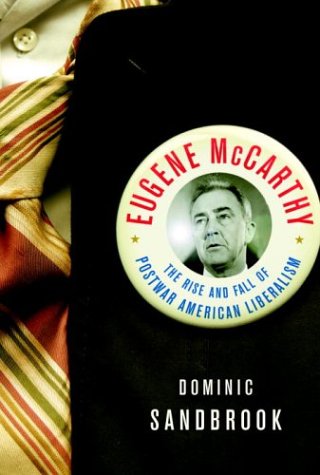
Dominic Sandbrook traces Eugene McCarthy's rise to prominence and his subsequent failures, and makes clear how his story embodies the larger history of American liberalism over the last half century. We see McCarthy elected from Minnesota to the House and then to the Senate, part of a new liberal movement that combined New Deal domestic policies and fierce Cold War hawkishness, a consensus that produced huge electoral victories until it was shattered by the war in Vietnam.
As the situation in Vietnam escalated, many liberals, like McCarthy, found themselves increasingly estranged from the anti-Communism that they had supported for nearly two decades. Sandbrook recounts McCarthy's growing opposition to President Johnson and his policies, which culminated in McCarthy's stunning near-victory in the New Hampshire presidential primary and Johnson's subsequent withdrawal from the race. McCarthy went on to lose the nomination to Hubert Humphrey at the infamous 1968 Democratic National Convention in Chicago, which secured his downfall and led to Richard Nixon's election, but he had pulled off one of the greatest electoral upsets in American history, one that helped shape the political landscape for decades.
Die Inhaltsangabe kann sich auf eine andere Ausgabe dieses Titels beziehen.
Über die Autorin bzw. den Autor
Dominic Sandbrook studied history and modern languages at Oxford University. He has a master’s degree from the University of St. Andrews and a doctorate from Cambridge University. He taught American history at the University of Sheffield from 2001 to 2004, when he resigned to write full-time.
Aus dem Klappentext
Eugene McCarthy was one of the most fascinating political figures of the postwar era: a committed liberal anti-Communist who broke with his party’s leadership over Vietnam and ultimately helped take down the political giant Lyndon B. Johnson. His presidential candidacy in 1968 seized the hearts and fired the imaginations of countless young liberals; it also presaged the declining fortunes of liberalism and the rise of conservatism over the past three decades.<br><br>Dominic Sandbrook traces Eugene McCarthy’s rise to prominence and his subsequent failures, and makes clear how his story embodies the larger history of American liberalism over the last half century. We see McCarthy elected from Minnesota to the House and then to the Senate, part of a new liberal movement that combined New Deal domestic policies and fierce Cold War hawkishness, a consensus that produced huge electoral victories until it was shattered by the war in Vietnam.<br><br>As the situation in Vietnam escalated, many liberals, like McCarthy, found themselves increasingly estranged from the anti-Communism that they had supported for nearly two decades. Sandbrook recounts McCarthy’s growing opposition to President Johnson and his policies, which culminated in McCarthy’s stunning near-victory in the New Hampshire presidential primary and Johnson’s subsequent withdrawal from the race. McCarthy went on to lose the nomination to Hubert Humphrey at the infamous 1968 Democratic National Convention in Chicago, which secured his downfall and led to Richard Nixon’s election, but he had pulled off one of the greatest electoral upsets in American history, one that helped shape the political landscape for decades.<br><br>These were tumultuous times in American politics, and Sandbrook vividly captures the drama and historical significance of the period through his intimate portrait of a singularly interesting man at the center of it all.
Auszug. © Genehmigter Nachdruck. Alle Rechte vorbehalten.
Chapter One
The Watkins Wonder
Eugene Joseph McCarthy was born in the small town of Watkins, Minnesota, on 29 March 1916. Although he was half German by blood, McCarthy always presented himself as an Irishman, relishing his frequent trips to Ireland and long conversations about Irish literature over a glass of whisky. His mother's parents were in fact German Catholics, while his father's family was Irish. His paternal grandparents, Michael McCarthy and Mary Harbinson, hailed from County Cork and County Antrim respectively; they had met in Quebec and moved to Minnesota in the 1870s. There was said to be much of the elder Michael McCarthy in his grandson. "He was always real interested in politics, and in reading the newspapers and finding out what was going on," recalled Eugene's elder sister Mildred. Eugene noted that his grandfather was said to have been "especially learned about and agitated by the British treatment of the Irish over the centuries." Eugene's father, also named Michael, was born in 1875, one of eleven children. Eugene's mother, Anna Baden, was the daughter of a Bavarian miller and blacksmith who had moved to Minnesota during the great surge of German Catholic immigration after the revolutions of 1848.
Eugene was Anna's third child. He had two older sisters, Mildred and Marian, and when he was two his mother gave birth to another son, Austin. Anna was forty when Eugene was born, and took responsibility for the four McCarthy children, since their father, a cattle buyer, was often away for months at a time. "Mother was the one who really raised us," explained her second son, Austin. She rarely raised her voice to her family, and was devoutly religious, walking every day to Mass whatever the weather and also leading the children in prayers at home. Eugene's mother, like her elder son, rarely showed anger or open emotion. He later wrote a poem entitled "Mother," celebrating her qualities "of tolerance, of strength, of gentleness / Of quiet voice, certainty, security." Not only did Eugene inherit Anna's reserve and patience, he also absorbed her religious passion. His mother dearly hoped that he would become a priest, and his wife, Abigail, later wrote that Anna had viewed the appearance of a girlfriend as a threat to her cherished dream. He may even have been his mother's favorite; his sister Marian remembered that "if she was sick or there was a crisis, she always wanted Gene to be with her."
Eugene's father, Michael, was a very different character. He had been born in central Minnesota in 1875, into "a wilderness of meager hopes," and had endured an austere childhood. A staunch Republican, he had been the Watkins postmaster until displaced by Woodrow Wilson and the Democrats in 1913, and by the time Eugene was born he was a cattle trader, buying cattle in Minnesota and the Dakotas and shipping them to the stockyards in South St. Paul. Michael always regretted his son's choice of a political career; on one occasion, he complained, "Gene is a good boy, but he's in the wrong party." Eugene was evidently in awe of his father, and he recorded his precepts in a series of poems with titles like "Wisdom" and "Integrity." Michael was hot-tempered, gruff and caustic, "a strong Irishman and quite domineering," in the words of one Watkins neighbor. "Dad would flare up and shake you by the back of the neck when he got mad," recalled his second son, Austin. If Eugene did not inherit his father's temper, he certainly inherited his sense of humor. Michael McCarthy's wit was famous in the family: it was dry, bitter, unsentimental and even cruel. He was, his son later wrote, "doubtful of politicians," "suspicious of doctors" and "slow to take pride in sons or daughters." While the children admired him, Eugene's wife, Abigail, wrote that Michael "seemed to look on any show of tenderness and emotional dependence as weakness . . . his appraisal of his fellow men was almost universally sour and he had the habit of limning them unforgettably with biting, homely witticisms." He belonged, she concluded, "to that generation of men for whom the Depression was the last defeat." As later events were to demonstrate, Eugene's own personality owed as much to his father's hard-bitten cynicism as it did to his mother's gentle reserve.
In 1968 a reporter visited Watkins and noted that it had changed little since McCarthy's childhood. It lay seventy miles west of the Twin Cities, across a flat, sullen landscape "deserted except for silos, cylindrical wire corncribs, fishing huts scattered across a frozen lake, black-and-white cows brooding or loping over a glassy coat of snow." Then, suddenly, he saw "a little huddle of buildings dominated by the spire of a redstone church." It was a railroad village, established during the building of the Soo Line across Meeker County in the 1880s, and had been named after a Soo railroad official. By 1930 its population had grown to 512 people, most of them connected with the railroad or dairy farming. "Its stability and growth," Eugene wrote in 1939, "is due to the character of its citizenship which is largely of German extraction with the exception of a scattering of Americans of Swedish and Irish descent. These citizens are thrifty, strongly attached to the soil and progressive in thought and action." All but a tiny minority were Catholics. Watkins and the surrounding area actually contained the highest concentration of German speakers in the state, many of whom had moved to the area even before the building of the railroad. Social life was based on the church and the local beer taverns, and the children studied German for several years at the parochial school. Visiting baseball teams from villages to the north often spoke German, and as Abigail McCarthy reported, "at church the people prayed in German and the sermons were often in German." Watkins, she thought, "seemed almost transplanted from rural Germany to rural Meeker County, Minnesota."
The German Catholics of Watkins attracted little attention from other groups in the state. They were middle-class farmers who kept to themselves and provoked no great nativist animosity. "I don't have to recall how my grandmother was maid to the Saltonstalls as Kennedy did," McCarthy remarked decades afterward. In the early 1930s, however, the Depression hit the farmers of central Minnesota very hard. Farmers rushed to form cooperatives and sometimes violently resisted attempts by businessmen to close down the creameries on which they depended. By convention, the Watkins Germans were mostly Democrats, partly because they disliked the nativism of the Republican Party, and partly because they opposed Prohibition, which they cheerfully ignored after it was enacted in the county in 1915.
While Eugene was growing up, however, the county was gripped by an atmosphere of increasing fear, agitation and class consciousness, exemplified by the popularity in the county of agricultural cooperatives and of A. C. Townley's Non-Partisan League, which paved the way for the success of the radical Minnesota Farmer-Labor Party in the 1930s. The sense of despair and hardship had a powerful impact on the young McCarthy. In 1961 he recalled watching Minnesota farm auctions with his father: "hardworking and honest" neighbors forced to sell all they had for shatteringly low returns. "The experience helped to teach me that we must look first to the needs of the people, and that when these needs are great, we should survey our private and public resources and then determine a policy and work out a program of...
„Über diesen Titel“ kann sich auf eine andere Ausgabe dieses Titels beziehen.
Suchergebnisse für Eugene McCarthy: The Rise and Fall of Postwar American...

Beispielbild für diese ISBN
Eugene McCarthy: The Rise and Fall of Postwar American Liberalism
Anbieter: World of Books (was SecondSale), Montgomery, IL, USA
Verkäuferbewertung 5 von 5 Sternen

Hardback. Zustand: Good. Originally a New Deal liberal and aggressive anticommunist, Senator Eugene McCarthy famously lost faith with the Democratic party over Vietnam. His stunning challenge to Lyndon Johnson in the 1968 New Hampshire primary inspired young liberals and was one of the greatest electoral upsets in American history. But the 1968 election ultimately brought Richard Nixon and the Republican Party to power, irrevocably shifting the country's political landscape to the right for decades to come. Dominic Sandbrook traces one of the most remarkable and significant lives in postwar politics, a career marked by both courage and arrogance. Sandbrook draws on extensive new research - including interviews with McCarthy himself - to show convincingly how Eugene McCarthy's political experience embodies the larger decline of American liberalism after World War I. These were tumultuous times in American politics, and Sandbrook vividly captures the drama and historical significance through his intimate portrait of a singularly interesting man at the heart of it all. Artikel-Nr. 00106132236
Gebraucht kaufen
EUR 3,79
Versand gratis
Versand innerhalb von USA
Versand innerhalb von USA
Anzahl: 3 verfügbar
Beispielbild für diese ISBN
Eugene McCarthy: The Rise and Fall of Postwar American Liberalism
Anbieter: World of Books (was SecondSale), Montgomery, IL, USA
Verkäuferbewertung 5 von 5 Sternen
Hardback. Zustand: Fair. Originally a New Deal liberal and aggressive anticommunist, Senator Eugene McCarthy famously lost faith with the Democratic party over Vietnam. His stunning challenge to Lyndon Johnson in the 1968 New Hampshire primary inspired young liberals and was one of the greatest electoral upsets in American history. But the 1968 election ultimately brought Richard Nixon and the Republican Party to power, irrevocably shifting the country's political landscape to the right for decades to come. Dominic Sandbrook traces one of the most remarkable and significant lives in postwar politics, a career marked by both courage and arrogance. Sandbrook draws on extensive new research - including interviews with McCarthy himself - to show convincingly how Eugene McCarthy's political experience embodies the larger decline of American liberalism after World War I. These were tumultuous times in American politics, and Sandbrook vividly captures the drama and historical significance through his intimate portrait of a singularly interesting man at the heart of it all. Artikel-Nr. 00106628872
Gebraucht kaufen
EUR 3,79
Versand gratis
Versand innerhalb von USA
Versand innerhalb von USA
Anzahl: 2 verfügbar
Beispielbild für diese ISBN
Eugene McCarthy: The Rise and Fall of Postwar American Liberalism
Anbieter: ThriftBooks-Phoenix, Phoenix, AZ, USA
Verkäuferbewertung 5 von 5 Sternen
Hardcover. Zustand: Good. No Jacket. Pages can have notes/highlighting. Spine may show signs of wear. ~ ThriftBooks: Read More, Spend Less. Artikel-Nr. G1400041058I3N00
Gebraucht kaufen
EUR 6,76
Versand gratis
Versand innerhalb von USA
Versand innerhalb von USA
Anzahl: 1 verfügbar
Beispielbild für diese ISBN
Eugene McCarthy: The Rise and Fall of Postwar American Liberalism
Anbieter: ThriftBooks-Atlanta, AUSTELL, GA, USA
Verkäuferbewertung 5 von 5 Sternen
Hardcover. Zustand: Good. No Jacket. Pages can have notes/highlighting. Spine may show signs of wear. ~ ThriftBooks: Read More, Spend Less. Artikel-Nr. G1400041058I3N00
Gebraucht kaufen
EUR 6,76
Versand gratis
Versand innerhalb von USA
Versand innerhalb von USA
Anzahl: 1 verfügbar
Beispielbild für diese ISBN
Eugene McCarthy: The Rise and Fall of Postwar American Liberalism
Anbieter: ThriftBooks-Dallas, Dallas, TX, USA
Verkäuferbewertung 5 von 5 Sternen
Hardcover. Zustand: Good. No Jacket. Pages can have notes/highlighting. Spine may show signs of wear. ~ ThriftBooks: Read More, Spend Less. Artikel-Nr. G1400041058I3N00
Gebraucht kaufen
EUR 6,76
Versand gratis
Versand innerhalb von USA
Versand innerhalb von USA
Anzahl: 1 verfügbar
Beispielbild für diese ISBN
Eugene McCarthy: The Rise and Fall of Postwar American Liberalism
Anbieter: ThriftBooks-Atlanta, AUSTELL, GA, USA
Verkäuferbewertung 5 von 5 Sternen
Hardcover. Zustand: Good. No Jacket. Former library book; Pages can have notes/highlighting. Spine may show signs of wear. ~ ThriftBooks: Read More, Spend Less. Artikel-Nr. G1400041058I3N10
Gebraucht kaufen
EUR 6,76
Versand gratis
Versand innerhalb von USA
Versand innerhalb von USA
Anzahl: 1 verfügbar
Beispielbild für diese ISBN
Eugene McCarthy: The Rise and Fall of Postwar American Liberalism
Anbieter: ThriftBooks-Dallas, Dallas, TX, USA
Verkäuferbewertung 5 von 5 Sternen
Hardcover. Zustand: Good. No Jacket. Former library book; Pages can have notes/highlighting. Spine may show signs of wear. ~ ThriftBooks: Read More, Spend Less. Artikel-Nr. G1400041058I3N10
Gebraucht kaufen
EUR 6,76
Versand gratis
Versand innerhalb von USA
Versand innerhalb von USA
Anzahl: 1 verfügbar
Beispielbild für diese ISBN
Eugene McCarthy: The Rise and Fall of Postwar American Liberalism
Anbieter: ThriftBooks-Atlanta, AUSTELL, GA, USA
Verkäuferbewertung 5 von 5 Sternen
Hardcover. Zustand: Very Good. No Jacket. Former library book; May have limited writing in cover pages. Pages are unmarked. ~ ThriftBooks: Read More, Spend Less. Artikel-Nr. G1400041058I4N10
Gebraucht kaufen
EUR 6,76
Versand gratis
Versand innerhalb von USA
Versand innerhalb von USA
Anzahl: 1 verfügbar
Beispielbild für diese ISBN
Eugene Mccarthy : The Rise and Fall of Postwar American Liberalism
Verlag:
Knopf Doubleday Publishing Group, 2004
ISBN 10: 1400041058
ISBN 13: 9781400041053
Gebraucht
Hardcover
Erstausgabe
Anbieter: Better World Books: West, Reno, NV, USA
Verkäuferbewertung 5 von 5 Sternen
Zustand: Good. First Edition. Former library copy. Pages intact with minimal writing/highlighting. The binding may be loose and creased. Dust jackets/supplements are not included. Includes library markings. Stock photo provided. Product includes identifying sticker. Better World Books: Buy Books. Do Good. Artikel-Nr. 5868029-75
Gebraucht kaufen
EUR 6,92
Versand gratis
Versand innerhalb von USA
Versand innerhalb von USA
Anzahl: 1 verfügbar
Beispielbild für diese ISBN
Eugene Mccarthy : The Rise and Fall of Postwar American Liberalism
Verlag:
Knopf Doubleday Publishing Group, 2004
ISBN 10: 1400041058
ISBN 13: 9781400041053
Gebraucht
Hardcover
Erstausgabe
Anbieter: Better World Books, Mishawaka, IN, USA
Verkäuferbewertung 5 von 5 Sternen
Zustand: Good. First Edition. Former library copy. Pages intact with minimal writing/highlighting. The binding may be loose and creased. Dust jackets/supplements are not included. Includes library markings. Stock photo provided. Product includes identifying sticker. Better World Books: Buy Books. Do Good. Artikel-Nr. 5868029-75
Gebraucht kaufen
EUR 7,37
Versand gratis
Versand innerhalb von USA
Versand innerhalb von USA
Anzahl: 2 verfügbar