
Verwandte Artikel zu Small Things Considered: Why There Is No Perfect Design...
Inhaltsangabe
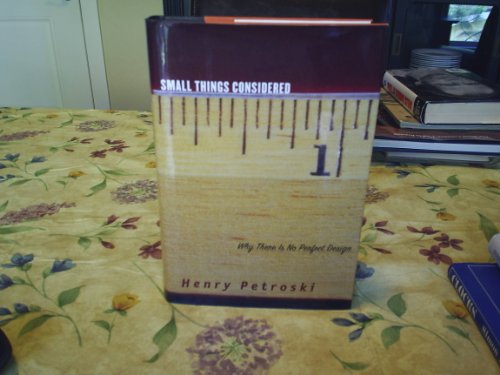
Even everyday objects that most people never think of as having been designed, says Petroski (civil engineering and history, Duke U.), remain works in progress. He points out that objects change with age and use, people change in their needs and wants, and the environment changes, so no design is more than an approximation for a particular time, place, and purpose. Annotation (c) Book News, Inc., Portland, OR (booknews.com)
Die Inhaltsangabe kann sich auf eine andere Ausgabe dieses Titels beziehen.
Über die Autorinnen und Autoren
Henry Petroski is the Aleksandar S. Vesic Professor of Civil Engineering and a professor of history at Duke University.
Henry Petroski,<b> </b>the Aleksandar S. Vesic Professor of Civil Engineering and a professor of history at Duke University, lives in Durham, North Carolina. He is the author of ten previous books.
Auszug. © Genehmigter Nachdruck. Alle Rechte vorbehalten.
ONE
The Nature of Design
An architect, a psychologist, and an engineer were appearing together on a radio talk show. This may sound like the setup line for one of those jokes about professionals, but the situation was real and the subject of the National Public Radio program, Talk of the Nation-Science Friday, was not comedy but the design of everyday objects. The hour's discussion showed that the participants, each in his own way, took design very seriously indeed. Their characteristic mind-sets were evident from the beginning, and by the end of the hour they had conveyed a great deal about how differently their professions approach the subject under discussion.
Ira Flatow, the show's host, asked each guest to comment on what constituted good and bad design-giving examples-and the talk ranged widely from teakettles to computers. As if to signal that this was not too heavy a subject for a Friday afternoon, the architect stressed at the outset that the design of anything can be whimsical and a source of great enjoyment. He recalled getting a letter from a French poet who said that he smiled every time the little red bird on his Michael Graves-designed teakettle whistled to announce that the water had come to a boil. The psychologist agreed that the architect's teakettle was a thing of beauty and a joy to use, and he confessed that he even displayed one in his kitchen window for people to admire. The engineer, having had no personal experience with the whimsical teakettle, said nothing about it, but he thought to himself of the many times he had dripped boiling water from the very attractive but poorly designed kettle that sat on his stove at home.
Throughout the show, the architect spoke often of aesthetics and about how much of design should be driven by the appearance of things, if for no other reason than to distinguish from one another in the marketplace objects that serve the same purpose. The psychologist, while acknowledging that he liked attractive designs, stressed how important it was that an object communicate how it was to be used. Among the examples of poor "user interfaces" he cited in the course of the show were feature-laden telephone systems and shower controls that gave no hint of how they were operated.
The engineer did not disagree with the architect and psychologist. He, too, expressed a wish that the design of objects be attractive enough that they could be displayed in a place of honor and their use be transparent. However, he pointed out, the primary purpose of most things is to perform a function, and because the goals of aesthetics, user friendliness, and doing a job effectively can be in conflict, economics often becomes the referee. The design process is characterized mostly by tensions between competing objectives that are resolved by compromises, usually driven by the realities of manufacturing cost and sales price. After some discussion, which led to a collegial agreement that good design must take into account, within the context of cost, all manner of considerations, the host invited the listening audience to call in and describe their favorite examples of good design and also relate their greatest "design nightmares."
Of the many things named by the host, the guests, and call-in listeners over the course of the show, there were about equal numbers of what were considered good and bad designs. Among the "good" designs were musical instruments, the Chrysler Building, and the paper clip. "Bad" designs included car-radio buttons, electronic remote controls, and water pitchers. But the dividing line between good and bad design was not drawn sharply, and opinion was not always unanimous. One caller offered the modern automobile steering wheel as an example of good design: By having so many controls at their fingertips, drivers do not have to take their eyes off the road to fiddle with knobs and buttons, thus making driving safer. Another caller criticized the modern steering wheel as a safety liability for not having, as older cars did, an obvious button or ring for beeping the horn. No sooner had one caller praised the fashionable fat-handled kitchen gadgets as a godsend for older people than another listener called to complain that they are not so wonderful for those, like her, who are allergic to latex. Reacting to the material on a new set of utensils given her as a gift, she removed the molded covering from the handles before she continued to use the things, leaving them unsightly and rather uncomfortable to hold. At the end of the program, the only clear conclusion was that it can be as hard for three professionals to agree on the essence of design as it is for three sightless men to agree on the nature of an elephant. But no matter what it is, design is certainly no joke.
During a different public radio show, on which the engineer was the lone guest, the question of the design of common objects arose once again. The host preempted the design cynics by asking listeners to discuss only good design, and she challenged the audience to call in with their favorite examples. One listener hesitatingly began describing an object that she was not sure anyone else would appreciate but which she marveled at when she had a hot pizza delivered: the "thingy" that keeps the top of the box from sagging and getting stuck to the melted cheese. Though she did not know what it was really called, the white plastic tripod she described was immediately recognizable to those in the studio and control room, all of whom smiled their assent.
The caller's enthusiasm for the object made it clear that she thought the pizza-box insert was the epitome of design. She told of washing and saving the little tripods, expecting someday to find new uses for them. The host of the show again nodded her silent approval. The engineer confessed to having saved some of the humble devices as examples of clever functional design that he thought he might write about someday. No one called in to ask for a better description of the throwaway thing, or to offer its name. But such identification was not needed for it to be recognized, admired for its ingenuity, and appreciated for its purpose. After the show aired, another listener, an artist, sent an E-mail message, saying that she also admired the design of the white plastic objects, which she called "triangle platforms." She described shortening their legs and using them as spacers between stacked palettes in her paint-storage box. She had also used them for a different purpose, turning them upside down to support, like little Atlases, spherical objects for display. Things are often used for purposes other than what their designers intended or even imagined.
Another fan of the plastic tripods finds them ideal for holding eggs, to which she applies sequins, beads, and other festive trim to make Christmas-tree decorations. For this admirer, the simple devices are definitely not throwaway items. In fact, on the illustrated Web site describing her utilization of these objects, they are lightheartedly evaluated:
The plastic tripod is very expensive, costing somewhere around $10 US, but it is worth it for the ease of working with the eggs. It's probably the packaging that makes the tripod so expensive. It comes packaged with a Pizza Hut carry out pizza. The pizza and the cardboard box protect the plastic tripod, though some would assert that the box and tripod protect the pizza. Regardless, the pizza and box can be discarded in some ecologically sound manner and the tripod used to hold the egg as a work in progress.
However viewed, the pizza-box platform presents a fine example of something designed to be very functional, but not something most of us would think to put on display in our windows-or something whose use would be at all apparent out of context. Yet at least one...
„Über diesen Titel“ kann sich auf eine andere Ausgabe dieses Titels beziehen.
Suchergebnisse für Small Things Considered: Why There Is No Perfect Design...

Beispielbild für diese ISBN
Small Things Considered. Why There Is No Perfect Design
Anbieter: World of Books (was SecondSale), Montgomery, IL, USA
Verkäuferbewertung 5 von 5 Sternen

Zustand: Acceptable. Item in acceptable condition! Textbooks may not include supplemental items i.e. CDs, access codes etc. Artikel-Nr. 00106694932
Gebraucht kaufen
EUR 3,86
Versand gratis
Versand innerhalb von USA
Versand innerhalb von USA
Anzahl: 1 verfügbar
Beispielbild für diese ISBN
Small Things Considered: Why There Is No Perfect Design
Verlag:
Knopf (edition First Edition), 2003
ISBN 10: 1400040507
ISBN 13: 9781400040506
Gebraucht
Hardcover
Erstausgabe
Anbieter: BooksRun, Philadelphia, PA, USA
Verkäuferbewertung 5 von 5 Sternen
Hardcover. Zustand: Very Good. First Edition. It's a well-cared-for item that has seen limited use. The item may show minor signs of wear. All the text is legible, with all pages included. It may have slight markings and/or highlighting. Artikel-Nr. 1400040507-11-1
Gebraucht kaufen
EUR 5,74
Versand gratis
Versand innerhalb von USA
Versand innerhalb von USA
Anzahl: 1 verfügbar
Beispielbild für diese ISBN
Small Things Considered : Why There Is No Perfect Design
Verlag:
Knopf Doubleday Publishing Group, 2003
ISBN 10: 1400040507
ISBN 13: 9781400040506
Gebraucht
Hardcover
Erstausgabe
Anbieter: Better World Books, Mishawaka, IN, USA
Verkäuferbewertung 5 von 5 Sternen
Zustand: Very Good. 1ST. Pages intact with possible writing/highlighting. Binding strong with minor wear. Dust jackets/supplements may not be included. Stock photo provided. Product includes identifying sticker. Better World Books: Buy Books. Do Good. Artikel-Nr. 3679965-6
Gebraucht kaufen
EUR 6,26
Versand gratis
Versand innerhalb von USA
Versand innerhalb von USA
Anzahl: 1 verfügbar
Beispielbild für diese ISBN
Small Things Considered : Why There Is No Perfect Design
Verlag:
Knopf Doubleday Publishing Group, 2003
ISBN 10: 1400040507
ISBN 13: 9781400040506
Gebraucht
Hardcover
Erstausgabe
Anbieter: Better World Books: West, Reno, NV, USA
Verkäuferbewertung 5 von 5 Sternen
Zustand: Very Good. 1ST. Pages intact with possible writing/highlighting. Binding strong with minor wear. Dust jackets/supplements may not be included. Stock photo provided. Product includes identifying sticker. Better World Books: Buy Books. Do Good. Artikel-Nr. 3679965-6
Gebraucht kaufen
EUR 6,26
Versand gratis
Versand innerhalb von USA
Versand innerhalb von USA
Anzahl: 1 verfügbar
Beispielbild für diese ISBN
Small Things Considered: Why There Is No Perfect Design
Anbieter: Wonder Book, Frederick, MD, USA
Verkäuferbewertung 5 von 5 Sternen
Zustand: Very Good. Very Good condition. Very Good dust jacket. A copy that may have a few cosmetic defects. May also contain light spine creasing or a few markings such as an owner's name, short gifter's inscription or light stamp. Artikel-Nr. C13C-02438
Gebraucht kaufen
EUR 6,33
Versand gratis
Versand innerhalb von USA
Versand innerhalb von USA
Anzahl: 2 verfügbar
Beispielbild für diese ISBN
Small Things Considered: Why There Is No Perfect Design
Anbieter: Wonder Book, Frederick, MD, USA
Verkäuferbewertung 5 von 5 Sternen
Zustand: Very Good. Very Good condition. Good dust jacket. A copy that may have a few cosmetic defects. May also contain light spine creasing or a few markings such as an owner's name, short gifter's inscription or light stamp. Artikel-Nr. U01B-04650
Gebraucht kaufen
EUR 6,33
Versand gratis
Versand innerhalb von USA
Versand innerhalb von USA
Anzahl: 3 verfügbar
Beispielbild für diese ISBN
Small Things Considered: Why There Is No Perfect Design
Anbieter: ThriftBooks-Atlanta, AUSTELL, GA, USA
Verkäuferbewertung 5 von 5 Sternen
Hardcover. Zustand: Very Good. No Jacket. May have limited writing in cover pages. Pages are unmarked. ~ ThriftBooks: Read More, Spend Less. Artikel-Nr. G1400040507I4N00
Gebraucht kaufen
EUR 6,92
Versand gratis
Versand innerhalb von USA
Versand innerhalb von USA
Anzahl: 1 verfügbar
Beispielbild für diese ISBN
Small Things Considered: Why There Is No Perfect Design
Anbieter: ThriftBooks-Atlanta, AUSTELL, GA, USA
Verkäuferbewertung 5 von 5 Sternen
Hardcover. Zustand: Very Good. No Jacket. Former library book; May have limited writing in cover pages. Pages are unmarked. ~ ThriftBooks: Read More, Spend Less. Artikel-Nr. G1400040507I4N10
Gebraucht kaufen
EUR 6,92
Versand gratis
Versand innerhalb von USA
Versand innerhalb von USA
Anzahl: 1 verfügbar
Beispielbild für diese ISBN
Small Things Considered: Why There Is No Perfect Design
Anbieter: ThriftBooks-Phoenix, Phoenix, AZ, USA
Verkäuferbewertung 5 von 5 Sternen
Hardcover. Zustand: Very Good. No Jacket. May have limited writing in cover pages. Pages are unmarked. ~ ThriftBooks: Read More, Spend Less. Artikel-Nr. G1400040507I4N00
Gebraucht kaufen
EUR 6,92
Versand gratis
Versand innerhalb von USA
Versand innerhalb von USA
Anzahl: 1 verfügbar
Beispielbild für diese ISBN
Small Things Considered: Why There Is No Perfect Design
Anbieter: ThriftBooks-Dallas, Dallas, TX, USA
Verkäuferbewertung 5 von 5 Sternen
Hardcover. Zustand: Very Good. No Jacket. May have limited writing in cover pages. Pages are unmarked. ~ ThriftBooks: Read More, Spend Less. Artikel-Nr. G1400040507I4N00
Gebraucht kaufen
EUR 6,92
Versand gratis
Versand innerhalb von USA
Versand innerhalb von USA
Anzahl: 1 verfügbar