
Verwandte Artikel zu Supreme Command: Soldiers, Statesmen, and Leadership...
Inhaltsangabe
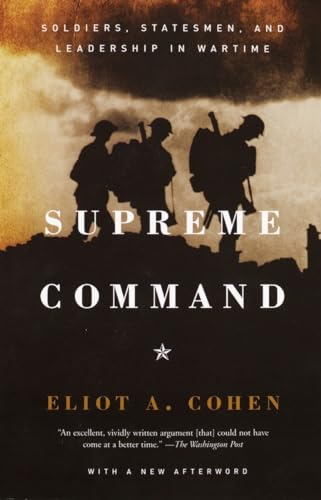
The orthodoxy regarding the relationship between politicians and military leaders in wartime democracies contends that politicians should declare a military operation's objectives and then step aside and leave the business of war to the military. In this timely and controversial examination of civilian-military relations in wartime democracies, Eliot A. Cohen chips away at this time-honored belief with case studies of statesmen who dared to prod, provoke, and even defy their military officers to great effect.
Using the leadership of Abraham Lincoln, Georges Clemenceau, Winston Churchill, and David Ben-Gurion to build his argument, Cohen offers compelling proof that, as Clemenceau put it, “War is too important to leave to the generals.” By examining the shared leadership traits of four politicians who triumphed in extraordinarily varied military campaigns, Cohen argues that active statesmen make the best wartime leaders, pushing their military subordinates to succeed where they might have failed if left to their own devices. Thought provoking and soundly argued, Cohen's Supreme Command is essential reading not only for military and political players but also for informed citizens and anyone interested in leadership.
Die Inhaltsangabe kann sich auf eine andere Ausgabe dieses Titels beziehen.
Über die Autorin bzw. den Autor
Eliot A. Cohen is Professor of Strategic Studies at the Paul H. Nitze School of Advanced International Studies of the Johns Hopkins University. He previously served on the policy planning staff of the Office of the Secretary of Defense and as an intelligence officer in the United States Army Reserve, and taught at the U.S. Naval War College and at Harvard University. He has written books and articles on a variety of military and national security-related subjects. A frequent consultant to the Department of Defense and the intelligence community, he is a member of the Defense Policy Board, advising the Secretary of Defense. He lives in Washington, D.C.
Von der hinteren Coverseite
The orthodoxy regarding the relationship between politicians and military leaders in wartime democracies contends that politicians should declare a military operation's objectives and then step aside and leave the business of war to the military. In this timely and controversial examination of civilian-military relations in wartime democracies, Eliot A. Cohen chips away at this time-honored belief with case studies of statesmen who dared to prod, provoke, and even defy their military officers to great effect.
Using the leadership of Abraham Lincoln, Georges Clemenceau, Winston Churchill, and David Ben-Gurion to build his argument, Cohen offers compelling proof that, as Clemenceau put it, "War is too important to leave to the generals." By examining the shared leadership traits of four politicians who triumphed in extraordinarily varied military campaigns, Cohen argues that active statesmen make the best wartime leaders, pushing their military subordinates to succeed where they might have failed if left to their own devices. Thought provoking and soundly argued, Cohen's Supreme Command is essential reading not only for military and political players but also for informed citizens and anyone interested in leadership.
Auszug. © Genehmigter Nachdruck. Alle Rechte vorbehalten.
Chapter 1
The Soldier and the Statesman
Few choices bedevil organizations as much as the selection of senior leaders. Often they look for those with high-level experience in different settings: New York City's Columbia University sought out America's most senior general, Dwight D. Eisenhower, to lead it after World War II; President Ronald Reagan made a corporate tycoon his chief of staff in 1985; in the early 1990s, Sears Roebuck, an ailing giant, looked to the chief logistician of the Gulf War to help it turn around. Frequently enough the transplant fails; the sets of skills and aptitudes that led to success in one walk of life either do not carry over or are downright dysfunctional in another. The rules of politics differ from those of business, and universities do not act the way corporations do. Even within the business world, car companies and software giants may operate very differently, and the small arms manufacturer who takes over an ice-cream company may never quite settle in to the new culture.
To be sure, leaders at the top have some roughly similar tasks: setting directions, picking subordinates, monitoring performance, handling external constituencies, and inspiring achievement. And they tend, often enough, to think that someone in a different walk of life has the answers to their dilemmas, which is why the generals study business books, and the CEOs peruse military history. But in truth the details of their work differ so much that in practice the parallels often elude them, or can only be discovered by digging more deeply than is the norm.
The relations between statesmen and soldiers in wartime offer a special case of this phenomenon. Many senior leaders in private life must manage equally senior professionals who have expertise and experience that dwarf their own, but politicians dealing with generals in wartime face exceptional difficulties. The stakes are so high, the gaps in mutual understanding so large, the differences in personality and background so stark, that the challenges exceed anything found in the civilian sector-which is why, perhaps, these relationships merit close attention not only from historians and students of policy, but from anyone interested in leadership at its most acutely difficult. To learn how statesmen manage their generals in wartime one must explore the peculiarities of the military profession and the exceptional atmospheres and values produced by war. These peculiarities and conditions are unique and extreme, and they produce relationships far more complicated and tense than either citizen or soldier may expect in peacetime, or even admit to exist in time of war.
"Let him come with me into Macedonia"
To see why, turn back to the year 168 b.c. The place is the Senate of the Roman republic, the subject the proposed resumption of war (for the third time) against Macedonia, and the speaker Consul Lucius Aemilius:
I am not, fellow-citizens, one who believes that no advice may be given to leaders; nay rather I judge him to be not a sage, but haughty, who conducts everything according to his own opinion alone. What therefore is my conclusion? Generals should receive advice, in the first place from the experts who are both specially skilled in military matters and have learned from experience; secondly, from those who are on the scene of action, who see the terrain, the enemy, the fitness of the occasion, who are sharers in the danger, as it were, aboard the same vessel. Thus, if there is anyone who is confident that he can advise me as to the best advantage of the state in this campaign which I am about to conduct, let him not refuse his services to the state, but come with me into Macedonia. I will furnish him with his sea-passage, with a horse, a tent, and even travel-funds. If anyone is reluctant to do this and prefers the leisure of the city to the hardships of campaigning, let him not steer the ship from on shore. The city itself provides enough subjects for conversation; let him confine his garrulity to these; and let him be aware that I shall be satisfied with the advice originating in camp.1
The Consul's cry for a free hand echoes that of generals throughout history-although the historian Livy records that, as a matter of fact, an unusually large number of senators decided to accompany him on campaign. Still, the notion that generals once given a mission should have near total discretion in its execution is a powerful one.
Popular interpretations of the Vietnam and Gulf wars, the one supposedly a conflict characterized by civilian interference in the details of warmaking, the other a model of benign operational and tactical neglect by an enlightened civilian leadership, seem to confirm the value of a bright line drawn between the duties of soldiers and civilians. Thus the chief of staff to General Norman Schwarzkopf, commander of US forces in Southwest Asia: "Schwarzkopf was never second-guessed by civilians, and that's the way it ought to work."2 Or more directly, then-President George Bush's declaration when he received the Association of the US Army's George Catlett Marshall Medal: "I vowed that I would never send an American soldier into combat with one hand tied behind that soldier's back. We did the politics and you superbly did the fighting."3 Small wonder, then, that the editor of the US Army War College's journal wrote to his military colleagues:
There will be instances where civilian officials with Napoleon complexes and micromanaging mentalities are prompted to seize the reins of operational control. And having taken control, there will be times when they then begin to fumble toward disaster. When this threatens to happen, the nation's top soldier . . . must summon the courage to rise and say to his civilian masters, "You can't do that!" and then stride to the focal point of decision and tell them how it must be done.4
Such a view of the roles of civilian and soldier reflects popular understandings as well. The 1996 movie Independence Day, for example, features only one notable villain (aside, that is, from the aliens who are attempting to devastate and conquer the Earth)-an overweening secretary of defense who attempts to direct the American military's counterattack against the invaders from outer space. Only after the interfering and deceitful civilian is out of the way can the president, a former Air Force combat pilot who gets back into uniform to lead the climactic aerial battle, and his military assistants (with the aid of one civilian scientist in a purely technical role) get on with the job of defeating the foe. To this comfortable consensus of capital, camp, and Hollywood one can add the weight of academic theory. Samuel Huntington, arguably the greatest American political scientist of our time, in a classic work, The Soldier and the State,5 laid out what he termed a theory of "objective control," which holds that the healthiest and most effective form of civilian control of the military is that which maximizes professionalism by isolating soldiers from politics, and giving them as free a hand as possible in military matters.
The normal theory of civil-military relations
We can call this consensus the "normal" theory of civil-military relations, which runs something like this. Officers are professionals, much like highly trained surgeons: the statesman is in the position of a patient requiring urgent care. He may freely decide whether or not to have an operation, he may choose one doctor over another, and he may even make a decision among different surgical options, although that is more rare. He may not, or at least ought not supervise a surgical procedure, select the doctor's scalpel, or rearrange the operating room to his liking. Even the patient who has medical training is well-advised not to attempt to do so, and indeed,...
„Über diesen Titel“ kann sich auf eine andere Ausgabe dieses Titels beziehen.
Suchergebnisse für Supreme Command: Soldiers, Statesmen, and Leadership...

Beispielbild für diese ISBN
Supreme Command Soldiers State
Anbieter: World of Books (was SecondSale), Montgomery, IL, USA
Verkäuferbewertung 5 von 5 Sternen

Zustand: Good. Item in good condition. Textbooks may not include supplemental items i.e. CDs, access codes etc. Artikel-Nr. 00099392604
Gebraucht kaufen
EUR 4,57
Versand gratis
Versand innerhalb von USA
Versand innerhalb von USA
Anzahl: 9 verfügbar
Beispielbild für diese ISBN
Supreme Command: Soldiers, Statesmen, and Leadership in Wartime
Anbieter: World of Books (was SecondSale), Montgomery, IL, USA
Verkäuferbewertung 5 von 5 Sternen
Paperback. Zustand: Very Good. The relationship between military leaders and political leaders has always been a complicated one, especially in times of war. When the chips are down, who should run the show, the politicians or the generals? In Supreme Command, Eliot Cohen examines four great democratic war statesmen, Abraham Lincoln, Georges Clemenceau, Winston Churchill, and David Ben-Gurion, to reveal the surprising answer--the politicians. The generals may think they know how to win, but the statesmen are the ones who see the big picture. The lessons of the book apply not just to President Bush and other world leaders but to anyone who faces extreme adversity at the head of a free organization, including leaders and managers throughout the corporate world. Artikel-Nr. 00103912698
Gebraucht kaufen
EUR 4,57
Versand gratis
Versand innerhalb von USA
Versand innerhalb von USA
Anzahl: 3 verfügbar
Beispielbild für diese ISBN
Supreme Command: Soldiers, Statesmen, and Leadership in Wartime
Verlag:
Knopf Doubleday Publishing Group (edition Reprint), 2003
ISBN 10: 1400034043
ISBN 13: 9781400034048
Gebraucht
Paperback
Anbieter: BooksRun, Philadelphia, PA, USA
Verkäuferbewertung 5 von 5 Sternen
Paperback. Zustand: Fair. Reprint. The item might be beaten up but readable. May contain markings or highlighting, as well as stains, bent corners, or any other major defect, but the text is not obscured in any way. Artikel-Nr. 1400034043-7-1
Gebraucht kaufen
EUR 4,83
Versand gratis
Versand innerhalb von USA
Versand innerhalb von USA
Anzahl: 1 verfügbar
Beispielbild für diese ISBN
Supreme Command: Soldiers, Statesmen, and Leadership in Wartime
Anbieter: ThriftBooks-Atlanta, AUSTELL, GA, USA
Verkäuferbewertung 5 von 5 Sternen
Paperback. Zustand: Good. No Jacket. Pages can have notes/highlighting. Spine may show signs of wear. ~ ThriftBooks: Read More, Spend Less. Artikel-Nr. G1400034043I3N00
Gebraucht kaufen
EUR 6,02
Versand gratis
Versand innerhalb von USA
Versand innerhalb von USA
Anzahl: 2 verfügbar
Beispielbild für diese ISBN
Supreme Command: Soldiers, Statesmen, and Leadership in Wartime
Anbieter: ThriftBooks-Dallas, Dallas, TX, USA
Verkäuferbewertung 5 von 5 Sternen
Paperback. Zustand: Good. No Jacket. Pages can have notes/highlighting. Spine may show signs of wear. ~ ThriftBooks: Read More, Spend Less. Artikel-Nr. G1400034043I3N00
Gebraucht kaufen
EUR 6,02
Versand gratis
Versand innerhalb von USA
Versand innerhalb von USA
Anzahl: 1 verfügbar
Beispielbild für diese ISBN
Supreme Command: Soldiers, Statesmen, and Leadership in Wartime
Anbieter: ThriftBooks-Phoenix, Phoenix, AZ, USA
Verkäuferbewertung 5 von 5 Sternen
Paperback. Zustand: Good. No Jacket. Pages can have notes/highlighting. Spine may show signs of wear. ~ ThriftBooks: Read More, Spend Less. Artikel-Nr. G1400034043I3N00
Gebraucht kaufen
EUR 6,02
Versand gratis
Versand innerhalb von USA
Versand innerhalb von USA
Anzahl: 1 verfügbar
Beispielbild für diese ISBN
Supreme Command: Soldiers, Statesmen, and Leadership in Wartime
Anbieter: ThriftBooks-Reno, Reno, NV, USA
Verkäuferbewertung 5 von 5 Sternen
Paperback. Zustand: Good. No Jacket. Pages can have notes/highlighting. Spine may show signs of wear. ~ ThriftBooks: Read More, Spend Less. Artikel-Nr. G1400034043I3N00
Gebraucht kaufen
EUR 6,02
Versand gratis
Versand innerhalb von USA
Versand innerhalb von USA
Anzahl: 1 verfügbar
Beispielbild für diese ISBN
Supreme Command : Soldiers, Statesmen, and Leadership in Wartime
Verlag:
Knopf Doubleday Publishing Group, 2003
ISBN 10: 1400034043
ISBN 13: 9781400034048
Gebraucht
Softcover
Anbieter: Better World Books, Mishawaka, IN, USA
Verkäuferbewertung 5 von 5 Sternen
Zustand: Good. Former library copy. Pages intact with minimal writing/highlighting. The binding may be loose and creased. Dust jackets/supplements are not included. Includes library markings. Stock photo provided. Product includes identifying sticker. Better World Books: Buy Books. Do Good. Artikel-Nr. 8618572-6
Gebraucht kaufen
EUR 6,16
Versand gratis
Versand innerhalb von USA
Versand innerhalb von USA
Anzahl: 1 verfügbar
Beispielbild für diese ISBN
Supreme Command : Soldiers, Statesmen, and Leadership in Wartime
Verlag:
Knopf Doubleday Publishing Group, 2003
ISBN 10: 1400034043
ISBN 13: 9781400034048
Gebraucht
Softcover
Anbieter: Better World Books, Mishawaka, IN, USA
Verkäuferbewertung 5 von 5 Sternen
Zustand: Good. Pages intact with minimal writing/highlighting. The binding may be loose and creased. Dust jackets/supplements are not included. Stock photo provided. Product includes identifying sticker. Better World Books: Buy Books. Do Good. Artikel-Nr. 4265763-6
Gebraucht kaufen
EUR 6,16
Versand gratis
Versand innerhalb von USA
Versand innerhalb von USA
Anzahl: 3 verfügbar
Beispielbild für diese ISBN
Supreme Command: Soldiers, Statesmen, and Leadership in Wartime
Anbieter: Wonder Book, Frederick, MD, USA
Verkäuferbewertung 5 von 5 Sternen
Zustand: Good. Good condition. A copy that has been read but remains intact. May contain markings such as bookplates, stamps, limited notes and highlighting, or a few light stains. Artikel-Nr. V13B-04578
Gebraucht kaufen
EUR 6,40
Versand gratis
Versand innerhalb von USA
Versand innerhalb von USA
Anzahl: 3 verfügbar