
Inhaltsangabe
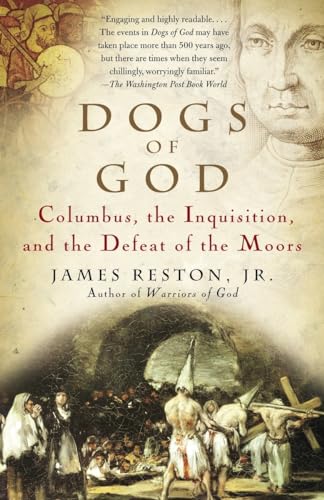
From the acclaimed author of Warriors of God comes a riveting account of the pivotal events of 1492, when towering political ambitions, horrific religious excesses, and a drive toward international conquest changed the world forever.James Reston, Jr., brings to life the epic story of Spain’s effort to consolidate its own burgeoning power by throwing off the yoke of the Vatican. By waging war on the remaining Moors in Granada and unleashing the Inquisitor Torquemada on Spain’s Jewish and converso population, King Ferdinand and Queen Isabella attained enough power and wealth to fund Columbus’ expedition to America and to chart a Spanish destiny separate from that of Italy. With rich characterizations of the central players, this engrossing narrative captures all the political and religious ferment of this crucial moment on the eve of the discovery of the New World.
Die Inhaltsangabe kann sich auf eine andere Ausgabe dieses Titels beziehen.
Über die Autorin bzw. den Autor
James Reston, Jr., is the author of thirteen books, including Warriors of God, The Last Apocalypse, and Galileo: A Life. He has written articles for The New Yorker, Esquire, Vanity Fair, Time, Rolling Stone, and many other publications; three plays; and the scripts for three Frontline documentaries. He lives in Chevy Chase, Maryland.
Auszug. © Genehmigter Nachdruck. Alle Rechte vorbehalten.
1
The Land of the Infidel
Iberia
Castile, that flat expanse of tableland in central Spain, some 300 miles across, derives its lovely, lilting name from the Spanish word castillos, or castles, for so many of these daunting crenellated bastions dot its windswept steppe. From the tenth century onward, they had been built one by one as a protection against the ferocious Moors to the south.
With its principal towns of Ávila, Burgos, Segovia, and Valladolid, the territory of Old Castile was first to be liberated from the Mohammedan horde that had swept north into the Iberian peninsula in the eighth century. In pushing the infidels back, Ferdinand I established his kingdom in a.d. 1037. Not many years later, the province of Le—n to the north was joined to it, and the Kingdom of Castile and Le—n made its capital at Burgos. In the decades after Ferdinand I's death in 1065, the kingdom was expanded south. Toledo was captured in 1085, and Ciudad Real, Cuenca, Guadalajara, and Madrid were taken soon after. By the beginning of the twelfth century, the forces of Christianity were making steady progress in taking back from the Moors land claimed by the Church. The process became known as the Spanish Reconquest.
The Reconquest was a crusade, every bit as intense as the storied crusades of Godfrey of Bouillon and Richard the Lionheart in Palestine. From the days of Charlemagne in the ninth century, the dream of driving the Arab heathens from the Iberian peninsula had been the sacred calling of every Christian king in the north. Ferdinand I had thrust as far south as Seville before retreating, but it was the recapture of Toledo in 1085 that shocked the Islamic world to its core. For several hundred years, as the Berber dynasty of the Almorav’das in Granada gave way to the fanatical Almohades, and eventually to the brilliant Nasarids, and as the great Alhambra was constructed above the bowl of the Andalusian vega, there was thrust and counterthrust between Christians and Muslims. Yet, a kind of stasis was established.
But such detente was not to last. In A.D. 1236, C—rdoba, the seat of Moorish culture since the eighth century, fell to the Christians, followed by Valencia in 1238, and Seville in 1248. In an elegiac lament, the Moorish poet Al-Rundi wrote of the devastation Moorish Spain felt at its defeat by the infidel.
Mosques have become churches
in which only bells and crosses are found . . .
O who will redress the humiliation
of a people who were once powerful?
Yesterday they were kings in their own homes.
But today they are slaves in the land of the Infidel.
By the year 1265 the Mohammedan empire, the glorious Al Andalus, had been reduced to the province of Granada and a line of ports around Cádiz.
Despite this upheaval, the 150 years from the mid-thirteenth century to the end of the fourteenth century would be a period of relative tranquility. It was to become the golden age of diversity in medieval Spain. The Christians comprised half the population of the peninsula, the rest being Jews and Moors. The Jewish population, numbering about 120,000, maintained good relations with the Christian kings of Castile. Under the rulers of the Almohades, the Jews had been repressed, and they responded by helping the Castilian kings in their perpetual struggle against the Moors. When the Christians seized more and more Moorish territory, they returned the favor, and Jews soon held numerous important posts in the royal court. Meanwhile, Arabs living under Christian rule (called Mozarabs) were tolerated and nurtured. Through them the wisdom of the Arab world, from its science to its arts, was translated from the Arabic into Latin. This trove of learning was then sent north into the largely illiterate principalities of Central Europe.
The reign of the Castilian king Alfonso X (1252-84) represented the high point of this cross-fertilization. Schooled in Arabic and known as El Sabio, the Learned One, Alfonso was responsible for great cultural and social works. Even as he gave lip service to the traditional obligation of Christian kings to confront and conquer the Moors, he set out to create a Christian culture in the north of Spain that was equal in glory to Moorish culture in the south. He ordered both the Koran and the Talmud to be translated into Latin. And he promoted valuable translations from Arabic astronomy that came to be known as the Alfonsine Tables and that would guide the study of astronomy for the next two hundred years until the revolutionary work of Nicolaus Copernicus changed everything.
These tables were produced by a collaborative effort of fifty astronomers in 1252, including a clutch of Arabic astronomers and an important Jewish astronomer named Yehuda ben Moses Cohen. They sought to plot the path of the planets as a series of intricate and interrelated epicycles and to describe the constellations beyond the planets. In the Alfonsine Tables, the Arabic names for certain stars like Altar, Betelgeuse, Rigel, and Vega were used. Later, Alfonso was said to have remarked, apocryphally no doubt, that if he had been present at creation, he could have given the Good Lord some hints.
Under the Learned One other technical fields were also enriched through the translation of Arabic science. Arabic chemical words came into European languages: alkali, alcohol, camphor, elixir, syrup, talc, and tartar. Mathematical terms like azimith, zero, sine, root, algebra, nadir, and zenith came from the Arabic, as did botanical names like ginger, lilac, jasmine, myrrh, saffron, sesame, lemon, rhubarb, and coffee. Modern Spanish contains approximately eight thousand words derived from Arabic.
The humanities and arts also found their patron in Alfonso. Under this remarkable king a seminal collection of medieval poetry and music was compiled, as well as an illustrated book of games, Libro de los Juegos, about dice and chess played on boards of different sizes. Historical memory was important to him as well. He encouraged the writing of a history called Crónica General, insisting that it be written in the language of the common man. By this simple act, Castilian became the standard for written and spoken Spanish. Alfonso also initiated the formation of a comprehensive legal code, Las Siete Partidas, which among other things removed his kingdom from papal influence. This remarkable achievement had one glaring deficit, however. It associated all Jews with the Antichrist, declaring them to be helpmates of the Devil, and the prime villains in the last days of the coming apocalypse.
Alfonso's cultural influence was to last well beyond his death. Much original literary work, including the prose of Infante Don Juan Manuel and the poetry of the archpriest of Hita, was created in what became known as the School of Alfonso. Better as a man of letters than a leader of men, he nevertheless added the port of Cádiz to the Kingdom of Castile, in an arrangement with his vassal, the Moorish king of Granada.
* * *
After the fall of Córdoba to the Christian side in 1236, the center of Islamic Al Andalus shifted to Granada. Its natural circumstance protected the province of Granada better than Córdoba. Its capital city, also called Granada, was built on the slopes of the massive Sierra Nevada, the highest mountains in all of Spain. These daunting and gorgeous peaks, rising over 11,000 feet, separated Granada from its seaport of Málaga to the south. Their highest peak, the Mulhacén, is named for the father of the last Moorish king. Between the Sierra Nevada and the coast, only fifty miles south, lie the Alpujarras Mountains with their rich and fertile bottomlands. Málaga was then the richest seaport in Spain. It was a bustling hub of trade with North...
„Über diesen Titel“ kann sich auf eine andere Ausgabe dieses Titels beziehen.
Weitere beliebte Ausgaben desselben Titels

Suchergebnisse für Dogs of God: Columbus, the Inquisition, and the Defeat...

Beispielbild für diese ISBN
Dogs of God Columbus the Inqui
Verlag:
Knopf Doubleday Publishing Group, 2006
ISBN 10: 1400031915
ISBN 13: 9781400031917
Gebraucht
Softcover
Anbieter: World of Books (was SecondSale), Montgomery, IL, USA
Verkäuferbewertung 5 von 5 Sternen

Zustand: Good. Item in good condition. Textbooks may not include supplemental items i.e. CDs, access codes etc. Artikel-Nr. 00100954615
Gebraucht kaufen
EUR 4,96
Versand gratis
Versand innerhalb von USA
Versand innerhalb von USA
Anzahl: 4 verfügbar
Beispielbild für diese ISBN
Dogs of God Columbus the Inqui
Verlag:
Knopf Doubleday Publishing Group, 2006
ISBN 10: 1400031915
ISBN 13: 9781400031917
Gebraucht
Softcover
Anbieter: World of Books (was SecondSale), Montgomery, IL, USA
Verkäuferbewertung 5 von 5 Sternen
Zustand: Acceptable. Item in acceptable condition! Textbooks may not include supplemental items i.e. CDs, access codes etc. Artikel-Nr. 00104238481
Gebraucht kaufen
EUR 4,96
Versand gratis
Versand innerhalb von USA
Versand innerhalb von USA
Anzahl: 2 verfügbar
Beispielbild für diese ISBN
Dogs of God: Columbus, the Inquisition, and the Defeat of the Moors
Anbieter: ThriftBooks-Atlanta, AUSTELL, GA, USA
Verkäuferbewertung 5 von 5 Sternen
Paperback. Zustand: Good. No Jacket. Pages can have notes/highlighting. Spine may show signs of wear. ~ ThriftBooks: Read More, Spend Less. Artikel-Nr. G1400031915I3N00
Gebraucht kaufen
EUR 5,82
Versand gratis
Versand innerhalb von USA
Versand innerhalb von USA
Anzahl: 4 verfügbar
Beispielbild für diese ISBN
Dogs of God: Columbus, the Inquisition, and the Defeat of the Moors
Anbieter: ThriftBooks-Reno, Reno, NV, USA
Verkäuferbewertung 5 von 5 Sternen
Paperback. Zustand: Good. No Jacket. Pages can have notes/highlighting. Spine may show signs of wear. ~ ThriftBooks: Read More, Spend Less. Artikel-Nr. G1400031915I3N00
Gebraucht kaufen
EUR 5,82
Versand gratis
Versand innerhalb von USA
Versand innerhalb von USA
Anzahl: 3 verfügbar
Beispielbild für diese ISBN
Dogs of God: Columbus, the Inquisition, and the Defeat of the Moors
Anbieter: ThriftBooks-Dallas, Dallas, TX, USA
Verkäuferbewertung 5 von 5 Sternen
Paperback. Zustand: Good. No Jacket. Missing dust jacket; Pages can have notes/highlighting. Spine may show signs of wear. ~ ThriftBooks: Read More, Spend Less. Artikel-Nr. G1400031915I3N01
Gebraucht kaufen
EUR 5,82
Versand gratis
Versand innerhalb von USA
Versand innerhalb von USA
Anzahl: 1 verfügbar
Beispielbild für diese ISBN
Dogs of God: Columbus, the Inquisition, and the Defeat of the Moors
Anbieter: ThriftBooks-Reno, Reno, NV, USA
Verkäuferbewertung 5 von 5 Sternen
Paperback. Zustand: Very Good. No Jacket. Former library book; May have limited writing in cover pages. Pages are unmarked. ~ ThriftBooks: Read More, Spend Less. Artikel-Nr. G1400031915I4N10
Gebraucht kaufen
EUR 5,82
Versand gratis
Versand innerhalb von USA
Versand innerhalb von USA
Anzahl: 1 verfügbar
Beispielbild für diese ISBN
Dogs of God: Columbus, the Inquisition, and the Defeat of the Moors
Anbieter: ThriftBooks-Dallas, Dallas, TX, USA
Verkäuferbewertung 5 von 5 Sternen
Paperback. Zustand: Good. No Jacket. Pages can have notes/highlighting. Spine may show signs of wear. ~ ThriftBooks: Read More, Spend Less. Artikel-Nr. G1400031915I3N00
Gebraucht kaufen
EUR 5,82
Versand gratis
Versand innerhalb von USA
Versand innerhalb von USA
Anzahl: 4 verfügbar
Beispielbild für diese ISBN
Dogs of God: Columbus, the Inquisition, and the Defeat of the Moors
Anbieter: ThriftBooks-Atlanta, AUSTELL, GA, USA
Verkäuferbewertung 5 von 5 Sternen
Paperback. Zustand: Good. No Jacket. Former library book; Pages can have notes/highlighting. Spine may show signs of wear. ~ ThriftBooks: Read More, Spend Less. Artikel-Nr. G1400031915I3N10
Gebraucht kaufen
EUR 5,82
Versand gratis
Versand innerhalb von USA
Versand innerhalb von USA
Anzahl: 1 verfügbar
Beispielbild für diese ISBN
Dogs of God: Columbus, the Inquisition, and the Defeat of the Moors
Anbieter: ThriftBooks-Dallas, Dallas, TX, USA
Verkäuferbewertung 5 von 5 Sternen
Paperback. Zustand: Fair. No Jacket. Readable copy. Pages may have considerable notes/highlighting. ~ ThriftBooks: Read More, Spend Less. Artikel-Nr. G1400031915I5N00
Gebraucht kaufen
EUR 5,82
Versand gratis
Versand innerhalb von USA
Versand innerhalb von USA
Anzahl: 1 verfügbar
Beispielbild für diese ISBN
Dogs of God: Columbus, the Inquisition, and the Defeat of the Moors
Anbieter: ThriftBooks-Reno, Reno, NV, USA
Verkäuferbewertung 5 von 5 Sternen
Paperback. Zustand: Fair. No Jacket. Readable copy. Pages may have considerable notes/highlighting. ~ ThriftBooks: Read More, Spend Less. Artikel-Nr. G1400031915I5N00
Gebraucht kaufen
EUR 5,82
Versand gratis
Versand innerhalb von USA
Versand innerhalb von USA
Anzahl: 1 verfügbar