
Verwandte Artikel zu Creative Change: Why We Resist It . . . How We Can...
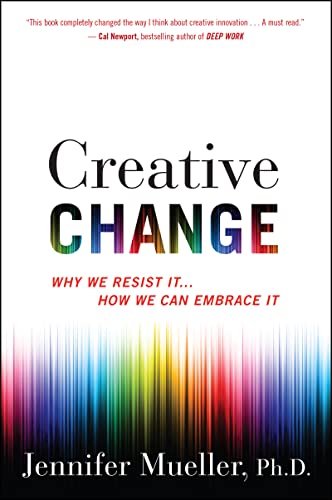
Creative Change: Why We Resist It . . . How We Can Embrace It: Why We Resist It . . . How We Can Embrace It – Evidence-Based Leadership Guide on Accepting Innovation - Softcover
Inhaltsangabe
“This book completely changed the way I think about creative innovation . . . A must-read.” — Cal Newport, best-selling author of Deep Work
“If we all crave creativity so much, why do we reject new ideas so often? Jen Mueller’s smart new book unravels this puzzle.” – Daniel H. Pink, best-selling author of Drive and A Whole New Mind
Business leaders say they want creativity and need real innovation in order to thrive. But according to startling research from management professor Jennifer Mueller, these same leaders chronically reject creative solutions, even as they profess commitment to innovation.
Mueller’s research reveals that it’s not just CEOs but educators, parents, and other social trendsetters who struggle to accept new and creative ideas. Mueller parses the tough questions that these findings raise. Do we all have an inherent prejudice against creative ideas? Can we learn to outsmart this bias? Creative Change combines analysis of the latest research with practical guidance on how to shift your mindset, and offers a wealth of counterintuitive recommendations to help you embrace the creative ideas you want.
“Mueller, an accomplished scholar in the management field, has developed a well-formulated argument for creativity. Her ideas and research need to be available to academics, business practitioners, and, really, everyone.” — Library Journal
Die Inhaltsangabe kann sich auf eine andere Ausgabe dieses Titels beziehen.
Über die Autorin bzw. den Autor
DR. MUELLER holds a doctorate in social psychology and has taught at top business schools, including Wharton, the Yale School of Management, and New York University's Stern School of Business. Her highly acclaimed paper “The Bias Against Creativity” went viral, was downloaded more than 65,000 times, and was heralded as “famous” by an article in The Atlantic. She currently serves on the faculty at the University of San Diego and lives in Solana Beach, California.
Auszug. © Genehmigter Nachdruck. Alle Rechte vorbehalten.
Creative Change
Why We Resist It ... How We Can Embrace It
By Jennifer MuellerHoughton Mifflin Harcourt Publishing Company
Copyright © 2017 Jennifer Mueller
All rights reserved.
ISBN: 978-1-328-74566-8All rights reserved.
Contents
Title Page,
Contents,
Copyright,
Dedication,
Preface: The Seeds of Our Uncreative Destruction,
The Hidden Innovation Barrier,
Our Love-Hate Relationship with Creativity,
The Science Behind the Paradox,
Self-Disrupt: Overcome Your Own Bias against Creativity,
Overcome Others' Bias against Creativity,
Cultivating Creative Change in Your Organization,
Overcome the Bias against Creative Leadership,
Stop Generating Ideas and Start Making Impact,
Acknowledgments,
Notes,
Index,
About the Author,
Connect with HMH,
CHAPTER 1
The Hidden Innovation Barrier
Within the first few months after starting my new position as an assistant professor at Wharton, I met with a group of vice presidents who worked for a large global company. For the sake of confidentiality, I'll refer to that business as Company Z.
The VPs had determined that their company was struggling with how to be more creative, and they asked me to present my perspective on why this might be the case. I was extremely excited about this meeting, in no small part because I knew the literature cold — backward and forward. So like any good academic, I presented a summary of the research about how hard it is to generate creative (novel and useful) ideas and then actually implement them.
I will never forget the look on the executives' faces after I finished my talk. I expected nodding heads, grunts of approval, or at least some expressions of curiosity.
What I saw instead in their eyes was confusion and disappointment. Finally, one executive looked at me with skepticism and said, "Yeah, but that isn't it."
Another executive was more patient with me. He explained in detail the problem Company Z was having with creativity, and it honestly had little to do with the material I had presented to the group. "I wouldn't say that we struggle with generating creative ideas, or that implementation is the problem," the executive explained. "We can buy our creativity. We buy companies with breakthrough products, but these products rarely get to the implementation phase — and not because we don't know how to efficiently bring a product to market. Our problem is that once we buy these companies and integrate them under our umbrella, over time, they aren't creative anymore. Their pipeline dwindles and so we sell them off. But suddenly, only a short time later, those same companies that were vanilla are now developing creative products again."
He concluded: "If you want to help us figure out how to be more creative, figure out how to solve this puzzle, because, as far as we are concerned, that is the billion-, no, trillion-dollar question."
After this comment, I was rendered speechless (which, I can tell you, is a rare situation for me). The executives didn't agree with my traditional academic account of why creativity was so uncommon — it just didn't mesh with what they were experiencing. But if generating creative ideas wasn't the bottleneck, and implementation concerns weren't relevant to their situation, what then was the problem? This company didn't appear to be resistant to change — they were investing billions of dollars in creative products. So why were they struggling?
I soon learned that Company Z was not unique. Other companies — large, small, and in between — were struggling to be creative as well. Executives called and asked me to provide their organizations with training on creative-idea generation. Senior managers would tell me that creativity was a strategic priority for the company, but that their employees just weren't coming up with creative solutions.
Time after time, I conducted these trainings only to discover that most of the participants had already received training on idea generation. I would hear story after story of how employees had developed terrific ideas — which management promptly ignored. One participant even showed me a large stack of white papers she had written to document her many ideas — now in the file drawer. When I asked her why the company rejected her ideas when corporate leaders told me they were desperate for more creativity, she told me something I found quite surprising. She said, "Executives here don't actually want creative ideas."
That didn't make sense to me. Why would top-level executives at the very companies that were hiring me to help them be more creative spend a ton of resources to cultivate internal creativity, only to reject their employees' creative ideas? At best, it seemed like a blatant waste of money and other resources. At worst, it seemed like the essence of hypocrisy. Maybe all this talk about creativity was just lip service? I thought back to my meeting with Company Z — there's no way those busy executives would waste their time listening to consultants and spending billions of dollars on new companies if they were just pretending to want creativity.
Would they?
One thing was certain — executives wanted real solutions, and academics like me had spent decades identifying solutions. A quick search on the ABI Informs database (a database of business articles) shows that roughly 30,000 articles on creative idea generation — and 150,000 articles on implementation — have been published since the 1990s. Why, if we have all these solutions for how to generate and implement creative ideas, were companies still having a difficult time being creative?
If our best solutions weren't solving the problem, then maybe we needed to redefine the problem we were trying to solve. Was there an invisible third barrier to innovation beyond idea generation and implementation? If so, it must be so big that it could harm innovation, even in companies that were great at generating ideas and incredibly efficient at implementing them. Not only that, but it would have to be invisible to the decision makers whose job it was to innovate new solutions and convert opportunities into wins. So what was this invisible barrier?
As I pondered this question, I again considered the case of Company Z. Executives there told me that generating and implementing ideas was not the bottleneck they faced — they were certain of that. Instead, they believed that the companies they acquired became less creative over time. If this was indeed the case, then one possibility was that Company Z bought companies and then squelched their ability to generate creative ideas, perhaps due to loads of bureaucracy and paperwork. The problem with this logic was that Company Z was buying small companies that made medical devices, products that typically develop very slowly. From the time these companies were acquired to the time they were sold off, their products probably didn't change much at all.
I was on my own. I didn't have any answers, but I had a problem I was passionate about solving. I wanted to isolate this hidden barrier to innovation. And I had a hunch: maybe the executives at Company Z perceived the companies they had acquired differently over time not because the products had changed, but because the way executives evaluated the products had changed.
Were all of us operating using a false assumption? That is, we assume that any expert in a specific industry can accurately assess...
„Über diesen Titel“ kann sich auf eine andere Ausgabe dieses Titels beziehen.
Suchergebnisse für Creative Change: Why We Resist It . . . How We Can...

Beispielbild für diese ISBN
Creative Change: Why We Resist It . . . How We Can Embrace It
Anbieter: World of Books (was SecondSale), Montgomery, IL, USA
Verkäuferbewertung 5 von 5 Sternen

Zustand: Good. Item in good condition. Textbooks may not include supplemental items i.e. CDs, access codes etc. Artikel-Nr. 00069999252
Gebraucht kaufen
EUR 5,17
Versand gratis
Versand innerhalb von USA
Versand innerhalb von USA
Anzahl: 2 verfügbar
Beispielbild für diese ISBN
Creative Change: Why We Resist It . . . How We Can Embrace It
Anbieter: World of Books (was SecondSale), Montgomery, IL, USA
Verkäuferbewertung 5 von 5 Sternen
Zustand: Acceptable. Item in acceptable condition! Textbooks may not include supplemental items i.e. CDs, access codes etc. Artikel-Nr. 00108479283
Gebraucht kaufen
EUR 5,17
Versand gratis
Versand innerhalb von USA
Versand innerhalb von USA
Anzahl: 1 verfügbar
Beispielbild für diese ISBN
Creative Change: Why We Resist It . . . How We Can Embrace It
Anbieter: World of Books (was SecondSale), Montgomery, IL, USA
Verkäuferbewertung 5 von 5 Sternen
Zustand: Very Good. Item in very good condition! Textbooks may not include supplemental items i.e. CDs, access codes etc. Artikel-Nr. 00107784915
Gebraucht kaufen
EUR 5,17
Versand gratis
Versand innerhalb von USA
Versand innerhalb von USA
Anzahl: 8 verfügbar
Beispielbild für diese ISBN
Creative Change : Why We Resist It . How We Can Embrace It
Verlag:
HarperCollins Publishers, 2018
ISBN 10: 132874566X
ISBN 13: 9781328745668
Gebraucht
Softcover
Anbieter: Better World Books: West, Reno, NV, USA
Verkäuferbewertung 5 von 5 Sternen
Zustand: Good. Reprint. Pages intact with minimal writing/highlighting. The binding may be loose and creased. Dust jackets/supplements are not included. Stock photo provided. Product includes identifying sticker. Better World Books: Buy Books. Do Good. Artikel-Nr. 56595532-75
Gebraucht kaufen
EUR 8,15
Versand gratis
Versand innerhalb von USA
Versand innerhalb von USA
Anzahl: 1 verfügbar
Beispielbild für diese ISBN
Creative Change : Why We Resist It . How We Can Embrace It
Verlag:
HarperCollins Publishers, 2018
ISBN 10: 132874566X
ISBN 13: 9781328745668
Gebraucht
Softcover
Anbieter: Better World Books Ltd, Dunfermline, Vereinigtes Königreich
Verkäuferbewertung 5 von 5 Sternen
Zustand: Good. Reprint. Pages intact with minimal writing/highlighting. The binding may be loose and creased. Dust jackets/supplements are not included. Stock photo provided. Product includes identifying sticker. Better World Books: Buy Books. Do Good. Artikel-Nr. 56595532-75
Gebraucht kaufen
EUR 6,32
EUR 5,83 Versand
Versand von Vereinigtes Königreich nach USA
Versand von Vereinigtes Königreich nach USA
Anzahl: 1 verfügbar
Beispielbild für diese ISBN
Creative Change: Why We Resist It. How We Can Embrace It
Anbieter: Sell Books, Elland, YORKS, Vereinigtes Königreich
Verkäuferbewertung 5 von 5 Sternen
paperback. Zustand: Good. Our good condition books are generally good for reading but not for gifting or collecting. They could have imperfections such as creasing, fanning, inscriptions, margin notes, yellowing, staining on edge or cover or pages, bumps, scuffs, etc etc (sometimes multiple of these). It's a wide category that encompasses anything that isn't almost-new down to anything that is slightly better than poor. We would NOT recommend gifting Good books - these should be considered reading copies. Our books are dispatched from a Yorkshire former cotton mill. We list via barcode/ISBN so please note that the images are stock images and may not be the exact copy you receive, furthermore the details about edition and year might not be accurate as many publishers reuse the same ISBN for multiple editions and as we simply scan a barcode or enter an ISBN we do not check the validity of the edition data when listing. If you're looking for an exact edition please don't order (at least not without checking with us first, although we don't always have time to check). We aim to dispatch prompty, the service used will depend on order value and book size. We can ship to most countries, see our shipping policies. Payment is via Abe only. Artikel-Nr. L-BAO00769-RAG-20241015-VG
Gebraucht kaufen
EUR 2,65
EUR 14,17 Versand
Versand von Vereinigtes Königreich nach USA
Versand von Vereinigtes Königreich nach USA
Anzahl: 1 verfügbar
Beispielbild für diese ISBN
Creative Change: Why We Resist It . . . How We Can Embrace It - Evidence-Based Leadership Guide on Accepting Innovation
Anbieter: Ria Christie Collections, Uxbridge, Vereinigtes Königreich
Verkäuferbewertung 5 von 5 Sternen
Zustand: New. In English. Artikel-Nr. ria9781328745668_new
Neu kaufen
EUR 19,52
EUR 10,93 Versand
Versand von Vereinigtes Königreich nach USA
Versand von Vereinigtes Königreich nach USA
Anzahl: Mehr als 20 verfügbar
Beispielbild für diese ISBN
Creative Change: Why We Resist It . . . How We Can Embrace It
Anbieter: Revaluation Books, Exeter, Vereinigtes Königreich
Verkäuferbewertung 5 von 5 Sternen
Paperback. Zustand: Brand New. reprint edition. 256 pages. 8.00x5.25x0.50 inches. In Stock. Artikel-Nr. x-132874566X
Neu kaufen
EUR 19,08
EUR 11,66 Versand
Versand von Vereinigtes Königreich nach USA
Versand von Vereinigtes Königreich nach USA
Anzahl: 2 verfügbar