
Verwandte Artikel zu Win or Die: Leadership Secrets from Game of Thrones
Inhaltsangabe
“When it comes to the most-anticipated business books of 2019, Win or Die: Leadership Secrets From Game of Thrones is the one to beat.”—Inc.
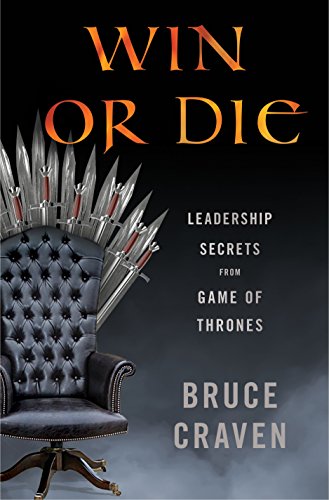
A guide to leading without losing your head, inspired by the bestselling books and smash television series Game of Thrones.
"When you play the game of thrones, you win or you die. There is no middle ground." —Cersei Lannister
One of the great joys of Game of Thrones is strategizing what bold moves you'd make in this bloody, volatile world—from the comfort of your living room. And one of the great terrors of being a leader is knowing your real world can be just as brutal—and offices bring no comfort.
Every day you're presented with opportunities and challenges, and must decide which roads to follow, which risks to confront, when to deny an opportunity and when to pursue the call to adventure. And you won't know whether you'll profit or fail while you're in the thick of it. In Win or Die: Leadership Secrets from Game of Thrones, Bruce Craven brilliantly analyzes the journeys of the best and worst leaders in Westeros, so that leaders can create their own narratives of success.
Craven considers beloved characters such as Ned Stark, Jon Snow, Daenerys Targaryen, and Tyrion Lannister as they make terrible decisions and fatal mistakes, but also achieve incredible victories and surprising successes, learning and growing along their (often bloody) ways. Readers will learn how to face conflict and build resilience, develop contextual and emotional intelligence, develop their vision, and more.
This entertaining and accessible guide will show readers how to turn danger into opportunity, even when dragons threaten.
Die Inhaltsangabe kann sich auf eine andere Ausgabe dieses Titels beziehen.
Über die Autorin bzw. den Autor
BRUCE CRAVEN teaches his popular elective Leadership Through Fiction at Columbia Business School, where he also serves as the Director of Columbia’s Advanced Management Program. He has taught workshops in resilience and flexible thinking for organizations in the United States and Europe. He studied politics and literature at the University of California at Santa Cruz and has a MFA in Writing from Columbia University. He lives with his wife and two sons in the Coachella Valley in California.
Auszug. © Genehmigter Nachdruck. Alle Rechte vorbehalten.
Win Or Die
Leadership Secrets from Game of Thrones
By Bruce CravenSt. Martin's Press
Copyright © 2019 Bruce Craven
All rights reserved.
ISBN: 978-1-250-30117-8All rights reserved.
Contents
Title Page,
Copyright Notice,
Dedication,
Preface,
1. Don't Be Ned Stark!,
2. See True!,
3. Be a Player, Not a Piece!,
4. Be More Than a Sword-Hand!,
5. Ride to Meereen!,
6. Don't Walk, Fly!,
7. Don't Get Assassinated!,
8. Find Dragonglass!,
9. Kill The White Walker!,
10. Ride Dragons!,
Acknowledgments,
Notes,
Index,
About the Author,
Copyright,
CHAPTER 1
Don't Be Ned Stark!
HOW TO LEAD WITH VALUES
In Westeros, Lord Eddard "Ned" Stark faces significant leadership challenges when King Robert travels north and requests Ned's services: "I want you down in King's Landing, not up here at the end of the world where you are no damned use to anybody." Ned travels with his daughters to the capital. Lord Stark enters a city of potential allies and enemies. Exhausted and hungry from travel, he takes his seat at the table as Hand of the King. He studies the five men present at the urgent meeting of the small council called by Grand Maester Pycelle. Ned wonders which, in the words of King Robert, "were the flatterers and which the fools. He thought he knew already."
Down in King's Landing
Ned reacts instinctively, guided by his personal values. He doesn't realize his values are subjective. He makes faulty assumptions. Ned fails to understand an important leadership insight: the people he has been tasked to report to, work with, and lead have different values from his own or share values but present themselves with less transparency.
As a result, Ned's biases about values trigger a disastrous argument with his boss, King Robert, and blind him to the advantages of a partnership with the Master of Whisperers, Lord Varys. Ned follows his values but doesn't factor into his decisions any of his subjective perspective on the values of other people on the King's Small Council or the values of people, such as Queen Cersei, who have influence with the King. Ned Stark underestimates Queen Cersei and he badly evaluates the Master of Coin, Petyr Baelish. Ned Stark isn't able to recover from his leadership misjudgment.
When King Robert Baratheon loses his temper with Ned in a Small Council meeting in King's Landing, it is because Ned, serving as Hand of the King, has questioned King Robert's courage. Ned is also courageous but his idea of courage is primarily about fulfilling his duty and obligation to his community, to act with honor, as well as to protect his family. This is where their problems begin. If King Robert thought he had hired Ned as a friend who would always defer to Robert's position as king of the Seven Kingdoms, he was mistaken. They share certain values but rank them differently.
Ned Stark assumes his values are a good method to evaluate all the members of King Robert's Small Council, as well as other stakeholders in the King's family, such as Queen Cersei and the Kingslayer, Jaime Lannister. Ned doesn't work to understand what values might motivate the other people who report to King Robert. Ned doesn't understand that the values that guide his decision making are irrelevant to colleagues he considers under his jurisdiction as Hand of the King. These people — potential colleagues or competitors — base their decisions on their own personal values. Ned also blinds himself to the opportunity of building partnerships with colleagues who have similar values because those colleagues aren't transparent and easy for Ned to understand and evaluate. If a colleague in a leadership role doesn't present himself exactly as Ned would present himself, then Ned decides that colleague cannot be trusted or can't have the same values that Ned considers important.
The Small Council is debating the news that a young woman, Daenerys Targaryen, is pregnant in Essos. Daenerys's long-dead father, King Aerys, held the Iron Throne before King Robert. If Daenerys gives birth to a baby boy, people could claim her Targaryen son has a right to King Robert's monarchy.
Ned and Robert, both allies and former brothers-in-arms during Robert's Rebellion, argue about a solution that involves sending an assassin to kill the pregnant Daenerys Targaryen:
Ned fought to keep the scorn out of his voice, and failed.
"Have the years so unmanned you that you tremble at the shadow of an unborn child?"
Robert purpled. "No more, Ned," he warned, pointing. "Not another word. Have you forgotten who is king here?"
Ned had more luck swaying King Robert earlier by appealing to another one of his values: pride. The King wants to compete in a melee, a brutal fight with other knights that will turn into hand-to-hand brawling. The violence and danger don't trouble King Robert. What troubles him is Ned pointing out that the other knights won't fight hard against their King.
The king rose to his feet, his face flushed. "Are you telling me those prancing cravens will let me win?"
"For a certainty," Ned said, and Ser Barristan Selmy bowed his head in silent accord.
King Robert realizes that fighting in the melee will not provide opportunity to prove his courage so he loses interest and returns to his vices. Ned appreciates having fulfilled his duty.
In leadership, we have a responsibility to understand our values. Our values motivate us. We also have a responsibility to not be owned and controlled by our values.
Queen Cersei knows that Robert's courage makes him vulnerable to wanting to prove it. When her initial plan to have him assassinated during the melee is foiled, she drugs his wine, aware he will attempt to prove his courage on a hunting trip. She is right and succeeds at using the King's values against him to achieve her personal ends: his mortal injury. King Robert never recognized that what he saw as his greatest strength was also his greatest weakness.
Ned suffers the same fate when he judges the Queen according to his own values. When faced with Ned's threat to reveal the parentage of her children, Cersei doesn't see a duty to gather her children and escape from King's Landing to protect her family from King Robert's wrath; rather, she sees an opportunity to prove her courage and superiority, defend her family, and increase her power. She won't run. The Queen will seize the Iron Throne.
Ned compounds his mistake by underestimating the cunning of Petyr Baelish. He doesn't like Baelish but still finds the pact that Baelish offers easier to accept than trusting the Master of Whisperers, Lord Varys. Varys, also known disparagingly as the Spider, puts himself in a vulnerable position by approaching Ned in disguise and sharing confidential information with him. Lord Varys's attempt to communicate in private with Ned is in alignment with Ned's values. This is an act of courage, duty, and honor by Lord Varys, but Ned Stark doesn't see it that way. Ned only understands certain values if they are presented in a way similar to his own behavior. Varys can't be acting with courage and honor, thinks Ned, because if he was he wouldn't need to sneak into Ned's room in disguise. Ned believes in complete transparency and he rejects the possibility of an alliance with someone who uses deception.
On top of this, Ned Stark finds the political and tactical maneuvering...
„Über diesen Titel“ kann sich auf eine andere Ausgabe dieses Titels beziehen.
Suchergebnisse für Win or Die: Leadership Secrets from Game of Thrones

Beispielbild für diese ISBN
Win or Die: Leadership Secrets from Game of Thrones
Anbieter: World of Books (was SecondSale), Montgomery, IL, USA
Verkäuferbewertung 5 von 5 Sternen

Hardback. Zustand: Good. A guide to leading without losing your head, inspired by the bestselling books and smash television series. 'When you play the game of thrones, you win or you die. There is no middle ground.' - Cersei Lannister. Artikel-Nr. 00089993764
Gebraucht kaufen
EUR 5,75
Versand gratis
Versand innerhalb von USA
Versand innerhalb von USA
Anzahl: 3 verfügbar
Beispielbild für diese ISBN
Win or Die: Leadership Secrets from Game of Thrones
Verlag:
Thomas Dunne Books (edition ), 2019
ISBN 10: 1250301173
ISBN 13: 9781250301178
Gebraucht
Hardcover
Anbieter: BooksRun, Philadelphia, PA, USA
Verkäuferbewertung 5 von 5 Sternen
Hardcover. Zustand: Very Good. With dust jacket. It's a well-cared-for item that has seen limited use. The item may show minor signs of wear. All the text is legible, with all pages included. It may have slight markings and/or highlighting. Artikel-Nr. 1250301173-8-1-29
Gebraucht kaufen
EUR 5,75
Versand gratis
Versand innerhalb von USA
Versand innerhalb von USA
Anzahl: 1 verfügbar
Beispielbild für diese ISBN
Win or Die: Leadership Secrets from Game of Thrones
Anbieter: Wonder Book, Frederick, MD, USA
Verkäuferbewertung 5 von 5 Sternen
Zustand: As New. Like New condition. Very Good dust jacket. A near perfect copy that may have very minor cosmetic defects. Artikel-Nr. E08K-00255
Gebraucht kaufen
EUR 6,44
Versand gratis
Versand innerhalb von USA
Versand innerhalb von USA
Anzahl: 2 verfügbar
Beispielbild für diese ISBN
Win or Die : Leadership Secrets from Game of Thrones
Anbieter: Better World Books, Mishawaka, IN, USA
Verkäuferbewertung 5 von 5 Sternen
Zustand: Good. Former library copy. Pages intact with minimal writing/highlighting. The binding may be loose and creased. Dust jackets/supplements are not included. Includes library markings. Stock photo provided. Product includes identifying sticker. Better World Books: Buy Books. Do Good. Artikel-Nr. 17339947-6
Gebraucht kaufen
EUR 6,77
Versand gratis
Versand innerhalb von USA
Versand innerhalb von USA
Anzahl: 1 verfügbar
Beispielbild für diese ISBN
Win or Die : Leadership Secrets from Game of Thrones
Anbieter: Better World Books, Mishawaka, IN, USA
Verkäuferbewertung 5 von 5 Sternen
Zustand: Very Good. Former library copy. Pages intact with possible writing/highlighting. Binding strong with minor wear. Dust jackets/supplements may not be included. Includes library markings. Stock photo provided. Product includes identifying sticker. Better World Books: Buy Books. Do Good. Artikel-Nr. 16524528-6
Gebraucht kaufen
EUR 6,77
Versand gratis
Versand innerhalb von USA
Versand innerhalb von USA
Anzahl: 1 verfügbar
Beispielbild für diese ISBN
Win or Die: Leadership Secrets from Game of Thrones
Verlag:
Thomas Dunne Books, 2019
ISBN 10: 1250301173
ISBN 13: 9781250301178
Gebraucht
Hardcover
Erstausgabe
Anbieter: Browse Awhile Books, Tipp City, OH, USA
Verkäuferbewertung 5 von 5 Sternen
Hardcover. Zustand: Fine. 1st Edition. Artikel-Nr. 1150879
Gebraucht kaufen
EUR 4,61
EUR 6,26 Versand
Versand innerhalb von USA
Versand innerhalb von USA
Anzahl: 1 verfügbar
Beispielbild für diese ISBN
Win or Die: Leadership Secrets from Game of Thrones
Anbieter: Revaluation Books, Exeter, Vereinigtes Königreich
Verkäuferbewertung 5 von 5 Sternen
Hardcover. Zustand: Brand New. 288 pages. 9.50x6.25x1.50 inches. In Stock. Artikel-Nr. 1250301173
Neu kaufen
EUR 52,56
EUR 11,94 Versand
Versand von Vereinigtes Königreich nach USA
Versand von Vereinigtes Königreich nach USA
Anzahl: 1 verfügbar