
Verwandte Artikel zu The Clean 20: 20 Foods, 20 Days, Total Transformation
Inhaltsangabe
New York Times bestseller
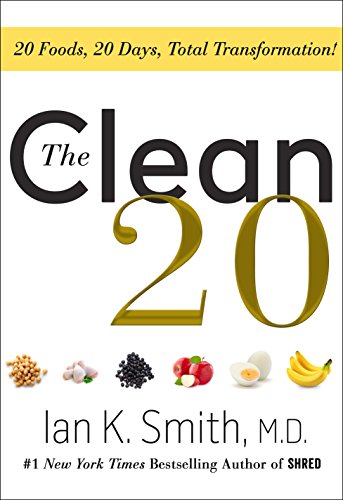
From the New York Times bestselling author of SHRED and Blast the Sugar Out, the ultimate guide to clean eating!
What is clean eating? In his newest diet book, Dr. Ian K. Smith teaches readers the benefits of clean eating and how to implement it in their own lives. He tells readers how to easily reduce unhealthy processed foods in their diets, a key to weight loss, disease prevention, and overall health. The Clean 20 focuses on twenty clean foods--from avocado to whole wheat pasta and everything in between--that readers can easily find, prepare, and incorporate into their diets. The Clean 20 includes a complete clean eating program with a daily meal plan, 60 recipes and substitutions, as well as 20 minute easy-to-work-in workouts.
Dr. Ian knows what works: it’s not eliminating food groups, but choosing foods within each group wisely to satisfy the palate and the body’s nutritional demands. The Clean 20 isn’t just vegetables. Grains are in. And so is fruit, fat, meat and fish. When palate and nutrition are in sync, weight loss not only follows, it sticks. The Clean 20 is a life and body changer.
Die Inhaltsangabe kann sich auf eine andere Ausgabe dieses Titels beziehen.
Über die Autorin bzw. den Autor
Ian K. Smith, M.D. is the #1 New York Times bestselling author of SHRED, SUPER SHRED, The SHRED Power Cleanse and Blast the Sugar Out. He has created two national health initiatives--the 50 Million Pound Challenge and the Makeover Mile—and has served two terms on the President’s Council on Fitness, Sports, and Nutrition. A graduate of Harvard, Columbia, and the University of Chicago’s Pritzker School of Medicine, Smith is an avid fitness enthusiast and sportsman.
Auszug. © Genehmigter Nachdruck. Alle Rechte vorbehalten.
The Clean 20
20 Foods, 20 Days, Total Transformation
By Ian K. SmithSt. Martin's Press
Copyright © 2018 Ian K. Smith
All rights reserved.
ISBN: 978-1-250-18207-4All rights reserved.
Contents
Title Page,
Copyright Notice,
Dedication,
Acknowledgments,
Introduction,
Part I: The Foundation,
one. What Is Clean Eating?,
two. The Clean 20 Foods,
Part II: The Plan,
three. The Clean 20 Rules,
four. How the Clean 20 Works,
five. The Clean 20 Daily Meal Plan,
six. Reemergence,
Part III: The Bonus,
seven. The Clean 20 Recipes,
eight. Clean Snacks,
nine. Exercises,
Index,
Also by Ian K. Smith, M.D.,
About the Author,
Copyright,
CHAPTER 1
What Is Clean Eating?
Clean eating is a concept and term that has been around for decades but has become fashionable in the last several years as health trends in general have gained popularity from being promoted in reality shows to fitness centers to tiny kitchens across the country. In its simplest form, clean eating is based on the basic premise that eating more natural, less-processed foods is not only good for one's health, but equally important for the environment. Food that crosses our table in a form closest to what it looked like coming out of the ground or off a tree has been considered to be the healthiest and the natural order of humankind's engagement with the environment. Free of chemicals, artificial ingredients, and other potentially toxic additives, clean food represents the best there is to nourish and fuel our bodies.
The clean-eating movement, like any other popular trend (paleo, gluten-free, raw) has not been immune to detractors who claim that it unfairly demonizes certain food groups, takes the concept of avoiding processed foods to the extreme, is too expensive, and is impractical for most people to follow for an extended period of time. It has given birth to many derivative programs that fall under the general category of clean eating but have subtle and sometimes major differences in philosophy and execution strategies. Ask fifteen nutritionists to define clean eating and you are likely to get fifteen different answers. But there is a theme that runs through most of these answers, a common core that gives form to the basic concept of eating foods in their most natural state with as little manipulation as possible.
In The Clean 20, I will set forth some basic clean-eating principals that will serve you well and help you make informed decisions when it comes to nourishing the world's most awesome machine — your body. Clean eating is not at all about perfection. It is not about a rigid, dense cadre of rules and penalties that must be strictly adhered to in order to benefit from the tremendous health value of food. Clean eating can benefit all of us and at the same time not be overly expensive, overly restrictive, or inaccessible. Remember that some of a good thing is still better than none of a good thing, and to think harshly of those who do not believe in austere eating principles is a misplaced judgment.
Reducing Processed Foods
Despite what some purists think, not all processed foods are bad for you and some processed foods still can fall under the category of clean foods. The term "processed" is considered to be the equivalent of unhealthy by many, and for good reason. Take grains, for example. In their processing methods, manufacturers will take the whole grain and refine, mill, or process it by taking away part or parts of the three-part grain (bran, endosperm, germ). This could mean losing as many as fifteen or more different nutrients. Once the manufacturers have stripped the grain, they then use a process to add some — but not all — of the nutrients back. This is where the word "enriched," which you may have seen on bread or cracker packaging, comes from. This is why it's better to choose an "unrefined" grain over a "refined" grain and it's important to pay attention to labels such as "100% whole grain" or "100% whole wheat." When it comes to bread, that 100% makes a big difference. Multigrain might seem like the same thing, but it's not: multigrain simply means many grains. This is not a guarantee that grains are whole. You could still be eating many grains that are refined.
There is no hard and fast rule when it comes to how many ingredients should be in a clean food, but many nutritionists suggest that if a product has more than five or six ingredients, then it's likely not to be very "clean." It's easy to look at the food label and check the ingredients list. If a package does not have a list of ingredients and you aren't certain of what it contains, it's prudent to either confirm the information or approach the product with a fair degree of caution.
Decreasing Added Sugars
Plenty of foods naturally contain sugar. Fruits, for example, should be part of the foundation of any good eating regimen, and many fruits contain lots of natural sugars. (Some have less sugar: apples, avocados, blackberries, grapefruit, peaches, oranges, raspberries, strawberries.) What a lot of people don't know is that many vegetables also naturally contain sugar. Peppers, carrots, parsnips, radishes, squash, potatoes, corn, and peas are just a few examples of sugar-containing vegetables. Demanding all clean foods be free of sugar is nonsensical, as that would mean eliminating fruits and vegetables that are the staples of any healthy diet.
But what does make sense is eliminating foods that have added sugars. In the course of processing foods, manufacturers are keen to add sugar to the mix. This makes complete sense from a business perspective, as sugar is highly satisfying to the palate and addictive. If people like the sugar and it will sell, then give them the sugar; health consequences typically take a back seat to the financial concerns. The major food and beverage sources that contain added sugars include candy, cakes, cookies, donuts, pastries, sweet rolls, pies, sodas or soft drinks, energy drinks, sports drinks, and fruit drinks such as fruitades and fruit punch.
A study published in JAMA Internal Medicine found that added sugars make up at least 10% of the calories the average American eats in a day. But approximately one in ten people get an enormous 25% of their calories from added sugar. Why does this matter? Because the findings of this study were earthshattering. Over the course of this fifteen-year study, participants who took in 25% or more of their daily calories as sugar were more than twice as likely to die from heart disease compared to those who included less than 10% added sugar in their diets. The study went one step further and concluded that the odds of dying from heart disease rose in tandem with the percentage of sugar in the diet, something that was true regardless of a person's age, sex, physical activity level, or body-mass index (BMI).
It's important when looking at labels to be able to identify these added sugars. The ingredients list is created in a specific way. Ingredients are listed in descending order, which means the closer it is to the front of the list the higher a percentage it is in the food. But you must be careful. Just because you might see sugar listed as the fifth ingredient doesn't mean it is not the ingredient with the highest percentage. Sugars have lots of different names, many of which you are not going to recognize. So, if the ingredients list has corn syrup as number three, dextrose as number five, cane sugar as number six,...
„Über diesen Titel“ kann sich auf eine andere Ausgabe dieses Titels beziehen.
Suchergebnisse für The Clean 20: 20 Foods, 20 Days, Total Transformation

Beispielbild für diese ISBN
The Clean 20: 20 Foods, 20 Days, Total Transformation
Anbieter: World of Books (was SecondSale), Montgomery, IL, USA
Verkäuferbewertung 5 von 5 Sternen

Hardback. Zustand: Good. New York Times bestseller From the bestselling author of SHRED and Blast the Sugar Out, the ultimate guide to clean eating! What is clean eating? In his newest diet book, Dr. Ian K. Smith teaches readers the benefits of clean eating and how to implement it in their own lives. He tells readers how to easily reduce unhealthy processed foods in their diets, a key to weight loss, disease prevention, and overall health. The Clean 20 focuses on twenty clean foods--from avocado to whole wheat pasta and everything in between--that readers can easily find, prepare, and incorporate into their diets. The Clean 20 includes a complete clean eating program with a daily meal plan, 60 recipes and substitutions, as well as 20 minute easy-to-work-in workouts. Dr. Ian knows what works: it's not eliminating food groups, but choosing foods within each group wisely to satisfy the palate and the body's nutritional demands. The Clean 20 isn't just vegetables. Grains are in. And so is fruit, fat, meat and fish. When palate and nutrition are in sync, weight loss not only follows, it sticks. The Clean 20 is a life and body changer. Artikel-Nr. 00086860683
Gebraucht kaufen
EUR 3,87
Versand gratis
Versand innerhalb von USA
Versand innerhalb von USA
Anzahl: 15 verfügbar
Beispielbild für diese ISBN
The Clean 20: 20 Foods, 20 Days, Total Transformation
Verlag:
St. Martin's Press (edition 1), 2018
ISBN 10: 1250182077
ISBN 13: 9781250182074
Gebraucht
Hardcover
Anbieter: BooksRun, Philadelphia, PA, USA
Verkäuferbewertung 5 von 5 Sternen
Hardcover. Zustand: Very Good. 1. With dust jacket. It's a well-cared-for item that has seen limited use. The item may show minor signs of wear. All the text is legible, with all pages included. It may have slight markings and/or highlighting. Artikel-Nr. 1250182077-11-1-29
Gebraucht kaufen
EUR 4,84
Versand gratis
Versand innerhalb von USA
Versand innerhalb von USA
Anzahl: 2 verfügbar
Beispielbild für diese ISBN
The Clean 20: 20 Foods, 20 Days, Total Transformation
Verlag:
St. Martin's Press (edition 1), 2018
ISBN 10: 1250182077
ISBN 13: 9781250182074
Gebraucht
Hardcover
Anbieter: BooksRun, Philadelphia, PA, USA
Verkäuferbewertung 5 von 5 Sternen
Hardcover. Zustand: Very Good. 1. With dust jacket. It's a well-cared-for item that has seen limited use. The item may show minor signs of wear. All the text is legible, with all pages included. It may have slight markings and/or highlighting. Artikel-Nr. 1250182077-8-18-29
Gebraucht kaufen
EUR 5,56
Versand gratis
Versand innerhalb von USA
Versand innerhalb von USA
Anzahl: 1 verfügbar
Beispielbild für diese ISBN
The Clean 20: 20 Foods, 20 Days, Total Transformation
Verlag:
St. Martin's Press (edition 1), 2018
ISBN 10: 1250182077
ISBN 13: 9781250182074
Gebraucht
Hardcover
Anbieter: BooksRun, Philadelphia, PA, USA
Verkäuferbewertung 5 von 5 Sternen
Hardcover. Zustand: Very Good. 1. With dust jacket. It's a well-cared-for item that has seen limited use. The item may show minor signs of wear. All the text is legible, with all pages included. It may have slight markings and/or highlighting. Artikel-Nr. 1250182077-8-1-29
Gebraucht kaufen
EUR 5,70
Versand gratis
Versand innerhalb von USA
Versand innerhalb von USA
Anzahl: 2 verfügbar
Beispielbild für diese ISBN
The Clean 20: 20 Foods, 20 Days, Total Transformation
Anbieter: ThriftBooks-Atlanta, AUSTELL, GA, USA
Verkäuferbewertung 5 von 5 Sternen
Hardcover. Zustand: As New. No Jacket. Pages are clean and are not marred by notes or folds of any kind. ~ ThriftBooks: Read More, Spend Less. Artikel-Nr. G1250182077I2N00
Gebraucht kaufen
EUR 5,96
Versand gratis
Versand innerhalb von USA
Versand innerhalb von USA
Anzahl: 1 verfügbar
Beispielbild für diese ISBN
The Clean 20: 20 Foods, 20 Days, Total Transformation
Anbieter: ThriftBooks-Dallas, Dallas, TX, USA
Verkäuferbewertung 5 von 5 Sternen
Hardcover. Zustand: As New. No Jacket. Pages are clean and are not marred by notes or folds of any kind. ~ ThriftBooks: Read More, Spend Less. Artikel-Nr. G1250182077I2N00
Gebraucht kaufen
EUR 5,96
Versand gratis
Versand innerhalb von USA
Versand innerhalb von USA
Anzahl: 1 verfügbar
Beispielbild für diese ISBN
The Clean 20: 20 Foods, 20 Days, Total Transformation
Anbieter: ThriftBooks-Reno, Reno, NV, USA
Verkäuferbewertung 5 von 5 Sternen
Hardcover. Zustand: As New. No Jacket. Pages are clean and are not marred by notes or folds of any kind. ~ ThriftBooks: Read More, Spend Less. Artikel-Nr. G1250182077I2N00
Gebraucht kaufen
EUR 5,96
Versand gratis
Versand innerhalb von USA
Versand innerhalb von USA
Anzahl: 1 verfügbar
Beispielbild für diese ISBN
The Clean 20 : 20 Foods, 20 Days, Total Transformation
Verlag:
St. Martin's Press, 2018
ISBN 10: 1250182077
ISBN 13: 9781250182074
Gebraucht
Hardcover
Erstausgabe
Anbieter: Better World Books, Mishawaka, IN, USA
Verkäuferbewertung 5 von 5 Sternen
Zustand: Very Good. 1st Edition. Pages intact with possible writing/highlighting. Binding strong with minor wear. Dust jackets/supplements may not be included. Stock photo provided. Product includes identifying sticker. Better World Books: Buy Books. Do Good. Artikel-Nr. 15303331-6
Gebraucht kaufen
EUR 6,19
Versand gratis
Versand innerhalb von USA
Versand innerhalb von USA
Anzahl: 2 verfügbar
Beispielbild für diese ISBN
The Clean 20 : 20 Foods, 20 Days, Total Transformation
Verlag:
St. Martin's Press, 2018
ISBN 10: 1250182077
ISBN 13: 9781250182074
Gebraucht
Hardcover
Erstausgabe
Anbieter: Better World Books, Mishawaka, IN, USA
Verkäuferbewertung 5 von 5 Sternen
Zustand: Good. 1st Edition. Pages intact with minimal writing/highlighting. The binding may be loose and creased. Dust jackets/supplements are not included. Stock photo provided. Product includes identifying sticker. Better World Books: Buy Books. Do Good. Artikel-Nr. 14827223-6
Gebraucht kaufen
EUR 6,19
Versand gratis
Versand innerhalb von USA
Versand innerhalb von USA
Anzahl: 1 verfügbar
Beispielbild für diese ISBN
The Clean 20 : 20 Foods, 20 Days, Total Transformation
Verlag:
St. Martin's Press, 2018
ISBN 10: 1250182077
ISBN 13: 9781250182074
Gebraucht
Hardcover
Erstausgabe
Anbieter: Better World Books: West, Reno, NV, USA
Verkäuferbewertung 5 von 5 Sternen
Zustand: Very Good. 1st Edition. Pages intact with possible writing/highlighting. Binding strong with minor wear. Dust jackets/supplements may not be included. Stock photo provided. Product includes identifying sticker. Better World Books: Buy Books. Do Good. Artikel-Nr. 15303331-6
Gebraucht kaufen
EUR 6,19
Versand gratis
Versand innerhalb von USA
Versand innerhalb von USA
Anzahl: 1 verfügbar