
Verwandte Artikel zu One Nation After Trump: A Guide for the Perplexed,...
One Nation After Trump: A Guide for the Perplexed, the Disillusioned, the Desperate, and the Not-Yet Deported - Hardcover
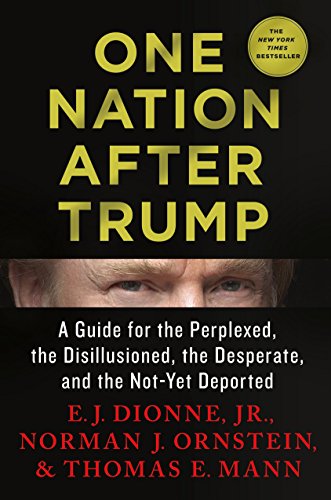
Inhaltsangabe
THE INSTANT NEW YORK TIMES AND WASHINGTON POST BESTSELLER
A call to action from three of Washington's premier political scholar-journalists, One Nation After Trump offers the definitive work on the threat posed by the Trump presidency and how to counter it.
American democracy was never supposed to give the nation a president like Donald Trump. We have never had a president who gave rise to such widespread alarm about his lack of commitment to the institutions of self-government, to the norms democracy requires, and to the need for basic knowledge about how government works. We have never had a president who raises profound questions about his basic competence and his psychological capacity to take on the most challenging political office in the world.
Yet if Trump is both a threat to our democracy and a product of its weaknesses, the citizen activism he has inspired is the antidote. The reaction to the crisis created by Trump’s presidency can provide the foundation for an era of democratic renewal and vindicate our long experiment in self-rule.
The award-winning authors of One Nation After Trump explain Trump’s rise and the danger his administration poses to our free institutions. They also offer encouragement to the millions of Americans now experiencing a new sense of citizenship and engagement and argue that our nation needs a unifying alternative to Trump’s dark and divisive brand of politics—an alternative rooted in a New Economy, a New Patriotism, a New Civil Society, and a New Democracy. One Nation After Trump is the essential book for our era, an unsparing assessment of the perils facing the United States and an inspiring roadmap for how we can reclaim the future.
Die Inhaltsangabe kann sich auf eine andere Ausgabe dieses Titels beziehen.
Über die Autorin bzw. den Autor
E.J. Dionne, Jr., is a columnist for The Washington Post, Senior Fellow at the Brookings Institution, and professor at Georgetown University. Thomas E. Mann is a resident scholar at the Institute of Governmental Studies at the University of California, Berkeley and a Senior Fellow at the Brookings Institution. Norman J. Ornstein is Resident Scholar the American Enterprise Institute and a contributing editor and columnist for National Journal and The Atlantic. They are the authors of recent New York Times bestsellers, Dionne’s Why the Right Went Wrong and Mann and Ornstein’s It’s Even Worse Than It Looks.
Auszug. © Genehmigter Nachdruck. Alle Rechte vorbehalten.
One Nation After Trump
A Guide for the Perplexed, the Disillusioned, the Desperate, and the Not-Yet Deported
By E. J. Dionne Jr., Norman J. Ornstein, Thomas E. MannSt. Martin's Press
Copyright © 2017 E. J. Dionne, Jr., Norman J. Ornstein, and Thomas E. Mann
All rights reserved.
ISBN: 978-1-250-16405-6All rights reserved.
Contents
Title Page,
Dedication,
Epigraph,
INTRODUCTION When a Crisis Is an Opportunity: The Perils of Trumpism and the Call to Engagement,
PART ONE Trump and Trumpism,
ONE Trumpian Misconceptions: What Trump's Election Meant, What It Didn't, and Why Trumpism Doesn't Own the Future,
TWO When the Truth Doesn't Matter: The Crisis of the Media and the Rise of "Alternative Facts",
THREE Bad Behavior: The Disappearing Norms of American Politics,
FOUR A Penchant for Authoritarianism: How Trump Intimidates Opponents, Promotes Kleptocracy, and Challenges the Rule of Law,
FIVE Phony Friend of the Working Class: Trump, "Populism," and the New Politics of the Far Right,
SIX Race, Immigration, Culture, or Economics? The Complicated Motivations of the Trump Voter,
PART TWO The Way Forward,
SEVEN With Opportunity and Justice for All: Building a New Economy,
EIGHT Yearning to Breathe Free: Discovering a New Patriotism,
NINE Our Little Platoons: The Urgency of a New Civil Society,
TEN What "Draining the Swamp" Really Looks Like: Bringing a New Democracy to Life,
ELEVEN "Show Up, Dive In, Stay at It": Building One Nation After Trump,
Acknowledgments,
Notes,
Index,
About the Authors,
Earlier Titles,
Copyright,
CHAPTER 1
Trumpian Misconceptions
What Trump's Election Meant, What It Didn't, and Why Trumpism Doesn't Own the Future
Two moments define Donald Trump's rise to power.
March 2011: Trump initiated his long entanglement with birtherism, the false claim that President Obama had not been born in the United States and was therefore ineligible to be president. In a March 17 interview on ABC's Good Morning America, he told Ashleigh Banfield: "If I ever got the nomination, if I ever decide to run, you may go back and interview people from my kindergarten, they'll remember me. Nobody ever comes forward. Nobody knows who he is until later in his life. It's very strange. The whole thing is very strange." Six days later, on The View, Trump asked Whoopi Goldberg and Barbara Walters, "Why doesn't he show his birth certificate?" He added: "I wish he would because I think it's a terrible pall that's hanging over him. ... There's something on that birth certificate that he doesn't like."
The outbursts crystallized all that was wrong with Trump — and also how he would get to the White House. He was a shameless liar, and unapologetically demagogic. He would rally the angriest wing of the Republican Party by exploiting its racial and religious fears and prejudices.
June 10, 2014: In a Republican primary result almost no one expected, Eric Cantor, the House Republican majority leader, was ousted by a little-known college professor named Dave Brat. The routing of a thoroughly conservative Republican leader by the Tea Party, a movement Cantor himself had extolled, was a sign of how vulnerable traditional Republican politicians were to challenges from inside their party. No matter how much they tried to appease the GOP far right, more would be demanded of them. Brat's campaign was a prototype of what was to come.
He fiercely attacked Cantor as beholden to the party's moneyed interests and soft on immigration. "Eric is running on the Chamber of Commerce and Business Roundtable principles," Brat told an audience of Tea Party supporters. "They want amnesty for illegal immigrants. They want them granted citizenship. And it's in the millions — 40 millions — coming in."
Brat, the prototype of a new nationalist, populist-sounding far right, explicitly denounced Cantor as a tool of Wall Street. "All the investment banks in the New York [sic] and D.C. — those guys should have gone to jail. Instead of going to jail, they went on Eric's Rolodex, and they are sending him big checks," Brat said. "They get cheap labor," he added of big business, "but everyone in the 7th district gets cheap wages."
John Judis, a journalist who closely followed the Tea Party and other populist movements, accurately noted at the time that Brat, a libertarian, would likely end up being far more business-friendly than he advertised himself in the campaign. But Judis added presciently that "in defeating Cantor, Brat echoed the age-old, darker, and more complicated themes of right-wing populism. These themes will continue to resonate, even if Brat abandons them."
They did, for Donald Trump. At the time, the front-running Republican presidential candidates did not make the connection. In 2016, this would prove to be politically fatal for Jeb Bush, Marco Rubio, John Kasich, and even Ted Cruz. In more moderate tones in the cases of Bush, Rubio, and, especially, Kasich, and with a harder edge in Cruz's, all would count on a mainstream conservative message to deliver them the party's nomination. Cantor might have warned them that a large contingent of the GOP rank and file was looking for something more incendiary.
* * *
Because Trump's rise to the presidency surprised nearly everyone (including the authors of this book and, it would appear from the evidence, Trump himself), he and his supporters have taken to scoffing at any and all analysts who, since his victory, have pointed to the underlying weakness of his position: his loss of the popular vote, his low favorability ratings throughout the campaign, and his record-low approval numbers on Inauguration Day. The idea seems to be that those who saw Trump as an unlikely president before Election Day are doomed to be wrong about everything they say now about the trouble he faces.
Humility is certainly a virtue, and it's fair to preach its benefits in the wake of the difficulties prognosticators confronted in 2016. But in fact, the predictions that Trump would never appeal to a majority of Americans were correct.
It is important to remember the basic facts of 2016. Trump's victory was a very close-run thing — a matter of 77,744 votes in three crucial states, almost certainly enabled by the intervention at the end of the campaign by then–FBI Director James Comey, who made Hillary Clinton's controversial use of email central to the dialogue in the final ten days before voting. Trump was also helped immensely by the interference of the Russian government and the heavy play throughout the fall of disclosures from hacked Democratic emails. There was also evidence that the two events overlapped — that Russian disinformation about the Obama Justice Department's handling of the email investigation may have prompted Comey's aggressively critical public comments about Clinton.
And it was no trivial matter that Trump lost the popular vote to Clinton by some 2.9 million ballots and ran nearly 11 million votes behind the combined Democratic, Libertarian, and Green totals. Trump received 62,984,824 votes, a gain of 2,051,167 over Mitt Romney's 2012 total. Nationwide, Clinton received 65,853,516 votes, just 62,419 fewer than Obama. A monumental shift in the nature of the nation's political leadership was enabled by relatively modest shifts in the electorate.
Trump's victory was less an endorsement of his program than a rejection of Clinton. Exit polling found that in the...
„Über diesen Titel“ kann sich auf eine andere Ausgabe dieses Titels beziehen.
Suchergebnisse für One Nation After Trump: A Guide for the Perplexed,...

Beispielbild für diese ISBN
One Nation After Trump: A Guide for the Perplexed, the Disillusioned, the Desperate, and the Not-Yet Deported
Anbieter: World of Books (was SecondSale), Montgomery, IL, USA
Verkäuferbewertung 5 von 5 Sternen

Zustand: Very Good. Item in very good condition! Textbooks may not include supplemental items i.e. CDs, access codes etc. Artikel-Nr. 00110190130
Gebraucht kaufen
EUR 3,54
Versand gratis
Versand innerhalb von USA
Versand innerhalb von USA
Anzahl: 1 verfügbar
Beispielbild für diese ISBN
One Nation After Trump: A Guide for the Perplexed, the Disillusioned, the Desperate, and the Not-Yet Deported
Anbieter: World of Books (was SecondSale), Montgomery, IL, USA
Verkäuferbewertung 5 von 5 Sternen
Zustand: Good. Item in good condition. Textbooks may not include supplemental items i.e. CDs, access codes etc. Artikel-Nr. 00091245622
Gebraucht kaufen
EUR 3,54
Versand gratis
Versand innerhalb von USA
Versand innerhalb von USA
Anzahl: 12 verfügbar
Beispielbild für diese ISBN
One Nation After Trump: A Guide for the Perplexed, the Disillusioned, the Desperate, and the Not-Yet Deported
Verlag:
St. Martin's Press (edition First Edition), 2017
ISBN 10: 1250164052
ISBN 13: 9781250164056
Gebraucht
Hardcover
Erstausgabe
Anbieter: BooksRun, Philadelphia, PA, USA
Verkäuferbewertung 5 von 5 Sternen
Hardcover. Zustand: Fair. First Edition. The item might be beaten up but readable. May contain markings or highlighting, as well as stains, bent corners, or any other major defect, but the text is not obscured in any way. Artikel-Nr. 1250164052-7-1-13
Gebraucht kaufen
EUR 5,06
Versand gratis
Versand innerhalb von USA
Versand innerhalb von USA
Anzahl: 1 verfügbar
Beispielbild für diese ISBN
One Nation after Trump : A Guide for the Perplexed, the Disillusioned, the Desperate, and the Not-Yet Deported
Anbieter: Better World Books, Mishawaka, IN, USA
Verkäuferbewertung 5 von 5 Sternen
Zustand: Good. Pages intact with minimal writing/highlighting. The binding may be loose and creased. Dust jackets/supplements are not included. Stock photo provided. Product includes identifying sticker. Better World Books: Buy Books. Do Good. Artikel-Nr. 14063964-6
Gebraucht kaufen
EUR 5,98
Versand gratis
Versand innerhalb von USA
Versand innerhalb von USA
Anzahl: 1 verfügbar
Beispielbild für diese ISBN
One Nation after Trump : A Guide for the Perplexed, the Disillusioned, the Desperate, and the Not-Yet Deported
Anbieter: Better World Books: West, Reno, NV, USA
Verkäuferbewertung 5 von 5 Sternen
Zustand: Good. Former library copy. Pages intact with minimal writing/highlighting. The binding may be loose and creased. Dust jackets/supplements are not included. Includes library markings. Stock photo provided. Product includes identifying sticker. Better World Books: Buy Books. Do Good. Artikel-Nr. 14398948-6
Gebraucht kaufen
EUR 5,98
Versand gratis
Versand innerhalb von USA
Versand innerhalb von USA
Anzahl: 2 verfügbar
Beispielbild für diese ISBN
One Nation After Trump: A Guide for the Perplexed, the Disillusioned, the Desperate, and the Not-Yet Deported
Anbieter: ThriftBooks-Dallas, Dallas, TX, USA
Verkäuferbewertung 5 von 5 Sternen
Hardcover. Zustand: Very Good. No Jacket. May have limited writing in cover pages. Pages are unmarked. ~ ThriftBooks: Read More, Spend Less. Artikel-Nr. G1250164052I4N00
Gebraucht kaufen
EUR 6,12
Versand gratis
Versand innerhalb von USA
Versand innerhalb von USA
Anzahl: 1 verfügbar
Beispielbild für diese ISBN
One Nation After Trump: A Guide for the Perplexed, the Disillusioned, the Desperate, and the Not-Yet Deported
Anbieter: ThriftBooks-Atlanta, AUSTELL, GA, USA
Verkäuferbewertung 5 von 5 Sternen
Hardcover. Zustand: As New. No Jacket. Pages are clean and are not marred by notes or folds of any kind. ~ ThriftBooks: Read More, Spend Less. Artikel-Nr. G1250164052I2N00
Gebraucht kaufen
EUR 6,12
Versand gratis
Versand innerhalb von USA
Versand innerhalb von USA
Anzahl: 1 verfügbar
Beispielbild für diese ISBN
One Nation After Trump: A Guide for the Perplexed, the Disillusioned, the Desperate, and the Not-Yet Deported
Anbieter: ThriftBooks-Atlanta, AUSTELL, GA, USA
Verkäuferbewertung 5 von 5 Sternen
Hardcover. Zustand: Very Good. No Jacket. Missing dust jacket; May have limited writing in cover pages. Pages are unmarked. ~ ThriftBooks: Read More, Spend Less. Artikel-Nr. G1250164052I4N01
Gebraucht kaufen
EUR 6,12
Versand gratis
Versand innerhalb von USA
Versand innerhalb von USA
Anzahl: 1 verfügbar
Beispielbild für diese ISBN
One Nation After Trump: A Guide for the Perplexed, the Disillusioned, the Desperate, and the Not-Yet Deported
Anbieter: Wonder Book, Frederick, MD, USA
Verkäuferbewertung 5 von 5 Sternen
Zustand: Good. Good condition. Good dust jacket. A copy that has been read but remains intact. May contain markings such as bookplates, stamps, limited notes and highlighting, or a few light stains. Artikel-Nr. S24L-00139
Gebraucht kaufen
EUR 6,21
Versand gratis
Versand innerhalb von USA
Versand innerhalb von USA
Anzahl: 1 verfügbar
Beispielbild für diese ISBN
One Nation After Trump: A Guide for the Perplexed, the Disillusioned, the Desperate, and the Not-Yet Deported
Anbieter: Wonder Book, Frederick, MD, USA
Verkäuferbewertung 5 von 5 Sternen
Zustand: Very Good. Very Good condition. Very Good dust jacket. A copy that may have a few cosmetic defects. May also contain light spine creasing or a few markings such as an owner's name, short gifter's inscription or light stamp. Artikel-Nr. A05A-05847
Gebraucht kaufen
EUR 6,21
Versand gratis
Versand innerhalb von USA
Versand innerhalb von USA
Anzahl: 1 verfügbar