
Verwandte Artikel zu From the Left: A Life in the Crossfire
Inhaltsangabe
THE WASHINGTON POST BESTSELLER
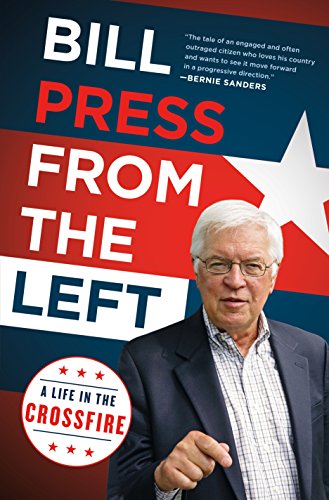
"Bill Press has done it all. He was the Chair of the California Democratic Party, he has been involved in numerous campaigns, he has been a prolific writer, and has worked as a host and commentator on radio and TV. In other words, he knows politics inside and out. This is the tale of an engaged and often outraged citizen who loves his country and wants to see it move forward in a progressive direction." ―Senator Bernie Sanders
A memoir of talk radio host and political commentator Bill Press.
The name Bill Press is synonymous with honest journalism, intelligent commentary, and progressive politics.
But based on where he came from, it's a wonder he didn't end up a Trump voter. He grew up in a blue-collar family in a small town in Delaware south of the Mason-Dixon line, where segregation was the rule. As a Catholic, he was taught that abortion, divorce, sex outside of marriage, and homosexuality were morally wrong: beliefs later reinforced in ten years of seminary studies for the priesthood. He was on his way to be a rock-ribbed conservative.
So what went right for him that he swerved so far to the left?
In From the Left, Press shows this gradual transformation, starting with two years of studies in Europe and a providential escape to California. From Sacramento he made his way to Southern California television and talk radio as a political commentator and liberal talk show host. Jumping to Washington and national cable TV, Press hosted Crossfire and The Spin Room on CNN, and Buchanan and Press on MSNBC. A member of the White House Press Corps and columnist for Tribune Media Services and The Hill, Press was an early supporter of Bernie Sanders and hosted two of the Senator's first presidential strategy sessions in his living room.
If you're already on the left, you'll cheer a fellow traveler. If not yet there, you soon will be.
Die Inhaltsangabe kann sich auf eine andere Ausgabe dieses Titels beziehen.
Über die Autorin bzw. den Autor
BILL PRESS is the host of the nationally syndicated radio program The Bill Press Show. He writes a syndicated column for Tribune Media Services, and is the former cohost of MSNBC’s Buchanan and Press and CNN’s Crossfire and The Spin Room.
Auszug. © Genehmigter Nachdruck. Alle Rechte vorbehalten.
From The Left
A Life in the Crossfire
By Bill PressSt. Martin's Press
Copyright © 2018 Bill Press
All rights reserved.
ISBN: 978-1-250-14715-8All rights reserved.
Contents
TITLE PAGE,
COPYRIGHT NOTICE,
DEDICATION,
PREFACE: "DON'T TAKE NO SHIT!",
EPIGRAPH,
1 CANAL RAT ON THE DELAWARE,
2 JOINING GOD'S ARMY,
3 CALIFORNIA DREAMIN',
4 LOWER YOUR EXPECTATIONS,
5 BILL PRESS, TRUE AMERICAN,
6 BILL PRESS FOR SENATE,
7 "PAT, YOU IGNORANT SLUT!",
8 MSNBC AND BEYOND,
9 LIFE INSIDE THE BELTWAY,
10 FEEL THE BERN,
PHOTOGRAPHS,
ACKNOWLEDGMENTS,
INDEX,
ALSO BY BILL PRESS,
ABOUT THE AUTHOR,
COPYRIGHT,
CHAPTER 1
CANAL RAT ON THE DELAWARE
Delaware City is a little town that could have, but never did. But it's where I grew up. And I still love it.
It was originally settled as Newbold's Landing, surrounded by peach orchards, a small port on the Delaware River serving farmers in southern New Castle County. In 1829, it suddenly grew to prominence — and was renamed Delaware City — when it became the eastern terminus of the newly constructed Chesapeake and Delaware Canal, linking the Chesapeake Bay to the Delaware River, and Baltimore to Philadelphia.
Delaware City's at the east end of the canal; Chesapeake City, at the west end. As a kid, I remember being shown an old map on the wall of our town hall that projected Delaware City to grow bigger than Philadelphia was at the time. But that was not to be.
By the turn of the century, many larger ships could no longer squeeze through the locks at Delaware City. So, on January 31, 1927, the locks on the old canal shut down and a new, wider, and straighter canal opened. It was rerouted to enter the Delaware River at sea level at Reedy Point, a mile to the south of Delaware City. Grand plans for the next Philadelphia collapsed. And Delaware City remained a small town with a big name.
Today, Delaware City's much the same as it was back then: a quaint, sleepy, forgotten, little one-traffic-light town on the banks of the Delaware River, nine miles south of historic New Castle. The running joke among locals is that Delaware City's population is 1,200. At low tide, that is. Only 900 at high tide.
It was in Delaware City that I spent the first eighteen years of my life. And — for a young white boy, at least — it was a magical place to grow up: an Ozzie and Harriet kind of town, where everybody knew everybody else, where neighbors and family looked out for one other, where nobody had much money but it didn't really matter, and where life centered around work, church, and school. I only realized later that not all of Delaware City's residents had it so good.
I might as well admit this, too: For those first eighteen years, I was not known as Bill Press, either. I was stuck with the family nickname: Chippy, or simply Chip. My family called me that, I was told, because I had the same legal name — William Henry Press — as my father and grandfather before me. (My full name, in fact, which I never use, is William Henry Press III.) So they needed some way to tell us apart. And, besides, I was just a "chip off the old block."
I suffered that nickname gladly until the first day of my eighth grade class at Salesianum High School, when Oblate Scholastic Mr. Robert Lawler called the roll. After declaiming, "William Press," he asked, "What do they call you, son? Bill?"
At that point, I'd never been called Bill in my life, but I was too scared to contradict him. "Yes," I nervously stammered. And, from that day on, I've been Bill Press — everywhere, that is, but in Delaware City.
The Press family, part of the Cook Cousins clan, made up a big part of Delaware City, even at high tide. The family patriarch, my grandfather, William H. "Pop" Press Sr., was born on December 2, 1888, in Salem, New Jersey. He joined the army in World War I and was assigned to Fort DuPont in Delaware City, directly across the Delaware River from Salem. There, like many of my uncles and family friends, all fellow Fort DuPont alumni, he met and married a local girl, and never left.
For us grandkids, the big question, then and now, was: Where did the Press family come from? It's a question we often asked Pop-Pop Press, without ever getting a straight answer. He insisted he was a direct descendant of the Cherokee. As proof, he'd unbutton his shirt, show us his bare smooth chest, and ask, "You never saw an American Indian with hair on his chest, did you?" Not exactly a DNA test, but some of our family still believe that tall tale. Even as a kid, I always thought it was bullshit. And I am now more than ever convinced it was.
My first sign came while working at my first job in politics, as administrative assistant to San Francisco supervisor Roger Boas. One day, I accompanied Roger to a luncheon at one of the city's big synagogues. Roger, a prominent member of San Francisco's Jewish community, sat at the head table, alongside the president of the congregation, whose name was, curiously enough — Sam Press. Meanwhile, I was seated at a table in the back of the room, where everyone was speaking Yiddish. At one point, the woman next to me turned and whispered, "You do understand what we're talking about, don't you?" When I admitted I didn't have a clue, she was stunned. "What? A name like Press and you don't speak Yiddish?"
More evidence poured in, years later, once I popped up on television, first on KABC-TV in Los Angeles, and later on CNN and MSNBC. I've heard from dozens of people from all over the country with the same last name, none of them directly related to our Press family. Yet every one with the same story: their ancestors were Russian Jews who emigrated to the United States from Latvia.
I was especially struck one night, attending a black-tie event at the Dorothy Chandler Pavilion in downtown Los Angeles, when a friend asked if I knew Jim Press, then head of Toyota Motors for California (later head of Toyota for the entire country). When I said I'd never met him, my friend disappeared across the ballroom, only to reappear with the more famous Mr. Press in tow. Jim walked up, stuck out his hand, and gave me a big smile. The first two words out of his mouth were "Russian Jew!"
How could it be otherwise? I have since, hit or miss, traced Pop-Pop's family back to the 1830s, all in the Salem or Pennsville, New Jersey, area. In immigration records, I've also discovered several Presses arriving in the Philadelphia area from Latvia in the early nineteenth century, long before Ellis Island. So I'm convinced there's a connection, even though not yet firmly established. Interestingly, even in Latvia in the 1800s, the name was already Press — although, much earlier, it must have been shortened from a longer family name.
So I have long considered myself the Catholic descendant of a Russian Jew — a prospect that did not go down well with Grandmom Press, a loyal Catholic of German descent, who made sure all of her grandchildren were baptized and raised Catholic and went to Mass every Sunday. On one visit from California, I told her I'd heard from a lot of people around the country named Press and, after doing a little research on my own, concluded that Pop-Pop's family were originally Russian Jews. "No!" she snapped. "Pop-Pop weren't no Jew!" I thought afterward that maybe Grandmom Press's attitude toward Jewish people said a lot about why Pop-Pop hid his lineage. At any rate, I never met a (self-admitted) Jew...
„Über diesen Titel“ kann sich auf eine andere Ausgabe dieses Titels beziehen.
Suchergebnisse für From the Left: A Life in the Crossfire

Beispielbild für diese ISBN
From the Left: A Life in the Crossfire
Anbieter: World of Books (was SecondSale), Montgomery, IL, USA
Verkäuferbewertung 5 von 5 Sternen

Hardback. Zustand: Very Good. THE WASHINGTON POST BESTSELLER "Bill Press has done it all. He was the Chair of the California Democratic Party, he has been involved in numerous campaigns, he has been a prolific writer, and has worked as a host and commentator on radio and TV. In other words, he knows politics inside and out. This is the tale of an engaged and often outraged citizen who loves his country and wants to see it move forward in a progressive direction." --Senator Bernie Sanders A memoir of talk radio host and political commentator Bill Press. The name Bill Press is synonymous with honest journalism, intelligent commentary, and progressive politics. But based on where he came from, it's a wonder he didn't end up a Trump voter. He grew up in a blue-collar family in a small town in Delaware south of the Mason-Dixon line, where segregation was the rule. As a Catholic, he was taught that abortion, divorce, sex outside of marriage, and homosexuality were morally wrong: beliefs later reinforced in ten years of seminary studies for the priesthood. He was on his way to be a rock-ribbed conservative. So what went right for him that he swerved so far to the left? In From the Left, Press shows this gradual transformation, starting with two years of studies in Europe and a providential escape to California. From Sacramento he made his way to Southern California television and talk radio as a political commentator and liberal talk show host. Jumping to Washington and national cable TV, Press hosted Crossfire and The Spin Room on CNN, and Buchanan and Press on MSNBC. A member of the White House Press Corps and columnist for Tribune Media Services and The Hill, Press was an early supporter of Bernie Sanders and hosted two of the Senator's first presidential strategy sessions in his living room. If you're already on the left, you'll cheer a fellow traveler. If not yet there, you soon will be. Artikel-Nr. 00087681394
Gebraucht kaufen
EUR 5,77
Versand gratis
Versand innerhalb von USA
Versand innerhalb von USA
Anzahl: 2 verfügbar
Beispielbild für diese ISBN
From the Left: A Life in the Crossfire
Anbieter: World of Books (was SecondSale), Montgomery, IL, USA
Verkäuferbewertung 5 von 5 Sternen
Hardback. Zustand: Good. THE WASHINGTON POST BESTSELLER "Bill Press has done it all. He was the Chair of the California Democratic Party, he has been involved in numerous campaigns, he has been a prolific writer, and has worked as a host and commentator on radio and TV. In other words, he knows politics inside and out. This is the tale of an engaged and often outraged citizen who loves his country and wants to see it move forward in a progressive direction." --Senator Bernie Sanders A memoir of talk radio host and political commentator Bill Press. The name Bill Press is synonymous with honest journalism, intelligent commentary, and progressive politics. But based on where he came from, it's a wonder he didn't end up a Trump voter. He grew up in a blue-collar family in a small town in Delaware south of the Mason-Dixon line, where segregation was the rule. As a Catholic, he was taught that abortion, divorce, sex outside of marriage, and homosexuality were morally wrong: beliefs later reinforced in ten years of seminary studies for the priesthood. He was on his way to be a rock-ribbed conservative. So what went right for him that he swerved so far to the left? In From the Left, Press shows this gradual transformation, starting with two years of studies in Europe and a providential escape to California. From Sacramento he made his way to Southern California television and talk radio as a political commentator and liberal talk show host. Jumping to Washington and national cable TV, Press hosted Crossfire and The Spin Room on CNN, and Buchanan and Press on MSNBC. A member of the White House Press Corps and columnist for Tribune Media Services and The Hill, Press was an early supporter of Bernie Sanders and hosted two of the Senator's first presidential strategy sessions in his living room. If you're already on the left, you'll cheer a fellow traveler. If not yet there, you soon will be. Artikel-Nr. 00090109755
Gebraucht kaufen
EUR 5,77
Versand gratis
Versand innerhalb von USA
Versand innerhalb von USA
Anzahl: 2 verfügbar
Beispielbild für diese ISBN
From the Left: A Life in the Crossfire
Verlag:
Thomas Dunne Books (edition ), 2018
ISBN 10: 1250147158
ISBN 13: 9781250147158
Gebraucht
Hardcover
Anbieter: BooksRun, Philadelphia, PA, USA
Verkäuferbewertung 5 von 5 Sternen
Hardcover. Zustand: Very Good. With dust jacket. It's a well-cared-for item that has seen limited use. The item may show minor signs of wear. All the text is legible, with all pages included. It may have slight markings and/or highlighting. Artikel-Nr. 1250147158-11-1-29
Gebraucht kaufen
EUR 5,78
Versand gratis
Versand innerhalb von USA
Versand innerhalb von USA
Anzahl: 1 verfügbar
Beispielbild für diese ISBN
From the Left: A Life in the Crossfire
Anbieter: Wonder Book, Frederick, MD, USA
Verkäuferbewertung 5 von 5 Sternen
Zustand: Very Good. Very Good condition. Very Good dust jacket. A copy that may have a few cosmetic defects. May also contain light spine creasing or a few markings such as an owner's name, short gifter's inscription or light stamp. Artikel-Nr. F04A-08775
Gebraucht kaufen
EUR 6,45
Versand gratis
Versand innerhalb von USA
Versand innerhalb von USA
Anzahl: 1 verfügbar
Beispielbild für diese ISBN
From the Left : A Life in the Crossfire
Anbieter: Better World Books, Mishawaka, IN, USA
Verkäuferbewertung 5 von 5 Sternen
Zustand: Very Good. Former library copy. Pages intact with possible writing/highlighting. Binding strong with minor wear. Dust jackets/supplements may not be included. Includes library markings. Stock photo provided. Product includes identifying sticker. Better World Books: Buy Books. Do Good. Artikel-Nr. 15099581-75
Gebraucht kaufen
EUR 6,77
Versand gratis
Versand innerhalb von USA
Versand innerhalb von USA
Anzahl: 2 verfügbar
Beispielbild für diese ISBN
From the Left: A Life in the Crossfire
Verlag:
Thomas Dunne Books, 2018
ISBN 10: 1250147158
ISBN 13: 9781250147158
Gebraucht
Hardcover
Signiert
Anbieter: Wonder Book, Frederick, MD, USA
Verkäuferbewertung 5 von 5 Sternen
Zustand: Good. Signed Copy . Good dust jacket. Signed/Inscribed by author on half title page. Slightly dampstained. Artikel-Nr. D12OS-00479
Gebraucht kaufen
EUR 7,83
Versand gratis
Versand innerhalb von USA
Versand innerhalb von USA
Anzahl: 1 verfügbar
Foto des Verkäufers
From the left
Verlag:
Thomas Dunne Books, St. Martin's Press, 2018
ISBN 10: 1250147158
ISBN 13: 9781250147158
Gebraucht
Hardcover
Erstausgabe
Signiert
Anbieter: Southampton Books, Sag Harbor, NY, USA
Verkäuferbewertung 5 von 5 Sternen
Hardcover. Zustand: Like New. First Edition. First Edition, First Printing. Not price-clipped. Published by Thomas Dunne Books, St. Martin's Press, 2018. Signed by the author on the half title page. Octavo. Hardcover. Book is like new. Dust jacket is like new.100% positive feedback. 30 day money back guarantee. NEXT DAY SHIPPING! Excellent customer service. Please email with any questions. All books packed carefully and ship with free delivery confirmation/tracking. All books come with free bookmarks. Ships from Sag Harbor, New York. Artikel-Nr. 419136
Gebraucht kaufen
EUR 32,30
EUR 4,47 Versand
Versand innerhalb von USA
Versand innerhalb von USA
Anzahl: 1 verfügbar
Beispielbild für diese ISBN
From the Left; A Life in the Crossfire
ISBN 10: 1250147158
ISBN 13: 9781250147158
Gebraucht
Hardcover
Erstausgabe
Anbieter: Ground Zero Books, Ltd., Silver Spring, MD, USA
Verkäuferbewertung 5 von 5 Sternen
Hardcover. Zustand: Very good. Zustand des Schutzumschlags: Very good. Martin H. Simon (Cover photograph) (illustrator). xiii, [5], 267, [3] pages. Illustrations (some in color). Index. Inscribed and signed by the author on the title page. Inscription reads For Roxanne--From The Left! Bill Press. William H. Press (born April 8, 1940) is an American talk radio host, liberal Pundit, and author. He was chairman of the California Democratic Party from 1993 to 1996, and is a regular CNN political contributor. His weekly column is syndicated by Tribune Content Agency. Press started his broadcasting career in Los Angeles for TV stations KABC-TV and KCOP-TV. He has worked as a political commentator for CNN and MSNBC. He is best known for co-hosting CNN's Spin Room opposite Tucker Carlson, and Crossfire and MSNBC's Buchanan and Press. In this book, Bill Press shows his gradual transformation from the far right to the far left, starting with two years of studies in Europe and a providential escape to California. From Sacramento he made his way to Southern California television and talk radio as a political commentator and liberal talk-show host. Jumping to Washington and national cable TV, Press co-hosted Crossfire and the Spin Room on CNN, and Buchanan and Press on MSNBC. A member of the White House Press Corps, and a columnist for Tribune Media Services and The Hill, Press was an early supporter of Bernie Sanders, and hosted two of the senator's first peresidential-strargy sessions in his living room. Derived from a Kirkus review: A politically liberal radio and TV host reflects on his unconventional career path. Born in 1940, Press grew up in Delaware City. He has happy memories of his childhood and adolescence, but with the benefit of hindsight inflected by progressivism, he observes that life in his hometown was good "as long as you were white." His first encounter with politics came through his grandfather and father, both of whom served as mayor of their town. He wanted a career in public service. After a few years "protesting the war in Vietnam, counseling runaways in the Haight-Ashbury.and working for Gene McCarthy," he went to Sacramento to begin his career as a staffer for Democratic state senator Peter Behr. Press then spent the next decade as an environmental activist and then as a key player in Jerry Brown's 1976 presidential campaign. By 1980, the author had turned his attention to media work, which led to TV and radio jobs at stations in Los Angeles and, later, to the position-as the liberal co-host of CNN's Crossfire-that brought him to national attention. Throughout the book, the author tends toward frequent name-dropping while expressing an unapologetically leftist perspective. Yet at the same time, he speaks with respect and affection of many of his right-leaning colleagues such as Pat Buchanan, Tucker Carlson, and John McCain. In an age where the debate between left and right has become "ugly and personal" and blighted by negativity, his ability to remain optimistic about politics and disagree with the opposition in a civil manner is a welcome relief. A lively and refreshing memoir. First Edition [Stated], First Printing [Stated]. Artikel-Nr. 79531
Gebraucht kaufen
EUR 41,53
EUR 4,48 Versand
Versand innerhalb von USA
Versand innerhalb von USA
Anzahl: 1 verfügbar