
Verwandte Artikel zu Tears We Cannot Stop: A Sermon to White America
Inhaltsangabe
NOW A NEW YORK TIMES, PUBLISHER'S WEEKLY, INDIEBOUND, LOS ANGELES TIMES, WASHINGTON POST, CHRONICLE HERALD, SALISBURY POST, GUELPH MERCURY TRIBUNE, AND BOSTON GLOBE BESTSELLER | NAMED A BEST/MOST ANTICIPATED BOOK OF 2017 BY: The Washington Post • Bustle • Men's Journal • The Chicago Reader • StarTribune • Blavity • The Guardian • NBC New York's Bill's Books • Kirkus • Essence
“One of the most frank and searing discussions on race ... a deeply serious, urgent book, which should take its place in the tradition of Baldwin's The Fire Next Time and King's Why We Can't Wait." —The New York Times Book Review
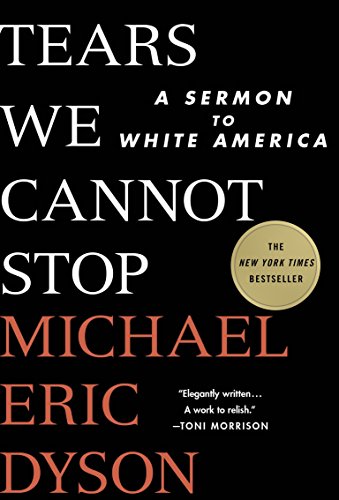
Toni Morrison hails Tears We Cannot Stop as "Elegantly written and powerful in several areas: moving personal recollections; profound cultural analysis; and guidance for moral redemption. A work to relish."
Stephen King says: "Here’s a sermon that’s as fierce as it is lucid…If you’re black, you’ll feel a spark of recognition in every paragraph. If you’re white, Dyson tells you what you need to know—what this white man needed to know, at least. This is a major achievement. I read it and said amen."
Short, emotional, literary, powerful—Tears We Cannot Stop is the book that all Americans who care about the current and long-burning crisis in race relations will want to read.
As the country grapples with racist division at a level not seen since the 1960s, one man's voice soars above the rest with conviction and compassion. In his 2016 New York Times op-ed piece "Death in Black and White," Michael Eric Dyson moved a nation. Now he continues to speak out in Tears We Cannot Stop—a provocative and deeply personal call for change. Dyson argues that if we are to make real racial progress we must face difficult truths, including being honest about how black grievance has been ignored, dismissed, or discounted.
"The time is at hand for reckoning with the past, recognizing the truth of the present, and moving together to redeem the nation for our future. If we don't act now, if you don't address race immediately, there very well may be no future."
Die Inhaltsangabe kann sich auf eine andere Ausgabe dieses Titels beziehen.
Über die Autorin bzw. den Autor
MICHAEL ERIC DYSON—distinguished University Professor of African American and Diaspora Studies, College of Arts & Science, and of Ethics and Society, Divinity School, and Centennial Professor at Vanderbilt University—is one of America’s premier public intellectuals and the author of seven New York Times bestsellers including JAY-Z, Tears We Cannot Stop, and What Truth Sounds Like, and most recently Long Time Coming. A contributing opinion writer for The New York Times, Dr. Dyson is a recipient of two NAACP Image awards and the 2020 Langston Hughes Festival Medallion. Former president Barack Obama has noted: “Everybody who speaks after Michael Eric Dyson pales in comparison.”
Auszug. © Genehmigter Nachdruck. Alle Rechte vorbehalten.
Tears We Cannot Stop
A Sermon to White America
By Michael Eric DysonSt. Martin's Press
Copyright © 2017 Michael Eric Dyson
All rights reserved.
ISBN: 978-1-250-13599-5All rights reserved.
Contents
Title Page,
Copyright Notice,
Dedication,
Epigraph,
I. Call to Worship,
II. Hymns of Praise,
III. Invocation,
IV. Scripture Reading,
V. Sermon,
Repenting of Whiteness,
1. Inventing Whiteness,
2. The Five Stages of White Grief,
3. The Plague of White Innocence,
Being Black in America,
4. Nigger,
5. Our Own Worst Enemy?,
6. Coptopia,
VI. Benediction,
VII. Offering Plate,
VIII. Prelude to Service,
IX. Closing Prayer,
About the Author,
Copyright,
CHAPTER 1
CALL TO WORSHIP
"Here," she said, "in this here place, we flesh; flesh that weeps, laughs; flesh that dances on bare feet in grass. Love it. Love it hard. Yonder they do not love your flesh. They despise it. They don't love your eyes; they'd just as soon pick em out. No more do they love the skin on your back. Yonder they flay it ... And no, they ain't in love with your mouth. Yonder, out there, they will see it broken and break it again. What you say out of it they will not heed. What you scream from it they do not hear."
— Toni Morrison, Beloved
America is in trouble, and a lot of that trouble — perhaps most of it — has to do with race. Everywhere we turn, there is discord and division, death and destruction. When we survey the land, we see a country full of suffering that we cannot fully understand, and a history that we can no longer deny. Slavery casts a long shadow across our lives. The spoils we reaped from forcing people to work without wages and treating them with grievous inhumanity continue to haunt us in a racial gulf that seems impossible to overcome. Black and white people don't merely have different experiences; we seem to occupy different universes, with worldviews that are fatally opposed to one another. The merchants of racial despair easily peddle their wares in a marketplace riddled by white panic and fear. Black despair piles up with each body that gets snuffed on video and streamed on social media. We have, in the span of a few years, elected the nation's first black president and placed in the Oval Office the scariest racial demagogue in a generation. The two may not be unrelated. The remarkable progress we seemed to make with the former has brought out the peril of the latter.
What, then, can we do? We must return to the moral and spiritual foundations of our country and grapple with the consequences of our original sin. To do that we need not share the same religion, worship the same God, or, truly, even be believers at all. For better and worse, our national moral landscape has been shaped by the dynamics of a Christianity that has from the start been deeply intertwined with religious mythology and cultural symbolism. The Founding Fathers did not for the most part believe what evangelical Christians believe now. Most believers today certainly do not share Thomas Jefferson's view of the Bible. In his redacted version of the New Testament, Jefferson purged the miracles, Jesus' divinity, and the Resurrection. But all of us, from agreeable agnostics to fire-and-brimstone Protestants, from devout Catholics to observant Jews, from devoted Muslims to those who claim no god at all, share a language of moral repair. That language is our common meeting ground, our tool of analysis, and yes, our inspiration for repentance, our hope for redemption.
Although I am a scholar, a cultural and political critic, and a social activist, I am, before, and above anything else, an ordained Baptist minister. Please don't hold that against me, although I'll understand if you do. I know that religion has a bad rap. We believers deserve a lot of the criticism that we receive. Our actions and beliefs nearly warrant wholesale skepticism. (Can I let you in on a secret? I share a lot of that reaction, but that's another book.) But deep in my heart I believe that our moral and spiritual passions can lead to a better day for our nation. I know that when we get out of our own way and let the spirit of love and hope shine through we are a better people.
But such love and hope can only come about if we first confront the poisonous history that has almost unmade our nation and undone our social compact. We must face up to what we as a country have made of the black people who have been the linchpin of democracy, the folk who saved America from itself, who redeemed it from the hypocrisy of proclaiming liberty and justice for all while denying all that liberty and justice should be to us.
Yes, I said us. This is where I take leave of my analytical neutrality, or at least the appearance of it. This is where I cast my fate with the black people who birthed and loved me, who built a legacy of excellence and struggle and pride amidst one of the most vicious assaults on humanity in recorded history. That assault may have started with slavery, but it didn't end there. The legacy of that assault, its lingering and lethal effect, continues to this day. It flares in broken homes and blighted communities, in low wages and social chaos, in self-destruction and self-hate too. But so much of what ails us — black people, that is — is tied up with what ails you — white folk, that is. We are tied together in what Martin Luther King, Jr., called a single garment of destiny. Yet sewed into that garment are pockets of misery and suffering that seem to be filled with a disproportionate number of black people. (Of course, America is far from simply black and white by whatever definition you use, but the black-white divide has been the major artery through which the meaning of race has flowed throughout the body politic.)
Now just because I identify with my people doesn't mean that I don't understand and grapple with what it means to be white in America. In fact, I was trained in your schools and I now teach your children. But I remain what I was when I started my vocation, my pilgrimage of self-discovery: a black preacher. It is for that reason that I don't want to — really, I can't afford to — give up on the possibility that white America can definitively, finally, hear from one black American preacher a plea, a cry, a sermon, from my heart to yours.
If you're interested in my social analysis and my scholarly reflections on race, I've written plenty of other books for you to read. I tried to make this book one of them, but in the end, I couldn't. I kept coming up short. I kept deleting words from the screen, a lot of them, enough of them to drive me to despair that I'd ever finish. I was stopped cold. I was trying to make the message fit the form, when it was the form itself that was the problem.
What I need to say can only be said as a sermon. I have no shame in that confession, because confession, and repentance, and redemption play a huge role in how we can make it through the long night of despair to the bright day of hope. Sermons are tough, not only to deliver, but, just as often, to hear. Yet, in my experience, if we stick with the sermon — through its pitiless recall of our sin, its relentless indictment of our flaws — we can make it to the uplifting expressions and redeeming practices that make our faith flow from the pulpit to the public, from darkness to light.
There is a long tradition of a kind of sermon, or what some call the jeremiad, an extended...
„Über diesen Titel“ kann sich auf eine andere Ausgabe dieses Titels beziehen.
Suchergebnisse für Tears We Cannot Stop: A Sermon to White America

Beispielbild für diese ISBN
Tears We Cannot Stop: A Sermon
Anbieter: World of Books (was SecondSale), Montgomery, IL, USA
Verkäuferbewertung 5 von 5 Sternen

Zustand: Very Good. Item in very good condition! Textbooks may not include supplemental items i.e. CDs, access codes etc. Artikel-Nr. 00094899152
Gebraucht kaufen
EUR 3,64
Versand gratis
Versand innerhalb von USA
Versand innerhalb von USA
Anzahl: 9 verfügbar
Beispielbild für diese ISBN
Tears We Cannot Stop: A Sermon
Anbieter: World of Books (was SecondSale), Montgomery, IL, USA
Verkäuferbewertung 5 von 5 Sternen
Zustand: Good. Item in good condition. Textbooks may not include supplemental items i.e. CDs, access codes etc. Artikel-Nr. 00081407854
Gebraucht kaufen
EUR 3,64
Versand gratis
Versand innerhalb von USA
Versand innerhalb von USA
Anzahl: 15 verfügbar
Beispielbild für diese ISBN
Tears We Cannot Stop: A Sermon to White America
Verlag:
St. Martin's Press (edition 1), 2017
ISBN 10: 1250135990
ISBN 13: 9781250135995
Gebraucht
Hardcover
Anbieter: BooksRun, Philadelphia, PA, USA
Verkäuferbewertung 5 von 5 Sternen
Hardcover. Zustand: Very Good. 1. With dust jacket. It's a well-cared-for item that has seen limited use. The item may show minor signs of wear. All the text is legible, with all pages included. It may have slight markings and/or highlighting. Artikel-Nr. 1250135990-8-1-29
Gebraucht kaufen
EUR 4,83
Versand gratis
Versand innerhalb von USA
Versand innerhalb von USA
Anzahl: 2 verfügbar
Beispielbild für diese ISBN
Tears We Cannot Stop: A Sermon to White America
Verlag:
St. Martin's Press (edition 1), 2017
ISBN 10: 1250135990
ISBN 13: 9781250135995
Gebraucht
Hardcover
Anbieter: BooksRun, Philadelphia, PA, USA
Verkäuferbewertung 5 von 5 Sternen
Hardcover. Zustand: Very Good. 1. With dust jacket. It's a well-cared-for item that has seen limited use. The item may show minor signs of wear. All the text is legible, with all pages included. It may have slight markings and/or highlighting. Artikel-Nr. 1250135990-11-18-29
Gebraucht kaufen
EUR 4,95
Versand gratis
Versand innerhalb von USA
Versand innerhalb von USA
Anzahl: 2 verfügbar
Beispielbild für diese ISBN
Tears We Cannot Stop: A Sermon to White America
Anbieter: Wonder Book, Frederick, MD, USA
Verkäuferbewertung 5 von 5 Sternen
Zustand: Very Good. Very Good condition. Like New dust jacket. A copy that may have a few cosmetic defects. May also contain light spine creasing or a few markings such as an owner's name, short gifter's inscription or light stamp. Bundled media such as CDs, DVDs, floppy disks or access codes may not be included. Artikel-Nr. N22J-00813
Gebraucht kaufen
EUR 5,38
Versand gratis
Versand innerhalb von USA
Versand innerhalb von USA
Anzahl: 1 verfügbar
Beispielbild für diese ISBN
Tears We Cannot Stop: A Sermon to White America
Anbieter: ThriftBooks-Dallas, Dallas, TX, USA
Verkäuferbewertung 5 von 5 Sternen
Hardcover. Zustand: Very Good. No Jacket. Former library book; May have limited writing in cover pages. Pages are unmarked. ~ ThriftBooks: Read More, Spend Less. Artikel-Nr. G1250135990I4N10
Gebraucht kaufen
EUR 5,83
Versand gratis
Versand innerhalb von USA
Versand innerhalb von USA
Anzahl: 1 verfügbar
Beispielbild für diese ISBN
Tears We Cannot Stop: A Sermon to White America
Anbieter: ThriftBooks-Dallas, Dallas, TX, USA
Verkäuferbewertung 5 von 5 Sternen
Hardcover. Zustand: Very Good. No Jacket. May have limited writing in cover pages. Pages are unmarked. ~ ThriftBooks: Read More, Spend Less. Artikel-Nr. G1250135990I4N00
Gebraucht kaufen
EUR 5,83
Versand gratis
Versand innerhalb von USA
Versand innerhalb von USA
Anzahl: 1 verfügbar
Beispielbild für diese ISBN
Tears We Cannot Stop: A Sermon to White America
Anbieter: ThriftBooks-Atlanta, AUSTELL, GA, USA
Verkäuferbewertung 5 von 5 Sternen
Hardcover. Zustand: Very Good. No Jacket. May have limited writing in cover pages. Pages are unmarked. ~ ThriftBooks: Read More, Spend Less. Artikel-Nr. G1250135990I4N00
Gebraucht kaufen
EUR 5,83
Versand gratis
Versand innerhalb von USA
Versand innerhalb von USA
Anzahl: 1 verfügbar
Beispielbild für diese ISBN
Tears We Cannot Stop: A Sermon to White America
Anbieter: ThriftBooks-Reno, Reno, NV, USA
Verkäuferbewertung 5 von 5 Sternen
Hardcover. Zustand: Very Good. No Jacket. May have limited writing in cover pages. Pages are unmarked. ~ ThriftBooks: Read More, Spend Less. Artikel-Nr. G1250135990I4N00
Gebraucht kaufen
EUR 5,83
Versand gratis
Versand innerhalb von USA
Versand innerhalb von USA
Anzahl: 1 verfügbar
Beispielbild für diese ISBN
Tears We Cannot Stop: A Sermon to White America
Anbieter: ThriftBooks-Phoenix, Phoenix, AZ, USA
Verkäuferbewertung 5 von 5 Sternen
Hardcover. Zustand: Very Good. No Jacket. Missing dust jacket; May have limited writing in cover pages. Pages are unmarked. ~ ThriftBooks: Read More, Spend Less. Artikel-Nr. G1250135990I4N01
Gebraucht kaufen
EUR 5,83
Versand gratis
Versand innerhalb von USA
Versand innerhalb von USA
Anzahl: 1 verfügbar