
Verwandte Artikel zu Common Sense Economics: What Everyone Should Know about...
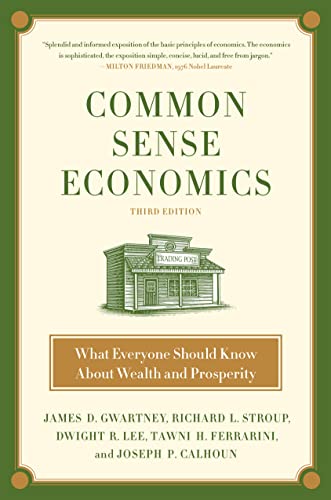
Inhaltsangabe
With the global economy recovering from a steep recession, and with that recovery challenging our long-held ideas about what careers and the market can be, learning the basics of economics has never been more essential. Principles such as gains from trade, the role of profit and loss, and the secondary effects of government spending, taxes, and borrowing risk continue to be critically important to the way America's economy functions, and critically important to understand for those hoping to further their professional lives - even their personal lives. Common Sense Economics discusses key points and theories, using them to show how any reader can make wiser personal choices and form more informed positions on policy.
Now in its third edition, this fully updated classic from James D. Gwartney, Richard L. Stroup, Dwight R. Lee, and Tawni H. Ferrarini reflects on the recession and the progress that's been made since the crash; it offers insight into political processes and the many ways in which economics informs policy, illuminating our world and what might be done to make it better.
Die Inhaltsangabe kann sich auf eine andere Ausgabe dieses Titels beziehen.
Über die Autorin bzw. den Autor
JAMES D. GWARTNEY holds the Gus A. Stavros Eminent Scholar Chair at Florida State University and is the director of the Stavros Center for the Advancement of Free Enterprise and Economic Education.
RICHARD L. STROUP is the author of Eco-Nomics and an adjunct professor of economics at North Carolina State University.
DWIGHT R. LEE is coauthor of Getting Rich in America and holds the William J. O'Neil Chair of Global Markets and Freedom at Southern Methodist University.
TAWNI Hunt FERRARINI is the Sam M. Cohodas Professor of Economics and the Director of the Center for Economic Education and Entrepreneurship at Northern Michigan University.
JOSEPH CALHOUN is a lecturer in the Assistant Director of the Stavros Center for the Advancement of Free Enterprise and Economic Education, and a lecturer in the Department of Economics at Florida State University.
Auszug. © Genehmigter Nachdruck. Alle Rechte vorbehalten.
Common Sense Economics
What Everyone Should Know About Wealth and Prosperity
By James D. Gwartney, Richard L. Stroup, Dwight R. Lee, Tawni H. Ferrarini, Joseph P. CalhounSt. Martin's Press
Copyright © 2016 James D. Gwartney, Richard L. Stroup, Dwight R. Lee, Tawni H. Ferrarini, and Joseph P. Calhoun
All rights reserved.
ISBN: 978-1-250-10694-0All rights reserved.
Contents
TITLE PAGE,
COPYRIGHT NOTICE,
DEDICATION,
PREFACE,
Part 1: Twelve Key Elements of Economics,
Part 2: Seven Major Sources of Economic Progress,
Part 3: Ten Key Elements of Economic Thinking About the Role of Government,
Part 4: Twelve Key Elements of Practical Personal Finance,
ACKNOWLEDGMENTS,
DIGITAL ASSETS, SUPPLEMENTAL UNITS, AND WEBSITE,
SUGGESTED ADDITIONAL READINGS,
GLOSSARY,
NOTES,
INDEX,
ABOUT THE AUTHORS,
COPYRIGHT,
CHAPTER 1
PART 1
Twelve Key Elements of Economics
TWELVE KEY ELEMENTS OF ECONOMICS
1. Incentives matter: Changes in benefits and costs will influence choices in a predictable manner.
2. There is no such thing as a free lunch: Goods are scarce and therefore we have to make choices.
3. Decisions are made at the margin: If we want to get the most out of our resources, options should be chosen only when the marginal benefits exceed the marginal cost.
4. Trade promotes economic progress.
5. Transaction costs are an obstacle to trade.
6. Prices bring the choices of buyers and sellers into balance.
7. Profits direct businesses toward productive activities that increase the value of resources, while losses direct them away from wasteful activities that reduce resource value.
8. People earn income by providing others with things they value.
9. Production of goods and services people value, not just jobs, provides the source of high living standards.
10. Economic progress comes primarily through trade, investment, better ways of doing things, and sound economic institutions.
11. The "invisible hand" of market prices directs buyers and sellers toward activities that promote the general welfare.
12. Too often long-term consequences, or the secondary effects, of an action are ignored.
Introduction
Life is about choices, and economics is about how incentives affect those choices and shape our lives. Choices about our education, how we spend and invest, what we do in the workplace, and many other personal decisions will influence our well-being and quality of life. Moreover, the choices we make as voters and citizens affect the laws or "rules of the game," and these rules exert an enormous impact on our freedom and prosperity. To choose intelligently, both for ourselves and for society generally, we must understand some basic principles about how people choose, what motivates their actions, and how their actions influence their personal welfare and that of others. Thus, economics is about human decision-making, the analysis of the forces underlying choice, and the implications for how societies work.
The economic way of thinking involves the integration of key concepts into your thought process. The following section presents twelve concepts that are crucial for the understanding of economies, and why some countries grow and achieve high income levels while others stagnate and remain poor. You will learn such things as the true meaning of costs, why prices matter, how trade furthers prosperity, and why production of things people value underpins our standard of living. In the subsequent parts of the book, these concepts will be used to address other vitally important topics.
1. Incentives matter: Changes in benefits and costs will influence choices in a predictable manner.
All of economics rests on one simple principle: Changes in incentives influence human behavior in predictable ways. Both monetary and nonmonetary factors influence incentives. If something becomes more costly, people will be less likely to choose it. Correspondingly, when the benefits derived from an option increase, people will be more likely to choose it. This simple idea, sometimes called the basic postulate of economics, is a powerful tool because it applies to almost everything that we do.
People will be less likely to choose an option as it becomes more costly. Think about the implications of this proposition. When late for an appointment, a person will be less likely to take time to stop and visit with a friend. Fewer people will go picnicking on a cold and rainy day. Higher prices will reduce the number of units sold. Attendance in college classes will be below normal the day before spring break. In each case, the explanation is the same: As the option becomes more costly, less is chosen.
Similarly, when the payoff derived from a choice increases, people will be more likely to choose it. A person will be more likely to bend over and pick up a quarter than a penny. Students will attend and pay more attention in class when they know the material will be on the exam. Customers will buy more from stores that offer low prices, high-quality service, and a convenient location. Employees will work harder and more efficiently when they are rewarded for doing so. All of these outcomes are highly predictable and they merely reflect the "incentives matter" postulate of economics.
This basic postulate explains how changes in market prices alter incentives in a manner that works to coordinate the actions of buyers and sellers. If buyers want to purchase more of an item than producers are willing (or able) to sell, its price will soon rise. As the price increases, sellers will be more willing to provide the item while buyers purchase less, until the higher price brings the amount demanded and the amount supplied into balance. At that point the price stabilizes.
What happens if it starts out the other way: if sellers want to supply more than buyers are willing to purchase? If sellers cannot sell all of their goods at the current price, they will have to cut the price of the item. In turn, the lower price will encourage people to buy more — but will also discourage producers from producing as much, since it is less attractive to them to supply the product at the new, lower price. Again, the price change works to bring the amount demanded by consumers into balance with the amount produced by suppliers. At that point there is no further pressure for a price change.
Remember the record-high gas prices in the summer of 2008? While a lot of people felt the pain of higher prices at the pump, there was no panic in the streets or long lines at the gas pumps. Why? When the higher prices made it more costly to purchase gasoline, most consumers eliminated some less important trips. Others arranged more carpooling. With time, consumers also shifted to smaller, more fuel-efficient cars in order to reduce their gasoline bills.
Furthermore, as buyers reacted to higher gas prices, so did sellers. The oil companies supplying gasoline increased their drilling, developed new techniques such as fracking to recover more oil from existing wells, and intensified their search for new oil fields. The higher price helped to keep the quantity supplied in line with the quantity demanded. Eventually, the prices of both crude oil and gasoline fell as supply expanded.
Incentives also influence political choices. There is little reason to believe that a person making choices in the voting booth will behave much differently than when making choices in the...
„Über diesen Titel“ kann sich auf eine andere Ausgabe dieses Titels beziehen.
Suchergebnisse für Common Sense Economics: What Everyone Should Know about...

Beispielbild für diese ISBN
Common Sense Economics: What Everyone Should Know About Wealth and Pro
Anbieter: World of Books (was SecondSale), Montgomery, IL, USA
Verkäuferbewertung 5 von 5 Sternen

Hardback. Zustand: Good. With the global economy recovering from a steep recession, and with that recovery challenging our long-held ideas about what careers and the market can be, learning the basics of economics has never been more essential. Principles such as gains from trade, the role of profit and loss, and the secondary effects of government spending, taxes, and borrowing risk continue to be critically important to the way America's economy functions, and critically important to understand for those hoping to further their professional lives - even their personal lives. Common Sense Economics discusses key points and theories, using them to show how any reader can make wiser personal choices and form more informed positions on policy. Now in its third edition, this fully updated classic from James D. Gwartney, Richard L. Stroup, Dwight R. Lee, and Tawni H. Ferrarini reflects on the recession and the progress that's been made since the crash; it offers insight into political processes and the many ways in which economics informs policy, illuminating our world and what might be done to make it better. Artikel-Nr. 00099882273
Gebraucht kaufen
EUR 4,05
Versand gratis
Versand innerhalb von USA
Versand innerhalb von USA
Anzahl: 8 verfügbar
Beispielbild für diese ISBN
Common Sense Economics: What Everyone Should Know About Wealth and Pro
Anbieter: World of Books (was SecondSale), Montgomery, IL, USA
Verkäuferbewertung 5 von 5 Sternen
Hardback. Zustand: Fair. With the global economy recovering from a steep recession, and with that recovery challenging our long-held ideas about what careers and the market can be, learning the basics of economics has never been more essential. Principles such as gains from trade, the role of profit and loss, and the secondary effects of government spending, taxes, and borrowing risk continue to be critically important to the way America's economy functions, and critically important to understand for those hoping to further their professional lives - even their personal lives. Common Sense Economics discusses key points and theories, using them to show how any reader can make wiser personal choices and form more informed positions on policy. Now in its third edition, this fully updated classic from James D. Gwartney, Richard L. Stroup, Dwight R. Lee, and Tawni H. Ferrarini reflects on the recession and the progress that's been made since the crash; it offers insight into political processes and the many ways in which economics informs policy, illuminating our world and what might be done to make it better. Artikel-Nr. 00098998652
Gebraucht kaufen
EUR 4,05
Versand gratis
Versand innerhalb von USA
Versand innerhalb von USA
Anzahl: 2 verfügbar
Beispielbild für diese ISBN
Common Sense Economics: What Everyone Should Know About Wealth and Prosperity
Verlag:
St. Martin's Press (edition 3), 2016
ISBN 10: 125010694X
ISBN 13: 9781250106940
Gebraucht
Hardcover
Anbieter: BooksRun, Philadelphia, PA, USA
Verkäuferbewertung 5 von 5 Sternen
Hardcover. Zustand: Very Good. 3. With dust jacket. It's a well-cared-for item that has seen limited use. The item may show minor signs of wear. All the text is legible, with all pages included. It may have slight markings and/or highlighting. Artikel-Nr. 125010694X-11-22-29
Gebraucht kaufen
EUR 4,75
Versand gratis
Versand innerhalb von USA
Versand innerhalb von USA
Anzahl: 1 verfügbar
Beispielbild für diese ISBN
Common Sense Economics: What Everyone Should Know About Wealth and Prosperity
Anbieter: Wonder Book, Frederick, MD, USA
Verkäuferbewertung 5 von 5 Sternen
Zustand: Good. Good condition. Good dust jacket. 3rd edition. A copy that has been read but remains intact. May contain markings such as bookplates, stamps, limited notes and highlighting, or a few light stains. Artikel-Nr. U13A-05822
Gebraucht kaufen
EUR 6,42
Versand gratis
Versand innerhalb von USA
Versand innerhalb von USA
Anzahl: 1 verfügbar
Beispielbild für diese ISBN
Common Sense Economics : What Everyone Should Know about Wealth and Prosperity
Anbieter: Better World Books, Mishawaka, IN, USA
Verkäuferbewertung 5 von 5 Sternen
Zustand: Good. Pages intact with minimal writing/highlighting. The binding may be loose and creased. Dust jackets/supplements are not included. Stock photo provided. Product includes identifying sticker. Better World Books: Buy Books. Do Good. Artikel-Nr. 15451883-6
Gebraucht kaufen
EUR 6,56
Versand gratis
Versand innerhalb von USA
Versand innerhalb von USA
Anzahl: 6 verfügbar
Beispielbild für diese ISBN
Common Sense Economics : What Everyone Should Know about Wealth and Prosperity
Anbieter: Better World Books, Mishawaka, IN, USA
Verkäuferbewertung 5 von 5 Sternen
Zustand: Very Good. Pages intact with possible writing/highlighting. Binding strong with minor wear. Dust jackets/supplements may not be included. Stock photo provided. Product includes identifying sticker. Better World Books: Buy Books. Do Good. Artikel-Nr. 12342306-6
Gebraucht kaufen
EUR 6,56
Versand gratis
Versand innerhalb von USA
Versand innerhalb von USA
Anzahl: 2 verfügbar
Beispielbild für diese ISBN
Common Sense Economics : What Everyone Should Know about Wealth and Prosperity
Anbieter: Better World Books, Mishawaka, IN, USA
Verkäuferbewertung 5 von 5 Sternen
Zustand: Good. Former library copy. Pages intact with minimal writing/highlighting. The binding may be loose and creased. Dust jackets/supplements are not included. Includes library markings. Stock photo provided. Product includes identifying sticker. Better World Books: Buy Books. Do Good. Artikel-Nr. 16113744-6
Gebraucht kaufen
EUR 6,56
Versand gratis
Versand innerhalb von USA
Versand innerhalb von USA
Anzahl: 2 verfügbar
Beispielbild für diese ISBN
Common Sense Economics : What Everyone Should Know about Wealth and Prosperity
Anbieter: Better World Books: West, Reno, NV, USA
Verkäuferbewertung 5 von 5 Sternen
Zustand: Very Good. Former library copy. Pages intact with possible writing/highlighting. Binding strong with minor wear. Dust jackets/supplements may not be included. Includes library markings. Stock photo provided. Product includes identifying sticker. Better World Books: Buy Books. Do Good. Artikel-Nr. 9389171-6
Gebraucht kaufen
EUR 6,56
Versand gratis
Versand innerhalb von USA
Versand innerhalb von USA
Anzahl: 1 verfügbar
Beispielbild für diese ISBN
Common Sense Economics: What Everyone Should Know about Wealth and Prosperity
Anbieter: ThriftBooks-Dallas, Dallas, TX, USA
Verkäuferbewertung 5 von 5 Sternen
Hardcover. Zustand: Good. No Jacket. Missing dust jacket; Pages can have notes/highlighting. Spine may show signs of wear. ~ ThriftBooks: Read More, Spend Less. Artikel-Nr. G125010694XI3N01
Gebraucht kaufen
EUR 6,74
Versand gratis
Versand innerhalb von USA
Versand innerhalb von USA
Anzahl: 1 verfügbar
Beispielbild für diese ISBN
Common Sense Economics: What Everyone Should Know about Wealth and Prosperity
Anbieter: ThriftBooks-Atlanta, AUSTELL, GA, USA
Verkäuferbewertung 5 von 5 Sternen
Hardcover. Zustand: Good. No Jacket. Pages can have notes/highlighting. Spine may show signs of wear. ~ ThriftBooks: Read More, Spend Less. Artikel-Nr. G125010694XI3N00
Gebraucht kaufen
EUR 6,74
Versand gratis
Versand innerhalb von USA
Versand innerhalb von USA
Anzahl: 2 verfügbar