
Verwandte Artikel zu Encounter in Rendlesham Forest: The Inside Story of...
Encounter in Rendlesham Forest: The Inside Story of the World's Best-Documented UFO Incident - Softcover
Inhaltsangabe
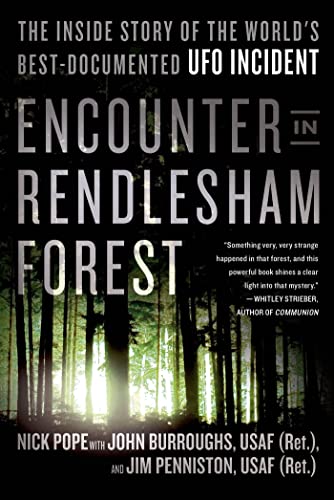
Roswell was only the beginning! An in-depth look at the Rendlesham Forest UFO Incident, the world's most sensational and compelling series of UFO encounters.
In 1980, a UFO was tracked on military radar in Rendlesham Forest, England. It landed near two of the most strategically important military bases in NATO, and was approached by military witnesses who touched the hull. This explosive new book tells the full story of this incident, which is set to become better-known than Roswell.
Written by Nick Pope, an international bestselling author and former government UFO investigator, working closely with John Burroughs and Jim Penniston, the two officers at the heart of the encounters, Encounter in Rendlesham Forest reveals the first-hand witnesses' full stories for the first time and is supported by numerous formerly-classified documents obtained under the Freedom of Information Act. The inside story of these events and their aftermath will change people's perceptions about UFOs and about the true role played by government, the military and the intelligence agencies.
Die Inhaltsangabe kann sich auf eine andere Ausgabe dieses Titels beziehen.
Über die Autorin bzw. den Autor
NICK POPE is the international bestselling author of well-known nonfiction books about UFOs and aliens, including Encounter in Rendlesham Forest.
Auszug. © Genehmigter Nachdruck. Alle Rechte vorbehalten.
1. GROUND ZERO
In the early hours of December 26, 1980, there’s little outward sign of activity at the twin US Air Force bases of Bentwaters and Woodbridge. The bases lie a few hundred yards from each other. Between them lies Rendlesham Forest. The twin bases are much as you’d expect military bases to be—though they hide a secret that would horrify most people in the area, who were blissfully unaware of the bases’ true mission. Bentwaters and Woodbridge lie in the sleepy county of Suffolk, on the cold, exposed coast of the East of England. For most of the young men and women here, it’s their first experience of a foreign country. To soften the blow, the bases have all the comforts of home—a bar, a burger joint, and other stores—they’re like small American towns nestling in the heart of the English countryside.
The events started when Airman First Class John Burroughs spotted strange lights in the forest. Burroughs had been patrolling Woodbridge and was close to the East Gate (sometimes colloquially referred to as the back gate). The lights were due east from that location and were red and blue. The red light was above the blue light and they were flashing on and off. Burroughs altered his supervisor, Staff Sergeant Bud Steffens. Both men watched in amazement as despite being familiar with the area (Burroughs had been based there for seventeen months), they had never seen anything like it before.
Their first thought was that an aircraft might have crashed in the forest. Not one of the A-10s (there was no military flying activity on the night concerned) but perhaps a civilian light aircraft. Their first and most basic instinct, of course, was to investigate and to render assistance if it was needed. Also, there was the question of security. If some unexplained activity was going on so close to the twin bases, was there a threat—actual or potential?
Burroughs unlocked the combination lock on the East Gate and he and Steffens drove out of the gate and a couple of hundred yards or so down to a small public road. There they turned right and drove another ten or twenty yards, before reaching a left-hand turning where a small track led into the forest. At this point, a white light was visible, in addition to the red and blue lights. This white light was particularly odd and at one point appeared to be coming closer to them, down the small track. The color, configuration, and movement of the lights were like no aircraft or vehicle they were familiar with.
Despite the urge to press on, they realized they needed to call in this incident, so drove back to the East Gate, where they phoned in a brief report—using the landline in the guard shack, as opposed to their pocket radios, which were known to be insecure and susceptible to scanners, which could be used to pick up conversations.
Burroughs spoke to the Law Enforcement (LE) duty desk sergeant, Sergeant “Crash” McCabe, and explained what was happening. McCabe wasn’t sure what to make of this and briefly wondered whether some sort of practical joke was being played on him. He asked to speak to Steffens, who confirmed what Burroughs had said was true and that he, too, had witnessed the strange lights. McCabe also suspected that an aircraft crash might have occurred and called through to Central Security Control, passing the problem to Staff Sergeant John Coffey.
Coffey called the on-duty flight chief at RAF Woodbridge, Staff Sergeant James (Jim) W. Penniston. Penniston wasn’t briefed on the nature of the situation but was told to proceed with his rider, Airman First Class Edward N. Cabansag, driving to the East Gate with blue lights on to rendezvous with “Police Four” and “Police Five”—the call signs for Burroughs and Steffens. This was highly unusual, and Penniston was somewhat flustered and annoyed that he wasn’t briefed on what to expect but was simply told to rendezvous with Burroughs and Penniston at the East Gate, where he’d be told the nature of the situation. This departure from standard procedure was one of the first indications that this was a highly unusual and sensitive situation. It also raises the possibility that at least some people in the chain of command already knew more about this than they were saying or had been instructed not to give details of the situation over the communications systems. Otherwise, why not simply say to Penniston something along the lines that a patrol was investigating a possible aircraft crash in the forest? Coffey could have been even vaguer and used a phrase such as “possible security situation” or that phrase so beloved by police all around the world, “an incident.” There was no problem in terms of jurisdiction and USAF personnel were certainly allowed to patrol off-base (outside the wire, as it’s called in the military) in a wide range of circumstances.
While there’s some confusion over the exact time, Jim Penniston recalls that it was just after midnight.
Burroughs and Steffens were still waiting at the East Gate when they were joined by Penniston and his driver, Airman First Class Edward Cabansag. They quickly briefed Penniston, and once again the view of the experienced flight chief was that this must have been an aircraft crash. But it was the middle of the night, at Christmas, and there was certainly no military aircraft activity. And while the possibility of a civil aircraft was still being considered, nobody had heard an explosion or any sounds. And that’s when Steffens made an odd remark that caught everyone’s attention:
“It didn’t crash. It landed.”
Despite that disconcerting observation, Penniston felt the aircraft crash theory was still the most likely explanation and with this in mind radioed Central Security Control and asked to speak to the overall flight chief for both bases, Master Sergeant J. D. Chandler.
If all this “A calls B, who then checks with C” procedure seems somewhat labored, especially in a situation where those involved might have been dealing with an aircraft crash, there are three important points to bear in mind. First, while looking at a written account might lead readers to think valuable time was being wasted, most of the actions set out previously are relatively quick and easy ones and—in the case of the telephone calls and radio conversations—take only seconds. Second, the military is a notoriously hierarchical organization where everybody is very rank conscious; in such a culture, clearing a non-routine action with your supervisor, or at the very least informing him or her, is rather more important than it is in most civilian organizations—getting your top cover, as it’s sometimes referred to. Finally, the security police and law enforcement specialisms tend to be very process driven in many respects. Initiative is still encouraged, but a lot of tasks are performed by following a set procedure that’s learned by heart and then constantly tested and reinforced through training.
With the aircraft crash theory in mind, Chandler checked the position with regard to aircraft activity with the control tower at Bentwaters. Somebody in the control tower checked the radar and also placed calls to RAF Bawdsey, RAF Watton, and Heathrow Airport in London. The key piece of information that came back was that a “bogey”—or “bogie”—(defined by the USAF as “a radar or visual air contact whose identity is unknown”) had been tracked around fifteen minutes previously but that the target had been lost when it disappeared from the radar screen directly over the Woodbridge base. Chandler contacted the shift commander and gave Penniston the OK to continue the investigation. Perhaps because he...
„Über diesen Titel“ kann sich auf eine andere Ausgabe dieses Titels beziehen.
Suchergebnisse für Encounter in Rendlesham Forest: The Inside Story of...

Beispielbild für diese ISBN
Encounter in Rendlesham Forest: The Inside Story of the World's Best-Documented UFO Incident
Anbieter: World of Books (was SecondSale), Montgomery, IL, USA
Verkäuferbewertung 5 von 5 Sternen

Paperback. Zustand: Good. Roswell was only the beginning! An in-depth look at the Rendlesham Forest UFO Incident, the world's most sensational and compelling series of UFO encounters. In 1980, a UFO was tracked on military radar in Rendlesham Forest, England. It landed near two of the most strategically important military bases in NATO, and was approached by military witnesses who touched the hull. This explosive new book tells the full story of this incident, which is set to become better-known than Roswell. Written by Nick Pope, an international bestselling author and former government UFO investigator, working closely with John Burroughs and Jim Penniston, the two officers at the heart of the encounters, Encounter in Rendlesham Forest reveals the first-hand witnesses' full stories for the first time and is supported by numerous formerly-classified documents obtained under the Freedom of Information Act. The inside story of these events and their aftermath will change people's perceptions about UFOs and about the true role played by government, the military and the intelligence agencies. Artikel-Nr. 00110773964
Gebraucht kaufen
EUR 21,15
Versand gratis
Versand innerhalb von USA
Versand innerhalb von USA
Anzahl: 1 verfügbar
Beispielbild für diese ISBN
Encounter in Rendlesham Forest: The Inside Story of the World's Best-Documented UFO Incident
Anbieter: WorldofBooks, Goring-By-Sea, WS, Vereinigtes Königreich
Verkäuferbewertung 5 von 5 Sternen
Paperback. Zustand: Good. The book has been read but remains in clean condition. All pages are intact and the cover is intact. Some minor wear to the spine. Artikel-Nr. GOR012657005
Gebraucht kaufen
EUR 24,57
EUR 6,68 Versand
Versand von Vereinigtes Königreich nach USA
Versand von Vereinigtes Königreich nach USA
Anzahl: 1 verfügbar