
Verwandte Artikel zu Beekeeper's Apprentice: or, On the Segregation...
Beekeeper's Apprentice: or, On the Segregation of the Queen (A Mary Russell Mystery, 1) - Softcover
Buch 1 von 19: Mary Russell and Sherlock Holmes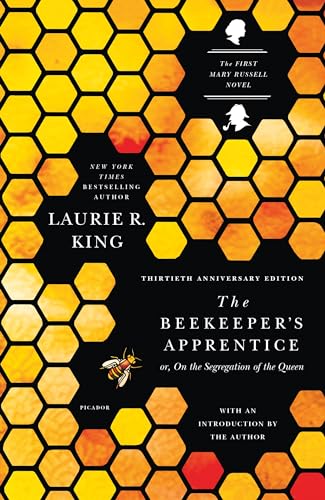
Inhaltsangabe
The Twentieth-Anniversary Edition of the First Novel of the Acclaimed Mary Russell Series by Edgar Award–Winning Author Laurie R. King.
An Agatha Award Best Novel Nominee • Named One of the Century's Best 100 Mysteries by the Independent Mystery Booksellers Association
In 1915, Sherlock Holmes is retired and quietly engaged in the study of honeybees in Sussex when a young woman literally stumbles onto him on the Sussex Downs. Fifteen years old, gawky, egotistical, and recently orphaned, the young Mary Russell displays an intellect to impress even Sherlock Holmes. Under his reluctant tutelage, this very modern, twentieth-century woman proves a deft protégée and a fitting partner for the Victorian detective. They are soon called to Wales to help Scotland Yard find the kidnapped daughter of an American senator, a case of international significance with clues that dip deep into Holmes's past. Full of brilliant deduction, disguises, and danger, The Beekeeper's Apprentice, the first book of the Mary Russell–Sherlock Holmes mysteries, is "remarkably beguiling" (The Boston Globe).
Die Inhaltsangabe kann sich auf eine andere Ausgabe dieses Titels beziehen.
Über die Autorin bzw. den Autor
Laurie R. King is the Edgar Award–winning author of the Kate Martinelli novels and the acclaimed Mary Russell-Sherlock Holmes mysteries, as well as a few stand-alone novels. The Beekeeper's Apprentice, the first in her Mary Russell series, was nominated for an Agatha Award and was named one of the Century's Best 100 Mysteries by the Independent Mystery Booksellers Association. A Monstrous Regiment of Women won the Nero Wolfe Award. She has degrees in theology, and besides writing she has also managed a coffee store and raised children, vegetables and the occasional building. She lives in Northern California.
Von der hinteren Coverseite
In 1915, long since retired from his crime-fighting days, Sherlock Holmes is engaged in a reclusive study of honeybees on the Sussex Downs. Never did the Victorian detective think to meet an intellect matching his own-until his acquaintance with Miss Mary Russell, a young twentieth-century lady whose mental acuity is equaled only by her penchant for deduction, disguises, and danger. Under Holmes's reluctant tutelage,
Russell embarks on a case involving a landowner's mysterious fever and the kidnapping of an American senator's daughter in the wilds of Wales. Then a near-fatal bomb on her doorstep-and another on Holmes's-sends the two sleuths on the trail of a murderer who scatters bizarre clues and seems utterly without motive. The villain's objective, however, is quite unequivocal: to end Russell and Holmes's partnership-and then their lives.
Auszug. © Genehmigter Nachdruck. Alle Rechte vorbehalten.
The Beekeeper's Apprentice
Or, On the Segregation of the Queen
By Laurie R. KingPicador
Copyright © 1994 Laurie R. King
All rights reserved.
ISBN: 978-1-250-05570-5All rights reserved.
Contents
Title Page,
Copyright Notice,
Dedication,
Introduction,
Editor's Preface,
Prelude,
Book One: Apprenticeship,
1. Two Shabby Figures,
2. The Sorcerer's Apprentice,
3. Mistress of the Hounds,
4. A Case of My Own,
Book Two: Internship,
5. The Vagrant Gipsy Life,
6. A Child Gone from Her Bed,
7. Words with Miss Simpson,
Book Three: Partnership,
8. We Have a Case,
9. The Game, Afoot,
10. The Problem of the Empty House,
11. Another Problem: The Mutilated Four-Wheeler,
12. Flight,
Excursus: A Gathering of Strength,
13. Umbilicus Mundi,
Book Four: Mastery,
14. The Act Begins,
15. Separation Trial,
16. The Daughter of the Voice,
17. Forces Joined,
18. Battle Royal,
Postlude: Putting off the Armour,
19. Return Home,
By Laurie R. King,
About the Author,
Copyright,
CHAPTER 1
Two Shabby Figures
The discovery of a sign of true intellect outside ourselves procures us something of the emotion Robinson Crusoe felt when he saw the imprint of a human foot on the sandy beach of his island.
I was fifteen when I first met Sherlock Holmes, fifteen years old with my nose in a book as I walked the Sussex Downs, and nearly stepped on him. In my defence I must say it was an engrossing book, and it was very rare to come across another person in that particular part of the world in that war year of 1915. In my seven weeks of peripatetic reading amongst the sheep (which tended to move out of my way) and the gorse bushes (to which I had painfully developed an instinctive awareness), I had never before stepped on a person.
It was a cool, sunny day in early April, and the book was by Virgil. I had set out at dawn from the silent farmhouse, chosen a different direction from my usual — in this case southeasterly, towards the sea — and had spent the intervening hours wrestling with Latin verbs, climbing unconsciously over stone walls, and unthinkingly circling hedgerows, and would probably not have noticed the sea until I stepped off one of the chalk cliffs into it.
As it was, my first awareness that there was another soul in the universe was when a male throat cleared itself loudly not four feet from me. The Latin text flew into the air, followed closely by an Anglo-Saxon oath. Heart pounding, I hastily pulled together what dignity I could and glared down through my spectacles at this figure hunched up at my feet: a gaunt, greying man in his fifties wearing a cloth cap, ancient tweed greatcoat, and decent shoes, with a threadbare army rucksack on the ground beside him. A tramp perhaps, who had left the rest of his possessions stashed beneath a bush. Or an Eccentric. Certainly no shepherd.
He said nothing. Very sarcastically. I snatched up my book and brushed it off.
"What on earth are you doing?" I demanded. "Lying in wait for someone?"
He raised one eyebrow at that, smiled in a singularly condescending and irritating manner, and opened his mouth to speak in that precise drawl which is the trademark of the overly educated upper-class English gentleman. A high voice; a biting one: definitely an Eccentric.
"I should think that I can hardly be accused of 'lying' anywhere," he said, "as I am seated openly on an uncluttered hillside, minding my own business. When, that is, I am not having to fend off those who propose to crush me underfoot." He rolled the penultimate r to put me in my place.
Had he said almost anything else, or even said the same words in another manner, I should merely have made a brusque apology and a purposeful exit, and my life would have been a very different thing. However, he had, all unknowing, hit squarely on a highly sensitive spot. My reason for leaving the house at first light had been to avoid my aunt, and the reason (the most recent of many reasons) for wishing to avoid my aunt was the violent row we'd had the night before, a row sparked by the undeniable fact that my feet had outgrown their shoes, for the second time since my arrival three months before. My aunt was small, neat, shrewish, sharp-tongued, quick-witted, and proud of her petite hands and feet. She invariably made me feel clumsy, uncouth, and unreasonably touchy about my height and the corresponding size of my feet. Worse, in the ensuing argument over finances, she had won.
His innocent words and his far-from-innocent manner hit my smouldering temper like a splash of petrol. My shoulders went back, my chin up, as I stiffened for combat. I had no idea where I was or who this man was, whether I was standing on his land or he on mine, if he was a dangerous lunatic or an escaped convict or the lord of the manor, and I did not care. I was furious.
"You have not answered my question, sir," I bit off.
He ignored my fury. Worse than that, he seemed unaware of it. He looked merely bored, as if he wished I might go away.
"What am I doing here, do you mean?"
"Exactly."
"I am watching bees," he said flatly, and turned back to his contemplation of the hillside.
Nothing in the man's manner showed a madness to correspond with his words. Nonetheless, I kept a wary eye on him as I thrust my book into my coat pocket and dropped to the ground — a safe distance away from him — and studied the movement in the flowers before me.
There were indeed bees, industriously working at stuffing pollen into those leg sacs of theirs, moving from flower to flower. I watched, and was just thinking that there was nothing particularly noteworthy about these bees when my eyes were caught by the arrival of a peculiarly marked specimen. It seemed an ordinary honeybee but had a small red spot on its back. How odd — perhaps what he had been watching? I glanced at the Eccentric, who was now staring intently off into space, and then looked more closely at the bees, interested in spite of myself. I quickly concluded that the spot was no natural phenomenon but rather paint, for there was another bee, its spot slightly lopsided, and another, and then another odd thing: a bee with a blue spot as well. As I watched, two red spots flew off in a northwesterly direction. I carefully observed the blue-and-red spot as it filled its pouches and saw it take off towards the northeast.
I thought for a minute, got up, and walked to the top of the hill, scattering ewes and lambs, and when I looked down at a village and river, I knew instantly where I was. My house was less than two miles from here. I shook my head ruefully at my inattention, thought for a moment longer about this man and his red- and blue-spotted bees, and walked back down to take my leave of him. He did not look up, so I spoke to the back of his head.
"I'd say the blue spots are a better bet, if you're trying for another hive," I told him. "The ones you've only marked with red are probably from Mr. Warner's orchard. The blue spots are farther away, but they're almost sure to be wild ones." I dug the book from my pocket, and when I looked up to wish him a good day, he was looking back at me, and the expression on his face took all words from my lips — no mean accomplishment. He was, as the writers say but people seldom actually are, openmouthed. He looked a bit like a fish, in fact, gaping at me as if I were growing another head. He slowly stood up,...
„Über diesen Titel“ kann sich auf eine andere Ausgabe dieses Titels beziehen.
Suchergebnisse für Beekeeper's Apprentice: or, On the Segregation...

Beispielbild für diese ISBN
The Beekeeper's Apprentice: Or, on the Segregation of the Queen
Anbieter: World of Books (was SecondSale), Montgomery, IL, USA
Verkäuferbewertung 5 von 5 Sternen

Paperback. Zustand: Good. The Twentieth-Anniversary Edition of the First Novel of the Acclaimed Mary Russell Series by Edgar Award-Winning Author Laurie R. King. An Agatha Award Best Novel Nominee * Named One of the Century's Best 100 Mysteries by the Independent Mystery Booksellers Association In 1915, Sherlock Holmes is retired and quietly engaged in the study of honeybees in Sussex when a young woman literally stumbles onto him on the Sussex Downs. Fifteen years old, gawky, egotistical, and recently orphaned, the young Mary Russell displays an intellect to impress even Sherlock Holmes. Under his reluctant tutelage, this very modern, twentieth-century woman proves a deft protégée and a fitting partner for the Victorian detective. They are soon called to Wales to help Scotland Yard find the kidnapped daughter of an American senator, a case of international significance with clues that dip deep into Holmes's past. Full of brilliant deduction, disguises, and danger, The Beekeeper's Apprentice, the first book of the Mary Russell-Sherlock Holmes mysteries, is "remarkably beguiling" (The Boston Globe). Artikel-Nr. 00104101301
Gebraucht kaufen
EUR 4,05
Versand gratis
Versand innerhalb von USA
Versand innerhalb von USA
Anzahl: Mehr als 20 verfügbar
Beispielbild für diese ISBN
The Beekeeper's Apprentice: Or, on the Segregation of the Queen
Anbieter: World of Books (was SecondSale), Montgomery, IL, USA
Verkäuferbewertung 5 von 5 Sternen
Paperback. Zustand: Fair. The Twentieth-Anniversary Edition of the First Novel of the Acclaimed Mary Russell Series by Edgar Award-Winning Author Laurie R. King. An Agatha Award Best Novel Nominee * Named One of the Century's Best 100 Mysteries by the Independent Mystery Booksellers Association In 1915, Sherlock Holmes is retired and quietly engaged in the study of honeybees in Sussex when a young woman literally stumbles onto him on the Sussex Downs. Fifteen years old, gawky, egotistical, and recently orphaned, the young Mary Russell displays an intellect to impress even Sherlock Holmes. Under his reluctant tutelage, this very modern, twentieth-century woman proves a deft protégée and a fitting partner for the Victorian detective. They are soon called to Wales to help Scotland Yard find the kidnapped daughter of an American senator, a case of international significance with clues that dip deep into Holmes's past. Full of brilliant deduction, disguises, and danger, The Beekeeper's Apprentice, the first book of the Mary Russell-Sherlock Holmes mysteries, is "remarkably beguiling" (The Boston Globe). Artikel-Nr. 00102807991
Gebraucht kaufen
EUR 4,05
Versand gratis
Versand innerhalb von USA
Versand innerhalb von USA
Anzahl: 5 verfügbar
Beispielbild für diese ISBN
The Beekeeper's Apprentice: or, On the Segregation of the Queen (A Mary Russell Mystery, 1)
Verlag:
Picador (edition Special edition, 20th Anniversary), 2014
ISBN 10: 1250055709
ISBN 13: 9781250055705
Gebraucht
Paperback
Anbieter: BooksRun, Philadelphia, PA, USA
Verkäuferbewertung 5 von 5 Sternen
Paperback. Zustand: Very Good. Special edition, 20th Anniversary. It's a well-cared-for item that has seen limited use. The item may show minor signs of wear. All the text is legible, with all pages included. It may have slight markings and/or highlighting. Artikel-Nr. 1250055709-11-1
Gebraucht kaufen
EUR 4,73
Versand gratis
Versand innerhalb von USA
Versand innerhalb von USA
Anzahl: 3 verfügbar
Foto des Verkäufers
The Beekeeper's Apprentice: or, On the Segregation of the Queen (A Mary Russell Mystery, 1)
Anbieter: Dream Books Co., Denver, CO, USA
Verkäuferbewertung 5 von 5 Sternen
Zustand: acceptable. This copy has clearly been enjoyedâ"expect noticeable shelf wear and some minor creases to the cover. Binding is strong, and all pages are legible. May contain previous library markings or stamps. Artikel-Nr. 4EKGLF0081R5_ns
Gebraucht kaufen
EUR 5,10
Versand gratis
Versand innerhalb von USA
Versand innerhalb von USA
Anzahl: 1 verfügbar
Beispielbild für diese ISBN
The Beekeeper's Apprentice: Or, on the Segregation of the Queen
Anbieter: ThriftBooks-Reno, Reno, NV, USA
Verkäuferbewertung 5 von 5 Sternen
Paperback. Zustand: Very Good. No Jacket. May have limited writing in cover pages. Pages are unmarked. ~ ThriftBooks: Read More, Spend Less. Artikel-Nr. G1250055709I4N00
Gebraucht kaufen
EUR 6,15
Versand gratis
Versand innerhalb von USA
Versand innerhalb von USA
Anzahl: 1 verfügbar
Beispielbild für diese ISBN
The Beekeeper's Apprentice: Or, on the Segregation of the Queen
Anbieter: ThriftBooks-Phoenix, Phoenix, AZ, USA
Verkäuferbewertung 5 von 5 Sternen
Paperback. Zustand: Very Good. No Jacket. May have limited writing in cover pages. Pages are unmarked. ~ ThriftBooks: Read More, Spend Less. Artikel-Nr. G1250055709I4N00
Gebraucht kaufen
EUR 6,15
Versand gratis
Versand innerhalb von USA
Versand innerhalb von USA
Anzahl: 1 verfügbar
Beispielbild für diese ISBN
The Beekeeper's Apprentice: Or, on the Segregation of the Queen
Anbieter: ThriftBooks-Phoenix, Phoenix, AZ, USA
Verkäuferbewertung 5 von 5 Sternen
Paperback. Zustand: Good. No Jacket. Pages can have notes/highlighting. Spine may show signs of wear. ~ ThriftBooks: Read More, Spend Less. Artikel-Nr. G1250055709I3N00
Gebraucht kaufen
EUR 6,15
Versand gratis
Versand innerhalb von USA
Versand innerhalb von USA
Anzahl: 1 verfügbar
Beispielbild für diese ISBN
The Beekeeper's Apprentice: Or, on the Segregation of the Queen
Anbieter: ThriftBooks-Dallas, Dallas, TX, USA
Verkäuferbewertung 5 von 5 Sternen
Paperback. Zustand: Good. No Jacket. Pages can have notes/highlighting. Spine may show signs of wear. ~ ThriftBooks: Read More, Spend Less. Artikel-Nr. G1250055709I3N00
Gebraucht kaufen
EUR 6,17
Versand gratis
Versand innerhalb von USA
Versand innerhalb von USA
Anzahl: 1 verfügbar
Beispielbild für diese ISBN
The Beekeeper's Apprentice: Or, on the Segregation of the Queen
Anbieter: ThriftBooks-Atlanta, AUSTELL, GA, USA
Verkäuferbewertung 5 von 5 Sternen
Paperback. Zustand: Very Good. No Jacket. May have limited writing in cover pages. Pages are unmarked. ~ ThriftBooks: Read More, Spend Less. Artikel-Nr. G1250055709I4N00
Gebraucht kaufen
EUR 6,17
Versand gratis
Versand innerhalb von USA
Versand innerhalb von USA
Anzahl: 1 verfügbar
Beispielbild für diese ISBN
The Beekeeper's Apprentice: Or, on the Segregation of the Queen
Anbieter: ThriftBooks-Atlanta, AUSTELL, GA, USA
Verkäuferbewertung 5 von 5 Sternen
Paperback. Zustand: Good. No Jacket. Pages can have notes/highlighting. Spine may show signs of wear. ~ ThriftBooks: Read More, Spend Less. Artikel-Nr. G1250055709I3N00
Gebraucht kaufen
EUR 6,17
Versand gratis
Versand innerhalb von USA
Versand innerhalb von USA
Anzahl: 1 verfügbar