
Verwandte Artikel zu Saltwater Cowboy: The Rise and Fall of a Marijuana...
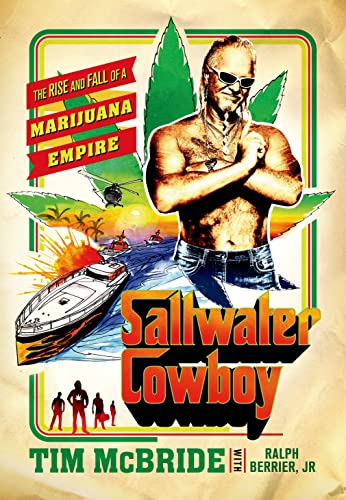
Inhaltsangabe
In 1979, Wisconsin native Tim McBride hopped into his Mustang and headed south. He was twenty-one, and his best friend had offered him a job working as a crab fisherman in Chokoloskee Island, a town of fewer than 500 people on Florida's Gulf Coast. Easy of disposition and eager to experience life at its richest, McBride jumped in with both feet.
But this wasn't a typical fishing outfit. McBride had been unwittingly recruited into a band of smugglers--middlemen between a Colombian marijuana cartel and their distributors in Miami. His elaborate team comprised fishermen, drivers, stock houses, security--seemingly all of Chokoloskee Island was in on the operation. As McBride came to accept his new role, tons upon tons of marijuana would pass through his hands.
Then the federal government intervened in 1984, leaving the crew without a boss and most of its key players. McBride, now a veteran smuggler, was somehow spared. So when the Colombians came looking for a new middle-man, they turned to him.
McBride became the boss of an operation that was ultimately responsible for smuggling 30 million pounds of marijuana. A self-proclaimed "Saltwater Cowboy," he would evade the Coast Guard for years, facing volatile Colombian drug lords and risking betrayal by romantic partners until his luck finally ran out.
A tale of crime and excess, Saltwater Cowboy is the gripping memoir of one of the biggest pot smugglers in American history.
Die Inhaltsangabe kann sich auf eine andere Ausgabe dieses Titels beziehen.
Über die Autorinnen und Autoren
Tim McBride went from small-town pothead to big-time pot hauler, before being sentenced to ten years in prison for presiding over a drug-smuggling empire. Today he owns a construction business and is a father of two. He lives on the Gulf Coast of Florida.
Ralph Berrier, Jr. is a veteran journalist and the author of If Trouble Don’t Kill Me: A Family’s Story of Brotherhood, War, and Bluegrass.
Auszug. © Genehmigter Nachdruck. Alle Rechte vorbehalten.
Saltwater Cowboy
By Tim McBride, Ralph Berrier Jr.St. Martin's Press
Copyright © 2015 Tim McBride
All rights reserved.
ISBN: 978-1-250-05128-8All rights reserved.
CHAPTER 1
After a three-hour workout, I tossed a towel over my shoulder, picked up my water jug, and went for a walk to cool down.
Finding an empty bench was rare at that time of the evening, so when I saw one, I sat down for a while. I took off my shoes and socks, and I stretched my legs out so I could feel the cool grass under my bare feet. I sat there with each arm over the back of the bench and my head tilted back toward the evening sky.
Hearing the activities of others around me gave me a measure of contentment. There was the ricochet of a racquetball being struck, the ringing bang of a bouncing basketball, squeaking shoes as players ran up and down the court. I closed my eyes. I could hear an occasional jogger go past and birds singing as they prepared to roost for the night in one of the five trees in the yard. I opened my eyes in time to catch a glimpse of a moth drawn to the lights that had come on. It struggled against the same cool breeze that was drying the perspiration from my body.
This might sound like any of a thousand parks and any one of a million park benches in America. But this was the upper compound rec yard of the federal correctional institution in Tallahassee, Florida, and I was sharing it with 1,100 other convicted felons. It was 1991, I was the property of the US federal government, prisoner identification number 09498-018, and I was in hell.
I'd been here three years, and it was still hard for me to get used to the idea that I had seven more to do. It is a dose of harsh reality when you come to the realization that the world as you once knew it doesn't exist anymore. My whole world now was a little patch of land surrounded by two fences, separated by a twenty-foot stretch of land filled with razor wire, referred to as no-man's-land.
Every one hundred yards or so, those two fences met up with a concrete and brick structure that stood roughly fifty feet tall. Those were the half dozen or so gun towers. Behind the mirrored glass inside each tower were two armed guards standing vigil, their rifles in hand, just waiting to put a hole in your head should you decide to try your luck and make a break for home. If you were lucky enough to somehow make it past the interior fence, no-man's-land, and the exterior fence, you would surely be met by one of the two vehicles circling outside. Twenty-four hours a day, seven days a week, and three hundred and sixty-five days a year, those sentinels stood ready with their dogs and their rifles. The guards controlled the convicts' movements. That's what they called it—"controlled movement." They told us when to get up, when to eat, went to move from one area of the prison to another, when to piss, and when to sleep.
You see, there were only two ways for us convicts to get out of there. You either did your time like a good con, or you died. In a sense we were all castaways sharing the same desert island. Eating together, sleeping together, and growing older together.
That said, the most difficult obstacle wasn't the lack of control. It was the terrible feeling of loneliness and yet never being alone.
The time was nine thirty p.m., and over the intercom came those all-too-familiar words:
"Lockdown ... Lockdown ... All inmates return to your unit and prepare for ten o'clock count."
Everything began to wind down. All 1,100 of us would soon be locked into our units. I got out of my sweaty clothes and took a quick shower, then stood around bullshitting with a few guys near my cubicle.
Ten o'clock came and two guards approached. One remained at the door while the other shouted, "Stand next to your bunk, ladies, and shut up ... It's count time!"
So we all stood up straight next to our bunks, and one by one we were counted, like cattle in a pen. The first guard to do the counting must have been a fucking moron or something because when he did his count, he would take a bean from one pocket and put it in the other for every con he counted. After completing his round, the second guard would repeat this process. Only difference was that this guy could remember his count. Afterward we were left standing there while he helped the dumbass figure out how many beans he had in his fucking pocket. When the count was done, the guards would leave and lock us in for the night. We would now have one hour to do whatever we cared to do until lights-out.
Every night at that exact same time, my buddy George and I played as many hands of gin rummy as we could until lights-out. George lived about eight cubicles away from me. I knew that he was locked up because he'd been a bank robber, and he knew that I was in for drug smuggling. But it was the kind of secondhand knowledge that was rarely, if ever, discussed. He was a man of many years—and by "many years," I don't mean just that he was in his mid- to late sixties. I mean that he had been there for twenty-eight years before I met him.
George was a kind man and very soft-spoken. When he did speak, it was with a slow Southern drawl. He stood only about five foot six, with a thin face and piercing green eyes. His brown hair was streaked with silver, and he liked to comb it straight back. He was like a father to me. Of course I had a real father, but that was in another life, in an alternate reality.
We could talk about anything, George and I, especially when one of us was having a bad day. Those days didn't often happen, but when they did, they were very emotional. You constantly trained your mind to leave your old life behind in order to live the new prison life that was ahead of you. But sometimes your mind just couldn't help but drift beyond those fences. You started thinking about how good it felt to be free. My friendship with George was a special one. We helped each other stay behind the fences. It was the kind of bond that is virtually impossible to achieve in the outside world—and often the only thing that allows you to keep your sanity in a world where insanity reigns. Playing cards was a ritual that helped get us through. We talked about what went on that day. Who got busted, who got his ass kicked. Any other prison bullshit.
But George must have been in a pensive mood that night because he asked me a question we'd avoided over the preceding years. It was the same question I had asked myself dozens of times after lockdown, as I lay on my bunk and stared at the ceiling. A question that, for no matter how long I considered it, I could never answer.
"Timmy, how in hell did you wind up here, anyway?"
CHAPTER 2How did I end up in prison? How did an outdoors-loving boy from the Midwest wind up as one of the most successful marijuana haulers in the United States? When you look back at my childhood and where I came from, you don't see the stereotypical story of a poor kid from a rough neighborhood who seems destined for a life as an outlaw. You see a kid who was born near a military base and who grew up in a nice neighborhood on a lake. You just never know how these stories are going to turn out.
I was born in Fayetteville, North Carolina. My father was with the 82nd Airborne, stationed at Fort Bragg, so I guess that makes me an army brat. My father's career went from jumping out of airplanes to jumping into them, as he traveled to every city on the East Coast, selling construction equipment. He was gone for months at a time, so I didn't see much of him while growing up. That was just how it was.
My mom went to work each day several towns over as a swimming...
„Über diesen Titel“ kann sich auf eine andere Ausgabe dieses Titels beziehen.
Suchergebnisse für Saltwater Cowboy: The Rise and Fall of a Marijuana...

Beispielbild für diese ISBN
Saltwater Cowboy: The Rise and Fall of a Marijuana Empire
Anbieter: ThriftBooks-Dallas, Dallas, TX, USA
Verkäuferbewertung 5 von 5 Sternen

Hardcover. Zustand: Good. No Jacket. Missing dust jacket; Pages can have notes/highlighting. Spine may show signs of wear. ~ ThriftBooks: Read More, Spend Less. Artikel-Nr. G1250051282I3N01
Gebraucht kaufen
EUR 23,30
Versand gratis
Versand innerhalb von USA
Versand innerhalb von USA
Anzahl: 1 verfügbar
Beispielbild für diese ISBN
Saltwater Cowboy: The Rise and Fall of a Marijuana Empire
Anbieter: ThriftBooks-Dallas, Dallas, TX, USA
Verkäuferbewertung 5 von 5 Sternen
Hardcover. Zustand: Very Good. No Jacket. May have limited writing in cover pages. Pages are unmarked. ~ ThriftBooks: Read More, Spend Less. Artikel-Nr. G1250051282I4N00
Gebraucht kaufen
EUR 23,30
Versand gratis
Versand innerhalb von USA
Versand innerhalb von USA
Anzahl: 1 verfügbar
Beispielbild für diese ISBN
Saltwater Cowboy: The Rise and Fall of a Marijuana Empire
Anbieter: ThriftBooks-Atlanta, AUSTELL, GA, USA
Verkäuferbewertung 5 von 5 Sternen
Hardcover. Zustand: Very Good. No Jacket. May have limited writing in cover pages. Pages are unmarked. ~ ThriftBooks: Read More, Spend Less. Artikel-Nr. G1250051282I4N00
Gebraucht kaufen
EUR 23,30
Versand gratis
Versand innerhalb von USA
Versand innerhalb von USA
Anzahl: 1 verfügbar
Beispielbild für diese ISBN
Saltwater Cowboy: The Rise and Fall of a Marijuana Empire
Anbieter: ThriftBooks-Dallas, Dallas, TX, USA
Verkäuferbewertung 5 von 5 Sternen
Hardcover. Zustand: Good. No Jacket. Former library book; Pages can have notes/highlighting. Spine may show signs of wear. ~ ThriftBooks: Read More, Spend Less. Artikel-Nr. G1250051282I3N10
Gebraucht kaufen
EUR 23,30
Versand gratis
Versand innerhalb von USA
Versand innerhalb von USA
Anzahl: 1 verfügbar