
Verwandte Artikel zu Empire Rising
Inhaltsangabe
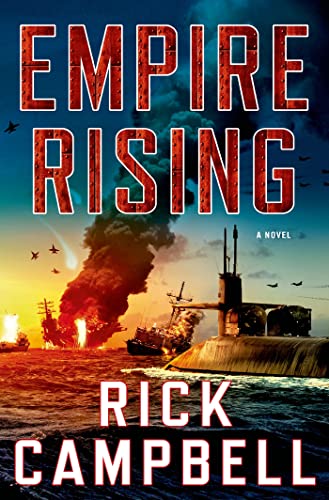
After a long, secret military buildup, China launches a swift and deadly attack on Taiwan. But that's only their first move in a much deadlier game.
In Rick Campbell's thrilling Empire Rising, Xiang Chenglei, Chinese president and party secretary, has both a problem and a plan. The problem is that China's limited supply of oil is threatening to derail its economic growth and prosperity. Having failed to win access to a greater supply diplomatically, he sets his backup plan in motion. And what is war, but diplomacy by other means?
The U.S. Pacific Fleet is the major military force in the area, and when Taiwan is invaded, the fleet is sent in to repel the invading Chinese forces. The U.S. military expects it to be an easy operation, but after a decades-long, top-secret buildup, China has military capabilities far greater than the United States is aware of. With hidden batteries of long range missiles, advanced cyber warfare capabilities, and a submarine fleet wielding a secret weapon, China is able to overwhelm the American fleet. In fact, China all but wipes out the U.S. Pacific Fleet—leaving them free to turn to their real objective—invasion and expansion across Asia, starting with the four main islands of Japan.
While the Atlantic Fleet surges westward to defend its allies and respond to the destruction of their counterparts, it falls to an unlikely alliance of three people to stop this incursion and prevent an all-but-inevitable global war. National Security Advisor Christine O'Connor has critical information, but she's trapped in Beijing; Captain Murray Wilson, commanding officer of the submarine USS Michigan must somehow infiltrate the Chinese submarine blockade; and Navy SEAL Jake Harrison must lead a strike team into the most hostile of territories with only hours to implement the most daring plan ever.
Die Inhaltsangabe kann sich auf eine andere Ausgabe dieses Titels beziehen.
Über die Autorin bzw. den Autor
Rick Campbell, a retired Navy Commander, spent more than twenty years on multiple submarine tours. On his last tour, he was one of the two men whose permission was required to launch the submarine's nuclear warhead-tipped missiles. Campbell is the author of The Trident Deception, and lives with his family in the greater Washington, D.C. area.
Auszug. © Genehmigter Nachdruck. Alle Rechte vorbehalten.
Empire Rising
By Rick CampbellSt. Martin's Press
Copyright © 2015 Rick Campbell
All rights reserved.
ISBN: 978-1-250-04046-6All rights reserved.
Contents
Title Page,
Copyright Notice,
Dedication,
Acknowledgments,
Principal Characters,
Prologue,
Opening Moves,
The Gambit,
Gambit Accepted,
The Sacrifice,
En Passant,
Middle Game,
Castle,
End Game,
Epilogue,
Complete Cast of Characters,
Author's Note,
About the Author,
Also by Rick Campbell,
Copyright,
CHAPTER 1
WASHINGTON, D.C.
A light rain was falling from a gray, overcast sky as a black Lincoln Town Car merged onto the 14th Street Bridge, fighting its way north across three lanes of early morning traffic. In the back of the sedan, Christine O'Connor gazed through rain-streaked windows at the Potomac River flowing lazily east toward the Chesapeake Bay. She ignored the rhythmic thump of the sedan's windshield wipers, focused instead on the radio tuned to a local AM news station. As she listened to the morning's headlines, she wasn't surprised the most important news of the day was absent from the broadcast.
As the president's national security advisor, Christine was briefed daily on events occurring around the world with the potential to affect the safety of American citizens. This morning, she was returning from the Pentagon after her weekly intelligence brief with Secretary of Defense Nelson Jennings. Near the end of the meeting, the discussion had turned to yesterday's assassination of China's prime minister. There would be instability within China's Politburo Standing Committee as its eight remaining members determined the replacement for the second most powerful person in China. Concern was voiced about the loss of Bai Tao, a staunch opponent to using military force to resolve China's conflicts. Considering what the United States was contemplating signing, that was not an insignificant issue.
The MAER Accord—the Mutual Access to Environmental Resources Accord—was the exact opposite of what it purported to be. Christine opened the manila folder in her lap, revealing the one-inch-thick document on the right side and her notes on the left, and began reviewing them one final time before her meeting with the president. Upon reading its title, one would think the accord ensured equal access to the world's supply of natural resources, which were straining to meet the demands of the industrialized and developing countries. Oil and natural gas production were simply not keeping pace, and within three years, there would not be enough to go around.
Instead of ensuring every country would receive their fair share, the MAER Accord included complicated price calculations that favored the United States and its allies. Less fortunate countries, including China, would be forced to pay much higher prices. Additionally, it included a military defense assurance between the United States and the Pacific Rim nations, who were fearful of an aggressive China, which had been rattling its sword and staking claim to many of the region's natural resources. The future lay in vast Asian offshore oil fields, and the half-century-long MAER Accord assured America and its allies would have access to the resources their economies would require for the next fifty years. In return, America would respond to any attempt by another country to claim the natural resources of another.
Christine's Town Car turned right on West Executive Avenue, bringing her closer to the White House and her final meeting on the accord with the president and Kevin Hardison. The mere thought of the president's chief of staff threatened to bring on a migraine. They were once close friends, working together on Congressman Tim Johnson's staff twenty years ago, when Hardison, ten years her senior, had been her mentor. But all that changed once she became the president's national security advisor, when she surprised Hardison with a mind of her own, refusing to subordinate herself to his orders.
Unlike most administrations, the president preferred to have counsel from both political parties. Unfortunately, Christine was the outsider, which meant she had the burden of fighting the uphill battles. Still, she had won a surprisingly large percentage of them, which was probably one of the reasons for the animosity between her and Hardison. Their disdain for each other wouldn't help in a few minutes when they met in the Oval Office, with one last opportunity to convince the president of the dangerous repercussions of signing the MAER Accord.
The Lincoln Town Car pulled to a stop under the north portico, next to two Marines in Dress Blues guarding the formal entrance to the West Wing. Standing between the two Marines—almost a head taller—was a Navy Captain wearing the Navy's version of its Dress Blues, with four gold stripes on each sleeve. Steve Brackman was the president's senior military aide, with whom she had forged a close working relationship. Christine had called ahead and asked him to meet her when she returned to the White House. As she prepared for battle with the president's powerful chief of staff, she preferred to have the military on her side.
Brackman greeted her as she stepped from the sedan, polite as always. "Good morning, Miss O'Connor."
Christine returned the Captain's greeting, and Brackman followed her to her corner office. She entered and dropped off her leather briefcase, but Brackman stopped at the entrance to her office. Christine returned to the doorway.
"I'm sorry, Miss O'Connor. Mr. Hardison requested I meet with him in a few minutes. Is there something quick I can help you with?"
Christine frowned. Hardison apparently had the same battle plan she had. She answered, "The president is going to make his decision on the MAER Accord today. Hardison is pushing the president to sign it while I'm advising against it. I wanted to spend a few minutes with you, so you fully understood my concerns."
"I think I understand both sides of the argument," Brackman replied.
Christine pressed her lips together. As the president's senior military aide, Brackman could tip the scales. "And your recommendation will be ...?"
Brackman's eyes searched hers for a moment, and it seemed he was about to answer, but he checked his watch instead. "If you'll excuse me."
As Brackman turned to leave, Christine grabbed his arm. "Don't let him persuade you. I'm counting on your support."
Brackman hesitated before replying. "I know, Miss O'Connor." He eased his arm from her grip, then turned and headed toward Hardison's office.
Christine watched him disappear down the hallway, then decided to wait where she could keep an eye on the Oval Office's doors. She headed down the seventy-foot-long hallway, turning left into the Roosevelt Room. While she waited, she took the opportunity to admire the two oil paintings hanging on opposing walls: Alfred Jonniaux's portrait of Franklin Delano Roosevelt seated behind his desk, and Tade Styka's equestrian portrait of Theodore Roosevelt titled Rough Rider. In accordance with tradition, the incoming administration had reversed the two portraits, placing the image of FDR over the fireplace and Theodore Roosevelt to Christine's right, on the south wall.
As Christine examined the portrait of Theodore Roosevelt, she reflected on his famous slogan—Speak softly and carry a big stick. If the president signed the MAER Accord and China responded as she predicted, the United States was going to need a big stick,...
„Über diesen Titel“ kann sich auf eine andere Ausgabe dieses Titels beziehen.
Suchergebnisse für Empire Rising

Beispielbild für diese ISBN
Empire Rising
Anbieter: World of Books (was SecondSale), Montgomery, IL, USA
Verkäuferbewertung 5 von 5 Sternen

Hardback. Zustand: Good. Xiang Li Cheng, the President of the People's Republic of China, has both a problem and a plan. The problem is that the limited supply of oil available to China is threatening to derail his country's economic growth and prosperity. But to secure access to those resources, he must contend with powerful U.S. Navy and the Pacific Fleet. After a decades-long largely secret military build-up, Cheng sets his plan in motion by suddenly invading Taiwan and drawing the Pacific Fleet in to its defence. With a faster, larger fleet with more capable long range missiles, China is able to surprise and quickly overwhelm the American fast attack fleet, all but wiping out the U.S. forces on deployment. Then China turns to its real objective - invasion and expansion across Asia, starting with the four main Islands of Japan. While the Atlantic Fleet surges westward to defend its allies and respond to the destruction of their counterparts, it falls to an unlikely alliance of three people to stop this incursion and prevent World War III. National Security Advisor Christine O'Connor has critical information, but she's trapped in Beijing; Captain Murray Wilson, C.O. of the submarine USS Georgia must somehow infiltrate the Chinese submarine blockade; and Navy SEAL Jake Harrison must lead a strike team into the most hostile of territories with only hours to implement the most daring plan ever. Artikel-Nr. 00107771980
Gebraucht kaufen
EUR 4,04
Versand gratis
Versand innerhalb von USA
Versand innerhalb von USA
Anzahl: 1 verfügbar
Beispielbild für diese ISBN
Empire Rising
Anbieter: World of Books (was SecondSale), Montgomery, IL, USA
Verkäuferbewertung 5 von 5 Sternen
Hardback. Zustand: Fair. Xiang Li Cheng, the President of the People's Republic of China, has both a problem and a plan. The problem is that the limited supply of oil available to China is threatening to derail his country's economic growth and prosperity. But to secure access to those resources, he must contend with powerful U.S. Navy and the Pacific Fleet. After a decades-long largely secret military build-up, Cheng sets his plan in motion by suddenly invading Taiwan and drawing the Pacific Fleet in to its defence. With a faster, larger fleet with more capable long range missiles, China is able to surprise and quickly overwhelm the American fast attack fleet, all but wiping out the U.S. forces on deployment. Then China turns to its real objective - invasion and expansion across Asia, starting with the four main Islands of Japan. While the Atlantic Fleet surges westward to defend its allies and respond to the destruction of their counterparts, it falls to an unlikely alliance of three people to stop this incursion and prevent World War III. National Security Advisor Christine O'Connor has critical information, but she's trapped in Beijing; Captain Murray Wilson, C.O. of the submarine USS Georgia must somehow infiltrate the Chinese submarine blockade; and Navy SEAL Jake Harrison must lead a strike team into the most hostile of territories with only hours to implement the most daring plan ever. Artikel-Nr. 00110486949
Gebraucht kaufen
EUR 4,04
Versand gratis
Versand innerhalb von USA
Versand innerhalb von USA
Anzahl: 1 verfügbar
Beispielbild für diese ISBN
Empire Rising: A Novel (Trident Deception Series, 2)
Verlag:
St. Martin's Press (edition First Edition), 2015
ISBN 10: 1250040469
ISBN 13: 9781250040466
Gebraucht
Hardcover
Erstausgabe
Anbieter: BooksRun, Philadelphia, PA, USA
Verkäuferbewertung 5 von 5 Sternen
Hardcover. Zustand: Very Good. First Edition. With dust jacket. It's a well-cared-for item that has seen limited use. The item may show minor signs of wear. All the text is legible, with all pages included. It may have slight markings and/or highlighting. Artikel-Nr. 1250040469-8-1-29
Gebraucht kaufen
EUR 5,45
Versand gratis
Versand innerhalb von USA
Versand innerhalb von USA
Anzahl: 1 verfügbar
Beispielbild für diese ISBN
Empire Rising
Anbieter: ThriftBooks-Reno, Reno, NV, USA
Verkäuferbewertung 5 von 5 Sternen
Hardcover. Zustand: Good. No Jacket. Pages can have notes/highlighting. Spine may show signs of wear. ~ ThriftBooks: Read More, Spend Less. Artikel-Nr. G1250040469I3N00
Gebraucht kaufen
EUR 5,96
Versand gratis
Versand innerhalb von USA
Versand innerhalb von USA
Anzahl: 1 verfügbar
Beispielbild für diese ISBN
Empire Rising
Anbieter: ThriftBooks-Atlanta, AUSTELL, GA, USA
Verkäuferbewertung 5 von 5 Sternen
Hardcover. Zustand: Fair. No Jacket. Missing dust jacket; Readable copy. Pages may have considerable notes/highlighting. ~ ThriftBooks: Read More, Spend Less. Artikel-Nr. G1250040469I5N01
Gebraucht kaufen
EUR 5,96
Versand gratis
Versand innerhalb von USA
Versand innerhalb von USA
Anzahl: 1 verfügbar
Beispielbild für diese ISBN
Empire Rising
Anbieter: ThriftBooks-Dallas, Dallas, TX, USA
Verkäuferbewertung 5 von 5 Sternen
Hardcover. Zustand: Good. No Jacket. Former library book; Pages can have notes/highlighting. Spine may show signs of wear. ~ ThriftBooks: Read More, Spend Less. Artikel-Nr. G1250040469I3N10
Gebraucht kaufen
EUR 5,96
Versand gratis
Versand innerhalb von USA
Versand innerhalb von USA
Anzahl: 2 verfügbar
Beispielbild für diese ISBN
Empire Rising
Anbieter: ThriftBooks-Phoenix, Phoenix, AZ, USA
Verkäuferbewertung 5 von 5 Sternen
Hardcover. Zustand: Good. No Jacket. Pages can have notes/highlighting. Spine may show signs of wear. ~ ThriftBooks: Read More, Spend Less. Artikel-Nr. G1250040469I3N00
Gebraucht kaufen
EUR 5,96
Versand gratis
Versand innerhalb von USA
Versand innerhalb von USA
Anzahl: 1 verfügbar
Beispielbild für diese ISBN
Empire Rising
Anbieter: ThriftBooks-Atlanta, AUSTELL, GA, USA
Verkäuferbewertung 5 von 5 Sternen
Hardcover. Zustand: Good. No Jacket. Missing dust jacket; Pages can have notes/highlighting. Spine may show signs of wear. ~ ThriftBooks: Read More, Spend Less. Artikel-Nr. G1250040469I3N01
Gebraucht kaufen
EUR 5,96
Versand gratis
Versand innerhalb von USA
Versand innerhalb von USA
Anzahl: 1 verfügbar
Beispielbild für diese ISBN
Empire Rising
Anbieter: ThriftBooks-Dallas, Dallas, TX, USA
Verkäuferbewertung 5 von 5 Sternen
Hardcover. Zustand: Fair. No Jacket. Former library book; Readable copy. Pages may have considerable notes/highlighting. ~ ThriftBooks: Read More, Spend Less. Artikel-Nr. G1250040469I5N10
Gebraucht kaufen
EUR 5,96
Versand gratis
Versand innerhalb von USA
Versand innerhalb von USA
Anzahl: 1 verfügbar
Beispielbild für diese ISBN
Empire Rising
Anbieter: ThriftBooks-Reno, Reno, NV, USA
Verkäuferbewertung 5 von 5 Sternen
Hardcover. Zustand: Good. No Jacket. Former library book; Pages can have notes/highlighting. Spine may show signs of wear. ~ ThriftBooks: Read More, Spend Less. Artikel-Nr. G1250040469I3N10
Gebraucht kaufen
EUR 5,96
Versand gratis
Versand innerhalb von USA
Versand innerhalb von USA
Anzahl: 1 verfügbar