
Verwandte Artikel zu Beyond the Idea: How to Execute Innovation in Any Organizati...
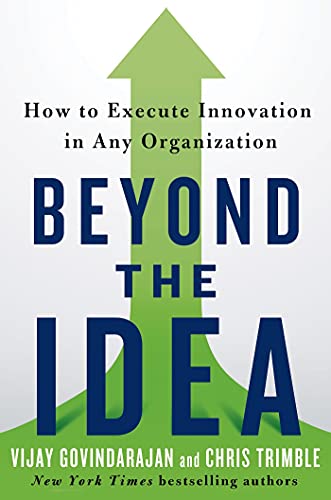
Inhaltsangabe
The New York Times bestselling authors of Reverse Innovation and How Stella Saved the Farm distill more than a decade of exclusive research into one short, powerful, action-oriented book.
Companies stumble when they imagine that innovation is mostly about ideas. The reality is that ideas are only beginnings. Indeed, even a company with the world's best idea still faces a devilish challenge: it must build the business of tomorrow without endangering the business of today.
Vijay Govindarajan and Chris Trimble are the world's leading authorities on the successful management of innovation. In Beyond the Idea, they distill more than a decade of research and insight into a practical, accessible, read-at-one-sitting handbook that offers invaluable guidance for anyone charged with making innovation happen: executives, managers, consultants, project leaders, and teams.
By offering specific action steps, Beyond the Idea extends the elegant conceptual insights from How Stella Saved the Farm, Govindarajan and Trimble's parable. Beyond the Idea shows exactly how to:
- Build a team with a very particular structure, one that makes it possible to simultaneously build something new and sustain what exists.
- Manage any innovation initiative as a disciplined experiment.
- Implement three distinct models for moving from ideas to action.
Beyond the Idea is an essential book for any business that recognizes that innovation always has been, and always will be, the key to long term growth and vitality.
Die Inhaltsangabe kann sich auf eine andere Ausgabe dieses Titels beziehen.
Über die Autorinnen und Autoren
Vijay Govindarajan is the Earl C. Daum 1924 Professor of International Business and founding director of the Tuck School’s Center for Global Leadership. He has worked with dozens of Fortune 500 corporations and speaks at conferences around the world. He is the co-author of Beyond the Idea and How Stella Saved the Farm. He lives in New Hampshire.
Chris Trimble has dedicated more than ten years to studying a single challenge that vexes even the best-managed corporations: how to execute an innovation initiative. With Govindarajan he coauthored the New York Times bestseller Reverse Innovation (2012). He lives in Vermont.
Auszug. © Genehmigter Nachdruck. Alle Rechte vorbehalten.
Beyond the Idea
How to Execute Innovation in Any Organization
By Vijay Govindarajan, Chris TrimbleSt. Martin's Press
Copyright © 2013 Vijay Govindarajan
All rights reserved.
ISBN: 978-1-250-04017-6All rights reserved.
CHAPTER 1
THE OTHER SIDE OF INNOVATION
Innovation is a two-part challenge. Part one is ideas; part two is execution.
To win, you have to succeed at both. Many companies, however, expend most or nearly all of their energies on part one. As such, they tend to produce a great many ideas on paper that never become anything more than … ideas on paper.
The most important message in Beyond the Idea is very simple: Part two, innovation execution, is its own unique discipline. It requires time, energy, and distinct thinking. Unfortunately, few companies treat it as such. In fact, few companies give it much thought at all.
FIRST, SHIFT ATTENTION TO EXECUTION
Companies wishing to improve at innovation must shift a substantial portion of their time and energy to part two, the other side of innovation. Doing so is not easy. The gravitational pull toward the front end of innovation is powerful. For one thing, the front end has the natural advantage of being first in the sequence. You can’t even get started without an idea!
That’s not all. Most everyone instinctively agrees that the world needs more front-end activity—more imagination, more creativity, more out-of-the-box thinking. Strategists see innovation as the pathway to disrupting your competition. Scientists and engineers link innovation to technological breakthroughs. Romantics see innovation as dramatic advances delivered by chance meetings and chance occurrences; by magic and by luck.
And then there is the icing on the cake—the rewards. We put idea people on a pedestal. We celebrate them, we promote them. We mythologize inventors and their inventions.
As such, it’s a snap to entice people into the front end. Getting people to attend creative brainstorming sessions, for example, rarely requires heavy persuasion. The front end offers the possibility of an exciting discovery, a eureka moment, an unexpected insight. It is, plainly put, fun.
The other side of innovation, on the other hand, is about practical matters. It is about getting the work done. It is blood, sweat, and tears. It is, plainly put, less fun.
Indeed, many people withdraw when it comes time to execute. Suddenly, innovation becomes just one more thing on a crowded agenda. Rather than the promise of outsize rewards, many will anticipate being blamed if the initiative does not go as well as hoped.
No wonder, then, that the front end gets all of the attention. No wonder that part two lives in part one’s long shadow. This imbalance of attention shows up on many maps that companies create of the innovation process. The typical map breaks down the front end of innovation into several substeps—for example, generating ideas, cross-pollinating ideas, evaluating ideas, selecting the best ideas. Then, on the far right side of the page, just barely hanging on in the consciousness of the mapmakers, is that one final step: execution.
These maps speak volumes. They show just how dramatically innovation execution is underestimated. The attitude is: The real innovation challenge is the epic search for the breakthrough idea! What is part two? That’s just getting the work done!
Be careful. Many companies are quite confident that they excel at execution of day-to-day operations. Therefore, they mistakenly conclude, they must be equally good at executing innovation. Unfortunately, comparing the two is like comparing a simple somersault to a triple flip with a quadruple twist. There really is no comparison.
ORGANIZATIONS ARE NOT BUILT TO EXECUTE INNOVATION
So why is innovation execution so hard? Simply put, organizations are not built for it. Quite to the contrary, they are built for ongoing operations. They are built to be Performance Engines.
A well-run Performance Engine is the master of many challenges. It excels at serving today’s customers and fighting today’s rivals. It is terrific at driving for efficiency by holding employees accountable. It is on time, on budget, and on spec—every day, every week, and every month. It delivers bottom-line results each and every quarter. Like a finely crafted Swiss timepiece, a great Performance Engine never misses a beat.
As impressive as this may be, the Performance Engine confronts innovation with high hurdles. Innovation promises short-term pain for long-term gain, but the Performance Engine wants to win now. Innovation requires experimentation; the Performance Engine demands efficiency. Innovations sometimes fail; the Performance Engine struggles to forgive.
These contrasts illustrate the first law of the other side of innovation: Innovation and ongoing operations are always and inevitably in conflict.
One indicator of just how deep the incompatibilities run is the fundamental accounting premise that a business is an ongoing concern, meaning that the current period will look an awful lot like the prior one. This is, of course, the antithesis of innovation.
The most fundamental source of conflict, however, lies in the method of the Performance Engine. This method is the same in every industry, in every part of the world, and in every type of organization—including private sector, public sector, and social sector organizations. It is to try to make every process and every activity as repeatable and as predictable as possible.
There is great power in both. When a process is repeatable, it is possible to break the process into small tasks and have people specialize. For centuries, specialization of labor has been recognized as a remarkable expedient to efficiency. Of equal importance, when a process becomes predictable, performance standards can be set and employees can be held accountable for very specific and quantified results.
Repeatability and predictability may be foundational for the Performance Engine, but they are also the antithesis of innovation. Far from being repeatable, innovation initiatives are intentional departures from the past. Far from being predictable, innovation initiatives proceed into territory in which there is no precedent upon which to base any forecast.
The Performance Engine strives for repeatable and predictable, but innovation is, by nature, nonroutine and uncertain. These are the fundamental incompatibilities between innovation and ongoing operations. They strike right at the heart of how managers are trained and how organizations are designed.
With such deep incompatibilities, perhaps the solution is to tear down the Performance Engine and rebuild organizations from scratch! Alas, we cannot. It is not that simple.
A well-run Performance Engine is a very powerful asset. Indeed, it is the foundation for an organization’s well-being. Great companies have great Performance Engines. Without one, customers leave, costs rise, profits fall, and organizations fall apart.
There may be deep incompatibilities, but that does not make the Performance Engine the enemy. In fact, without profits from the Performance Engine, there is no funding for innovation. Furthermore, the aspiration of every innovation initiative is to someday be just like the Performance Engine—successful, stable, and profitable.
Therefore, throughout this book, we have taken as our first obligation that we must do no harm. The challenge is not just to make...
THE OTHER SIDE OF INNOVATION
Innovation is a two-part challenge. Part one is ideas; part two is execution.
To win, you have to succeed at both. Many companies, however, expend most or nearly all of their energies on part one. As such, they tend to produce a great many ideas on paper that never become anything more than … ideas on paper.
The most important message in Beyond the Idea is very simple: Part two, innovation execution, is its own unique discipline. It requires time, energy, and distinct thinking. Unfortunately, few companies treat it as such. In fact, few companies give it much thought at all.
FIRST, SHIFT ATTENTION TO EXECUTION
Companies wishing to improve at innovation must shift a substantial portion of their time and energy to part two, the other side of innovation. Doing so is not easy. The gravitational pull toward the front end of innovation is powerful. For one thing, the front end has the natural advantage of being first in the sequence. You can’t even get started without an idea!
That’s not all. Most everyone instinctively agrees that the world needs more front-end activity—more imagination, more creativity, more out-of-the-box thinking. Strategists see innovation as the pathway to disrupting your competition. Scientists and engineers link innovation to technological breakthroughs. Romantics see innovation as dramatic advances delivered by chance meetings and chance occurrences; by magic and by luck.
And then there is the icing on the cake—the rewards. We put idea people on a pedestal. We celebrate them, we promote them. We mythologize inventors and their inventions.
As such, it’s a snap to entice people into the front end. Getting people to attend creative brainstorming sessions, for example, rarely requires heavy persuasion. The front end offers the possibility of an exciting discovery, a eureka moment, an unexpected insight. It is, plainly put, fun.
The other side of innovation, on the other hand, is about practical matters. It is about getting the work done. It is blood, sweat, and tears. It is, plainly put, less fun.
Indeed, many people withdraw when it comes time to execute. Suddenly, innovation becomes just one more thing on a crowded agenda. Rather than the promise of outsize rewards, many will anticipate being blamed if the initiative does not go as well as hoped.
No wonder, then, that the front end gets all of the attention. No wonder that part two lives in part one’s long shadow. This imbalance of attention shows up on many maps that companies create of the innovation process. The typical map breaks down the front end of innovation into several substeps—for example, generating ideas, cross-pollinating ideas, evaluating ideas, selecting the best ideas. Then, on the far right side of the page, just barely hanging on in the consciousness of the mapmakers, is that one final step: execution.
These maps speak volumes. They show just how dramatically innovation execution is underestimated. The attitude is: The real innovation challenge is the epic search for the breakthrough idea! What is part two? That’s just getting the work done!
Be careful. Many companies are quite confident that they excel at execution of day-to-day operations. Therefore, they mistakenly conclude, they must be equally good at executing innovation. Unfortunately, comparing the two is like comparing a simple somersault to a triple flip with a quadruple twist. There really is no comparison.
ORGANIZATIONS ARE NOT BUILT TO EXECUTE INNOVATION
So why is innovation execution so hard? Simply put, organizations are not built for it. Quite to the contrary, they are built for ongoing operations. They are built to be Performance Engines.
A well-run Performance Engine is the master of many challenges. It excels at serving today’s customers and fighting today’s rivals. It is terrific at driving for efficiency by holding employees accountable. It is on time, on budget, and on spec—every day, every week, and every month. It delivers bottom-line results each and every quarter. Like a finely crafted Swiss timepiece, a great Performance Engine never misses a beat.
As impressive as this may be, the Performance Engine confronts innovation with high hurdles. Innovation promises short-term pain for long-term gain, but the Performance Engine wants to win now. Innovation requires experimentation; the Performance Engine demands efficiency. Innovations sometimes fail; the Performance Engine struggles to forgive.
These contrasts illustrate the first law of the other side of innovation: Innovation and ongoing operations are always and inevitably in conflict.
One indicator of just how deep the incompatibilities run is the fundamental accounting premise that a business is an ongoing concern, meaning that the current period will look an awful lot like the prior one. This is, of course, the antithesis of innovation.
The most fundamental source of conflict, however, lies in the method of the Performance Engine. This method is the same in every industry, in every part of the world, and in every type of organization—including private sector, public sector, and social sector organizations. It is to try to make every process and every activity as repeatable and as predictable as possible.
There is great power in both. When a process is repeatable, it is possible to break the process into small tasks and have people specialize. For centuries, specialization of labor has been recognized as a remarkable expedient to efficiency. Of equal importance, when a process becomes predictable, performance standards can be set and employees can be held accountable for very specific and quantified results.
Repeatability and predictability may be foundational for the Performance Engine, but they are also the antithesis of innovation. Far from being repeatable, innovation initiatives are intentional departures from the past. Far from being predictable, innovation initiatives proceed into territory in which there is no precedent upon which to base any forecast.
The Performance Engine strives for repeatable and predictable, but innovation is, by nature, nonroutine and uncertain. These are the fundamental incompatibilities between innovation and ongoing operations. They strike right at the heart of how managers are trained and how organizations are designed.
With such deep incompatibilities, perhaps the solution is to tear down the Performance Engine and rebuild organizations from scratch! Alas, we cannot. It is not that simple.
A well-run Performance Engine is a very powerful asset. Indeed, it is the foundation for an organization’s well-being. Great companies have great Performance Engines. Without one, customers leave, costs rise, profits fall, and organizations fall apart.
There may be deep incompatibilities, but that does not make the Performance Engine the enemy. In fact, without profits from the Performance Engine, there is no funding for innovation. Furthermore, the aspiration of every innovation initiative is to someday be just like the Performance Engine—successful, stable, and profitable.
Therefore, throughout this book, we have taken as our first obligation that we must do no harm. The challenge is not just to make...
„Über diesen Titel“ kann sich auf eine andere Ausgabe dieses Titels beziehen.
Suchergebnisse für Beyond the Idea: How to Execute Innovation in Any Organizati...

Beispielbild für diese ISBN
Beyond the Idea: How to Execute Innovation in Any Organization
Verlag:
St. Martin's Press (edition 1), 2013
ISBN 10: 1250040175
ISBN 13: 9781250040176
Gebraucht
Hardcover
Anbieter: BooksRun, Philadelphia, PA, USA
Verkäuferbewertung 5 von 5 Sternen

Hardcover. Zustand: Very Good. 1. With dust jacket. It's a well-cared-for item that has seen limited use. The item may show minor signs of wear. All the text is legible, with all pages included. It may have slight markings and/or highlighting. Artikel-Nr. 1250040175-11-1-29
Gebraucht kaufen
EUR 4,61
Versand gratis
Versand innerhalb von USA
Versand innerhalb von USA
Anzahl: 1 verfügbar
Beispielbild für diese ISBN
Beyond the Idea How to Execute
Anbieter: World of Books (was SecondSale), Montgomery, IL, USA
Verkäuferbewertung 5 von 5 Sternen
Zustand: Acceptable. Item in acceptable condition! Textbooks may not include supplemental items i.e. CDs, access codes etc. Artikel-Nr. 00109736240
Gebraucht kaufen
EUR 5,42
Versand gratis
Versand innerhalb von USA
Versand innerhalb von USA
Anzahl: 1 verfügbar
Beispielbild für diese ISBN
Beyond the Idea How to Execute
Anbieter: World of Books (was SecondSale), Montgomery, IL, USA
Verkäuferbewertung 5 von 5 Sternen
Zustand: Good. Item in good condition. Textbooks may not include supplemental items i.e. CDs, access codes etc. Artikel-Nr. 00110450113
Gebraucht kaufen
EUR 5,42
Versand gratis
Versand innerhalb von USA
Versand innerhalb von USA
Anzahl: 1 verfügbar
Beispielbild für diese ISBN
Beyond the Idea: How to Execute Innovation in Any Organization
Anbieter: ThriftBooks-Phoenix, Phoenix, AZ, USA
Verkäuferbewertung 5 von 5 Sternen
Hardcover. Zustand: Very Good. No Jacket. May have limited writing in cover pages. Pages are unmarked. ~ ThriftBooks: Read More, Spend Less. Artikel-Nr. G1250040175I4N00
Gebraucht kaufen
EUR 5,87
Versand gratis
Versand innerhalb von USA
Versand innerhalb von USA
Anzahl: 1 verfügbar
Beispielbild für diese ISBN
Beyond the Idea: How to Execute Innovation in Any Organization
Anbieter: ThriftBooks-Atlanta, AUSTELL, GA, USA
Verkäuferbewertung 5 von 5 Sternen
Hardcover. Zustand: Very Good. No Jacket. May have limited writing in cover pages. Pages are unmarked. ~ ThriftBooks: Read More, Spend Less. Artikel-Nr. G1250040175I4N00
Gebraucht kaufen
EUR 5,87
Versand gratis
Versand innerhalb von USA
Versand innerhalb von USA
Anzahl: 1 verfügbar
Beispielbild für diese ISBN
Beyond the Idea: How to Execute Innovation in Any Organization
Anbieter: ThriftBooks-Reno, Reno, NV, USA
Verkäuferbewertung 5 von 5 Sternen
Hardcover. Zustand: As New. No Jacket. Pages are clean and are not marred by notes or folds of any kind. ~ ThriftBooks: Read More, Spend Less. Artikel-Nr. G1250040175I2N00
Gebraucht kaufen
EUR 5,87
Versand gratis
Versand innerhalb von USA
Versand innerhalb von USA
Anzahl: 1 verfügbar
Beispielbild für diese ISBN
Beyond the Idea: How to Execute Innovation in Any Organization
Anbieter: ThriftBooks-Phoenix, Phoenix, AZ, USA
Verkäuferbewertung 5 von 5 Sternen
Hardcover. Zustand: As New. No Jacket. Pages are clean and are not marred by notes or folds of any kind. ~ ThriftBooks: Read More, Spend Less. Artikel-Nr. G1250040175I2N00
Gebraucht kaufen
EUR 5,87
Versand gratis
Versand innerhalb von USA
Versand innerhalb von USA
Anzahl: 1 verfügbar
Beispielbild für diese ISBN
Beyond the Idea: How to Execute Innovation in Any Organization
Anbieter: ThriftBooks-Dallas, Dallas, TX, USA
Verkäuferbewertung 5 von 5 Sternen
Hardcover. Zustand: Very Good. No Jacket. May have limited writing in cover pages. Pages are unmarked. ~ ThriftBooks: Read More, Spend Less. Artikel-Nr. G1250040175I4N00
Gebraucht kaufen
EUR 5,87
Versand gratis
Versand innerhalb von USA
Versand innerhalb von USA
Anzahl: 1 verfügbar
Beispielbild für diese ISBN
Beyond the Idea: How to Execute Innovation in Any Organization
Anbieter: ThriftBooks-Reno, Reno, NV, USA
Verkäuferbewertung 5 von 5 Sternen
Hardcover. Zustand: Very Good. No Jacket. May have limited writing in cover pages. Pages are unmarked. ~ ThriftBooks: Read More, Spend Less. Artikel-Nr. G1250040175I4N00
Gebraucht kaufen
EUR 5,87
Versand gratis
Versand innerhalb von USA
Versand innerhalb von USA
Anzahl: 1 verfügbar
Beispielbild für diese ISBN
Beyond the Idea: How to Execute Innovation in Any Organization
Anbieter: ThriftBooks-Dallas, Dallas, TX, USA
Verkäuferbewertung 5 von 5 Sternen
Hardcover. Zustand: As New. No Jacket. Pages are clean and are not marred by notes or folds of any kind. ~ ThriftBooks: Read More, Spend Less. Artikel-Nr. G1250040175I2N00
Gebraucht kaufen
EUR 5,87
Versand gratis
Versand innerhalb von USA
Versand innerhalb von USA
Anzahl: 1 verfügbar