
Verwandte Artikel zu That Woman: The Life of Wallis Simpson, Duchess of...
Inhaltsangabe
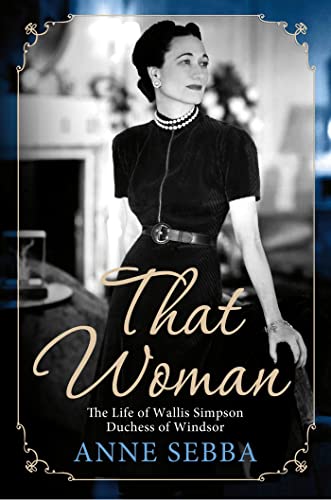
The first full scale biography of Wallis Simpson to be written by a woman, exploring the mind of one of the most glamorous and reviled figures of the Twentieth Century, a character who played prominently in the blockbuster film The King's Speech.
This is the story of the American divorcee notorious for allegedly seducing a British king off his throne. "That woman," so called by Queen Elizabeth, The Queen Mother, was born Bessie Wallis Warfield in 1896 in Baltimore. Neither beautiful nor brilliant, she endured an impoverished childhood, which fostered in her a burning desire to rise above her circumstances.
Acclaimed biographer Anne Sebba offers an eye-opening account of one of the most talked about women of her generation. It explores the obsessive nature of Simpson's relationship with Prince Edward, the suggestion that she may have had a Disorder of Sexual Development, and new evidence showing she may never have wanted to marry Edward at all.
Since her death, Simpson has become a symbol of female empowerment as well as a style icon. But her psychology remains an enigma. Drawing from interviews and newly discovered letters, That Woman shines a light on this captivating and complex woman, an object of fascination that has only grown with the years.
Die Inhaltsangabe kann sich auf eine andere Ausgabe dieses Titels beziehen.
Über die Autorin bzw. den Autor
Anne Sebba
Auszug. © Genehmigter Nachdruck. Alle Rechte vorbehalten.
That Woman
The Life of Wallis Simpson, Duchess of WindsorBy Anne SebbaSt. Martin's Griffin
Copyright © 2013 Anne SebbaAll right reserved.
ISBN: 9781250022189
That Woman
1
Becoming Wallis
'She has the Warfield look'
Choosing your own name is the supreme act of self-creation. Wallis, the androgynous and unusual name she insisted on for herself, is a bold statement of identity. 'Wallis' is saying not only this is who I am but you will know no one else like me. Take me on my own terms. It was a credo she lived by.
From the start this woman fashioned herself as something strong, intriguing, distinctive. In taking such a name she was constructing an identity, giving herself from a young age freedom that women of her era could not take for granted. She was displaying a contempt for tradition and the ordinary which would be so crucial to her destiny. Having chosen her own name she had to work hard to live up to it, to create a strong relationship with it. Although her surname changed many times, this name was one of the few constants in her life. 'Hi, I'm Wallis,' she would say when she entered a room.
The name her parents chose for her was 'Bessiewallis', to honour both her mother's beloved sister Bessie and her grandfather's illustrious friend Severn Teackle Wallis, an author and legislator and, in Baltimore, an important man. The latter had been imprisoned for a time during the Civil War, along with Wallis's grandfather, for supporting a call for secession from the Union, but was later appointed provost at the University of Maryland. Her own father, too, bore this man's name. His statue stands today at one end of Mount Vernon Square, the city's main plaza, overshadowed though it is by the imposing 178-foot-high monument of George Washington in the centre, the first erected in the first President's honour. But she soon jettisoned 'Bessie', describing it as a name fit only for cows.'Wallis', however, was a man's name for a woman who could hold her own with men.
Wallis was never a woman's woman. She wanted to be something out of the ordinary for a woman. She was funny, clever, smart - in both the English and American uses of the term. She wanted to pit her wits not against other women but against men in a man's world. With her sharp understanding of appearances, she always knew the importance of a name. Of course she had seen her mother change from 'Alys' to 'Alice'. But that was subtle, gentle, barely noticeable. Choosing Wallis in her youth was as much part of her armour as the carefully selected designer clothes and decor of her middle years. When inviting friends to her third wedding, her husband-to-be, the ex-King, a man with even more names to accommodate, suddenly started referring to her as 'Mrs Warfield'. This was a name she had never owned, nor could claim any right to. She encouraged it to shield the man she had dragged along in her wake.
Defining herself by her name was one of the first acts of a young girl intent on controlling a cold and often unfriendly world. Whenever Wallis succeeded, she felt most at peace. But for much of her life she was dependent on the charity of others and this led to long bouts of unhappiness to which she responded in a variety of ways.
There is no birth certificate for Wallis. It was not a legal requirement at the time to have one in Pennsylvania, where she was born amid some secrecy and scandal probably on 19 June 1896. Nor was there a newspaper announcement of her birth. The place where she was born, however, is not in doubt: a small wooden building known as Square Cottage at the back of the Monterey Inn in the summer resort of Blue Ridge Summit. The Blue Ridge Summit community, at the top of the South Mountain at Monterey Pass, was in its heyday as a fashionable spa and holiday area at the beginning of the twentieth century, after the introduction of the railroad in 1872. Blue Ridge Summit strays into four counties - two on the Pennsylvania side of the line and two on the Maryland side - and straddles the historic Mason - Dixon line, significantly giving Wallis aspects of both theSouth and North of the United States in her make-up. This was something she was to make much of later.
Her parents had gone there ostensibly to escape the heat of a Baltimore summer and in the hope of improving her father's health, but also because they were in flight from disapproving families. In her memoirs, Wallis is vague about the marriage of her parents, the consumptive Teackle Wallis Warfield and the spirited if flighty Alice Montague, a marriage neither family wanted.
'Without taking their families into their confidence, they slipped away and were married, according to one story in a church in Washington, according to another in a church in Baltimore,' Wallis wrote sixty years later. She would have us believe that Teackle and Alice were married in June 1895 when both were twenty-six years old. But, more likely, the marriage had been solemnized just seven months before her birth, on 19 November 1895, as a monograph on the Church of St Michael and All Angels in Baltimore states. According to this account, Dr C. Ernest Smith, the Rector, was called upon to officiate at a quiet marriage which attracted little attention at the time. 'On that day Teackle Wallis Warfield took as his bride Miss Alice M. Montague, a communicant of the parish. The ceremony took place not in the main church itself but in the rectory at 1929 St Paul Street in the presence of several friends.'
This version makes it seem that the marriage was arranged as soon as Alice realized she was pregnant, that the first and only child of the union was most probably conceived out of wedlock and that neither family attended. Perhaps, more significantly, it also indicates there was never a time in Wallis's life when she did not have to harbour secrets.
Wallis, with an attempt at insouciance, wrote later in her own account of how she once asked her mother for the date and time of her birth 'and she answered impatiently that she had been far too busy at the time to consult the calendar let alone the clock'. But the child may also have arrived prematurely, as the family doctor was not available and the twenty-two-year-old, newly qualified Dr Lewis Miles Allen received an emergency call from the Monterey Inn and delivered the baby in Alice's hotel bedroom.
The Warfields and the Montagues, although both shared impeccable Southern credentials and both were supporters of the Confederacy during the Civil War, did not get on. Both came from ancient and respected stock and traced their arrival in America to the seventeenth century. There is a much trumpeted mention of the Warfields in the Domesday Book and one of Wallis's ancestors, Pagan de Warfield, is said to have accompanied William the Conqueror from France and fought in the Battle of Hastings. The Montagues, similarly, hailed from an old English aristocratic family that arrived in America in 1621 when one Peter Montague left Buckinghamshire and settled on land in Virginia granted him by King Charles I. Wallis always felt proud of her ancestry and had reason to. 'For those who are prepared to accept that there can be class distinctions of any kind in the United States,' wrote the social commentator Alastair Forbes in the mid-1970s, 'she can be said to come from a far higher stratum than say Princess Grace of Monaco, Jacqueline Bouvier or the Jerome or Vanderbilt ladies of the nineteenth century. By...
„Über diesen Titel“ kann sich auf eine andere Ausgabe dieses Titels beziehen.
Suchergebnisse für That Woman: The Life of Wallis Simpson, Duchess of...

Beispielbild für diese ISBN
That Woman
Anbieter: World of Books (was SecondSale), Montgomery, IL, USA
Verkäuferbewertung 5 von 5 Sternen

Paperback. Zustand: Good. The first full scale biography of Wallis Simpson to be written by a woman, exploring the mind of one of the most glamorous and reviled figures of the Twentieth Century, a character who played prominently in the blockbuster film The King's Speech. This is the story of the American divorcee notorious for allegedly seducing a British king off his throne. "That woman," so called by Queen Elizabeth, The Queen Mother, was born Bessie Wallis Warfield in 1896 in Baltimore. Neither beautiful nor brilliant, she endured an impoverished childhood, which fostered in her a burning desire to rise above her circumstances. Acclaimed biographer Anne Sebba offers an eye-opening account of one of the most talked about women of her generation. It explores the obsessive nature of Simpson's relationship with Prince Edward, the suggestion that she may have had a Disorder of Sexual Development, and new evidence showing she may never have wanted to marry Edward at all. Since her death, Simpson has become a symbol of female empowerment as well as a style icon. But her psychology remains an enigma. Drawing from interviews and newly discovered letters, That Woman shines a light on this captivating and complex woman, an object of fascination that has only grown with the years. Artikel-Nr. 00099180667
Gebraucht kaufen
EUR 4,01
Versand gratis
Versand innerhalb von USA
Versand innerhalb von USA
Anzahl: 7 verfügbar
Beispielbild für diese ISBN
That Woman
Anbieter: World of Books (was SecondSale), Montgomery, IL, USA
Verkäuferbewertung 5 von 5 Sternen
Paperback. Zustand: Fair. The first full scale biography of Wallis Simpson to be written by a woman, exploring the mind of one of the most glamorous and reviled figures of the Twentieth Century, a character who played prominently in the blockbuster film The King's Speech. This is the story of the American divorcee notorious for allegedly seducing a British king off his throne. "That woman," so called by Queen Elizabeth, The Queen Mother, was born Bessie Wallis Warfield in 1896 in Baltimore. Neither beautiful nor brilliant, she endured an impoverished childhood, which fostered in her a burning desire to rise above her circumstances. Acclaimed biographer Anne Sebba offers an eye-opening account of one of the most talked about women of her generation. It explores the obsessive nature of Simpson's relationship with Prince Edward, the suggestion that she may have had a Disorder of Sexual Development, and new evidence showing she may never have wanted to marry Edward at all. Since her death, Simpson has become a symbol of female empowerment as well as a style icon. But her psychology remains an enigma. Drawing from interviews and newly discovered letters, That Woman shines a light on this captivating and complex woman, an object of fascination that has only grown with the years. Artikel-Nr. 00094322487
Gebraucht kaufen
EUR 4,01
Versand gratis
Versand innerhalb von USA
Versand innerhalb von USA
Anzahl: 3 verfügbar
Beispielbild für diese ISBN
That Woman: The Life of Wallis Simpson, Duchess of Windsor
Verlag:
St. Martin's Griffin (edition Reprint), 2013
ISBN 10: 1250022185
ISBN 13: 9781250022189
Gebraucht
Paperback
Anbieter: BooksRun, Philadelphia, PA, USA
Verkäuferbewertung 5 von 5 Sternen
Paperback. Zustand: Very Good. Reprint. It's a well-cared-for item that has seen limited use. The item may show minor signs of wear. All the text is legible, with all pages included. It may have slight markings and/or highlighting. Artikel-Nr. 1250022185-11-1
Gebraucht kaufen
EUR 4,61
Versand gratis
Versand innerhalb von USA
Versand innerhalb von USA
Anzahl: 1 verfügbar
Beispielbild für diese ISBN
That Woman
Anbieter: ThriftBooks-Dallas, Dallas, TX, USA
Verkäuferbewertung 5 von 5 Sternen
Paperback. Zustand: Good. No Jacket. Former library book; Pages can have notes/highlighting. Spine may show signs of wear. ~ ThriftBooks: Read More, Spend Less. Artikel-Nr. G1250022185I3N10
Gebraucht kaufen
EUR 6,01
Versand gratis
Versand innerhalb von USA
Versand innerhalb von USA
Anzahl: 1 verfügbar
Beispielbild für diese ISBN
That Woman
Anbieter: ThriftBooks-Atlanta, AUSTELL, GA, USA
Verkäuferbewertung 5 von 5 Sternen
Paperback. Zustand: Good. No Jacket. Pages can have notes/highlighting. Spine may show signs of wear. ~ ThriftBooks: Read More, Spend Less. Artikel-Nr. G1250022185I3N00
Gebraucht kaufen
EUR 6,01
Versand gratis
Versand innerhalb von USA
Versand innerhalb von USA
Anzahl: 1 verfügbar
Beispielbild für diese ISBN
That Woman
Anbieter: ThriftBooks-Dallas, Dallas, TX, USA
Verkäuferbewertung 5 von 5 Sternen
Paperback. Zustand: Good. No Jacket. Pages can have notes/highlighting. Spine may show signs of wear. ~ ThriftBooks: Read More, Spend Less. Artikel-Nr. G1250022185I3N00
Gebraucht kaufen
EUR 6,01
Versand gratis
Versand innerhalb von USA
Versand innerhalb von USA
Anzahl: 1 verfügbar
Beispielbild für diese ISBN
That Woman
Anbieter: ThriftBooks-Atlanta, AUSTELL, GA, USA
Verkäuferbewertung 5 von 5 Sternen
Paperback. Zustand: Very Good. No Jacket. May have limited writing in cover pages. Pages are unmarked. ~ ThriftBooks: Read More, Spend Less. Artikel-Nr. G1250022185I4N00
Gebraucht kaufen
EUR 6,01
Versand gratis
Versand innerhalb von USA
Versand innerhalb von USA
Anzahl: 1 verfügbar
Beispielbild für diese ISBN
That Woman: The Life of Wallis Simpson, Duchess of Windsor
Anbieter: Wonder Book, Frederick, MD, USA
Verkäuferbewertung 5 von 5 Sternen
Zustand: Good. Good condition. A copy that has been read but remains intact. May contain markings such as bookplates, stamps, limited notes and highlighting, or a few light stains. Bundled media such as CDs, DVDs, floppy disks or access codes may not be included. Artikel-Nr. I01A-09228
Gebraucht kaufen
EUR 6,43
Versand gratis
Versand innerhalb von USA
Versand innerhalb von USA
Anzahl: 1 verfügbar
Beispielbild für diese ISBN
That Woman: The Life of Wallis Simpson, Duchess of Windsor
Anbieter: Wonder Book, Frederick, MD, USA
Verkäuferbewertung 5 von 5 Sternen
Zustand: Very Good. Very Good condition. A copy that may have a few cosmetic defects. May also contain light spine creasing or a few markings such as an owner's name, short gifter's inscription or light stamp. Artikel-Nr. N14M-02216
Gebraucht kaufen
EUR 6,43
Versand gratis
Versand innerhalb von USA
Versand innerhalb von USA
Anzahl: 3 verfügbar
Beispielbild für diese ISBN
That Woman : The Life of Wallis Simpson, Duchess of Windsor
Anbieter: Better World Books, Mishawaka, IN, USA
Verkäuferbewertung 5 von 5 Sternen
Zustand: Good. Reprint. Former library copy. Pages intact with minimal writing/highlighting. The binding may be loose and creased. Dust jackets/supplements are not included. Includes library markings. Stock photo provided. Product includes identifying sticker. Better World Books: Buy Books. Do Good. Artikel-Nr. 7756038-6
Gebraucht kaufen
EUR 6,57
Versand gratis
Versand innerhalb von USA
Versand innerhalb von USA
Anzahl: 1 verfügbar