
Verwandte Artikel zu Learning to Silence the Mind: Wellness Through Meditation
Inhaltsangabe
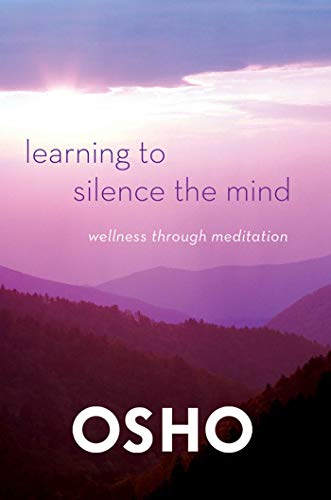
One of the twentieth century's greatest spiritual teachers will show you how to quiet your constant, worrying thoughts in Learning to Silence the Mind: Wellness Through Meditation.
The mind, says Osho, has the potential to be enormously creative in dealing with the challenges of everyday life, and the problems of the world in which we live. The difficulty, however, is that instead of using the mind as a helpful servant we have largely allowed it to become the master of our lives. Its ambitions, belief systems, and interpretations rule our days and our nights-bringing us into conflict with minds that are different from ours, keeping us awake at night rehashing those conflicts or planning the conflicts of tomorrow, and disturbing our sleep and our dreams.
If only there was a way to switch it off and give it a rest! Finding the switch that can silence the mind-not by force or performing some exotic ritual, but through understanding, watchfulness, and a healthy sense of humor-is meditation. A sharper, more relaxed and creative mind-one that can function at the peak of its unique intelligence-is the potential.
The book includes a link to tutorials on OSHO Nadabrahma Meditation.
Osho challenges readers to examine and break free of the conditioned belief systems and prejudices that limit their capacity to enjoy life in all its richness. He has been described by the Sunday Times of London as one of the "1000 Makers of the 20th Century" and by Sunday Mid-Day (India) as one of the ten people-along with Gandhi, Nehru, and Buddha-who have changed the destiny of India. Since his death in 1990, the influence of his teachings continues to expand, reaching seekers of all ages in virtually every country of the world.
Die Inhaltsangabe kann sich auf eine andere Ausgabe dieses Titels beziehen.
Über die Autorin bzw. den Autor
Osho is one of the most provocative and inspiring spiritual teachers of the twentieth century. Known for his revolutionary contribution to the science of inner transformation, the influence of his teachings continues to grow, reaching seekers of all ages in virtually every country of the world. He is the author of many books, including Love, Freedom, Aloneness; The Book of Secrets; and Innocence, Knowledge, and Wonder.
Auszug. © Genehmigter Nachdruck. Alle Rechte vorbehalten.
Learning to Silence the Mind
Wellness Through MeditationBy OshoSt. Martin's Griffin
Copyright © 2012 OshoAll right reserved.
ISBN: 9781250006226
1
What Is Meditation?
TO SAY SOMETHING ABOUT MEDITATION IS a contradiction in terms. It is something which you can have, which you can be, but by its very nature you cannot say what it is. Still, efforts have been made to convey it in some way. Even if only a fragmentary, partial understanding arises out of it, that is more than one can expect. But even that partial understanding of meditation can become a seed. Much depends on how you listen. If you only hear, then even a fragment cannot be conveyed to you, but if you listen.… Try to understand the difference between the two.
Hearing is mechanical. You have ears, you can hear. If you are getting deaf then a mechanical aid can help you to hear. Your ears are nothing but a certain mechanism to receive sounds. Hearing is very simple: Animals hear, anybody who has ears is capable of hearing—but listening is a far higher stage.
Listening means: When you are hearing, you are only hearing and not doing anything else—no other thoughts in your mind, no clouds passing in your inner sky—so whatever is being said reaches you, as it is being said. There is no interference from your mind; it is not interpreted by you, by your prejudices; not clouded by anything that, right now, is passing within you—because all these are distortions.
Ordinarily it is not difficult; you go on managing just by hearing, because the things you are hearing concern common objects. If I say something about the house, the door, the tree, the bird, there is no problem. These are common objects; there is no need of listening. But there is a need to listen when we are talking about something like meditation, which is not an object at all; it is a subjective state. We can only indicate it. You have to be very attentive and alert—then there is a possibility that some meaning reaches you.
Even if a little understanding arises in you, it is more than enough, because understanding has its own way of growing. If just a little bit of understanding falls in the right place, in the heart, it starts growing of its own accord.
First try to understand the word “meditation.” It is not the right word for the state about which any authentic seeker is bound to be concerned. So I would like to tell you something about a few words. In Sanskrit we have a special word for meditation, the word is dhyana. In no other language does a parallel word exist; the word is untranslatable. It has been recognized for two thousand years that this word is untranslatable for the simple reason that in no other language have people tried it or experienced the state that it denotes; so those languages don’t have the word.
A word is needed only when there is something to say, something to designate. In English there are three words: the first is concentration. I have seen many books written by very well-meaning people, but not people who have experienced meditation. They go on using the word “concentration” for dhyana—dhyana is not concentration. Concentration simply means your mind focused on one point; it is a state of mind. Ordinarily the mind is continuously moving, but if it continuously moves you cannot work with the mind on a certain subject.
For example, in science concentration is needed; without concentration there is no possibility of science. It is not surprising that science has not evolved in the East—I see these deep inner connections—because concentration was never valued. For religiousness something else is needed, not concentration.
Concentration is mind focused on one point. It has its utility, because then you can go deeper and deeper into a certain object. That’s what science goes on doing: finding out more and more about the objective world. A person with a mind that is continuously roaming around cannot be a scientist.
The whole art of the scientist is to be capable of forgetting the whole world and putting your whole consciousness on just one thing. And when the whole consciousness is poured into one thing, then it is almost like concentrating sun rays through a lens: Then you can create fire. Those rays themselves cannot create fire because they are diffused; they are going farther away from each other. Their movement is just the opposite of concentration. Concentration means rays coming together, meeting on one point; and when so many rays meet on one point they have enough energy to create fire.
Consciousness has the same quality: Concentrate it, and you can penetrate deeper into the mysteries of objects.
I am reminded of a story about Thomas Alva Edison, one of the great scientists of North America. He was working on something with such concentration, and when his wife came with his breakfast she saw that he was so much involved that he had not even heard her coming. He had not even looked at her, he was not aware that she was there. She knew that this was not the right time to disturb him. “Of course the breakfast will get cold but he will be really angry if I disturb him—one never knows where he is.” So she simply put the breakfast by his side, so that whenever he came back from his journey of concentration he would see the breakfast and eat it.
But what happened? In the meantime a friend dropped by—he also saw Edison so concentrated, and he looked at the breakfast getting cold and said, “Better let him do his work. I will take the breakfast, it is getting cold.” He ate the breakfast, and Edison was not even aware that this friend was there.
When he returned from his concentration, Edison looked around, saw the friend and saw the empty plates. He told the friend, “Please forgive me. You came a little late and I have already taken my breakfast.” Obviously, because the plates were empty, somebody had eaten, and who else could have eaten it? He must have! The poor friend didn’t know what to do. He had been thinking to give Edison a surprise, but this man had given him a bigger surprise: He said, “You came a little late.…”
But the wife was watching the whole thing. She came in and she said, “He has not come late, you have come late! He has finished your breakfast. I was watching, but I saw that it was getting cold anyway; at least somebody ate it. You are some scientist! How you manage your science I cannot understand.”
Concentration is always the narrowing of your consciousness. The narrower it becomes, the more powerful it is. It is like a sword that cuts into any secret of nature: You have to become oblivious of everything. But this is not meditation. Many people have misunderstood—not only in the West, but in the East, too. They think that concentration is meditation. It gives you tremendous powers, but those powers are of the mind.
For example, in 1920 the king of Varanasi in India went through surgery—and created news all over the world because of his operation. He refused to take any anesthetic. He said, “I have taken a vow not to take anything that makes me unconscious, so I cannot be put under chloroform; but you need not be worried.…”
It was a major operation, to remove his appendix. Now, to take out somebody’s appendix without giving him anesthetics is really dangerous; you may kill the man. He may not be able to bear the pain, because the pain is going to be terrible. You have...
What Is Meditation?
TO SAY SOMETHING ABOUT MEDITATION IS a contradiction in terms. It is something which you can have, which you can be, but by its very nature you cannot say what it is. Still, efforts have been made to convey it in some way. Even if only a fragmentary, partial understanding arises out of it, that is more than one can expect. But even that partial understanding of meditation can become a seed. Much depends on how you listen. If you only hear, then even a fragment cannot be conveyed to you, but if you listen.… Try to understand the difference between the two.
Hearing is mechanical. You have ears, you can hear. If you are getting deaf then a mechanical aid can help you to hear. Your ears are nothing but a certain mechanism to receive sounds. Hearing is very simple: Animals hear, anybody who has ears is capable of hearing—but listening is a far higher stage.
Listening means: When you are hearing, you are only hearing and not doing anything else—no other thoughts in your mind, no clouds passing in your inner sky—so whatever is being said reaches you, as it is being said. There is no interference from your mind; it is not interpreted by you, by your prejudices; not clouded by anything that, right now, is passing within you—because all these are distortions.
Ordinarily it is not difficult; you go on managing just by hearing, because the things you are hearing concern common objects. If I say something about the house, the door, the tree, the bird, there is no problem. These are common objects; there is no need of listening. But there is a need to listen when we are talking about something like meditation, which is not an object at all; it is a subjective state. We can only indicate it. You have to be very attentive and alert—then there is a possibility that some meaning reaches you.
Even if a little understanding arises in you, it is more than enough, because understanding has its own way of growing. If just a little bit of understanding falls in the right place, in the heart, it starts growing of its own accord.
First try to understand the word “meditation.” It is not the right word for the state about which any authentic seeker is bound to be concerned. So I would like to tell you something about a few words. In Sanskrit we have a special word for meditation, the word is dhyana. In no other language does a parallel word exist; the word is untranslatable. It has been recognized for two thousand years that this word is untranslatable for the simple reason that in no other language have people tried it or experienced the state that it denotes; so those languages don’t have the word.
A word is needed only when there is something to say, something to designate. In English there are three words: the first is concentration. I have seen many books written by very well-meaning people, but not people who have experienced meditation. They go on using the word “concentration” for dhyana—dhyana is not concentration. Concentration simply means your mind focused on one point; it is a state of mind. Ordinarily the mind is continuously moving, but if it continuously moves you cannot work with the mind on a certain subject.
For example, in science concentration is needed; without concentration there is no possibility of science. It is not surprising that science has not evolved in the East—I see these deep inner connections—because concentration was never valued. For religiousness something else is needed, not concentration.
Concentration is mind focused on one point. It has its utility, because then you can go deeper and deeper into a certain object. That’s what science goes on doing: finding out more and more about the objective world. A person with a mind that is continuously roaming around cannot be a scientist.
The whole art of the scientist is to be capable of forgetting the whole world and putting your whole consciousness on just one thing. And when the whole consciousness is poured into one thing, then it is almost like concentrating sun rays through a lens: Then you can create fire. Those rays themselves cannot create fire because they are diffused; they are going farther away from each other. Their movement is just the opposite of concentration. Concentration means rays coming together, meeting on one point; and when so many rays meet on one point they have enough energy to create fire.
Consciousness has the same quality: Concentrate it, and you can penetrate deeper into the mysteries of objects.
I am reminded of a story about Thomas Alva Edison, one of the great scientists of North America. He was working on something with such concentration, and when his wife came with his breakfast she saw that he was so much involved that he had not even heard her coming. He had not even looked at her, he was not aware that she was there. She knew that this was not the right time to disturb him. “Of course the breakfast will get cold but he will be really angry if I disturb him—one never knows where he is.” So she simply put the breakfast by his side, so that whenever he came back from his journey of concentration he would see the breakfast and eat it.
But what happened? In the meantime a friend dropped by—he also saw Edison so concentrated, and he looked at the breakfast getting cold and said, “Better let him do his work. I will take the breakfast, it is getting cold.” He ate the breakfast, and Edison was not even aware that this friend was there.
When he returned from his concentration, Edison looked around, saw the friend and saw the empty plates. He told the friend, “Please forgive me. You came a little late and I have already taken my breakfast.” Obviously, because the plates were empty, somebody had eaten, and who else could have eaten it? He must have! The poor friend didn’t know what to do. He had been thinking to give Edison a surprise, but this man had given him a bigger surprise: He said, “You came a little late.…”
But the wife was watching the whole thing. She came in and she said, “He has not come late, you have come late! He has finished your breakfast. I was watching, but I saw that it was getting cold anyway; at least somebody ate it. You are some scientist! How you manage your science I cannot understand.”
Concentration is always the narrowing of your consciousness. The narrower it becomes, the more powerful it is. It is like a sword that cuts into any secret of nature: You have to become oblivious of everything. But this is not meditation. Many people have misunderstood—not only in the West, but in the East, too. They think that concentration is meditation. It gives you tremendous powers, but those powers are of the mind.
For example, in 1920 the king of Varanasi in India went through surgery—and created news all over the world because of his operation. He refused to take any anesthetic. He said, “I have taken a vow not to take anything that makes me unconscious, so I cannot be put under chloroform; but you need not be worried.…”
It was a major operation, to remove his appendix. Now, to take out somebody’s appendix without giving him anesthetics is really dangerous; you may kill the man. He may not be able to bear the pain, because the pain is going to be terrible. You have...
„Über diesen Titel“ kann sich auf eine andere Ausgabe dieses Titels beziehen.
Suchergebnisse für Learning to Silence the Mind: Wellness Through Meditation

Beispielbild für diese ISBN
Learning to Silence the Mind: Wellness Through Meditation
Verlag:
St. Martin's Essentials, 2012
ISBN 10: 1250006228
ISBN 13: 9781250006226
Gebraucht
Softcover
Anbieter: Wonder Book, Frederick, MD, USA
Verkäuferbewertung 5 von 5 Sternen

Zustand: Good. Good condition. A copy that has been read but remains intact. May contain markings such as bookplates, stamps, limited notes and highlighting, or a few light stains. Artikel-Nr. K13E-01579
Gebraucht kaufen
EUR 7,55
Versand gratis
Versand innerhalb von USA
Versand innerhalb von USA
Anzahl: 1 verfügbar
Beispielbild für diese ISBN
Learning to Silence the Mind: Wellness Through Meditation
Verlag:
St. Martin's Essentials, 2012
ISBN 10: 1250006228
ISBN 13: 9781250006226
Gebraucht
Paperback
Anbieter: WorldofBooks, Goring-By-Sea, WS, Vereinigtes Königreich
Verkäuferbewertung 5 von 5 Sternen
Paperback. Zustand: Very Good. The book has been read, but is in excellent condition. Pages are intact and not marred by notes or highlighting. The spine remains undamaged. Artikel-Nr. GOR007219266
Gebraucht kaufen
EUR 6,13
EUR 6,51 Versand
Versand von Vereinigtes Königreich nach USA
Versand von Vereinigtes Königreich nach USA
Anzahl: 1 verfügbar
Beispielbild für diese ISBN
Learning to Silence the Mind: Wellness Through Meditation
Anbieter: Roundabout Books, Greenfield, MA, USA
Verkäuferbewertung 4 von 5 Sternen

paperback. Zustand: Near Fine. Condition Notes: Excellent, unmarked copy with little wear and tight binding. We ship in recyclable American-made mailers. 100% money-back guarantee on all orders. Artikel-Nr. 1686596
Gebraucht kaufen
EUR 13,60
Versand gratis
Versand innerhalb von USA
Versand innerhalb von USA
Anzahl: 1 verfügbar
Beispielbild für diese ISBN
Learning to Silence the Mind
Anbieter: Majestic Books, Hounslow, Vereinigtes Königreich
Verkäuferbewertung 4 von 5 Sternen
Zustand: New. pp. 192. Artikel-Nr. 38572633
Neu kaufen
EUR 6,21
EUR 7,56 Versand
Versand von Vereinigtes Königreich nach USA
Versand von Vereinigtes Königreich nach USA
Anzahl: 4 verfügbar
Beispielbild für diese ISBN
Learning to Silence the Mind: Wellness Through Meditation
Anbieter: Sell Books, Elland, YORKS, Vereinigtes Königreich
Verkäuferbewertung 5 von 5 Sternen
paperback. Zustand: Very Good. Most of our very good books have only minor imperfections such as shelf wear consistent with a new book that's sat on a bookshop shelf for a year or two. Occasionally we may miss other minor imperfections as we have to grade books at speed. Our books are dispatched from a Yorkshire former cotton mill. We list via barcode/ISBN so please note that the images are stock images and may not be the exact copy you receive, furthermore the details about edition and year might not be accurate as many publishers reuse the same ISBN for multiple editions and as we simply scan a barcode or enter an ISBN we do not check the validity of the edition data when listing. If you're looking for an exact edition please don't order (at least not without checking with us first, although we don't always have time to check). We aim to dispatch prompty, the service used will depend on order value and book size. We can ship to most countries, see our shipping policies. Payment is via Abe only. Artikel-Nr. mon0000098895
Gebraucht kaufen
EUR 7,42
EUR 14,13 Versand
Versand von Vereinigtes Königreich nach USA
Versand von Vereinigtes Königreich nach USA
Anzahl: 1 verfügbar

Internationale Ausgabe
Learning To Silence the Mind
Internationale AusgabeAnbieter: Romtrade Corp., STERLING HEIGHTS, MI, USA
Verkäuferbewertung 5 von 5 Sternen
Zustand: New. Brand New. Soft Cover International Edition. Different ISBN and Cover Image. Priced lower than the standard editions which is usually intended to make them more affordable for students abroad. The core content of the book is generally the same as the standard edition. The country selling restrictions may be printed on the book but is no problem for the self-use. This Item maybe shipped from US or any other country as we have multiple locations worldwide. Artikel-Nr. ABBB-242286
Beispielbild für diese ISBN
Learning To Silence The Mind
Anbieter: Romtrade Corp., STERLING HEIGHTS, MI, USA
Verkäuferbewertung 5 von 5 Sternen
Zustand: New. This is a Brand-new US Edition. This Item may be shipped from US or any other country as we have multiple locations worldwide. Artikel-Nr. ABBB-49607
Beispielbild für diese ISBN
Learning to Silence the Mind: Wellness Through Meditation
Anbieter: Ria Christie Collections, Uxbridge, Vereinigtes Königreich
Verkäuferbewertung 5 von 5 Sternen
Zustand: New. In English. Artikel-Nr. ria9781250006226_new
Neu kaufen
EUR 18,37
EUR 10,89 Versand
Versand von Vereinigtes Königreich nach USA
Versand von Vereinigtes Königreich nach USA
Anzahl: Mehr als 20 verfügbar
Beispielbild für diese ISBN
Learning to Silence the Mind: Wellness Through Meditation
Anbieter: Revaluation Books, Exeter, Vereinigtes Königreich
Verkäuferbewertung 5 von 5 Sternen
Paperback. Zustand: Brand New. 179 pages. 8.25x5.50x0.50 inches. In Stock. Artikel-Nr. x-1250006228
Neu kaufen
EUR 18,50
EUR 11,63 Versand
Versand von Vereinigtes Königreich nach USA
Versand von Vereinigtes Königreich nach USA
Anzahl: 2 verfügbar
Foto des Verkäufers
Learning to Silence the Mind : Wellness Through Meditation
Anbieter: AHA-BUCH GmbH, Einbeck, Deutschland
Verkäuferbewertung 5 von 5 Sternen
Taschenbuch. Zustand: Neu. Neuware - The mind has the potential to be enormously creative in dealing with the challenges of everyday life, and the problems of the world in which we live. The difficulty is that instead of using the mind as a helpful servant we have largely allowed it to become the master of our lives. Finding the switch that can silence the mind-through understanding, watchfulness, and a sense of humor-is meditation. Artikel-Nr. 9781250006226
Neu kaufen
EUR 25,94
EUR 35,00 Versand
Versand von Deutschland nach USA
Versand von Deutschland nach USA
Anzahl: 2 verfügbar