
Verwandte Artikel zu Field Systems and Farming Systems in Late Medieval...
Inhaltsangabe
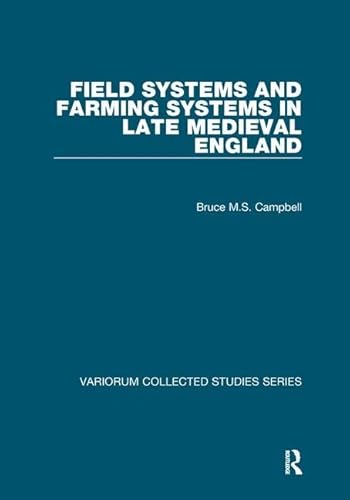
The later Middle Ages was an overwhelmingly rural world, with probably three out of four households reliant upon farming for a living. Yet conventional accounts of the period rarely do justice to the variety of ways in which the land was managed and worked. The thirteen essays collected in this volume draw upon the abundant documentary evidence of the period to explore that diversity. In the process they engage with the issue of classification - without which effective generalisation is impossible - and offer a series of solutions to that particularly thorny methodological challenge. Only through systematic and objective classification is it possible to differentiate between and map different field systems, husbandry types, and land-use categories. That, in turn, makes it possible to consider and evaluate the relative roles of soils and topography, institutional structures, and commercialised market demand in shaping farm enterprise both during the period of mounting population before the Black Death and the long era of demographic decline that followed it. What emerges is an agrarian world more commercialised, differentiated, and complex than is usually appreciated, whose institutional and agronomic contours shaped the course of agricultural development for centuries to come.
Die Inhaltsangabe kann sich auf eine andere Ausgabe dieses Titels beziehen.
Über die Autorin bzw. den Autor
Bruce M.S. Campbell is Professor of Medieval Economic History at the School of Geography, Archaeology and Palaeoecology, The Queen's University of Belfast, UK.
„Über diesen Titel“ kann sich auf eine andere Ausgabe dieses Titels beziehen.
Suchergebnisse für Field Systems and Farming Systems in Late Medieval...

Beispielbild für diese ISBN
Field Systems and Farming Systems in Late Medieval England (Variorum Collected Studies)
Anbieter: Majestic Books, Hounslow, Vereinigtes Königreich
Verkäuferbewertung 4 von 5 Sternen

Zustand: New. Artikel-Nr. 392201670
Neu kaufen
EUR 68,75
EUR 7,71 Versand
Versand von Vereinigtes Königreich nach USA
Versand von Vereinigtes Königreich nach USA
Anzahl: 3 verfügbar
Foto des Verkäufers
Field Systems and Farming Systems in Late Medieval England
Verlag:
Taylor & Francis, 2019
ISBN 10: 1138375233
ISBN 13: 9781138375239
Neu
Einband - flex.(Paperback)
Anbieter: moluna, Greven, Deutschland
Verkäuferbewertung 5 von 5 Sternen

Einband - flex.(Paperback). Zustand: New. Bruce M.S. Campbell is Professor of Medieval Economic History at the School of Geography, Archaeology and Palaeoecology, The Queen s University of Belfast, UK.The later Middle Ages was an overwhelmingly rural world, with probably three out of four house. Artikel-Nr. 595397978
Neu kaufen
EUR 68,95
EUR 48,99 Versand
Versand von Deutschland nach USA
Versand von Deutschland nach USA
Anzahl: Mehr als 20 verfügbar
Foto des Verkäufers
Field Systems and Farming Systems in Late Medieval England
Verlag:
Taylor & Francis Ltd Jun 2019, 2019
ISBN 10: 1138375233
ISBN 13: 9781138375239
Neu
Taschenbuch
Anbieter: AHA-BUCH GmbH, Einbeck, Deutschland
Verkäuferbewertung 5 von 5 Sternen
Taschenbuch. Zustand: Neu. Neuware - The later Middle Ages was an overwhelmingly rural world, with probably three out of four households reliant upon farming for a living. Yet conventional accounts of the period rarely do justice to the variety of ways in which the land was managed and worked. The thirteen essays collected in this volume draw upon the abundant documentary evidence of the period to explore that diversity. In the process they engage with the issue of classification - without which effective generalisation is impossible - and offer a series of solutions to that particularly thorny methodological challenge. Only through systematic and objective classification is it possible to differentiate between and map different field systems, husbandry types, and land-use categories. That, in turn, makes it possible to consider and evaluate the relative roles of soils and topography, institutional structures, and commercialised market demand in shaping farm enterprise both during the period of mounting population before the Black Death and the long era of demographic decline that followed it. What emerges is an agrarian world more commercialised, differentiated, and complex than is usually appreciated, whose institutional and agronomic contours shaped the course of agricultural development for centuries to come. Artikel-Nr. 9781138375239
Neu kaufen
EUR 93,62
EUR 35,00 Versand
Versand von Deutschland nach USA
Versand von Deutschland nach USA
Anzahl: 2 verfügbar