
Verwandte Artikel zu Being Berlusconi: The Rise & Fall from Cosa Nostra...
Inhaltsangabe
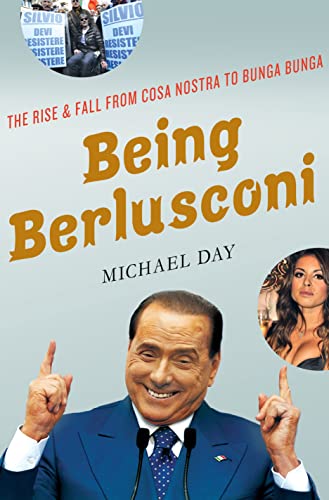
People from all walks of life are appalled and fascinated in equal measure by the stratospheric political career of the tycoon and three-time Italian Prime Minister. Michael Day provides an in depth look at the life and crimes of the shameless media mogul until his nine lives ran out and he faced definitive conviction which signaled his irreversible decline. He tells the story of a bright and ambitious man from a lower-middle class family who shook off his humble origins and rose to become rich and powerful beyond most people's dreams - a multi-billionaire whose Mediaset company remains one of Europe's largest television and cinema conglomerates. Along the way, amid the election victories, business triumphs, and womanizing, he became bogged down by his hubris, egotism, sexual obsessions, as well as his flagrant disregard for the law. And yet how and why did Italy and Italians put up with him for so long? With the 78-year-old's legal woes ongoing, including further trials for bribery, after a recent nine-month community service stint, Being Berlusconi is well-timed to mark the final chapters of a notorious-and astonishing-life and career.
Die Inhaltsangabe kann sich auf eine andere Ausgabe dieses Titels beziehen.
Über die Autorin bzw. den Autor
MICHAEL DAY is a London-born journalist with almost twenty years of experience. He has lived in Italy for the past seven years, and been Italy Correspondent for The Independent for the last six years. He has also covered Milan for the US weekly Variety, and written features from Italy for the Wall Street Journal.
Auszug. © Genehmigter Nachdruck. Alle Rechte vorbehalten.
Being Berlusconi
The Rise and Fall from Cosa Nostra to Bunga Bunga
By Michael DayPalgrave Macmillan
Copyright © 2015 Michael Day
All rights reserved.
ISBN: 978-1-137-28004-6All rights reserved.
Contents
Title Page,
Copyright Notice,
Acknowledgments,
Prologue,
PART I-The Rise,
1. Starting as He Meant to Continue,
2. Dirty Cash,
3. Realpolitik,
4. Escape Route,
5. Getting His Hands Dirty,
6. Justice for Sale,
7. The Gory Years,
8. Getting Away with It: Fact and Fiction,
PART II-The Fall,
9. Fiddling While Rome Burns,
10. Berlusconi's Not Well,
11. Rubygate and Bunga Bunga,
12. Final Fling,
13. Blame the Germans,
14. Demagogues,
15. The Devil's Advocates,
16. The Fall,
17. Fading Away,
Epilogue,
Notes,
Bibliography,
Index,
Photographs,
About the Author,
Copyright,
CHAPTER 1
STARTING AS HE MEANT TO CONTINUE
Milan, Italy's gritty design and finance hub, is the City where people get things done: they graft, they sell, they make and design, they earn. It's not like Rome, the beautiful capital, in which locals sit around waiting for the tourists to come and drop money in their laps, and where Italy's gilded and venal political class line their pockets and enjoy long lunches. Milan-born Silvio Berlusconi understood the potential of both his hometown and the Eternal City — that is, money and power, respectively. And he cashed in spectacularly.
If becoming a hedonistic multimillionaire politician were easy, then we'd all be at it. It's a testament to Berlusconi's genius as a businessman and politician — and key to his popular and vicarious appeal — that he started with very little and rose to become Italy's richest man and dominate its politics for two decades.
Like many exceptional individuals, his background was anything but. Berlusconi's father, Luigi, worked as a clerk in the one-branch Rasini bank in Milan. His mother, Rosella, was a housewife, although, by most accounts, she ruled the roost. According to friends of the family, it is from his mother that Silvio Berlusconi got his get-up-and-go. His affectionate nature was probably due in large part to a loving bond with his father, Luigi.
Berlusconi recalled the day his father finally returned home after a long absence during the Second World War. Young Silvio waited anxiously at Como railway station, north of Milan, before finally seeing his father get off the train. He remembered racing along the platform to embrace his dad. "That moment has remained in my memory as the most agonizing and the happiest of my life," he once said. Some reports suggest Berlusconi's high opinion of himself was probably thanks to both parents, who eschewed any criticism for constant praise and adoration. "Our Silvio is better than all of them" was the message drummed into him in his impressionable early years.
He was born in 1936 in what was then the city's northern edge. Today the area, Isola, is Milan's most up-and-coming neighborhood. Trendy bars and shops buzz in the shadow of skyscrapers that are continually sprouting up in the giant construction site around the nearby Garibaldi railway station. These days when he's in Milan, Berlusconi, the former real-estate magnate, no doubt casts a wistful glance at the gleaming edifices. "If I were just starting up now," he might tell himself, "I'd make a killing." Who would doubt it?
Young Silvio's parents packed him off to a strict Catholic boarding school in the city at the age of 11. Berlusconi rose at 7 every morning to study mathematics, history, philosophy, languages and religion, with the rosary after lunch. He always obtained good grades. It didn't go unnoticed, however, by the Salesian priests who ran the establishment, that his religious conviction was somewhat lacking. A school friend recalled how Berlusconi would drift away during prayers; his lips "moved mechanically; his thoughts were clearly elsewhere."
This was probably the earliest recorded evidence of the vexed relationship with religion that has marked his career. Berlusconi's political instincts have told him that in Vatican-influenced Italy, he needs to keep the Church on board. But playing at being a good Catholic has always been at odds with his libertine personal philosophy. The result has been numerous shows of fake piety — until finally, toward the end of his career, the documented tide of sleaze that engulfed Berlusconi was such that any religious posturing became pointless.
Back at the prayer sessions in the Sant'Ambrogio Salesian Institute, the young Berlusconi probably had business in mind. In his early teens he was already doing the homework of slower or lazier classmates in return for their pocket money. This conservative educational institute probably drummed into him the anticommunist rhetoric that he would continue to spout for the rest of his life. And it was at this boarding school that the future tycoon met lifelong friend Fedele Confalonieri. More than sixty years on, Berlusconi and Confalonieri — who now runs the mogul's TV empire — remain as thick as thieves. Berlusconi's second wife would compare their relationship to that of two brothers. The friendship also set a pattern that has seen Berlusconi stick by key associates with unswerving loyalty — loyalty that is mutual and underpinned, no doubt, by a shared knowledge of where all the skeletons are hidden.
Confalonieri, the dour straight man to Berlusconi's vaudeville act, shared with his school friend a passion for music. By the age of 16 the pair were putting on improvised shows, with Confalonieri on piano and Berlusconi twanging the double bass and crooning standards made popular by Frank Sinatra, Nat King Cole and Yves Montand.
By the late 1950s, when Berlusconi had to pay his way through Milan's Statale University, he was earning extra money as a singer and host on Mediterranean cruise ships, putting his natural charm to good use, effortlessly entertaining large groups for hours at a time with songs, jokes and patter. With his hair slicked back and his winning smile never more than a couple of seconds away, the young entertainer made up for his short stature (he's just five feet five inches) with his boy-next-door good looks and easy charm. Confalonieri has attested that Berlusconi never had any difficulty wooing the ladies.
Berlusconi graduated in law in 1961, with top honors. His thesis on the contractual aspects of advertising even won an award from a local advertising agency.
* * *
And so, in the early 1960s, Berlusconi, the ambitious young graduate, found himself in the right place at the right time. The postwar expansion of the Italian economy was in full flow. And Milan, the country's business capital, was the hottest spot of all. Thanks to the city's entrepreneurial spirit, good links with the rest of Europe and an abundance of cheap labor arriving from the poorer south of the country, there was money to be made — and Berlusconi knew it.
After graduating, Berlusconi sold vacuum cleaners for a while. But it occurred to him that selling property would be easier — and a lot more profitable. He just needed enough cash to get things going. He managed to convince the head of his father's bank, the tiny Banca Rasini, to guarantee the loan needed to build his first apartments in Via Alciati in Milan. His famous powers of persuasion were next in evidence when he sold the first Via Alciati property to Confalonieri's...
„Über diesen Titel“ kann sich auf eine andere Ausgabe dieses Titels beziehen.
Suchergebnisse für Being Berlusconi: The Rise & Fall from Cosa Nostra...

Beispielbild für diese ISBN
Being Berlusconi: The Rise and Fall from Cosa Nostra to Bunga Bunga
Anbieter: ThriftBooks-Dallas, Dallas, TX, USA
Verkäuferbewertung 5 von 5 Sternen

Hardcover. Zustand: Very Good. No Jacket. May have limited writing in cover pages. Pages are unmarked. ~ ThriftBooks: Read More, Spend Less. Artikel-Nr. G1137280042I4N00
Gebraucht kaufen
EUR 5,96
Versand gratis
Versand innerhalb von USA
Versand innerhalb von USA
Anzahl: 1 verfügbar
Beispielbild für diese ISBN
Being Berlusconi
Anbieter: World of Books (was SecondSale), Montgomery, IL, USA
Verkäuferbewertung 5 von 5 Sternen
Hardback. Zustand: Good. People from all walks of life are appalled and fascinated in equal measure by the stratospheric political career of the tycoon and three-time Italian Prime Minister. Michael Day provides an in depth look at the life and crimes of the shameless media mogul until his nine lives ran out and he faced definitive conviction which signaled his irreversible decline. He tells the story of a bright and ambitious man from a lower-middle class family who shook off his humble origins and rose to become rich and powerful beyond most people's dreams - a multi-billionaire whose Mediaset company remains one of Europe's largest television and cinema conglomerates. Along the way, amid the election victories, business triumphs, and womanizing, he became bogged down by his hubris, egotism, sexual obsessions, as well as his flagrant disregard for the law. And yet how and why did Italy and Italians put up with him for so long? With the 78-year-old's legal woes ongoing, including further trials for bribery, after a recent nine-month community service stint, Being Berlusconi is well-timed to mark the final chapters of a notorious-and astonishing-life and career. Artikel-Nr. 00081200974
Gebraucht kaufen
EUR 5,98
Versand gratis
Versand innerhalb von USA
Versand innerhalb von USA
Anzahl: 2 verfügbar
Beispielbild für diese ISBN
Being Berlusconi : The Rise and Fall from Cosa Nostra to Bunga Bunga
Anbieter: Better World Books, Mishawaka, IN, USA
Verkäuferbewertung 5 von 5 Sternen
Zustand: Very Good. Former library copy. Pages intact with possible writing/highlighting. Binding strong with minor wear. Dust jackets/supplements may not be included. Includes library markings. Stock photo provided. Product includes identifying sticker. Better World Books: Buy Books. Do Good. Artikel-Nr. 10325031-6
Gebraucht kaufen
EUR 8,43
Versand gratis
Versand innerhalb von USA
Versand innerhalb von USA
Anzahl: 1 verfügbar
Beispielbild für diese ISBN
Being Berlusconi
Anbieter: WorldofBooks, Goring-By-Sea, WS, Vereinigtes Königreich
Verkäuferbewertung 5 von 5 Sternen
Paperback. Zustand: Very Good. The book has been read, but is in excellent condition. Pages are intact and not marred by notes or highlighting. The spine remains undamaged. Artikel-Nr. GOR007154904
Gebraucht kaufen
EUR 14,39
EUR 6,51 Versand
Versand von Vereinigtes Königreich nach USA
Versand von Vereinigtes Königreich nach USA
Anzahl: 4 verfügbar