
Verwandte Artikel zu Understanding Oil Prices: A Guide to What Drives the...
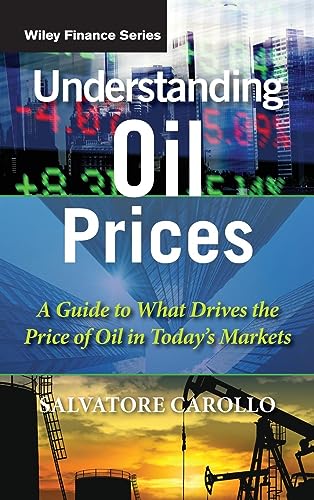
Understanding Oil Prices: A Guide to What Drives the Price of Oil in Today's Markets (The Wiley Finance Series) - Hardcover
Inhaltsangabe
It’s a fair bet that most of what you think you know about oil prices is wrong. Despite the massive price fluctuations of the past decade, the received wisdom on the subject has remained fundamentally unchanged since the 1970s. When asked, most people – including politicians, financial analysts and pundits – will respond with a tired litany of reasons ranging from increased Chinese and Indian competition for diminishing resources and tensions in the Middle East, to manipulation by OPEC and exorbitant petrol taxes in the EU. Yet the facts belie these explanations. For instance, what really happened in late 2008 when, in just a few weeks, oil prices plummeted from $144 dollars to $37 dollars a barrel? Did Chinese and Indian demand suddenly dry up? Did Middle East conflicts magically resolve themselves? Did OPEC flood the market with crude? In each case the answer is a definitive no – quite the opposite in fact.
Industry expert Salvatore Carollo explains that the truth behind today’s increasingly volatile oil market is that over the past two decades oil prices have come untethered from all classical notions of supply and demand and have transcended any country’s, consortium’s, cartel’s, or corporate entity’s powers to control them. At play is a subtler, more complex game than most analysts realise (or are unwilling to admit to), a very dangerous game involving runaway financial speculation, self-defeating government policymaking and a concerted disinvestment in refinery capacity among the oil majors.
In Understanding Oil Prices Carollo identifies the key players in this dangerous game, exploring their competing interests and motivations, their moves and countermoves. Beginning with the 1976 oil embargo and moving through the 1986 Chernobyl incident, the implementation of the US Clean Air Act Amendments of 1990, and the precipitous expansion of the oil futures market since the turn of the century, he traces the vast structural changes which have occurred within the oil industry over the past four decades, identifying their economic, social and geopolitical drivers, and analysing their fallout in the global economy. He explores the oil industry’s decision to scale down refining capacity in the face of increasing demand and the effects of global shortages of petrol, diesel, jet fuel, fuel oil, chemical feedstocks, lubricants and other essential finished products, and describes how, beginning in the year 2000, the oil futures market detached itself almost completely from the crude market, leading to the assetization of oil, and the crippling impact reckless speculation in oil futures has had on the global economy. Finally he proposes new, more sophisticated models that economists and financial analysts can use to make sense of today’s oil market, while offering industry leaders and government policymakers prescriptions for stabilising the market to ensure a relatively steady flow of affordable oil.
A concise, authoritative guide to understanding the complex, oft misunderstood oil markets, Understanding Oil Prices is an important resource for energy market participants, commodity traders and investors, as well as business journalists and government policymakers alike.
Die Inhaltsangabe kann sich auf eine andere Ausgabe dieses Titels beziehen.
Über die Autorin bzw. den Autor
About the author
SALVATORE CAROLLO graduated in engineering from the University of Palermo, where he also served as a lecturer and researcher. In 1975 he began working at eni; both in Italy and abroad where he was active in various sectors of the petroleum downstream, refining, market research, supply and trading of crude oil. Since 1995 he has been based first in Amsterdam and then in London as the manager of the Upstream Marketing Department, where he is responsible for the commercial relations with several producing countries and eni partners in various joint ventures. Within this area he provides support to eni corporate university, through teaching activities at the Mater MEDEA and organizing the annual Oil Market and Commercialization of Crude Oil seminar. He is often called in as an expert by various institutions in the oil sector to provide his own analysis on the dynamics of oil prices.
Von der hinteren Coverseite
It’s a fair bet that most of what you think you know about oil prices is wrong. Despite the massive price fluctuations of the past decade, the received wisdom on the subject has remained fundamentally unchanged since the 1970s. When asked, most people – including politicians, financial analysts and pundits – will respond with a tired litany of reasons ranging from increased Chinese and Indian competition for diminishing resources and tensions in the Middle East, to manipulation by OPEC and exorbitant petrol taxes in the EU. Yet the facts belie these explanations. For instance, what really happened in late 2008 when, in just a few weeks, oil prices plummeted from $144 dollars to $37 dollars a barrel? Did Chinese and Indian demand suddenly dry up? Did Middle East conflicts magically resolve themselves? Did OPEC flood the market with crude? In each case the answer is a definitive no – quite the opposite in fact.
Industry expert Salvatore Carollo explains that the truth behind today’s increasingly volatile oil market is that over the past two decades oil prices have come untethered from all classical notions of supply and demand and have transcended any country’s, consortium’s, cartel’s, or corporate entity’s powers to control them. At play is a subtler, more complex game than most analysts realise (or are unwilling to admit to), a very dangerous game involving runaway financial speculation, self-defeating government policymaking and a concerted disinvestment in refinery capacity among the oil majors.
In Understanding Oil Prices Carollo identifies the key players in this dangerous game, exploring their competing interests and motivations, their moves and countermoves. Beginning with the 1976 oil embargo and moving through the 1986 Chernobyl incident, the implementation of the US Clean Air Act Amendments of 1990, and the precipitous expansion of the oil futures market since the turn of the century, he traces the vast structural changes which have occurred within the oil industry over the past four decades, identifying their economic, social and geopolitical drivers, and analysing their fallout in the global economy. He explores the oil industry’s decision to scale down refining capacity in the face of increasing demand and the effects of global shortages of petrol, diesel, jet fuel, fuel oil, chemical feedstocks, lubricants and other essential finished products, and describes how, beginning in the year 2000, the oil futures market detached itself almost completely from the crude market, leading to the assetization of oil, and the crippling impact reckless speculation in oil futures has had on the global economy. Finally he proposes new, more sophisticated models that economists and financial analysts can use to make sense of today’s oil market, while offering industry leaders and government policymakers prescriptions for stabilising the market to ensure a relatively steady flow of affordable oil.
A concise, authoritative guide to understanding the complex, oft misunderstood oil markets, Understanding Oil Prices is an important resource for energy market participants, commodity traders and investors, as well as business journalists and government policymakers alike.
Aus dem Klappentext
A very complete analysis of the crude oil market, the final product markets and the refining industry I highly recommend this book.
Frédéric Lantz, Program Supervisor and Master in Environmental Economics, Sustainable Development and Energy, IFP-School
Salvatore Carollo makes a hard issue seem easy. Balanced, comprehensive and clear, this book will enlighten anyone interested in oil prices. It is a must read!
Giovani Machado DSc. in Energy Planning, Advisor at Energy Research Company EPE, Brazil
In addition to historical and theoretical background, Carollo's book provides an excellent ground-level view of the way oil markets really work. He explains not only the impact of product regulations on markets, but shows the way in which the trade is carried out in financial markets, such as the Brent forward market.
Michael Lynch, President and Director of Global Petroleum Service, Strategic Energy & Economic Research Inc. (SEER)
It is very hard to accurately anticipate the fluctuations of oil prices. Yet, understanding what drives these fluctuations is possible and this book offers a rigorous and intelligent synthesis of what we know about the forces and institutions that shape energy markets and, thus, oil prices. Salvatore Carollo has written an invaluable reference for professionals interested in the formation of oil prices.
Moisés Naím, PhD, Senior Associate, Carnegie Endowment for International Peace
„Über diesen Titel“ kann sich auf eine andere Ausgabe dieses Titels beziehen.
Suchergebnisse für Understanding Oil Prices: A Guide to What Drives the...

Beispielbild für diese ISBN
Understanding Oil Prices: A Guide to What Drives the Price of Oil in Today's Markets (The Wiley Finance Series)
Anbieter: BooksRun, Philadelphia, PA, USA
Verkäuferbewertung 5 von 5 Sternen

Hardcover. Zustand: Very Good. 1. With dust jacket. It's a well-cared-for item that has seen limited use. The item may show minor signs of wear. All the text is legible, with all pages included. It may have slight markings and/or highlighting. Artikel-Nr. 1119962722-8-1-29
Gebraucht kaufen
EUR 6,26
Versand gratis
Versand innerhalb von USA
Versand innerhalb von USA
Anzahl: 1 verfügbar
Beispielbild für diese ISBN
Understanding Oil Prices
Anbieter: PBShop.store UK, Fairford, GLOS, Vereinigtes Königreich
Verkäuferbewertung 5 von 5 Sternen
HRD. Zustand: New. New Book. Shipped from UK. Established seller since 2000. Artikel-Nr. FW-9781119962724
Neu kaufen
EUR 48,46
EUR 4,84 Versand
Versand von Vereinigtes Königreich nach USA
Versand von Vereinigtes Königreich nach USA
Anzahl: 15 verfügbar
Beispielbild für diese ISBN
Understanding Oil Prices: A Guide to What Drives the Price of Oil in Today's Markets (The Wiley Finance Series)
Anbieter: Ria Christie Collections, Uxbridge, Vereinigtes Königreich
Verkäuferbewertung 5 von 5 Sternen
Zustand: New. In English. Artikel-Nr. ria9781119962724_new
Neu kaufen
EUR 54,71
EUR 13,13 Versand
Versand von Vereinigtes Königreich nach USA
Versand von Vereinigtes Königreich nach USA
Anzahl: Mehr als 20 verfügbar
Beispielbild für diese ISBN
Understanding Oil Prices
Anbieter: Majestic Books, Hounslow, Vereinigtes Königreich
Verkäuferbewertung 4 von 5 Sternen

Zustand: New. pp. xxv + 168 Illus., Map. Artikel-Nr. 9700255
Neu kaufen
EUR 62,37
EUR 7,56 Versand
Versand von Vereinigtes Königreich nach USA
Versand von Vereinigtes Königreich nach USA
Anzahl: 3 verfügbar
Beispielbild für diese ISBN
Understanding Oil Prices: A Guide to What Drives the Price of Oil in Today s Markets
Anbieter: Kennys Bookstore, Olney, MD, USA
Verkäuferbewertung 5 von 5 Sternen
Zustand: New. Explains that the truth behind increasingly volatile oil market is that over the years oil prices have come untethered from all classical notions of supply and demand and have transcended any country's, consortium's, cartel's, or corporate entity's powers to control them. Series: Wiley Finance Series. Num Pages: 200 pages, Illustrations. BIC Classification: KFFM1; KNBP. Category: (P) Professional & Vocational. Dimension: 233 x 154 x 19. Weight in Grams: 432. . 2011. 1st Edition. Hardcover. . . . . Books ship from the US and Ireland. Artikel-Nr. V9781119962724
Neu kaufen
EUR 76,90
EUR 9,23 Versand
Versand innerhalb von USA
Versand innerhalb von USA
Anzahl: Mehr als 20 verfügbar
Beispielbild für diese ISBN
Understanding Oil Prices A Guide to What Drives the Price of Oil in Today's Markets
Anbieter: Revaluation Books, Exeter, Vereinigtes Königreich
Verkäuferbewertung 5 von 5 Sternen
Hardcover. Zustand: Brand New. 2nd edition. 220 pages. 9.10x6.00x0.90 inches. In Stock. Artikel-Nr. x-1119962722
Neu kaufen
EUR 93,71
EUR 11,63 Versand
Versand von Vereinigtes Königreich nach USA
Versand von Vereinigtes Königreich nach USA
Anzahl: 2 verfügbar
Foto des Verkäufers
Understanding Oil Prices
Anbieter: moluna, Greven, Deutschland
Verkäuferbewertung 5 von 5 Sternen
Gebunden. Zustand: New. SALVATORE CAROLLO graduated in engineering from the University of Palermo, where he also served as a lecturer and researcher. In 1975 he began working at eni both in Italy and abroad where he was active in various sectors of the petroleum downstream, refin. Artikel-Nr. 6026995
Neu kaufen
EUR 56,82
EUR 48,99 Versand
Versand von Deutschland nach USA
Versand von Deutschland nach USA
Anzahl: Mehr als 20 verfügbar
Foto des Verkäufers
Understanding Oil Prices
Anbieter: AHA-BUCH GmbH, Einbeck, Deutschland
Verkäuferbewertung 5 von 5 Sternen
Buch. Zustand: Neu. Neuware - Oil prices have seen massive fluctuation over the past 10 years, with price per barrel growing from $9 to $140. More recently, we have seen fluctuation from $140 to $37/barrel, and back up to $120 - all in a matter of months. But why It is still a popular belief that OPEC can affect the price of oil by regulating the volume of production and using this key raw material for their political aims, but the reality is quite different. In the last decade, despite a constant potential surplus of crude in the markets, we have seen the prices fluctuating dramatically with no apparent logic.Starting from the Chernobyl accident and the Clean Air Act implementation in the US, structural changes within the oil industry have modified the dynamics of oil prices. The existing technological refining system is no longer adequate to transform, with the necessary continuity, the crude oils into the high-quality finished products demanded by the market. Furthermore, from the beginning of the year 2000, the oil futures market detached itself almost completely from its original nature (the barrel of oil), becoming a purely financial market, but still able to heavily affect the real oil prices. More sophisticated models are needed to understand this new scenario.This book thoroughly demystifies the oil market, showing readers what really moves the price of oil today. It provides a comprehensive analysis of the industry fundamentals and the role of financial speculation, illustrating the complexity of the relationship of three different markets that regulate the oil sector: the crude oil market (raw material), the finished products market (gasoline, diesel, jet fuel, fuel oil, chemical feedstocks, lubricants), and the financial market (futures). It will provide an excellent grounding in the topic for anyone involved or interested in the oil markets, including financial analysts, traders, investors and energy market participants. Artikel-Nr. 9781119962724
Neu kaufen
EUR 71,09
EUR 35,00 Versand
Versand von Deutschland nach USA
Versand von Deutschland nach USA
Anzahl: 2 verfügbar