
Verwandte Artikel zu Evidence-Based Statistics: An Introduction to the Evidential...
Evidence-Based Statistics: An Introduction to the Evidential Approach - from Likelihood Principle to Statistical Practice - Hardcover
Inhaltsangabe
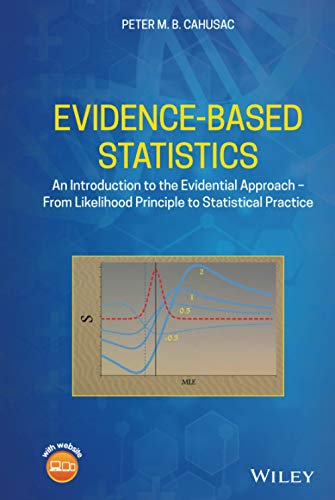
Evidence-Based Statistics: An Introduction to the Evidential Approach – from Likelihood Principle to Statistical Practice provides readers with a comprehensive and thorough guide to the evidential approach in statistics. The approach uses likelihood ratios, rather than the probabilities used by other statistical inference approaches. The evidential approach is conceptually easier to grasp, and the calculations more straightforward to perform. This book explains how to express data in terms of the strength of statistical evidence for competing hypotheses.
The evidential approach is currently underused, despite its mathematical precision and statistical validity. Evidence-Based Statistics is an accessible and practical text filled with examples, illustrations and exercises. Additionally, the companion website complements and expands on the information contained in the book.
While the evidential approach is unlikely to replace probability-based methods of statistical inference, it provides a useful addition to any statistician’s "bag of tricks." In this book:
- It explains how to calculate statistical evidence for commonly used analyses, in a step-by-step fashion
- Analyses include: t tests, ANOVA (one-way, factorial, between- and within-participants, mixed), categorical analyses (binomial, Poisson, McNemar, rate ratio, odds ratio, data that's 'too good to be true', multi-way tables), correlation, regression and nonparametric analyses (one sample, related samples, independent samples, multiple independent samples, permutation and bootstraps)
- Equations are given for all analyses, and R statistical code provided for many of the analyses
- Sample size calculations for evidential probabilities of misleading and weak evidence are explained
- Useful techniques, like Matthews's critical prior interval, Goodman's Bayes factor, and Armitage's stopping rule are described
Recommended for undergraduate and graduate students in any field that relies heavily on statistical analysis, as well as active researchers and professionals in those fields, Evidence-Based Statistics: An Introduction to the Evidential Approach – from Likelihood Principle to Statistical Practice belongs on the bookshelf of anyone who wants to amplify and empower their approach to statistical analysis.
Die Inhaltsangabe kann sich auf eine andere Ausgabe dieses Titels beziehen.
Über die Autorin bzw. den Autor
PETER M.B. CAHUSAC, PHD, received his doctorate in neuropharmacology from the Medical School Bristol University in 1984. He completed post-doctoral studies at Oxford University where he obtained an MSc in Applied Statistics in 1992. He is a member of the British Pharmacological Society, and Fellow of the Physiological (UK) and the Royal Statistical Societies. He is currently Associate Professor in Biostatistics and Pharmacology at Alfaisal University in Riyadh, Saudi Arabia.
Von der hinteren Coverseite
Evidence-Based Statistics: An Introduction to the Evidential Approach from Likelihood Principle to Statistical Practice provides readers with a comprehensive and thorough guide to the evidential approach in statistics. The approach uses likelihood ratios, rather than the probabilities used by other statistical inference approaches. The evidential approach is conceptually easier to grasp, and the calculations more straightforward to perform. This book explains how to express data in terms of the strength of statistical evidence for competing hypotheses.
Currently the evidential approach is underused, despite its mathematical precision and statistical validity. Evidence-Based Statistics is an accessible and practical text filled with examples, illustrations and exercises. Additionally, the companion website complements and expands on the information contained in the book.
While the evidential approach will probably not replace probability based methods of statistical inference, it provides a useful addition to any statistician's "bag of tricks". In this book:
- It explains how to calculate statistical evidence for commonly used analyses, in a step-by-step fashion
- Analyses include: t tests, ANOVA (one-way, factorial, between- and within-participants, mixed), categorical analyses (binomial, Poisson, McNemar, rate ratio, odds ratio, data that's 'too good to be true', multi-way tables), correlation, regression and nonparametric analyses (one sample, related samples, independent samples, multiple independent samples, permutation and bootstraps)
- Equations are given for all analyses, and R statistical code provided for many of the analyses
- Sample size calculations for evidential probabilities of misleading and weak evidence are explained
- Useful techniques, like Matthews's critical prior interval, Goodman's Bayes factor, and Armitage's stopping rule are described
Recommended for undergraduate and graduate students in any field that relies heavily on statistical analysis, as well as active researchers and professionals in those fields, Evidence-Based Statistics: An Introduction to the Evidential Approach from Likelihood Principle to Statistical Practice belongs on the bookshelf of anyone who wants to amplify and empower their approach to statistical analysis.
Aus dem Klappentext
Evidence-Based Statistics: An Introduction to the Evidential Approach – from Likelihood Principle to Statistical Practice provides readers with a comprehensive and thorough guide to the evidential approach in statistics. The approach uses likelihood ratios, rather than the probabilities used by other statistical inference approaches. The evidential approach is conceptually easier to grasp, and the calculations more straightforward to perform. This book explains how to express data in terms of the strength of statistical evidence for competing hypotheses.
Currently the evidential approach is underused, despite its mathematical precision and statistical validity. Evidence-Based Statistics is an accessible and practical text filled with examples, illustrations and exercises. Additionally, the companion website complements and expands on the information contained in the book.
While the evidential approach will probably not replace probability based methods of statistical inference, it provides a useful addition to any statistician's "bag of tricks". In this book:
- It explains how to calculate statistical evidence for commonly used analyses, in a step-by-step fashion
- Analyses include: t tests, ANOVA (one-way, factorial, between- and within-participants, mixed), categorical analyses (binomial, Poisson, McNemar, rate ratio, odds ratio, data that's 'too good to be true', multi-way tables), correlation, regression and nonparametric analyses (one sample, related samples, independent samples, multiple independent samples, permutation and bootstraps)
- Equations are given for all analyses, and R statistical code provided for many of the analyses
- Sample size calculations for evidential probabilities of misleading and weak evidence are explained
- Useful techniques, like Matthews's critical prior interval, Goodman's Bayes factor, and Armitage's stopping rule are described
Recommended for undergraduate and graduate students in any field that relies heavily on statistical analysis, as well as active researchers and professionals in those fields, Evidence-Based Statistics: An Introduction to the Evidential Approach – from Likelihood Principle to Statistical Practice belongs on the bookshelf of anyone who wants to amplify and empower their approach to statistical analysis.
„Über diesen Titel“ kann sich auf eine andere Ausgabe dieses Titels beziehen.
Suchergebnisse für Evidence-Based Statistics: An Introduction to the Evidential...

Beispielbild für diese ISBN
Evidence-Based Statistics - An Introduction to the Evidential Approach - from Likelihood Principle to Statistical Practice
Anbieter: PBShop.store UK, Fairford, GLOS, Vereinigtes Königreich
Verkäuferbewertung 5 von 5 Sternen

HRD. Zustand: New. New Book. Shipped from UK. Established seller since 2000. Artikel-Nr. FW-9781119549802
Neu kaufen
EUR 108,07
EUR 5,85 Versand
Versand von Vereinigtes Königreich nach USA
Versand von Vereinigtes Königreich nach USA
Anzahl: 15 verfügbar
Beispielbild für diese ISBN
An Introduction to Evidence Based Statistics
Anbieter: Ria Christie Collections, Uxbridge, Vereinigtes Königreich
Verkäuferbewertung 5 von 5 Sternen
Zustand: New. In English. Artikel-Nr. ria9781119549802_new
Neu kaufen
EUR 112,62
EUR 13,17 Versand
Versand von Vereinigtes Königreich nach USA
Versand von Vereinigtes Königreich nach USA
Anzahl: Mehr als 20 verfügbar
Beispielbild für diese ISBN
An Introduction to Evidence Based Statistics
Anbieter: Majestic Books, Hounslow, Vereinigtes Königreich
Verkäuferbewertung 4 von 5 Sternen

Zustand: New. Artikel-Nr. 385002548
Neu kaufen
EUR 121,90
EUR 7,58 Versand
Versand von Vereinigtes Königreich nach USA
Versand von Vereinigtes Königreich nach USA
Anzahl: 3 verfügbar
Beispielbild für diese ISBN
EvidenceBased Statistics An Introduction to the Evidential Approach from Likelihood Principle to Statistical Practice
Anbieter: Revaluation Books, Exeter, Vereinigtes Königreich
Verkäuferbewertung 5 von 5 Sternen
Hardcover. Zustand: Brand New. 240 pages. 9.25x6.25x1.00 inches. In Stock. Artikel-Nr. __1119549809
Neu kaufen
EUR 130,40
EUR 11,66 Versand
Versand von Vereinigtes Königreich nach USA
Versand von Vereinigtes Königreich nach USA
Anzahl: 2 verfügbar
Beispielbild für diese ISBN
Evidence-Based Statistics: An Introduction to the Evidential Approach - from Likelihood Principle to Statistical Practice
Anbieter: Kennys Bookstore, Olney, MD, USA
Verkäuferbewertung 5 von 5 Sternen
Zustand: New. 2020. 1st Edition. Hardcover. . . . . . Books ship from the US and Ireland. Artikel-Nr. V9781119549802
Neu kaufen
EUR 157,31
EUR 9,05 Versand
Versand innerhalb von USA
Versand innerhalb von USA
Anzahl: Mehr als 20 verfügbar