
Verwandte Artikel zu Physics I Workbook FD, 2e (For Dummies)
Inhaltsangabe
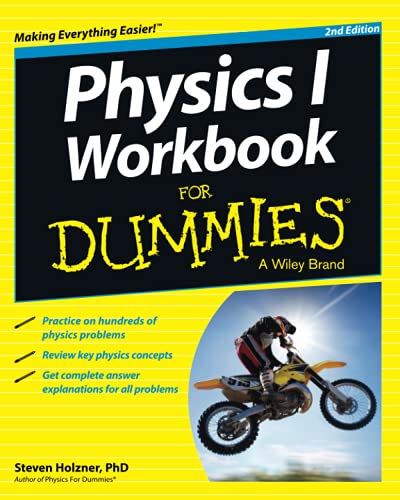
Unleash your inner Einstein and score higher in physics Do you have a handle on basic physics terms and concepts, but your problem-solving skills could use some static friction? Physics I Workbook For Dummies helps you build upon what you already know to learn how to solve the most common physics problems with confidence and ease. Physics I Workbook For Dummies gets the ball rolling with a brief overview of the nuts and bolts of physics (i.e. converting measure, counting signification figures, applying math skills to physics problems, etc.) before getting in the nitty gritty. If you're already a pro you can skip this section and jump right into the practice problems. There, you'll get the lowdown on how to take your problem-solving skills to a whole new plane--without ever feeling like you've been left spiraling down a black hole. * Easy-to-follow instructions and practical tips * Complete answer explanations are included so you can see where you went wrong (or right) * Covers the ten most common mistakes people make when solving practice physics problems When push comes to shove, this friendly guide is just what you need to set your physics problem-solving skills in motion.
Die Inhaltsangabe kann sich auf eine andere Ausgabe dieses Titels beziehen.
Über die Autorin bzw. den Autor
<p><b>Steven Holzner, PhD,</b> was an educator and contributing editor at <i>PC Magazine</i>.</p>
Von der hinteren Coverseite
<ul> <li>Practice on hundreds of physics problems</li> <li>Review key physics concepts</li> <li>Get complete answer explanations for all problems</li> </ul> <p><b><i>Solve physics problems with ease with this hands-on workbook</i></b></p> <p>If you already have a handle on physics, but sometimes get lost in the middle of solving a problem, fear not! This hands-on workbook features practice for the most common types of physics problems, with full explanations so you’ll know where you went wrong (or right). Find out how to solve problems about motion, kinetic energy, thermodynamics, electricity, and more to sharpen your skills today!</p> <p>Plain-English explanations</p> <p>Step-by-step procedures</p> <p>Hands-on practice exercises</p> <p>Ample workspace to work out problems</p> <p>A dash of humor and fun</p> <p><b><i>Discover</i></b></p> <p>The basics of applying physics</p> <p>Details on momentum and kinetic energy</p> <p>Step-by-step answers to boost your understanding</p> <p>Tips on using physics in practical applications</p>
Aus dem Klappentext
- Practice on hundreds of physics problems
- Review key physics concepts
- Get complete answer explanations for all problems
Solve physics problems with ease with this hands-on workbook
If you already have a handle on physics, but sometimes get lost in the middle of solving a problem, fear not! This hands-on workbook features practice for the most common types of physics problems, with full explanations so you’ll know where you went wrong (or right). Find out how to solve problems about motion, kinetic energy, thermodynamics, electricity, and more to sharpen your skills today!
Plain-English explanations
Step-by-step procedures
Hands-on practice exercises
Ample workspace to work out problems
A dash of humor and fun
Discover
The basics of applying physics
Details on momentum and kinetic energy
Step-by-step answers to boost your understanding
Tips on using physics in practical applications
Auszug. © Genehmigter Nachdruck. Alle Rechte vorbehalten.
Physics I Workbook For Dummies
By Steven HolznerJohn Wiley & Sons
Copyright © 2014 John Wiley & Sons, Ltd
All rights reserved.
ISBN: 978-1-118-82577-8All rights reserved.
CHAPTER 1
Reviewing Physics Basics
In This Chapter
* Laying down measurements
* Simplifying with scientific notation
* Practicing conversions
* Drawing on algebra and trigonometry
This chapter gets the ball rolling by discussing some fundamental physics measurements. At its root, physics is all about making measurements (and using those measurements as the basis of predictions), so it's the perfect place to start! I also walk you through the process of converting measurements from one unit to another, and I show you how to apply math skills to physics problems.
Measuring the Universe
A great deal of physics has to do with making measurements — that's the way all physics gets started. For that reason, physics uses a number of measurement systems, such as the CGS (centimeter-gram-second) system and the MKS (meter-kilogram-second) system. You also use the standard English system of inches and feet and so on — that's the FPI (foot-pound-inch) system.
REMEMBER
In physics, most measurements have units, such as meters or seconds. For example, when you measure how far and how fast a hockey puck slid, you need to measure both the distance in centimeters and the time in seconds.
For reference, Table 1-1 gives you the primary units of measurement in the MKS system.
These are the measuring sticks that will become familiar to you as you solve problems and triumph over the math in this workbook. Also for reference, Table 1-2 shows the primary units of measurement (and their abbreviations) in the CGS system. (Don't bother memorizing the ones you're not familiar with now; you can come back to them later as needed.)
EXAMPLE
Q. You're told to measure the length of a race car track using the MKS system. What unit(s) will your measurement be in?
A. The correct answer is meters. The unit of length in the MKS system is the meter.
1. You're told to measure the mass of a marble using the CGS system. What unit(s) will your measurement be in?
Solve It
2. You're asked to measure the time it takes the moon to circle the Earth using the MKS system. What will your measurement's units be?
Solve It
3. You need to measure the force a tire exerts on the road as it's moving using the MKS system. What are the units of your answer?
Solve It
4. You're asked to measure the amount of energy released by a firecracker when it explodes using the CGS system. What are the units of your answer?
Solve It
Putting Scientific Notation to Work
Physics deals with some very large and very small numbers. To work with such numbers, you use scientific notation. Scientific notation is expressed as a number multiplied by a power of 10.
For example, suppose you're measuring the mass of an electron in the MKS system. You put an electron on a scale (in practice, electrons are too small to measure on a scale — you have to see how they react to the pull of magnetic or electrostatic forces to measure their mass), and you measure the following:
0.00000000000000000000000000000091 kg
What the heck is that? That's a lot of zeros, and it makes this number very unwieldy to work with. Fortunately, you know all about scientific notation, so you can convert the number into the following:
9.1 × 10⁻³¹ kg
That is, 9.1 multiplied by a power of 10, 10-31. Scientific notation works by extracting the power of 10 and putting it on the side, where it's handy. You convert a number to scientific notation by counting the number of places you have to move the decimal point to get the first digit in front of that decimal point. For example, 0.050 is 5.0 × 10⁻² because you move the decimal point two places to the right to get 5.0. Similarly, 500 is 5.0 × 10² because you move the decimal point two places to the left to get 5.0.
Check out this practice question about scientific notation:
EXAMPLE
Q. What is 0.000037 in scientific notation?
A. The correct answer is 3.7 × 10⁻⁵. You have to move the decimal point five times to the right to get 3.7.
5. What is 0.0043 in scientific notation?
Solve It
6. What is 430,000.0 in scientific notation?
Solve It
7. What is 0.00000056 in scientific notation?
Solve It
8. What is 6,700.0 in scientific notation?
Solve It
Converting between Units
Physics problems frequently ask you to convert between different units of measurement. For example, you may measure the number of feet your toy car goes in three minutes and thus be able to calculate the speed of the car in feet per minute, but that's not a standard unit of measure, so you need to convert feet per minute to miles per hour, or meters per second, or whatever the physics problem asks for.
For another example, suppose you have 180 seconds — how much is that in minutes? You know that there are 60 seconds in a minute, so 180 seconds equals three minutes. Here are some common conversions between units:
[check] 1 m = 100 cm = 1,000 mm (millimeters)
[check] 1 km (kilometer) = 1,000 m
[check] 1 kg (kilogram) = 1,000 g (grams)
[check] 1 N (newton) = 105 dynes
[check] 1 J (joule) = 107 ergs
[check] 1 P (pascal) = 10 Ba
[check] 1 A (amp) = 0.1 Bi
[check] 1 T (tesla) = 104 G (gauss)
[check] 1 C (coulomb) = 2.9979 × 10⁹ Fr
The conversion between CGS and MKS almost always involves factors of 10 only, so converting between the two is simple. But what about converting to and from the FPI and other systems of measurement? Here are some handy conversions that you can come back to as needed:
[check] Length:
• 1 m = 100 cm
• 1 km = 1,000 m
• 1 in (inch) = 2.54 cm
• 1 m = 39.37 in
• 1 mile = 5,280 ft = 1.609 km
• 1 Å (angstrom) = 10-10 m
[check] Mass:
• 1 kg = 1,000 g
• 1 slug = 14.59 kg
• 1 u (atomic mass unit) = 1.6605 × 10⁻²⁷ kg
[check] Force:
• 1 lb (pound) = 4.448 N
• 1 N = 105 dynes
• 1 N = 0.2248 lb
[check] Energy:
• 1 J = 107 ergs
• 1 J = 0.7376 ft-lb
• 1 BTU (British thermal unit) = 1,055 J
• 1 kWh (kilowatt hour) = 3.600 × 10⁶ J
• 1 eV (electron volt) = 1.602 × 10⁻¹⁹ J
[check] Power:
• 1 hp (horsepower) = 550 ft-lb/s
• 1 W (watt) = 0.7376 ft-lb/s
Because conversions are such an important part of physics problems, and because you have to keep track of them so carefully, there's a systematic way of handling conversions: You multiply by a conversion constant that equals 1, such that the units you don't want cancel out.
EXAMPLE
Q. A ball drops 5 meters. How many centimeters did it drop?
A. The correct answer is 500 centimeters. To perform the conversion, you do the following calculation:
5.0 meters × [100 centimeters/1 meter] = 500 centimeters
Note that 100 centimeters divided by 1 meter equals 1 because there are 100 centimeters in a meter. In the calculation, the units...
„Über diesen Titel“ kann sich auf eine andere Ausgabe dieses Titels beziehen.
Suchergebnisse für Physics I Workbook FD, 2e (For Dummies)

Beispielbild für diese ISBN
Physics I Workbook For Dummies
Anbieter: World of Books (was SecondSale), Montgomery, IL, USA
Verkäuferbewertung 5 von 5 Sternen

Paperback. Zustand: Good. Unleash your inner Einstein and score higher in physics Do you have a handle on basic physics terms and concepts, but your problem-solving skills could use some static friction? Physics I Workbook For Dummies helps you build upon what you already know to learn how to solve the most common physics problems with confidence and ease. Artikel-Nr. 00105177331
Gebraucht kaufen
EUR 5,05
Versand gratis
Versand innerhalb von USA
Versand innerhalb von USA
Anzahl: 3 verfügbar
Beispielbild für diese ISBN
Physics I Workbook For Dummies, 2nd Edition
Anbieter: ThriftBooks-Dallas, Dallas, TX, USA
Verkäuferbewertung 5 von 5 Sternen
Paperback. Zustand: Good. No Jacket. Pages can have notes/highlighting. Spine may show signs of wear. ~ ThriftBooks: Read More, Spend Less. Artikel-Nr. G1118825772I3N00
Gebraucht kaufen
EUR 6,10
Versand gratis
Versand innerhalb von USA
Versand innerhalb von USA
Anzahl: 1 verfügbar
Beispielbild für diese ISBN
Physics I Workbook For Dummies, 2nd Edition
Anbieter: ThriftBooks-Atlanta, AUSTELL, GA, USA
Verkäuferbewertung 5 von 5 Sternen
Paperback. Zustand: As New. No Jacket. Pages are clean and are not marred by notes or folds of any kind. ~ ThriftBooks: Read More, Spend Less. Artikel-Nr. G1118825772I2N00
Gebraucht kaufen
EUR 6,10
Versand gratis
Versand innerhalb von USA
Versand innerhalb von USA
Anzahl: 1 verfügbar
Beispielbild für diese ISBN
Physics I Workbook For Dummies, 2nd Edition
Anbieter: ThriftBooks-Dallas, Dallas, TX, USA
Verkäuferbewertung 5 von 5 Sternen
Paperback. Zustand: Fair. No Jacket. Readable copy. Pages may have considerable notes/highlighting. ~ ThriftBooks: Read More, Spend Less. Artikel-Nr. G1118825772I5N00
Gebraucht kaufen
EUR 6,10
Versand gratis
Versand innerhalb von USA
Versand innerhalb von USA
Anzahl: 1 verfügbar
Beispielbild für diese ISBN
Physics I Workbook for Dummies
Verlag:
Wiley & Sons, Incorporated, John, 2014
ISBN 10: 1118825772
ISBN 13: 9781118825778
Gebraucht
Softcover
Anbieter: Better World Books, Mishawaka, IN, USA
Verkäuferbewertung 5 von 5 Sternen
Zustand: Good. Pages intact with minimal writing/highlighting. The binding may be loose and creased. Dust jackets/supplements are not included. Stock photo provided. Product includes identifying sticker. Better World Books: Buy Books. Do Good. Artikel-Nr. 9286344-6
Gebraucht kaufen
EUR 6,35
Versand gratis
Versand innerhalb von USA
Versand innerhalb von USA
Anzahl: 3 verfügbar
Beispielbild für diese ISBN
Physics I Workbook FD, 2e (For Dummies)
Verlag:
For Dummies (edition 2), 2014
ISBN 10: 1118825772
ISBN 13: 9781118825778
Gebraucht
Paperback
Anbieter: BooksRun, Philadelphia, PA, USA
Verkäuferbewertung 5 von 5 Sternen
Paperback. Zustand: Fair. 2. The item might be beaten up but readable. May contain markings or highlighting, as well as stains, bent corners, or any other major defect, but the text is not obscured in any way. Artikel-Nr. 1118825772-7-1
Gebraucht kaufen
EUR 13,17
Versand gratis
Versand innerhalb von USA
Versand innerhalb von USA
Anzahl: 1 verfügbar
Beispielbild für diese ISBN
Physics I Workbook FD, 2e (For Dummies)
Anbieter: WorldofBooks, Goring-By-Sea, WS, Vereinigtes Königreich
Verkäuferbewertung 5 von 5 Sternen
Paperback. Zustand: Very Good. The book has been read, but is in excellent condition. Pages are intact and not marred by notes or highlighting. The spine remains undamaged. Artikel-Nr. GOR008809165
Gebraucht kaufen
EUR 12,87
EUR 6,68 Versand
Versand von Vereinigtes Königreich nach USA
Versand von Vereinigtes Königreich nach USA
Anzahl: 2 verfügbar
Beispielbild für diese ISBN
Physics I Workbook FD, 2e (For Dummies)
Anbieter: Sell Books, Elland, YORKS, Vereinigtes Königreich
Verkäuferbewertung 5 von 5 Sternen
paperback. Zustand: Good. Our good condition books are generally good for reading but not for gifting or collecting. They could have imperfections such as creasing, fanning, inscriptions, margin notes, yellowing, staining on edge or cover or pages, bumps, scuffs, etc etc (sometimes multiple of these). It's a wide category that encompasses anything that isn't almost-new down to anything that is slightly better than poor. We would NOT recommend gifting Good books - these should be considered reading copies. Our books are dispatched from a Yorkshire former cotton mill. We list via barcode/ISBN so please note that the images are stock images and may not be the exact copy you receive, furthermore the details about edition and year might not be accurate as many publishers reuse the same ISBN for multiple editions and as we simply scan a barcode or enter an ISBN we do not check the validity of the edition data when listing. If you're looking for an exact edition please don't order (at least not without checking with us first, although we don't always have time to check). We aim to dispatch prompty, the service used will depend on order value and book size. We can ship to most countries, see our shipping policies. Payment is via Abe only. Artikel-Nr. SBAB-mon0000021671
Gebraucht kaufen
EUR 14,45
EUR 9,25 Versand
Versand von Vereinigtes Königreich nach USA
Versand von Vereinigtes Königreich nach USA
Anzahl: 1 verfügbar
Beispielbild für diese ISBN
Physics I Workbook for Dummies
Anbieter: Revaluation Books, Exeter, Vereinigtes Königreich
Verkäuferbewertung 5 von 5 Sternen
Paperback. Zustand: Brand New. 2nd edition. 336 pages. 9.75x8.00x1.00 inches. In Stock. Artikel-Nr. 1118825772
Neu kaufen
EUR 50,11
EUR 14,91 Versand
Versand von Vereinigtes Königreich nach USA
Versand von Vereinigtes Königreich nach USA
Anzahl: 1 verfügbar