
Verwandte Artikel zu Symbolic Mathematics for Chemists: A Guide for Maxima...
Inhaltsangabe
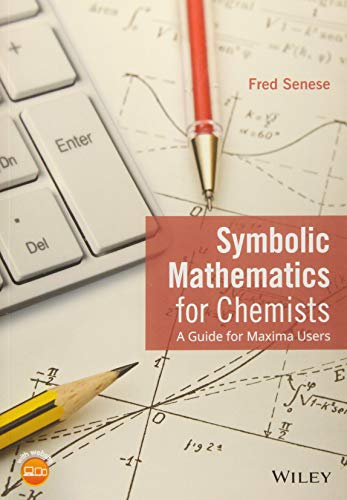
An essential guide to using Maxima, a popular open source symbolic mathematics engine to solve problems, build models, analyze data and explore fundamental concepts
Symbolic Mathematics for Chemists offers students of chemistry a guide to Maxima, a popular open source symbolic mathematics engine that can be used to solve problems, build models, analyze data, and explore fundamental chemistry concepts. The author ― a noted expert in the field ― focuses on the analysis of experimental data obtained in a laboratory setting and the fitting of data and modeling experiments. The text contains a wide variety of illustrative examples and applications in physical chemistry, quantitative analysis and instrumental techniques.
Designed as a practical resource, the book is organized around a series of worksheets that are provided in a companion website. Each worksheet has clearly defined goals and learning objectives and a detailed abstract that provides motivation and context for the material. This important resource:
- Offers an text that shows how to use popular symbolic mathematics engines to solve problems
- Includes a series of worksheet that are prepared in Maxima
- Contains step-by-step instructions written in clear terms and includes illustrative examples to enhance critical thinking, creative problem solving and the ability to connect concepts in chemistry
- Offers hints and case studies that help to master the basics while proficient users are offered more advanced avenues for exploration
Written for advanced undergraduate and graduate students in chemistry and instructors looking to enhance their lecture or lab course with symbolic mathematics materials, Symbolic Mathematics for Chemists: A Guide for Maxima Users is an essential resource for solving and exploring quantitative problems in chemistry.
Die Inhaltsangabe kann sich auf eine andere Ausgabe dieses Titels beziehen.
Über die Autorin bzw. den Autor
Professor Fred Senese is a computational chemist at Frostburg State University with a particular focus on chemical education. His research interests include applications of artificial intelligence in chemical education, development of web-based narratives and construction kits for chemical education, remote control and access of instrumentation, and environmental chemical analysis applied to problems in ethnobotany.
Von der hinteren Coverseite
An essential guide to using Maxima, a popular open source symbolic mathematics engine to solve problems, build models, analyze data and explore fundamental concepts
Symbolic Mathematics for Chemists offers students of chemistry a guide to Maxima, a popular open source symbolic mathematics engine that can be used to solve problems, build models, analyze data, and explore fundamental chemistry concepts. The author a noted expert in the field focuses on the analysis of experimental data obtained in a laboratory setting and the fitting of data and modeling experiments. The text contains a wide variety of illustrative examples and applications in physical chemistry, quantitative analysis and instrumental techniques.
Designed as a practical resource, the book is organized around a series of worksheets that are provided in a companion website. Each worksheet has clearly defined goals and learning objectives and a detailed abstract that provides motivation and context for the material. This important resource:
- Offers an text that shows how to use popular symbolic mathematics engines to solve problems
- Includes a series of worksheet that are prepared in Maxima
- Contains step-by-step instructions written in clear terms and includes illustrative examples to enhance critical thinking, creative problem solving and the ability to connect concepts in chemistry
- Offers hints and case studies that help to master the basics while proficient users are offered more advanced avenues for exploration
Written for advanced undergraduate and graduate students in chemistry and instructors looking to enhance their lecture or lab course with symbolic mathematics materials,Symbolic Mathematics for Chemists: A Guide for Maxima Users is an essential resource for solving and exploring quantitative problems in chemistry.
Aus dem Klappentext
An essential guide to using Maxima, a popular open source symbolic mathematics engine to solve problems, build models, analyze data and explore fundamental concepts
Symbolic Mathematics for Chemists offers students of chemistry a guide to Maxima, a popular open source symbolic mathematics engine that can be used to solve problems, build models, analyze data, and explore fundamental chemistry concepts. The author — a noted expert in the field — focuses on the analysis of experimental data obtained in a laboratory setting and the fitting of data and modeling experiments. The text contains a wide variety of illustrative examples and applications in physical chemistry, quantitative analysis and instrumental techniques.
Designed as a practical resource, the book is organized around a series of worksheets that are provided in a companion website. Each worksheet has clearly defined goals and learning objectives and a detailed abstract that provides motivation and context for the material. This important resource:
- Offers an text that shows how to use popular symbolic mathematics engines to solve problems
- Includes a series of worksheet that are prepared in Maxima
- Contains step-by-step instructions written in clear terms and includes illustrative examples to enhance critical thinking, creative problem solving and the ability to connect concepts in chemistry
- Offers hints and case studies that help to master the basics while proficient users are offered more advanced avenues for exploration
Written for advanced undergraduate and graduate students in chemistry and instructors looking to enhance their lecture or lab course with symbolic mathematics materials,Symbolic Mathematics for Chemists: A Guide for Maxima Users is an essential resource for solving and exploring quantitative problems in chemistry.
„Über diesen Titel“ kann sich auf eine andere Ausgabe dieses Titels beziehen.
Suchergebnisse für Symbolic Mathematics for Chemists: A Guide for Maxima...

Beispielbild für diese ISBN
Symbolic Mathematics for Chemists
Anbieter: PBShop.store UK, Fairford, GLOS, Vereinigtes Königreich
Verkäuferbewertung 5 von 5 Sternen

PAP. Zustand: New. New Book. Shipped from UK. Established seller since 2000. Artikel-Nr. FW-9781118798690
Neu kaufen
EUR 86,79
EUR 6,89 Versand
Versand von Vereinigtes Königreich nach USA
Versand von Vereinigtes Königreich nach USA
Anzahl: 15 verfügbar
Beispielbild für diese ISBN
Symbolic Mathematics for Chemists: A Guide for Maxima Users
Anbieter: Ria Christie Collections, Uxbridge, Vereinigtes Königreich
Verkäuferbewertung 5 von 5 Sternen
Zustand: New. In English. Artikel-Nr. ria9781118798690_new
Neu kaufen
EUR 109,82
EUR 13,25 Versand
Versand von Vereinigtes Königreich nach USA
Versand von Vereinigtes Königreich nach USA
Anzahl: Mehr als 20 verfügbar
Beispielbild für diese ISBN
Symbolic Mathematics for Chemists: A Guide for Maxima Users
Anbieter: Majestic Books, Hounslow, Vereinigtes Königreich
Verkäuferbewertung 4 von 5 Sternen

Zustand: New. pp. 400. Artikel-Nr. 370382979
Neu kaufen
EUR 115,90
EUR 7,63 Versand
Versand von Vereinigtes Königreich nach USA
Versand von Vereinigtes Königreich nach USA
Anzahl: 3 verfügbar
Beispielbild für diese ISBN
Symbolic Mathematics for Chemists: A Guide for Maxima Users
Anbieter: Kennys Bookstore, Olney, MD, USA
Verkäuferbewertung 5 von 5 Sternen
Zustand: New. Num Pages: 328 pages. BIC Classification: PDE; PN. Category: (P) Professional & Vocational. Dimension: 254 x 178. . . 2018. 1st Edition. Paperback. . . . . Books ship from the US and Ireland. Artikel-Nr. V9781118798690
Neu kaufen
EUR 140,50
EUR 9,33 Versand
Versand innerhalb von USA
Versand innerhalb von USA
Anzahl: Mehr als 20 verfügbar
Foto des Verkäufers
Symbolic Mathematics for Chemistry
Anbieter: moluna, Greven, Deutschland
Verkäuferbewertung 5 von 5 Sternen
Zustand: New. Professor Fred Senese is a computational chemist at Frostburg State University with a particular focus on chemical education. His research interests include applications of artificial intelligence in chemical education, development of web-based narratives a. Artikel-Nr. 66389019
Neu kaufen
EUR 131,88
EUR 48,99 Versand
Versand von Deutschland nach USA
Versand von Deutschland nach USA
Anzahl: Mehr als 20 verfügbar
Foto des Verkäufers
Symbolic Mathematics for Chemists
Anbieter: AHA-BUCH GmbH, Einbeck, Deutschland
Verkäuferbewertung 5 von 5 Sternen
Taschenbuch. Zustand: Neu. Neuware - An essential guide to using Maxima, a popular open source symbolic mathematics engine to solve problems, build models, analyze data and explore fundamental concepts Symbolic Mathematics for Chemists offers students of chemistry a guide to Maxima, a popular open source symbolic mathematics engine that can be used to solve problems, build models, analyze data, and explore fundamental chemistry concepts. The author - a noted expert in the field - focuses on the analysis of experimental data obtained in a laboratory setting and the fitting of data and modeling experiments. The text contains a wide variety of illustrative examples and applications in physical chemistry, quantitative analysis and instrumental techniques. Designed as a practical resource, the book is organized around a series of worksheets that are provided in a companion website. Each worksheet has clearly defined goals and learning objectives and a detailed abstract that provides motivation and context for the material. This important resource: - Offers an text that shows how to use popular symbolic mathematics engines to solve problems - Includes a series of worksheet that are prepared in Maxima - Contains step-by-step instructions written in clear terms and includes illustrative examples to enhance critical thinking, creative problem solving and the ability to connect concepts in chemistry - Offers hints and case studies that help to master the basics while proficient users are offered more advanced avenues for exploration Written for advanced undergraduate and graduate students in chemistry and instructors looking to enhance their lecture or lab course with symbolic mathematics materials, Symbolic Mathematics for Chemists: A Guide for Maxima Users is an essential resource for solving and exploring quantitative problems in chemistry. Artikel-Nr. 9781118798690
Neu kaufen
EUR 182,16
EUR 35,00 Versand
Versand von Deutschland nach USA
Versand von Deutschland nach USA
Anzahl: 2 verfügbar