
Verwandte Artikel zu Writing Children's Books For Dummies, 2nd Edition
Inhaltsangabe
Everything aspiring authors need to write, publish, and sell a children's book Everyone loves a children's book--and many dream about writing one. But is it actually possible for an unpublished writer--armed with a good story idea and a love of kids--to write, sell, publish, and promote a book? Yes, it is! Clearly and concisely written with straightforward advice and a plethora of specific up-to-date recommendations, Writing Children's Books For Dummies provides step-by-step information on everything aspiring children's book authors need to know--from researching the current marketplace to developing story ideas, strengthening writing skills, dealing with editors, and submitting proposals and manuscripts to agents and publishers. * Updated and improved writing exercises * All new content on social media and establishing an online presence as an author * Fresh, updated content on publishing via hard copy and all the e- platforms From setting down that first word on paper to doing a successful publicity tour, Writing Children's Books For Dummies gives you the confidence and the insiders' know-how to write and sell the story you've always wanted to write.
Die Inhaltsangabe kann sich auf eine andere Ausgabe dieses Titels beziehen.
Über die Autorin bzw. den Autor
<p><b>Lisa Rojany Buccieri</b> has written and ghostwritten more than 100 children's and grown-up's books, both fiction and nonfiction, including board books, picture books, and young adult series.</p> <p><b>Peter Economy</b> is a bestselling author, coauthor, and ghostwriter of more than 55 books, including several <i>For Dummies</i> titles.</p>
Von der hinteren Coverseite
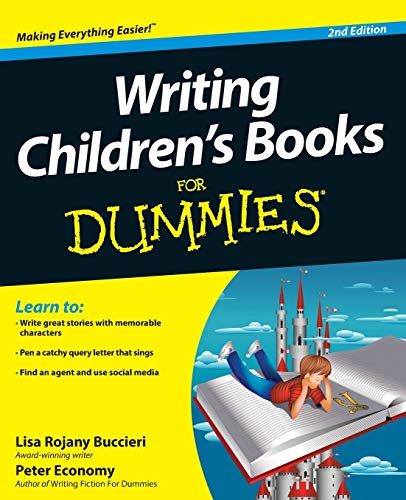
<p><b><i>Learn to:</i></b> <ul> <li>Write great stories with memorable characters</li> <li>Pen a catchy query letter that sings</li> <li>Find an agent and use social media</li> </ul> <p><b>Your guide to writing, publishing, and promoting a children's book</b> <p>Written with straightforward advice and a plethora of up-to-date recommendations, including the scoop on writing e-books, <i>Writing Children's Books For Dummies</i> provides step-by-step information on everything aspiring children's book authors need to know. Topics include researching the current marketplace, developing great stories and characters, writing captivating plots with drama, intriguing editors and agents, submitting queries and manuscripts, and making the most of social media marketing. <ul> <li><b>Children's books 101</b> — take an in-depth look at the many different formats of children's books (including e-books), as well as who actually buys children's books and why</li> <li><b>Enter the writing zone</b> — get a jump on the writing process, discover how to set up your workspace, develop great story ideas, and build upon your great ideas with research</li> <li><b>The plot thickens</b> — create a spellbinding story with a workable plot, characters to care about and root for, real dialogue, and a setting to transport your reader to the world you've created</li> <li><b>Put on your editor's cap</b> — revise and edit your manuscript, decide whether to illustrate your story on your own, and discover where to look for helpful feedback on your work</li> <li><b>Get the word out</b> — consider the pros and cons of working with literary agents versus contacting publishers yourself; get the scoop on book deals, contracts, and self-publishing; and conquer the publishing world with social media marketing</li> </ul> <p><b> Open the book and find:</b> <ul> <li>Explanations of children's book formats and genres</li> <li>Details on plot, character, and drama</li> <li>Trusted tips on writing believable dialogue</li> <li>Info on writing creative nonfiction children's books</li> <li>What you need to know about agents, publishers, self-publishing, and e-books</li> <li>The scoop on the illustration process</li> <li>How you can promote and publicize your book</li> </ul>
Aus dem Klappentext
Learn to:
- Write great stories with memorable characters
- Pen a catchy query letter that sings
- Find an agent and use social media
Your guide to writing, publishing, and promoting a children's book
Written with straightforward advice and a plethora of up-to-date recommendations, including the scoop on writing e-books, Writing Children's Books For Dummies provides step-by-step information on everything aspiring children's book authors need to know. Topics include researching the current marketplace, developing great stories and characters, writing captivating plots with drama, intriguing editors and agents, submitting queries and manuscripts, and making the most of social media marketing.
- Children's books 101 — take an in-depth look at the many different formats of children's books (including e-books), as well as who actually buys children's books and why
- Enter the writing zone — get a jump on the writing process, discover how to set up your workspace, develop great story ideas, and build upon your great ideas with research
- The plot thickens — create a spellbinding story with a workable plot, characters to care about and root for, real dialogue, and a setting to transport your reader to the world you've created
- Put on your editor's cap — revise and edit your manuscript, decide whether to illustrate your story on your own, and discover where to look for helpful feedback on your work
- Get the word out — consider the pros and cons of working with literary agents versus contacting publishers yourself; get the scoop on book deals, contracts, and self-publishing; and conquer the publishing world with social media marketing
Open the book and find:
- Explanations of children's book formats and genres
- Details on plot, character, and drama
- Trusted tips on writing believable dialogue
- Info on writing creative nonfiction children's books
- What you need to know about agents, publishers, self-publishing, and e-books
- The scoop on the illustration process
- How you can promote and publicize your book
Auszug. © Genehmigter Nachdruck. Alle Rechte vorbehalten.
Writing Children's Books For Dummies
By Lisa Rojany Buccieri, Peter EconomyJohn Wiley & Sons
Copyright © 2013 John Wiley & Sons, Ltd
All rights reserved.
ISBN: 978-1-118-35646-3All rights reserved.
CHAPTER 1
Exploring the Basics of Writing Children's Books
In This Chapter
* Defining the children's book world
* Diving into the writing process
* Creating a powerful story for children and polishing until it shines
* Publishing your book and spreading the word
For many, dreams of writing or illustrating a children's book remain just that — dreams — because they soon find out that writing a really good children's book is hard. Not only that, but actually getting a children's book published is even harder. If you don't know the conventions and styles, if you don't speak the lingo, if you don't have someone to advocate for your work, or if you or your manuscript don't come across as professional, you'll be hard pressed to get your manuscript read and considered, much less published.
Consider this chapter your sneak peek into the world of children's publishing. We fill you in on the basics of children's book formats, creating a productive writing zone, employing key storytelling techniques, revising your manuscript, and getting your story into the hands of publishers who sell to the exact children's audience you're targeting.
REMEMBER
Every bestselling children's book author started with a story idea — just like yours. Also, many of today's most successful writers were rejected time after time until they finally found someone who liked what he or she read or saw and decided to take a chance. Follow your dreams. Feed your passion. Never give up. The day your children's book is published, we'll be cheering for you.
Knowing Your Format and Audience
Before you do anything else, figure out what kind of children's book you're writing (or want to write). Manuscripts are published in several tried-and-true formats, with new ones developed every year. Formats involve the physical characteristics of a book: page count, trim size (width and height), whether it's color or black and white, has lots of pictures or lots of words, is hardcover or softcover, comes as an e-book or an app — or both. There are also lots of genres your book may (or may not) fall into. So figuring out your format and genre will help you determine exactly how to write and present your book. Chapter 2 has lots of examples of published books that do a great job in each format.
REMEMBER
You also need to ask yourself: Who is my audience? Believe it or not, children isn't the correct answer. Children of a particular age bracket, say infant to age 2, or ages 3 to 8, may come closer to defining the target age you're trying to reach, but are they really the ones who buy your book? Because books are ushered through the process by grown-ups — signed up by agents, acquired and edited by editors, categorized by publishers, pushed by sales reps, shelved and sold by booksellers, and most often purchased by parents and other adults — your audience is more complicated than you may think. In Chapter 3, we tell you all about the different people you need to impress before you get your book in the hands of children.
Getting into a Good Writing Zone
If you thought you could just grab a pen and paper and jump right in to writing, you're right! But you may also want to consider what will happen when your life starts to intrude on your writing time. How do you work around the children needing to be fed and your desk being buried under mounds of bills and old homework? How do you figure out when it's best to write? In Chapter 4, we talk about the importance of making a writing schedule and sticking to it. We also emphasize finding a space of your own for writing and making that space conducive to productivity and creativity.
After you figure out how to get to work, you have to decide what you're going to write about. Coming up with an interesting idea for a story isn't necessarily as easy as you may think, which is why we provide lots of ways to boot up your idea factory in Chapter 5. We also have ways to get you unstuck if you find yourself with a mysterious case of writer's block.
As soon as you have your good idea, it's time to get out there and research to make sure the idea fits your target audience. We cover the hows and whys of researching your audience, of figuring out what children like and what is important in their lives, and then researching the topic itself in Chapter 6.
Transforming Yourself into a Storyteller
By making sure your fiction story features these key elements, you'll be one step closer to publishing success:
[check] Memorable characters: Whether it's a child who can fly, a really hungry wolf, a boy and a slave floating down the Mississippi River, or a smelly green ogre, characters are the heart and soul of children's books. So how can you create characters who jump off the page and into your readers' hearts? Chapter 7 reveals how to build and flesh out great characters and how to avoid stereotyping and other common pitfalls.
[check] An engaging plot: What exactly is a plot, and how does one figure out what constitutes a beginning, a middle, and an ending? That's the territory of Chapter 8, as are conflict, climax, and resolution.
[check] Realistic dialogue: Kids can tell when dialogue doesn't sound right. This is why Chapter 9 features tips and step-by-step advice for writing realistic, age-appropriate dialogue for each of your characters. We also look at ways to keep your characters sounding different from one another.
[check] Interesting settings: One way to engage young readers is to set your story in places that intrigue them. We give you some pointers on how to create interesting settings that ground your story in a particular context and draw in your reader in Chapter 10.
Of course, you also need to consider your author voice or tone. Do you want to sound playful by incorporating word play, rhyming, and rhythm (the music inherent in words well matched)? Or do you want to make youngsters giggle uncontrollably? We give you the tools you need to create your character's voice in Chapter 11. And if you're struggling with sticking to a consistent point of view, Chapter 11 can help you out there, too.
TIP
Interested in writing nonfiction? Then turn to Chapter 12. It's chock-full of good advice on jump-starting your nonfiction project by choosing a kid-friendly topic, organizing your ideas into a comprehensive outline or plan, and fleshing out your ideas with all the right research.
Polishing Your Gem and Getting It Ready to Send
After you've written your first (or tenth) draft, you may be ready for the revising or editing process. Revising and editing aren't just exercises to go through step by step; they are processes in which the writer gets to know his story inside and out. Characters are fleshed out, the story is honed and sharpened, the pacing is fine-tuned, and the writing is buffed and polished.
In Chapter 13, we guide you through the steps of revising and editing, addressing in detail how to fix everything from dialogue issues to awkward writing, advising when to adhere to the rules of grammar (and when it's okay not to), and giving you a few simple questions to ask yourself to make the process much smoother and less complicated.
In the process of...
„Über diesen Titel“ kann sich auf eine andere Ausgabe dieses Titels beziehen.
Suchergebnisse für Writing Children's Books For Dummies, 2nd Edition

Beispielbild für diese ISBN
Writing Childrens Books For Du
Anbieter: World of Books (was SecondSale), Montgomery, IL, USA
Verkäuferbewertung 5 von 5 Sternen

Zustand: Good. Item in good condition. Textbooks may not include supplemental items i.e. CDs, access codes etc. Artikel-Nr. 00103133207
Gebraucht kaufen
EUR 3,71
Versand gratis
Versand innerhalb von USA
Versand innerhalb von USA
Anzahl: 7 verfügbar
Beispielbild für diese ISBN
Writing Children's Books For Dummies, 2nd Edition
Verlag:
For Dummies (edition 2), 2012
ISBN 10: 1118356462
ISBN 13: 9781118356463
Gebraucht
Paperback
Anbieter: BooksRun, Philadelphia, PA, USA
Verkäuferbewertung 5 von 5 Sternen
Paperback. Zustand: Very Good. 2. It's a well-cared-for item that has seen limited use. The item may show minor signs of wear. All the text is legible, with all pages included. It may have slight markings and/or highlighting. Artikel-Nr. 1118356462-8-1
Gebraucht kaufen
EUR 4,99
Versand gratis
Versand innerhalb von USA
Versand innerhalb von USA
Anzahl: 1 verfügbar
Beispielbild für diese ISBN
Writing Children's Books For Dummies, 2nd Edition
Anbieter: ThriftBooks-Reno, Reno, NV, USA
Verkäuferbewertung 5 von 5 Sternen
Paperback. Zustand: Good. No Jacket. Pages can have notes/highlighting. Spine may show signs of wear. ~ ThriftBooks: Read More, Spend Less. Artikel-Nr. G1118356462I3N00
Gebraucht kaufen
EUR 5,72
Versand gratis
Versand innerhalb von USA
Versand innerhalb von USA
Anzahl: 4 verfügbar
Beispielbild für diese ISBN
Writing Children's Books For Dummies, 2nd Edition
Anbieter: ThriftBooks-Atlanta, AUSTELL, GA, USA
Verkäuferbewertung 5 von 5 Sternen
Paperback. Zustand: Good. No Jacket. Pages can have notes/highlighting. Spine may show signs of wear. ~ ThriftBooks: Read More, Spend Less. Artikel-Nr. G1118356462I3N00
Gebraucht kaufen
EUR 5,72
Versand gratis
Versand innerhalb von USA
Versand innerhalb von USA
Anzahl: 4 verfügbar
Beispielbild für diese ISBN
Writing Children's Books For Dummies, 2nd Edition
Anbieter: ThriftBooks-Reno, Reno, NV, USA
Verkäuferbewertung 5 von 5 Sternen
Paperback. Zustand: Fair. No Jacket. Readable copy. Pages may have considerable notes/highlighting. ~ ThriftBooks: Read More, Spend Less. Artikel-Nr. G1118356462I5N00
Gebraucht kaufen
EUR 5,72
Versand gratis
Versand innerhalb von USA
Versand innerhalb von USA
Anzahl: 1 verfügbar
Beispielbild für diese ISBN
Writing Children's Books For Dummies, 2nd Edition
Anbieter: ThriftBooks-Phoenix, Phoenix, AZ, USA
Verkäuferbewertung 5 von 5 Sternen
Paperback. Zustand: Good. No Jacket. Pages can have notes/highlighting. Spine may show signs of wear. ~ ThriftBooks: Read More, Spend Less. Artikel-Nr. G1118356462I3N00
Gebraucht kaufen
EUR 5,72
Versand gratis
Versand innerhalb von USA
Versand innerhalb von USA
Anzahl: 4 verfügbar
Beispielbild für diese ISBN
Writing Children's Books For Dummies, 2nd Edition
Anbieter: ThriftBooks-Atlanta, AUSTELL, GA, USA
Verkäuferbewertung 5 von 5 Sternen
Paperback. Zustand: Fair. No Jacket. Readable copy. Pages may have considerable notes/highlighting. ~ ThriftBooks: Read More, Spend Less. Artikel-Nr. G1118356462I5N00
Gebraucht kaufen
EUR 5,72
Versand gratis
Versand innerhalb von USA
Versand innerhalb von USA
Anzahl: 1 verfügbar
Beispielbild für diese ISBN
Writing Children's Books For Dummies, 2nd Edition
Anbieter: ThriftBooks-Phoenix, Phoenix, AZ, USA
Verkäuferbewertung 5 von 5 Sternen
Paperback. Zustand: Good. No Jacket. Former library book; Pages can have notes/highlighting. Spine may show signs of wear. ~ ThriftBooks: Read More, Spend Less. Artikel-Nr. G1118356462I3N10
Gebraucht kaufen
EUR 5,72
Versand gratis
Versand innerhalb von USA
Versand innerhalb von USA
Anzahl: 1 verfügbar
Beispielbild für diese ISBN
Writing Children's Books For Dummies, 2nd Edition
Anbieter: ThriftBooks-Atlanta, AUSTELL, GA, USA
Verkäuferbewertung 5 von 5 Sternen
Paperback. Zustand: Good. No Jacket. Former library book; Pages can have notes/highlighting. Spine may show signs of wear. ~ ThriftBooks: Read More, Spend Less. Artikel-Nr. G1118356462I3N10
Gebraucht kaufen
EUR 5,72
Versand gratis
Versand innerhalb von USA
Versand innerhalb von USA
Anzahl: 1 verfügbar
Beispielbild für diese ISBN
Writing Children's Books For Dummies, 2nd Edition
Anbieter: ThriftBooks-Dallas, Dallas, TX, USA
Verkäuferbewertung 5 von 5 Sternen
Paperback. Zustand: Fair. No Jacket. Readable copy. Pages may have considerable notes/highlighting. ~ ThriftBooks: Read More, Spend Less. Artikel-Nr. G1118356462I5N00
Gebraucht kaufen
EUR 5,72
Versand gratis
Versand innerhalb von USA
Versand innerhalb von USA
Anzahl: 1 verfügbar