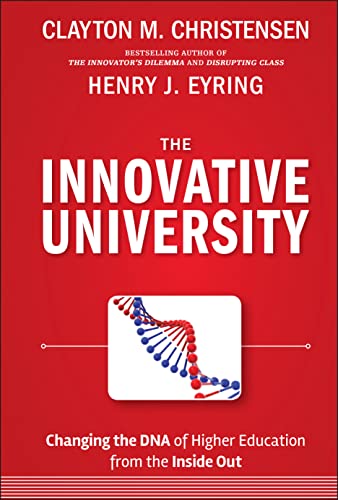
The Innovative University: Changing the DNA of Higher Education from the Inside Out (Jossey-Bass Higher and Adult Education Series) - Hardcover
Inhaltsangabe
The language of crisis is nothing new in higher education-for years critics have raised
alarms about rising tuition, compromised access, out of control costs, and a host of other
issues. Yet, though those issues are still part of the current crisis, it is not the same as
past ones. For the first time, disruptive technologies are at work in higher education. For
most of their histories, traditional universities and colleges have had no serious competition
except from institutions with similar operating models. Now, though, there are disruptive
competitors offering online degrees. Many of these institutions operate as for-profit entities,
emphasizing marketable degrees for working adults. Traditional colleges and universities
have valuable qualities and capacities that can offset those disruptors' advantages-but
not for everyone who aspires to higher education, and not without real innovation. How can
institutions of higher education think constructively and creatively about their response to
impending disruption?
Written by Clayton Christensen, the father of the theory of disruptive innovation, and his
colleague,
Henry J. Eyring, The Innovative University offers a nuanced and hopeful analysis of
the traditional university and its DNA. It explores how and why universities must change to
ensure future success.
Throughout the book Christensen and Eyring show what it takes to apply Christensen's
acclaimed model of disruptive innovation to a higher education environment. Through a
penetrating examination of the histories and current transformations of two very different
universities-Harvard and BYU-Idaho-and using other illustrative examples of innovation
in higher education, The Innovative University explores how universities can find innovative,
less costly ways of performing their uniquely valuable functions and thereby save themselves
from decline. The book explores the strategic choices and alternative ways in which traditional
universities can change to ensure their ongoing economic vitality. To avoid the pitfalls
of disruption and turn the scenario into a positive and productive one, universities must
re-
engineer their institutional DNA from the inside out.
The Innovative University reveals how the traditional university survives by breaking with
tradition, but thrives by building upon what it's done best.
Die Inhaltsangabe kann sich auf eine andere Ausgabe dieses Titels beziehen.
Über die Autorin bzw. den Autor
CLAYTON M. CHRISTENSEN is the Robert and Jane Cizik Professor of Business Administration at the Harvard Business School and the founder of Innosight Institute, a non-profit think tank. He is the author of many books, including The Innovator’s Dilemma, and has applied his theory to K–12 education in Disrupting Class and to medicine in The Innovator’s Prescription.
HENRY J. EYRING serves as an administrator at Brigham Young University-Idaho. He is a former strategy consultant at Cambridge, Massachusetts-based Monitor Company.
Von der hinteren Coverseite
The language of crisis is nothing new in higher education—for years critics have raised alarms about rising tuition, compromised access, out of control costs, and a host of other issues. Yet, though those issues are still part of the current crisis, it is not the same as past ones. For the first time, disruptive technologies are at work in higher education. For most of their histories, traditional universities and colleges have had no serious competition except from institutions with similar operating models. Now, though, there are disruptive competitors offering online degrees. Many of these institutions operate as for-profit entities, emphasizing marketable degrees for working adults. Traditional colleges and universities have valuable qualities and capacities that can offset those disruptors’ advantages—but not for everyone who aspires to higher education, and not without real innovation. How can institutions of higher education think constructively and creatively about their response to impending disruption?
Written by Clayton Christensen, the father of the theory of disruptive innovation, and his colleague, Henry J. Eyring, The Innovative University offers a nuanced and hopeful analysis of the traditional university and its DNA. It explores how and why universities must change to ensure future success.
Throughout the book Christensen and Eyring show what it takes to apply Christensen’s acclaimed model of disruptive innovation to a higher education environment. Through a penetrating examination of the histories and current transformations of two very different universities—Harvard and BYU-Idaho—and using other illustrative examples of innovation in higher education, The Innovative University explores how universities can find innovative, less costly ways of performing their uniquely valuable functions and thereby save themselves from decline. The book explores the strategic choices and alternative ways in which traditional universities can change to ensure their ongoing economic vitality. To avoid the pitfalls of disruption and turn the scenario into a positive and productive one, universities must re-engineer their institutional DNA from the inside out.
The Innovative University reveals how the traditional university survives by breaking with tradition, but thrives by building upon what it’s done best
Aus dem Klappentext
The language of crisis is nothing new in higher education?for years critics have raised alarms about rising tuition, compromised access, out of control costs, and a host of other issues. Yet, though those issues are still part of the current crisis, it is not the same as past ones. For the first time, disruptive technologies are at work in higher education. For most of their histories, traditional universities and colleges have had no serious competition except from institutions with similar operating models. Now, though, there are disruptive competitors offering online degrees. Many of these institutions operate as for-profit entities, emphasizing marketable degrees for working adults. Traditional colleges and universities have valuable qualities and capacities that can offset those disruptors' advantages?but not for everyone who aspires to higher education, and not without real innovation. How can institutions of higher education think constructively and creatively about their response to impending disruption?
Written by Clayton Christensen, the father of the theory of disruptive innovation, and his colleague, Henry J. Eyring, The Innovative University offers a nuanced and hopeful analysis of the traditional university and its DNA. It explores how and why universities must change to ensure future success.
Throughout the book Christensen and Eyring show what it takes to apply Christensen's acclaimed model of disruptive innovation to a higher education environment. Through a penetrating examination of the histories and current transformations of two very different universities?Harvard and BYU-Idaho?and using other illustrative examples of innovation in higher education, The Innovative University explores how universities can find innovative, less costly ways of performing their uniquely valuable functions and thereby save themselves from decline. The book explores the strategic choices and alternative ways in which traditional universities can change to ensure their ongoing economic vitality. To avoid the pitfalls of disruption and turn the scenario into a positive and productive one, universities must re-engineer their institutional DNA from the inside out.
The Innovative University reveals how the traditional university survives by breaking with tradition, but thrives by building upon what it's done best.
Auszug. © Genehmigter Nachdruck. Alle Rechte vorbehalten.
The Innovative University
Changing the DNA of Higher Education from the Inside OutBy Clayton M. Christensen Henry J. EyringJohn Wiley & Sons
Copyright © 2011 John Wiley & Sons, LtdAll right reserved.
ISBN: 978-1-1180-6348-4
Chapter One
The Educational Innovator's DilemmaThreat of Danger, Reasons for Hope
No one could doubt that U.S. Education Secretary Margaret Spellings meant business. In upbraiding the nation's universities and colleges, the 2006 report of her commission on the future of higher education used the language and metaphors of business:
What we have learned over the last year makes clear that American higher education has become what, in the business world, would be called a mature enterprise: increasingly risk-averse, at times self-satisfied, and unduly expensive. It is an enterprise that has yet to address the fundamental issues of how academic programs and institutions must be transformed to serve the changing educational needs of a knowledge economy. It has yet to successfully confront the impact of globalization, rapidly evolving technologies, an increasingly diverse and aging population, and an evolving marketplace characterized by new needs and paradigms.
History is littered with examples of industries that, at their peril, failed to respond—or even to notice—changes in the world around them, from railroads to steel manufacturers. Without serious self-examination and reform, institutions of higher education risk falling into the same trap, seeing their market share substantially reduced and their services increasingly characterized by obsolescence.
Not surprisingly, such confrontational, business-oriented language provoked controversy. During its drafting, the Spellings Commission report had been described by one of its own members as "flawed" and "hostile." Higher education officials and lobbyists agreed when they read the official report. Many saw it as a politically motivated attack that overlooked the fundamental mission and spirit of higher education. The report's comparison of higher learning to railway transportation and steel manufacturing was, at the individual level, an inapt analogy: the process of smelting steel offers little insight into the delicate task of molding a mind. And to speak of universities and colleges as having market share is to imply disregard for higher education's noneconomic role in creating knowledge and promoting social well-being.
Yet it was difficult to rebut many of the Spellings Commission report's most serious indictments—that fewer U.S. adults are completing post-high school degrees; that the costs of attending college are rising faster than inflation; that employers report hiring college graduates unprepared for the workplace.
Voices of Warning from Within
The Spellings Commission was not a lone voice of criticism in 2006. That same year two distinguished academics, Derek Bok and Harry Lewis, both of Harvard, published books critical of higher education. Though eschewing—and, in Lewis's case, rejecting—the business terms and competitive logic of the Spellings Commission report, these seasoned academic administrators were no less vocal about the shortcomings of higher education. Bok, a former president of Harvard University, titled his book Our Underachieving Colleges: A Candid Look at How Much Students Learn and Why They Should Be Learning More. Lewis, a forty-year veteran and former dean of Harvard College, the sub-unit of the university that serves undergraduate students, detailed its defects in a work called Excellence Without a Soul: How a Great University Forgot Education.
Bok's work was the more diplomatic of the two, as befitting a senior Harvard statesman who twice presided over the university. Yet Bok sounded his alarm with language reminiscent of the Spellings Commission's allusions to market forces. Having summarized the growing threat of global competition, he warned:
In view of these developments, neither American students nor our universities, nor the nation itself, can afford to take for granted the quality of higher education and the teaching and learning it provides. To be sure, professors and academic leaders must keep proper perspective. It is especially important to bear in mind all the purposes universities serve and to resist efforts to turn them into instruments preoccupied primarily with helping the economy grow. But resisting commercialization cannot become an excuse for resisting change. Rather, universities need to recognize the risks of complacency and use the emerging worldwide challenge as an occasion for a candid reappraisal to discover whether there are ways to lift the performance of our institutions of higher learning to higher levels.
After exploring the important noneconomic purposes of universities and noting the general satisfaction of students and recent graduates, Bok nonetheless leveled an indictment similar to that of the Spellings Commission:
Despite the favorable opinions of undergraduates and alumni, a closer look at the record ... shows that colleges and universities, for all the benefits they bring, accomplish far less for their students than they should. Many seniors graduate without being able to write well enough to satisfy their employers. Many cannot reason clearly or perform competently in analyzing complex, nontechnical problems, even though faculties rank critical thinking as the primary goal of a college education.
Harry Lewis likewise pulled few punches in Excellence Without a Soul. But in arguing that Harvard had "forgot[ten] education," Lewis took a different tack than Bok. Rather than warning of the forces of global competition, he accused Harvard and its peers of being driven too much by their own competitive ambitions. In particular, he noted how scholarly activity tends to distance professors from the undergraduate teaching and learning process. At the same time, he argued, the desire to attract and satisfy students as though they are mere customers leads to academic coddling, in the form of easy grades and expensive facilities and entertainments, such as intercollegiate athletic teams. In the process, Lewis concluded:
Universities have forgotten their larger role for college students.... Rarely will you hear more than bromides about personal strength, integrity, kindness, cooperation, compassion, and how to leave the world a better place than you found it. The greater the university, the more intent it is on competitive success in the marketplace of faculty, students, and research money. And the less likely it is to talk seriously to students about their development into people of good character who will know that they owe something to society for the privileged education they have received.
Lewis's prescription for solving this problem was for universities to be less businesslike:
Changing direction requires ... leadership that views the university idealistically, as something more than a business and something better than a slave to the logic of economic competition.
Pressures from Without
Ironically, Lewis's call for transcending economic competition sounded on the eve of the deepest financial crisis since the Great Depression. By 2009, the universities and colleges that the Spellings Commission had characterized as self-satisfied were struggling to fill budget gaps left by dramatic drops in their endowments and state appropriations. Even mighty Harvard was forced to suspend a major construction project and to lay off staff after its endowment, which had been producing one-third of its operating revenues, shrank from $37 billion to $26 billion. The budget crisis was particularly acute for universities modeled after Harvard, with expensive commitments to graduate schools and research activities spanning a wide array of academic disciplines. Unfortunately, few of these schools enjoyed Harvard's financial clout. Endowment losses and decreases in state funding led inevitably to budget cuts and tuition increases.
Meanwhile, new federal government attention and dollars flowed to public two-year colleges, which were perceived as offering the better near-term investment in economic revival; in the decade before the downturn, their prices increased only one-fifth as fast as those of their four-year counterparts. The enrollments of these two-year colleges swelled, as did those of rapidly proliferating for-profit higher education companies. Many of the for-profits in particular applied the power of online learning technology. Online courses offer the benefits of greater convenience and also lower total cost, as much of a student's expense in getting a traditional higher education is not in tuition but in leaving the workplace and relocating to a residential campus.
Online offerings grew in popularity throughout the decade but especially when times got tough. The downturn that knocked the wind out of the traditional universities billowed the sails of the for-profit educators. The University of Phoenix, for example, recognized revenues of $2.5 billion in 2007; by the end of 2009 that figure had risen to nearly $3.8 billion. In that year it enrolled 355,800 new students, roughly 150,000 more than the total enrollment of the ten campuses of the University of California. Investigations of student-recruiting abuses and proposals to tighten regulatory standards slowed the for-profits, but it would be unwise to dismiss the disruptive power of their educational model, especially the use of online learning technology.
In most industries, technology-enabled competition is deemed healthy and vital. Accustomed to a hyper-competitive modern world, we expect even the largest and most prestigious companies to be continually challenged by nimbler, more creative upstarts. Economists teach that disruptive innovation by newcomers and creative destruction of entrenched incumbents leads to better products and services. When a century-old auto company, airline, investment bank, or newspaper files for bankruptcy or disappears altogether, we regret the attendant human suffering but count the loss as the price of progress, knowing that without competitive innovation and destruction we would enjoy a standard of living no better than our great-grandparents did.
Higher education, though, has been different. Large universities rarely cease to operate. Nor are the prestigious ones quickly overtaken. Part of the reason is a dearth of disruptive competition. The most innovative would-be competitors, for-profit education companies, find great success among working adults, many of whom care more about the content and convenience of their education than the label on it. But many young college students still seek the assurance of traditional university names and the benefits of campus life. Because of loyal support from this large group of higher education customers, the incumbents have felt little pressure from the for-profits' use of potentially disruptive online technology.
Meanwhile, the terms of competition among traditional institutions, the public and private not-for-profit universities, have been set primarily by those at the top. The strategy of most schools is one of imitation, not innovation. Little-known and smaller institutions try to move up in the ranks by adding students, majors, and graduate programs, so as to look more like the large universities. They also task their faculty with research responsibilities. In the process the emulators incur new costs and thus must raise tuition. This blunts the price advantage that they began with. They are stuck in a dangerous competitive middle ground, neither highest in quality nor lowest in cost. The great schools, rather than being discomfited by the imitation, seem all the more desirable because of it.
The Educational Innovator's Dilemma
In their defense, the institutions that emulate Harvard and strive to climb the Carnegie ladder are doing just as conventional business logic dictates—trying to give customers what they want. The great universities such as Harvard inspire not just administrators, faculty, and alumni at other schools. They also excite the most elite prospective students, who want to win admission to the most Harvard-like institution they can. Thus, less prestigious schools emulate Harvard's essential features, such as graduate programs and expert faculty researchers and research facilities. They also give students costly noneducational amenities such as intercollegiate athletic teams, which Harvard no longer supports at the level of the most competitive schools.
The result of this competition-by-imitation is to solidify past educational practice among traditional universities, making them increasingly more expensive but not fundamentally better from a learning standpoint. The great-grandparents of today's students would easily recognize the essential elements of modern higher education. Though the students are more diverse, the shape of classrooms, the style of instruction, and the subjects of study are all remarkably true to their century-old antecedents. Great-grandpa and Grandma would likewise recognize the three schools atop U.S. News's 2010 college rankings: Harvard, Princeton, and Yale. In fact, asked to guess, they'd probably have picked just those three.
Only the costs of a higher education, one can argue, have kept pace with the times. In the ten years after 1997, the inflation-adjusted cost of a year of college at the average public university rose by 30 percent, while the earning power of a bachelor's degree remained roughly the same. Cost increases derive partly from higher faculty salaries, but more from activities unrelated to classroom instruction. Scientific research, competitive athletics, and student amenities require both large operating outlays and the construction of high-tech laboratories, football stadiums, and activity centers. As a result, the cost of higher education grows faster than faculty salaries or other instruction-related costs.
The problem is not unique to higher education. In fact, in products ranging from computers to breakfast cereals, history reveals a pattern of innovation that ultimately exceeds customers' needs. Hoping to get an edge on their competitors, companies offer new features, such as faster processing speeds in a computer or increased vitamin fortification in cereals. These enhancements are sustaining innovations rather than reinventions: the product becomes better while its basic design and uses remain the same.
The catch, as Clayton Christensen has shown in The Innovator's Dilemma, is that these performance enhancements at some point exceed even the most demanding customers' performance needs (see Figure 1.1). The producer is incurring greater costs and thus must raise prices. That leaves the typical purchaser of a $5,000 laptop or a $5 box of cereal paying more than they want to, given what they actually need.
Universities tend to innovate and set prices in similar ways. Those in a particular tier attempt to match one another's services; the ambitious ones also emulate the more prestigious institutions above them. To offset the cost of new offerings and activities, such as additional majors and graduate degree programs, they raise tuition, their most easily controllable source of revenue. In setting tuition levels, the primary question is not what students are willing and able to pay. Thanks to government grants and loans, the students are less price sensitive in their higher education choices than in other purchase decisions. Because third-party financing reduces student price sensitivity and most schools offer similar curricula, higher education prices can be set on the basis of institutional peer comparison. The most elite institutions charge nearly identical rates and stay in step with similar annual rate increases. The other schools maintain a set discount to the tuition of the elite ones, raising their rates confidently under this steadily rising price umbrella.
The Risk of Disruption
Much of what universities are doing is standard management practice: improve the product; give customers more of what they want; watch the competition. But it leads even great enterprises to fail, as detailed in The Innovator's Dilemma. Inevitably, while the industry leaders focus on better serving their most prized customers and matching their toughest competitors, they overlook what is happening beneath them. Two things are likely to be occurring there. One is growth in the number of would-be consumers who cannot afford the continuously enhanced offerings and thus become nonconsumers. The other is the emergence of technologies that will, in the right hands, allow new competitors to serve this disenfranchised group of nonconsumers, as shown in Figure 1.2.
(Continues...)
Excerpted from The Innovative Universityby Clayton M. Christensen Henry J. Eyring Copyright © 2011 by John Wiley & Sons, Ltd. Excerpted by permission of John Wiley & Sons. All rights reserved. No part of this excerpt may be reproduced or reprinted without permission in writing from the publisher.
Excerpts are provided by Dial-A-Book Inc. solely for the personal use of visitors to this web site.
„Über diesen Titel“ kann sich auf eine andere Ausgabe dieses Titels beziehen.
Suchergebnisse für The Innovative University: Changing the DNA of Higher...

Beispielbild für diese ISBN
The Innovative University : Changing the DNA of Higher Education from the Inside Out
Verlag:
Wiley & Sons, Incorporated, John, 2011
ISBN 10: 1118063481
ISBN 13: 9781118063484
Gebraucht
Hardcover
Erstausgabe
Anbieter: Better World Books, Mishawaka, IN, USA
Verkäuferbewertung 5 von 5 Sternen

Zustand: Fine. 1st Edition. Used book that is in almost brand-new condition. Artikel-Nr. 9005370-75
Beispielbild für diese ISBN
The Innovative University : Changing the DNA of Higher Education from the Inside Out
Verlag:
Wiley & Sons, Incorporated, John, 2011
ISBN 10: 1118063481
ISBN 13: 9781118063484
Gebraucht
Hardcover
Erstausgabe
Anbieter: Better World Books, Mishawaka, IN, USA
Verkäuferbewertung 5 von 5 Sternen
Zustand: Very Good. 1st Edition. Former library book; may include library markings. Used book that is in excellent condition. May show signs of wear or have minor defects. Artikel-Nr. 4705739-6
Beispielbild für diese ISBN
The Innovative University : Changing the DNA of Higher Education from the Inside Out
Verlag:
Wiley & Sons, Incorporated, John, 2011
ISBN 10: 1118063481
ISBN 13: 9781118063484
Gebraucht
Hardcover
Erstausgabe
Anbieter: Better World Books, Mishawaka, IN, USA
Verkäuferbewertung 5 von 5 Sternen
Zustand: Good. 1st Edition. Used book that is in clean, average condition without any missing pages. Artikel-Nr. 5767750-6
Beispielbild für diese ISBN
The Innovative University : Changing the DNA of Higher Education from the Inside Out
Verlag:
Wiley & Sons, Incorporated, John, 2011
ISBN 10: 1118063481
ISBN 13: 9781118063484
Gebraucht
Hardcover
Erstausgabe
Anbieter: Better World Books, Mishawaka, IN, USA
Verkäuferbewertung 5 von 5 Sternen
Zustand: Very Good. 1st Edition. Used book that is in excellent condition. May show signs of wear or have minor defects. Artikel-Nr. 4388912-6
Beispielbild für diese ISBN
The Innovative University : Changing the DNA of Higher Education from the Inside Out
Verlag:
Wiley & Sons, Incorporated, John, 2011
ISBN 10: 1118063481
ISBN 13: 9781118063484
Gebraucht
Hardcover
Erstausgabe
Anbieter: Better World Books, Mishawaka, IN, USA
Verkäuferbewertung 5 von 5 Sternen
Zustand: Good. 1st Edition. Former library book; may include library markings. Used book that is in clean, average condition without any missing pages. Artikel-Nr. 8689262-6
Beispielbild für diese ISBN
The Innovative University
Anbieter: ThriftBooks-Phoenix, Phoenix, AZ, USA
Verkäuferbewertung 5 von 5 Sternen
Hardcover. Zustand: Very Good. No Jacket. May have limited writing in cover pages. Pages are unmarked. ~ ThriftBooks: Read More, Spend Less. Artikel-Nr. G1118063481I4N00
Beispielbild für diese ISBN
The Innovative University
Anbieter: ThriftBooks-Atlanta, AUSTELL, GA, USA
Verkäuferbewertung 5 von 5 Sternen
Hardcover. Zustand: Very Good. No Jacket. May have limited writing in cover pages. Pages are unmarked. ~ ThriftBooks: Read More, Spend Less. Artikel-Nr. G1118063481I4N00
Beispielbild für diese ISBN
The Innovative University: Changing the DNA of Higher Education from the Inside Out
Anbieter: Wonder Book, Frederick, MD, USA
Verkäuferbewertung 5 von 5 Sternen
Zustand: Very Good. Very Good condition. Good dust jacket. A copy that may have a few cosmetic defects. May also contain light spine creasing or a few markings such as an owner's name, short gifter's inscription or light stamp. Artikel-Nr. O13B-04697
Beispielbild für diese ISBN
The Innovative University: Changing the DNA of Higher Education from the Inside Out
Anbieter: Wonder Book, Frederick, MD, USA
Verkäuferbewertung 5 von 5 Sternen
Zustand: Good. Good condition. Very Good dust jacket. A copy that has been read but remains intact. May contain markings such as bookplates, stamps, limited notes and highlighting, or a few light stains. Artikel-Nr. L20O-01286
Beispielbild für diese ISBN
The Innovative University: Changing the DNA of Higher Education from the Inside Out (Jossey-Bass Higher and Adult Education (Hardcover))
Anbieter: AwesomeBooks, Wallingford, Vereinigtes Königreich
Verkäuferbewertung 5 von 5 Sternen
Hardcover. Zustand: Very Good. The Innovative University: Changing the DNA of Higher Education from the Inside Out (Jossey-Bass Higher and Adult Education (Hardcover)) This book is in very good condition and will be shipped within 24 hours of ordering. The cover may have some limited signs of wear but the pages are clean, intact and the spine remains undamaged. This book has clearly been well maintained and looked after thus far. Money back guarantee if you are not satisfied. See all our books here, order more than 1 book and get discounted shipping. . Artikel-Nr. 7719-9781118063484
Gebraucht kaufen
EUR 3,96
Versand:
EUR 5,69
Von Vereinigtes Königreich nach USA
Anzahl: 1 verfügbar