
Verwandte Artikel zu The Innovative University: Changing the DNA of Higher...
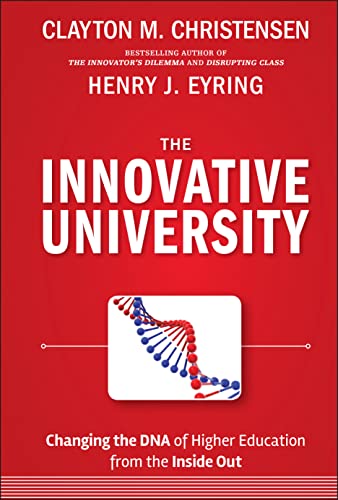
The Innovative University: Changing the DNA of Higher Education from the Inside Out (Jossey-Bass Higher and Adult Education Series) - Hardcover
Inhaltsangabe
The Innovative University illustrates how higher education can respond to the forces of disruptive innovation , and offers a nuanced and hopeful analysis of where the traditional university and its traditions have come from and how it needs to change for the future. Through an examination of Harvard and BYU-Idaho as well as other stories of innovation in higher education, Clayton Christensen and Henry Eyring decipher how universities can find innovative, less costly ways of performing their uniquely valuable functions.
- Offers new ways forward to deal with curriculum, faculty issues, enrollment, retention, graduation rates, campus facility usage, and a host of other urgent issues in higher education
- Discusses a strategic model to ensure economic vitality at the traditional university
- Contains novel insights into the kind of change that is necessary to move institutions of higher education forward in innovative ways
This book uncovers how the traditional university survives by breaking with tradition, but thrives by building on what it's done best.
Die Inhaltsangabe kann sich auf eine andere Ausgabe dieses Titels beziehen.
Über die Autorin bzw. den Autor
CLAYTON M. CHRISTENSEN is the Robert and Jane Cizik Professor of Business Administration at the Harvard Business School and the founder of Innosight Institute, a non-profit think tank. He is the author of many books, including The Innovator’s Dilemma, and has applied his theory to K–12 education in Disrupting Class and to medicine in The Innovator’s Prescription.
HENRY J. EYRING serves as an administrator at Brigham Young University-Idaho. He is a former strategy consultant at Cambridge, Massachusetts-based Monitor Company.
Von der hinteren Coverseite
The language of crisis is nothing new in higher education―for years critics have raised alarms about rising tuition, compromised access, out of control costs, and a host of other issues. Yet, though those issues are still part of the current crisis, it is not the same as past ones. For the first time, disruptive technologies are at work in higher education. For most of their histories, traditional universities and colleges have had no serious competition except from institutions with similar operating models. Now, though, there are disruptive competitors offering online degrees. Many of these institutions operate as for-profit entities, emphasizing marketable degrees for working adults. Traditional colleges and universities have valuable qualities and capacities that can offset those disruptors’ advantages―but not for everyone who aspires to higher education, and not without real innovation. How can institutions of higher education think constructively and creatively about their response to impending disruption?
Written by Clayton Christensen, the father of the theory of disruptive innovation, and his colleague, Henry J. Eyring, The Innovative University offers a nuanced and hopeful analysis of the traditional university and its DNA. It explores how and why universities must change to ensure future success.
Throughout the book Christensen and Eyring show what it takes to apply Christensen’s acclaimed model of disruptive innovation to a higher education environment. Through a penetrating examination of the histories and current transformations of two very different universities―Harvard and BYU-Idaho―and using other illustrative examples of innovation in higher education, The Innovative University explores how universities can find innovative, less costly ways of performing their uniquely valuable functions and thereby save themselves from decline. The book explores the strategic choices and alternative ways in which traditional universities can change to ensure their ongoing economic vitality. To avoid the pitfalls of disruption and turn the scenario into a positive and productive one, universities must re-engineer their institutional DNA from the inside out.
The Innovative University reveals how the traditional university survives by breaking with tradition, but thrives by building upon what it’s done best
Aus dem Klappentext
The language of crisis is nothing new in higher education?for years critics have raised alarms about rising tuition, compromised access, out of control costs, and a host of other issues. Yet, though those issues are still part of the current crisis, it is not the same as past ones. For the first time, disruptive technologies are at work in higher education. For most of their histories, traditional universities and colleges have had no serious competition except from institutions with similar operating models. Now, though, there are disruptive competitors offering online degrees. Many of these institutions operate as for-profit entities, emphasizing marketable degrees for working adults. Traditional colleges and universities have valuable qualities and capacities that can offset those disruptors' advantages?but not for everyone who aspires to higher education, and not without real innovation. How can institutions of higher education think constructively and creatively about their response to impending disruption?
Written by Clayton Christensen, the father of the theory of disruptive innovation, and his colleague, Henry J. Eyring, The Innovative University offers a nuanced and hopeful analysis of the traditional university and its DNA. It explores how and why universities must change to ensure future success.
Throughout the book Christensen and Eyring show what it takes to apply Christensen's acclaimed model of disruptive innovation to a higher education environment. Through a penetrating examination of the histories and current transformations of two very different universities?Harvard and BYU-Idaho?and using other illustrative examples of innovation in higher education, The Innovative University explores how universities can find innovative, less costly ways of performing their uniquely valuable functions and thereby save themselves from decline. The book explores the strategic choices and alternative ways in which traditional universities can change to ensure their ongoing economic vitality. To avoid the pitfalls of disruption and turn the scenario into a positive and productive one, universities must re-engineer their institutional DNA from the inside out.
The Innovative University reveals how the traditional university survives by breaking with tradition, but thrives by building upon what it's done best.
Auszug. © Genehmigter Nachdruck. Alle Rechte vorbehalten.
The Innovative University
Changing the DNA of Higher Education from the Inside OutBy Clayton M. Christensen Henry J. EyringJohn Wiley & Sons
Copyright © 2011 John Wiley & Sons, LtdAll right reserved.
ISBN: 978-1-1180-6348-4
Chapter One
The Educational Innovator's DilemmaThreat of Danger, Reasons for Hope
No one could doubt that U.S. Education Secretary Margaret Spellings meant business. In upbraiding the nation's universities and colleges, the 2006 report of her commission on the future of higher education used the language and metaphors of business:
What we have learned over the last year makes clear that American higher education has become what, in the business world, would be called a mature enterprise: increasingly risk-averse, at times self-satisfied, and unduly expensive. It is an enterprise that has yet to address the fundamental issues of how academic programs and institutions must be transformed to serve the changing educational needs of a knowledge economy. It has yet to successfully confront the impact of globalization, rapidly evolving technologies, an increasingly diverse and aging population, and an evolving marketplace characterized by new needs and paradigms.
History is littered with examples of industries that, at their peril, failed to respond—or even to notice—changes in the world around them, from railroads to steel manufacturers. Without serious self-examination and reform, institutions of higher education risk falling into the same trap, seeing their market share substantially reduced and their services increasingly characterized by obsolescence.
Not surprisingly, such confrontational, business-oriented language provoked controversy. During its drafting, the Spellings Commission report had been described by one of its own members as "flawed" and "hostile." Higher education officials and lobbyists agreed when they read the official report. Many saw it as a politically motivated attack that overlooked the fundamental mission and spirit of higher education. The report's comparison of higher learning to railway transportation and steel manufacturing was, at the individual level, an inapt analogy: the process of smelting steel offers little insight into the delicate task of molding a mind. And to speak of universities and colleges as having market share is to imply disregard for higher education's noneconomic role in creating knowledge and promoting social well-being.
Yet it was difficult to rebut many of the Spellings Commission report's most serious indictments—that fewer U.S. adults are completing post-high school degrees; that the costs of attending college are rising faster than inflation; that employers report hiring college graduates unprepared for the workplace.
Voices of Warning from Within
The Spellings Commission was not a lone voice of criticism in 2006. That same year two distinguished academics, Derek Bok and Harry Lewis, both of Harvard, published books critical of higher education. Though eschewing—and, in Lewis's case, rejecting—the business terms and competitive logic of the Spellings Commission report, these seasoned academic administrators were no less vocal about the shortcomings of higher education. Bok, a former president of Harvard University, titled his book Our Underachieving Colleges: A Candid Look at How Much Students Learn and Why They Should Be Learning More. Lewis, a forty-year veteran and former dean of Harvard College, the sub-unit of the university that serves undergraduate students, detailed its defects in a work called Excellence Without a Soul: How a Great University Forgot Education.
Bok's work was the more diplomatic of the two, as befitting a senior Harvard statesman who twice presided over the university. Yet Bok sounded his alarm with language reminiscent of the Spellings Commission's allusions to market forces. Having summarized the growing threat of global competition, he warned:
In view of these developments, neither American students nor our universities, nor the nation itself, can afford to take for granted the quality of higher education and the teaching and learning it provides. To be sure, professors and academic leaders must keep proper perspective. It is especially important to bear in mind all the purposes universities serve and to resist efforts to turn them into instruments preoccupied primarily with helping the economy grow. But resisting commercialization cannot become an excuse for resisting change. Rather, universities need to recognize the risks of complacency and use the emerging worldwide challenge as an occasion for a candid reappraisal to discover whether there are ways to lift the performance of our institutions of higher learning to higher levels.
After exploring the important noneconomic purposes of universities and noting the general satisfaction of students and recent graduates, Bok nonetheless leveled an indictment similar to that of the Spellings Commission:
Despite the favorable opinions of undergraduates and alumni, a closer look at the record ... shows that colleges and universities, for all the benefits they bring, accomplish far less for their students than they should. Many seniors graduate without being able to write well enough to satisfy their employers. Many cannot reason clearly or perform competently in analyzing complex, nontechnical problems, even though faculties rank critical thinking as the primary goal of a college education.
Harry Lewis likewise pulled few punches in Excellence Without a Soul. But in arguing that Harvard had "forgot[ten] education," Lewis took a different tack than Bok. Rather than warning of the forces of global competition, he accused Harvard and its peers of being driven too much by their own competitive ambitions. In particular, he noted how scholarly activity tends to distance professors from the undergraduate teaching and learning process. At the same time, he argued, the desire to attract and satisfy students as though they are mere customers leads to academic coddling, in the form of easy grades and expensive facilities and entertainments, such as intercollegiate athletic teams. In the process, Lewis concluded:
Universities have forgotten their larger role for college students.... Rarely will you hear more than bromides about personal strength, integrity, kindness, cooperation, compassion, and how to leave the world a better place than you found it. The greater the university, the more intent it is on competitive success in the marketplace of faculty, students, and research money. And the less likely it is to talk seriously to students about their development into people of good character who will know that they owe something to society for the privileged education they have received.
Lewis's prescription for solving this problem was for universities to be less businesslike:
Changing direction requires ... leadership that views the university idealistically, as something more than a business and something better than a slave to the logic of economic competition.
Pressures from Without
Ironically, Lewis's call for transcending economic competition sounded on the eve of the deepest financial crisis since the Great Depression. By 2009, the universities and colleges...
„Über diesen Titel“ kann sich auf eine andere Ausgabe dieses Titels beziehen.
Suchergebnisse für The Innovative University: Changing the DNA of Higher...

Foto des Verkäufers
The Innovative University: Changing the DNA of Higher Education from the Inside Out (Jossey-Bass Higher and Adult Education Series)
Anbieter: Dream Books Co., Denver, CO, USA
Verkäuferbewertung 5 von 5 Sternen

Zustand: acceptable. This copy has clearly been enjoyedâ"expect noticeable shelf wear and some minor creases to the cover. Binding is strong, and all pages are legible. May contain previous library markings or stamps. Artikel-Nr. DBV.1118063481.A
Gebraucht kaufen
EUR 5,58
Versand gratis
Versand innerhalb von USA
Versand innerhalb von USA
Anzahl: 1 verfügbar
Beispielbild für diese ISBN
The Innovative University: Changing the DNA of Higher Education from the Inside Out
Anbieter: World of Books (was SecondSale), Montgomery, IL, USA
Verkäuferbewertung 5 von 5 Sternen
Hardback. Zustand: Very Good. The Innovative University illustrates how higher education can respond to the forces of disruptive innovation , and offers a nuanced and hopeful analysis of where the traditional university and its traditions have come from and how it needs to change for the future. Artikel-Nr. 00100094683
Gebraucht kaufen
EUR 5,67
Versand gratis
Versand innerhalb von USA
Versand innerhalb von USA
Anzahl: 5 verfügbar
Beispielbild für diese ISBN
The Innovative University: Changing the DNA of Higher Education from the Inside Out
Anbieter: World of Books (was SecondSale), Montgomery, IL, USA
Verkäuferbewertung 5 von 5 Sternen
Hardback. Zustand: Fair. The Innovative University illustrates how higher education can respond to the forces of disruptive innovation , and offers a nuanced and hopeful analysis of where the traditional university and its traditions have come from and how it needs to change for the future. Artikel-Nr. 00110773208
Gebraucht kaufen
EUR 5,67
Versand gratis
Versand innerhalb von USA
Versand innerhalb von USA
Anzahl: 1 verfügbar
Beispielbild für diese ISBN
The Innovative University: Changing the DNA of Higher Education from the Inside Out
Anbieter: World of Books (was SecondSale), Montgomery, IL, USA
Verkäuferbewertung 5 von 5 Sternen
Hardback. Zustand: Good. The Innovative University illustrates how higher education can respond to the forces of disruptive innovation , and offers a nuanced and hopeful analysis of where the traditional university and its traditions have come from and how it needs to change for the future. Artikel-Nr. CIN1118063481G
Gebraucht kaufen
EUR 5,67
Versand gratis
Versand innerhalb von USA
Versand innerhalb von USA
Anzahl: 1 verfügbar
Beispielbild für diese ISBN
The Innovative University: Changing the DNA of Higher Education from the Inside Out (Jossey-Bass Higher and Adult Education Series)
Verlag:
Jossey-Bass (edition 1), 2011
ISBN 10: 1118063481
ISBN 13: 9781118063484
Gebraucht
Hardcover
Anbieter: BooksRun, Philadelphia, PA, USA
Verkäuferbewertung 5 von 5 Sternen
Hardcover. Zustand: Very Good. 1. With dust jacket. It's a well-cared-for item that has seen limited use. The item may show minor signs of wear. All the text is legible, with all pages included. It may have slight markings and/or highlighting. Artikel-Nr. 1118063481-11-1-29
Gebraucht kaufen
EUR 6,10
Versand gratis
Versand innerhalb von USA
Versand innerhalb von USA
Anzahl: 1 verfügbar
Beispielbild für diese ISBN
The Innovative University
Anbieter: ThriftBooks-Phoenix, Phoenix, AZ, USA
Verkäuferbewertung 5 von 5 Sternen
Hardcover. Zustand: Very Good. No Jacket. May have limited writing in cover pages. Pages are unmarked. ~ ThriftBooks: Read More, Spend Less. Artikel-Nr. G1118063481I4N00
Gebraucht kaufen
EUR 6,41
Versand gratis
Versand innerhalb von USA
Versand innerhalb von USA
Anzahl: 1 verfügbar
Beispielbild für diese ISBN
The Innovative University
Anbieter: ThriftBooks-Atlanta, AUSTELL, GA, USA
Verkäuferbewertung 5 von 5 Sternen
Hardcover. Zustand: As New. No Jacket. Pages are clean and are not marred by notes or folds of any kind. ~ ThriftBooks: Read More, Spend Less. Artikel-Nr. G1118063481I2N00
Gebraucht kaufen
EUR 6,41
Versand gratis
Versand innerhalb von USA
Versand innerhalb von USA
Anzahl: 1 verfügbar
Beispielbild für diese ISBN
The Innovative University
Anbieter: ThriftBooks-Dallas, Dallas, TX, USA
Verkäuferbewertung 5 von 5 Sternen
Hardcover. Zustand: Very Good. No Jacket. May have limited writing in cover pages. Pages are unmarked. ~ ThriftBooks: Read More, Spend Less. Artikel-Nr. G1118063481I4N00
Gebraucht kaufen
EUR 6,41
Versand gratis
Versand innerhalb von USA
Versand innerhalb von USA
Anzahl: 1 verfügbar
Beispielbild für diese ISBN
The Innovative University
Anbieter: ThriftBooks-Atlanta, AUSTELL, GA, USA
Verkäuferbewertung 5 von 5 Sternen
Hardcover. Zustand: Very Good. No Jacket. May have limited writing in cover pages. Pages are unmarked. ~ ThriftBooks: Read More, Spend Less. Artikel-Nr. G1118063481I4N00
Gebraucht kaufen
EUR 6,41
Versand gratis
Versand innerhalb von USA
Versand innerhalb von USA
Anzahl: 1 verfügbar
Beispielbild für diese ISBN
The Innovative University : Changing the DNA of Higher Education from the Inside Out
Verlag:
Wiley & Sons, Incorporated, John, 2011
ISBN 10: 1118063481
ISBN 13: 9781118063484
Gebraucht
Hardcover
Erstausgabe
Anbieter: Better World Books, Mishawaka, IN, USA
Verkäuferbewertung 5 von 5 Sternen
Zustand: Fine. 1st Edition. Used book that is in almost brand-new condition. May contain a remainder mark. Better World Books: Buy Books. Do Good. Artikel-Nr. 9005370-75
Gebraucht kaufen
EUR 6,49
Versand gratis
Versand innerhalb von USA
Versand innerhalb von USA
Anzahl: 1 verfügbar