
Verwandte Artikel zu The Pleasure Shock: The Rise of Deep Brain Stimulation...
Inhaltsangabe
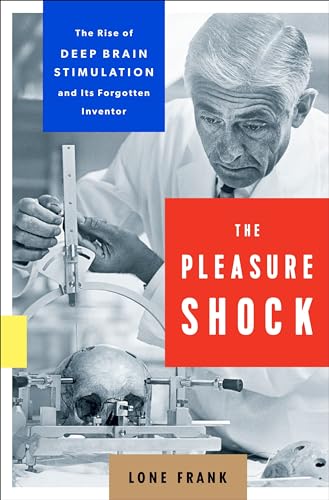
The electrifying, forgotten history of Robert Heath's brain pacemaker, investigating the origins and ethics of one of today's most promising medical breakthroughs: deep brain stimulation
The technology invented by psychiatrist Robert G. Heath in the 1950s and '60s has been described as among the most controversial experiments in US history. His work was alleged at the time to be part of MKUltra, the CIA's notorious "mind control" project. His research subjects included incarcerated convicts and gay men who wished to be "cured" of their sexual preference. Yet his cutting-edge research and legacy were quickly buried deep in Tulane University's archives. Investigative science journalist Lone Frank now tells the complete sage of this passionate, determined doctor and his groundbreaking neuroscience.
More than fifty years after Heath's experiments, this very same treatment is becoming mainstream practice in modern psychiatry for everything from schizophrenia, anorexia, and compulsive behavior to depression, Parkinson's, and even substance addiction.
Lone Frank uncovered lost documents and accounts of Heath's trailblazing work. She tracked down surviving colleagues and patients, and she delved into the current support for deep brain stimulation by scientists and patients alike. What has changed? Why do we today unquestioningly embrace this technology as a cure? How do we decide what is a disease of the brain to be cured and what should be allowed to remain unrobed and unprodded? And how do we weigh the decades of criticism against the promise of treatment that could be offered to millions of patients?
Elegantly written and deeply fascinating, The Pleasure Shock weaves together biography, scientific history, and medical ethics. It is an adventure into our ever-shifting views of the mind and the fateful power we wield when we tinker with the self.
Die Inhaltsangabe kann sich auf eine andere Ausgabe dieses Titels beziehen.
Über die Autorin bzw. den Autor
LONE FRANK is an acclaimed science writer and the author of two previous books in English, My Beautiful Genome (Oneworld, 2011)--which was shortlisted for the Royal Society's Winton Prize for Science Books--and Mindfield (Oneworld, 2009). She has also been a presenter and coproducer of several TV documentaries with global distribution and is currently working on a feature-length, internationally financed, English-language documentary about Heath and deep brain stimulation. Before her career as a science writer, she earned a PhD in neurobiology and worked in the US biotech industry. She lives in Copenhagen.
Auszug. © Genehmigter Nachdruck. Alle Rechte vorbehalten.
Chapter 1
Singing the Brain Electric
The year 1951 was a little over a month old when the small group of men in lab coats gathered in the operating theater. Anticipation hung heavy in the air but everyone went out of their way not to act as if this was just like any other day at the office.
The surgeon, a psychiatrist, and the others in turn offered their commentary on the unusually cold New Orleans winter. As they talked, a young woman lay before them on the operating table, conscious but not fully present. For the past six months she had been hospitalized, silent, and withdrawn, and almost immobile. If an aide started brushing her teeth or combing her hair, she would complete the task, but only torpidly.
DIAGNOSIS: Schizophrenic reaction, catatonic type, read her medical record.
The file noted that she was an only child, and had lived all of her twenty-six years with her parents in the countryside. They reported that she had always been a quiet and obedient child. "She's a good girl," her mother said.
At the same time, the woman's health was fragile. There was a long litany of complaints: discomfort, diffuse pain, general fatigue, repeated fainting spells. The year before her hospitalization, these episodes morphed into a chronic condition of irritable confusion and a morbid obsession with her guilt. With tears running down her cheeks, the good girl begged her parents again and again for forgiveness from sins neither of them could recognize-including imaginary sexual transgressions she supposedly committed in her early childhood. Finally, her parents had decided to try a private clinic that promised a definitive treatment for their daughter's overexcitement: a series of electric shock treatments.
The shock therapy helped a bit, but the woman quickly developed an exaggerated fear of disease. She was particularly anxious that her body was producing insidious, malignant cancers. Eventually, the worries became too much for her, and she attempted to kill herself with her father's hunting rifle.
"A feeble suicidal gesture," the medical file reported, but enough to land the young woman in New Orleans's Charity Hospital. She had been put in the women's ward-the white women's ward-where she had spent the past six months. Then, unfortunately, she had started to experience new delusions and hallucinations. Another round of electroshocks provided relief from these symptoms, but had also thrown her into a state of mute isolation.
There was a separate sheet in the medical record, marked "Patient 4," dedicated to the bold experimental treatment under way on this frigid February evening. That night, a young surgeon named Francisco Garcia was conducting a fourth surgery on the young woman's brain under the supervision of his boss, Robert G. Heath. Four hours earlier, they had opened her skull and cautiously placed a single, thin silver electrode through her right frontal lobe all the way down to the bottom of her brain, leaving its conductive tip in what was called the septum. This was Heath's area: a little region of the brain that he believed served as a focus for emotions, desires, and lust. Heath was convinced the septum was the key to waking his patient from her schizophrenic trance. It was the prince to her Sleeping Beauty.
Her shaved head was covered with a white, caplike bandage. On the right side of her pate, the back end of the fixed electrode jutted out like an antenna. In and of itself, the operation was simple, but Garcia was familiar with how difficult it was to place the electrode precisely. He had to cut through one side of the prefrontal cortex, the brain's tightly folded outer layer, and create a small opening into the cavity of the lateral ventricle, one of two fluid filled cavities almost at the brain's center. He then had to guide the electrode, following a chain of anatomical markers leading him to the tiny ventricular channel called the foramen of Monro, which was near the brain's midline. Using a technique called pneumoencephalography, Garcia and his helpers would then pump air into the hollows of the brain and take an X-ray to verify that the electrode was in the place they wanted. The process would give the patient a terrible headache later, but there was no way around it.
The electrode now properly placed, Heath took over. He turned toward the technician, a man called Herb Daigle, and told him it was time to connect the electrode to the power supply. Heath then moved gently to the patient's side. She looked petrified, her eyes nearly closed. When he began to speak to her, he adopted an everyday tone, as if the situation were entirely normal. He was here to help; she should follow his directions. It didn't seem as if she had heard anything, but he did not hesitate: He gave the signal to Herb to turn on the juice. The room went completely silent.
They had agreed to start cautiously and stimulate the patient's septum for one minute at 4 volts and 2 milliamps of current. Nothing. Absolutely no reaction. Throughout, they kept an eye out for any sign of seizures, which had been a complication during the surgery for Patient 2 a month earlier. No one wanted to see that again. They watched her blood pressure just as carefully. From animal experiments, they knew that blood pressure could rise sharply when the deep regions of the brain were tickled. But, again, she had no response. The current was turned off. Yet there was no reaction from the young woman.
After waiting for a moment, Heath nodded and Herb restarted the stimulation. This time, the intensity went up a notch, to three milliamps-higher, but still on the low end. The electric pulse was kept on for a minute and a half this time. They watched the patient's blood pressure but her body appeared to give no resistance to the stimulation. They were not sure what this meant. So, quickly, they drew a small amount of blood to test for changes in the woman's stress hormones. Heath once again spoke to the woman, asking trivial, easy questions: What's your name? Where are you?
"Hos-pital . . ." she whispered suddenly, and, a moment later, "New . . . Orleans . . ." this time more hesitantly, almost inaudibly, as if having a voice were new to her, something she must get used to. Heath, who had been standing in front of her until this moment, bent down and laid a hand on her arm. Looking directly into her eyes, which were now open, he asked whether she was in pain anywhere, if she felt anything special.
After a long pause she answered.
"No pain, Doctor."
The surgeon and the psychiatrist glanced at each other above the patient. Heath was glowing. This was exactly what he had predicted, what he had always known had to happen. At that moment, right there in the operating room, he might even have allowed himself the luxury of imagining a future in which he finally unlocked the mystery of schizophrenia and found a method to break the hardened shell of the disease and drag the person inside back into the real world.
"Do you see the change?" said Heath to the room, but he was mostly talking to himself. Behind his instruments, Herb was relieved, almost elated. He had helped construct the electrodes in the machine shop, and had spent hours discussing the dimensions and materials with his boss and the neurophysiologists. From the beginning,...
„Über diesen Titel“ kann sich auf eine andere Ausgabe dieses Titels beziehen.
Suchergebnisse für The Pleasure Shock: The Rise of Deep Brain Stimulation...

Beispielbild für diese ISBN
The Pleasure Shock: The Rise of Deep Brain Stimulation and Its Forgotten Inventor
Anbieter: World of Books (was SecondSale), Montgomery, IL, USA
Verkäuferbewertung 5 von 5 Sternen

Hardback. Zustand: Good. The award-winning science writer Lone Frank has uncovered lost documents and accounts of Heath's pioneering efforts. She has tracked down surviving colleagues and patients. And she has delved into the current embrace of deep brain stimulation by scientists and patients alike. The Pleasure Shock weaves together biography, neuroscience, psychology, the history of science, and medical ethics to explore our views of the mind and the self. Artikel-Nr. CIN1101986530G
Gebraucht kaufen
EUR 4,05
Versand gratis
Versand innerhalb von USA
Versand innerhalb von USA
Anzahl: 1 verfügbar
Beispielbild für diese ISBN
The Pleasure Shock: The Rise of Deep Brain Stimulation and Its Forgotten Inventor
Anbieter: World of Books (was SecondSale), Montgomery, IL, USA
Verkäuferbewertung 5 von 5 Sternen
Hardback. Zustand: Very Good. The award-winning science writer Lone Frank has uncovered lost documents and accounts of Heath's pioneering efforts. She has tracked down surviving colleagues and patients. And she has delved into the current embrace of deep brain stimulation by scientists and patients alike. The Pleasure Shock weaves together biography, neuroscience, psychology, the history of science, and medical ethics to explore our views of the mind and the self. Artikel-Nr. 00098947425
Gebraucht kaufen
EUR 4,05
Versand gratis
Versand innerhalb von USA
Versand innerhalb von USA
Anzahl: 3 verfügbar
Beispielbild für diese ISBN
The Pleasure Shock : The Rise of Deep Brain Stimulation and Its Forgotten Inventor
Verlag:
Penguin Publishing Group, 2018
ISBN 10: 1101986530
ISBN 13: 9781101986530
Gebraucht
Hardcover
Anbieter: Better World Books: West, Reno, NV, USA
Verkäuferbewertung 5 von 5 Sternen
Zustand: Very Good. Former library copy. Pages intact with possible writing/highlighting. Binding strong with minor wear. Dust jackets/supplements may not be included. Includes library markings. Stock photo provided. Product includes identifying sticker. Better World Books: Buy Books. Do Good. Artikel-Nr. 15667074-6
Gebraucht kaufen
EUR 6,75
Versand gratis
Versand innerhalb von USA
Versand innerhalb von USA
Anzahl: 1 verfügbar
Beispielbild für diese ISBN
The Pleasure Shock : The Rise of Deep Brain Stimulation and Its Forgotten Inventor
Verlag:
Penguin Publishing Group, 2018
ISBN 10: 1101986530
ISBN 13: 9781101986530
Gebraucht
Hardcover
Anbieter: Better World Books: West, Reno, NV, USA
Verkäuferbewertung 5 von 5 Sternen
Zustand: Good. Pages intact with minimal writing/highlighting. The binding may be loose and creased. Dust jackets/supplements are not included. Stock photo provided. Product includes identifying sticker. Better World Books: Buy Books. Do Good. Artikel-Nr. 14799438-6
Gebraucht kaufen
EUR 6,75
Versand gratis
Versand innerhalb von USA
Versand innerhalb von USA
Anzahl: 2 verfügbar
Beispielbild für diese ISBN
The Pleasure Shock : The Rise of Deep Brain Stimulation and Its Forgotten Inventor
Verlag:
Penguin Publishing Group, 2018
ISBN 10: 1101986530
ISBN 13: 9781101986530
Gebraucht
Hardcover
Anbieter: Better World Books, Mishawaka, IN, USA
Verkäuferbewertung 5 von 5 Sternen
Zustand: Good. Former library copy. Pages intact with minimal writing/highlighting. The binding may be loose and creased. Dust jackets/supplements are not included. Includes library markings. Stock photo provided. Product includes identifying sticker. Better World Books: Buy Books. Do Good. Artikel-Nr. 16520736-6
Gebraucht kaufen
EUR 6,75
Versand gratis
Versand innerhalb von USA
Versand innerhalb von USA
Anzahl: 1 verfügbar
Beispielbild für diese ISBN
The Pleasure Shock : The Rise of Deep Brain Stimulation and Its Forgotten Inventor
Verlag:
Penguin Publishing Group, 2018
ISBN 10: 1101986530
ISBN 13: 9781101986530
Gebraucht
Hardcover
Anbieter: Better World Books, Mishawaka, IN, USA
Verkäuferbewertung 5 von 5 Sternen
Zustand: Good. Pages intact with minimal writing/highlighting. The binding may be loose and creased. Dust jackets/supplements are not included. Stock photo provided. Product includes identifying sticker. Better World Books: Buy Books. Do Good. Artikel-Nr. 14799438-6
Gebraucht kaufen
EUR 6,75
Versand gratis
Versand innerhalb von USA
Versand innerhalb von USA
Anzahl: 1 verfügbar
Beispielbild für diese ISBN
The Pleasure Shock: The Rise of Deep Brain Stimulation and Its Forgotten Inventor
Anbieter: ThriftBooks-Atlanta, AUSTELL, GA, USA
Verkäuferbewertung 5 von 5 Sternen
Hardcover. Zustand: Good. No Jacket. Former library book; Pages can have notes/highlighting. Spine may show signs of wear. ~ ThriftBooks: Read More, Spend Less. Artikel-Nr. G1101986530I3N10
Gebraucht kaufen
EUR 7,60
Versand gratis
Versand innerhalb von USA
Versand innerhalb von USA
Anzahl: 1 verfügbar
Beispielbild für diese ISBN
The Pleasure Shock: The Rise of Deep Brain Stimulation and Its Forgotten Inventor
Anbieter: Powell's Bookstores Chicago, ABAA, Chicago, IL, USA
Verkäuferbewertung 5 von 5 Sternen
Hardcover. Zustand: Used-Very Good. Minimal shelf wear, clean internals. Remainder mark. Artikel-Nr. 2037145
Gebraucht kaufen
EUR 8,28
EUR 4,46 Versand
Versand innerhalb von USA
Versand innerhalb von USA
Anzahl: 5 verfügbar
Beispielbild für diese ISBN
The Pleasure Shock: The Rise of Deep Brain Stimulation and Its Forgotten Inventor
Anbieter: Powell's Bookstores Chicago, ABAA, Chicago, IL, USA
Verkäuferbewertung 5 von 5 Sternen
Hardcover. Zustand: Used-Very Good. Zustand des Schutzumschlags: dj. Cloth, dj. Minor shelf wear. Artikel-Nr. 1855204
Gebraucht kaufen
EUR 8,28
EUR 4,46 Versand
Versand innerhalb von USA
Versand innerhalb von USA
Anzahl: 1 verfügbar
Beispielbild für diese ISBN
The Pleasure Shock: The Rise of Deep Brain Stimulation and Its Forgotten Inventor
Anbieter: Majestic Books, Hounslow, Vereinigtes Königreich
Verkäuferbewertung 4 von 5 Sternen

Zustand: New. pp. 336. Artikel-Nr. 370651078
Neu kaufen
EUR 18,60
EUR 7,68 Versand
Versand von Vereinigtes Königreich nach USA
Versand von Vereinigtes Königreich nach USA
Anzahl: 1 verfügbar