
Verwandte Artikel zu Last Bus to Wisdom: A Novel (Two Medicine Country)
Inhaltsangabe
Named a Best Book of the Year by the Seattle Times and Kirkus Review
The final novel from a great American storyteller.
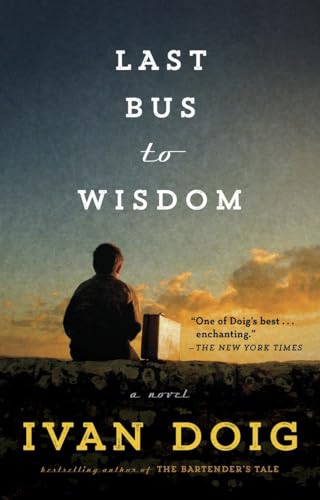
Donal Cameron is being raised by his grandmother, the cook at the legendary Double W ranch in Ivan Doig’s beloved Two Medicine Country of the Montana Rockies, a landscape that gives full rein to an eleven-year-old’s imagination. But when Gram has to have surgery for “female trouble” in the summer of 1951, all she can think to do is to ship Donal off to her sister in faraway Manitowoc, Wisconsin. There Donal is in for a rude surprise: Aunt Kate–bossy, opinionated, argumentative, and tyrannical—is nothing like her sister. She henpecks her good-natured husband, Herman the German, and Donal can’t seem to get on her good side either. After one contretemps too many, Kate packs him back to the authorities in Montana on the next Greyhound. But as it turns out, Donal isn’t traveling solo: Herman the German has decided to fly the coop with him. In the immortal American tradition, the pair light out for the territory together, meeting a classic Doigian ensemble of characters and having rollicking misadventures along the way.
Charming, wise, and slyly funny, Last Bus to Wisdom is a last sweet gift from a writer whose books have bestowed untold pleasure on countless readers.
Die Inhaltsangabe kann sich auf eine andere Ausgabe dieses Titels beziehen.
Über die Autorin bzw. den Autor
Ivan Doig was a third-generation Montanan and the author of fifteen previous books, including the bestselling The Bartender’s Tale and The Whistling Season and the classic memoir This House of Sky. He was a National Book Award finalist and received the Wallace Stegner Award, among many other honors. Doig lived in Seattle with his wife, Carol, for many years until his death.
Auszug. © Genehmigter Nachdruck. Alle Rechte vorbehalten.
THE DOG BUS
June 16–17, 1951
1.
THE TOWN OF GROS VENTRE was so far from anywhere that you had to take a bus to catch the bus. At that time, remote locales like ours were served by a homegrown enterprise with more name than vehicles, the Rocky Mountain Stage Line and Postal Courier, in the form of a lengthened Chevrolet sedan that held ten passengers besides the driver and the mailbag, and when I nervously went to climb in for the first time ever, the Chevy bus was already loaded with a ladies’ club heading home from an outing to Glacier National Park. The only seat left was in the back next to the mailbag, sandwiched between it and a hefty gray-haired woman clutching her purse to herself as though stage robbers were still on the loose in the middle of the twentieth century.
The swarm of apprehensions nibbling at me had not included this. Sure enough, no sooner did we pull out for the Greyhound station in Great Falls than my substantial seatmate leaned my way enough to press me into the mailbag and asked in that tone of voice a kid so much dreads, “And where are you off to, all by your lonesome?”
How things have changed in the world. I see the young people of today traveling the planet with their individual backpacks and weightless independence. Back then, on the epic journey that determined my life and drastically turned the course of others, I lived out of my grandmother’s wicker suitcase and carried a responsibility bigger than I was. Many, many miles bigger, as it turned out. But that lay ahead, and meanwhile I heard myself pipe up with an answer neither she nor I was ready for: “Pleasantville.”
When she cocked her head way to one side and said she couldn’t think where that was, I hazarded, “It’s around New York.”
To this day, I wonder what made me say any of that. Maybe the colorful wall map displaying Greyhound routes COAST TO COAST—THE FLEET WAY, back there in the hotel lobby that doubled as the Gros Ventre bus depot, stuck in my mind. Maybe my imagination answered for me, like being called on in school utterly unready and a whisper of help arrives out of nowhere, right or not. Maybe the truth scared me too much.
Whatever got into me, one thing all too quickly led to another as the woman clucked in concern and expressed, “That’s a long way to go all by yourself. I’d be such a bundle of nerves.” Sizing me up in a way I would come to recognize, as if I were either a very brave boy or a very ignorant one, she persisted: “What takes you so awful far?”
“Oh, my daddy works there.”
“Isn’t that interesting. And what does he do in, where’s it, Pleasantville?”
It’s funny about imagination, how it can add to your peril even while it momentarily comes to your rescue. I had to scramble to furnish, “Yeah, well, see, he’s a digester.”
“You don’t say! Wait till I tell the girls about this!” Her alarming exclamation had the other ladies, busy gabbing about mountain goats and summertime snowbanks and other memorable attractions of Glacier National Park, glancing over their shoulders at us. I shrank farther into the mailbag, but my fellow passenger dipped her voice to a confidential level.
“Tries out food to see if it agrees with the tummy, does he,” she endorsed enthusiastically, patting her own. “I’m glad to hear it,” she rushed on. “So much of what a person has to buy comes in cans these days, I’ve always thought they should have somebody somewhere testing those things on the digestion—that awful succotash about does me in—before they let any of it in the stores. Good for him.” Bobbing her head in vigorous approval, she gave the impression she wouldn’t mind that job herself, and she certainly had the capacity for it.
“Uh, actually”—maybe I should have, but I couldn’t let go of my own imaginative version of the digestive process—“it’s books he does that to. At the Reader’s Digest place.”
• • •
THERE WAS a story behind this, naturally.
I lived with my grandmother, who was the cook at the Double W, the big cattle ranch near Gros Ventre owned by the wealthy Williamson family. One of the few sources of entertainment anywhere on the ranch happened to be the shelf of sun-faded Reader’s Digest Condensed Books kept by Meredice Williamson in the otherwise unused parlor of the many-roomed house, and in her vague nice way she permitted me to take them to the cook shack to read, as long as Gram approved.
Gram had more than enough on her mind without policing my reading, and lately I had worked my way through the shipboard chapters of Mister Roberts, not so condensed that I couldn’t figure out what those World War Two sailors were peeking at through binoculars trained on the bathroom onshore where nurses took showers. Probably during that reading binge my eye caught on the fine print PLEASANTVILLE NY in the front of the book as the source of digested literature, and it did not take any too much inspiration, for me at least, to conjure a father back there peacefully taking apart books page by page and putting them back together in shortened form that somehow enriched them like condensed milk.
• • •
“WHY, I have those kind of books!” my fellow passenger vouched, squeezing her purse in this fresh enthusiasm. “I read The Egg and I practically in one sitting!”
“He’s real famous back there at the digest place,” I kept on. “They give him the ones nobody else can do. What’s the big fat book, Go like the Wind—”
“Gone with the Wind, you mean?” She was properly impressed any digester would tackle something like that. “It’s as long as the Bible!”
“That’s the one. See, he got it down to about like yay.” I backed that up with my thumb and finger no more than an inch apart.
“What an improvement,” she bought the notion with a gratified nod.
That settled matters down, thanks to a wartime story cooked down to the basics of bare-naked nurses and a helping of my imagination. The spacious woman took over the talking pretty much nonstop and I eased away from the U.S. mail a bit in relief and provided Uh-huh or Huh-uh as needed while the small bus cruised at that measured speed buses always seem to travel at, even in Montana’s widest of wide-open spaces. There we sat, close as churchgoers, while she chatted away the miles in her somber best dress that must have seen service at funerals and weddings, and me in stiff new blue jeans bought for the trip. Back then, you dressed up to go places.
And willing or not, I was now a long-distance traveler through time as well as earthbound scenery. When I wasn’t occupied providing two-syllable responses to my seatmate, this first leg of the journey was something like a tour of my existence since I was old enough to remember. Leaving behind Gros Ventre and its green covering of cottonwoods, Highway 89 wound past the southmost rangeland of the Two Medicine country, with Double W cattle pastured even here wherever there were not sheepherders’ white wagons and the gray sprinkles of ewes and lambs on the foothills in the distance. Above it all, the familiar sawtooth outline of the Rocky Mountains notched the horizon on into Canada. There where the South Fork of English Creek emerged from a canyon, during the Rainbow Reservoir construction job my folks and I had crammed into a...
„Über diesen Titel“ kann sich auf eine andere Ausgabe dieses Titels beziehen.
Suchergebnisse für Last Bus to Wisdom: A Novel (Two Medicine Country)

Beispielbild für diese ISBN
Last Bus to Wisdom Two Medicin
Anbieter: World of Books (was SecondSale), Montgomery, IL, USA
Verkäuferbewertung 5 von 5 Sternen

Zustand: Very Good. Item in very good condition! Textbooks may not include supplemental items i.e. CDs, access codes etc. Artikel-Nr. 00110213526
Gebraucht kaufen
EUR 3,97
Versand gratis
Versand innerhalb von USA
Versand innerhalb von USA
Anzahl: 1 verfügbar
Beispielbild für diese ISBN
Last Bus to Wisdom Two Medicin
Anbieter: World of Books (was SecondSale), Montgomery, IL, USA
Verkäuferbewertung 5 von 5 Sternen
Zustand: Good. Item in good condition. Textbooks may not include supplemental items i.e. CDs, access codes etc. Artikel-Nr. 00100370392
Gebraucht kaufen
EUR 3,97
Versand gratis
Versand innerhalb von USA
Versand innerhalb von USA
Anzahl: Mehr als 20 verfügbar
Beispielbild für diese ISBN
Last Bus to Wisdom Two Medicin
Anbieter: World of Books (was SecondSale), Montgomery, IL, USA
Verkäuferbewertung 5 von 5 Sternen
Zustand: Acceptable. Item in acceptable condition! Textbooks may not include supplemental items i.e. CDs, access codes etc. Artikel-Nr. 00104116964
Gebraucht kaufen
EUR 3,97
Versand gratis
Versand innerhalb von USA
Versand innerhalb von USA
Anzahl: 12 verfügbar
Foto des Verkäufers
Last Bus to Wisdom: A Novel (Two Medicine Country)
Anbieter: Dream Books Co., Denver, CO, USA
Verkäuferbewertung 5 von 5 Sternen
Zustand: acceptable. This copy has clearly been enjoyedâ"expect noticeable shelf wear and some minor creases to the cover. Binding is strong, and all pages are legible. May contain previous library markings or stamps. Artikel-Nr. DBV.110198256X.A
Gebraucht kaufen
EUR 4,12
Versand gratis
Versand innerhalb von USA
Versand innerhalb von USA
Anzahl: 4 verfügbar
Beispielbild für diese ISBN
Last Bus to Wisdom: A Novel (Two Medicine Country)
Verlag:
Riverhead Books (edition Reprint), 2016
ISBN 10: 110198256X
ISBN 13: 9781101982563
Gebraucht
Paperback
Anbieter: BooksRun, Philadelphia, PA, USA
Verkäuferbewertung 5 von 5 Sternen
Paperback. Zustand: Very Good. Reprint. It's a well-cared-for item that has seen limited use. The item may show minor signs of wear. All the text is legible, with all pages included. It may have slight markings and/or highlighting. Artikel-Nr. 110198256X-11-1
Gebraucht kaufen
EUR 5,37
Versand gratis
Versand innerhalb von USA
Versand innerhalb von USA
Anzahl: 1 verfügbar
Beispielbild für diese ISBN
Last Bus to Wisdom
Anbieter: ThriftBooks-Atlanta, AUSTELL, GA, USA
Verkäuferbewertung 5 von 5 Sternen
Paperback. Zustand: Good. No Jacket. Former library book; Pages can have notes/highlighting. Spine may show signs of wear. ~ ThriftBooks: Read More, Spend Less. Artikel-Nr. G110198256XI3N10
Gebraucht kaufen
EUR 5,78
Versand gratis
Versand innerhalb von USA
Versand innerhalb von USA
Anzahl: 1 verfügbar
Beispielbild für diese ISBN
Last Bus to Wisdom
Anbieter: ThriftBooks-Dallas, Dallas, TX, USA
Verkäuferbewertung 5 von 5 Sternen
Paperback. Zustand: Good. No Jacket. Former library book; Pages can have notes/highlighting. Spine may show signs of wear. ~ ThriftBooks: Read More, Spend Less. Artikel-Nr. G110198256XI3N10
Gebraucht kaufen
EUR 5,78
Versand gratis
Versand innerhalb von USA
Versand innerhalb von USA
Anzahl: 1 verfügbar
Beispielbild für diese ISBN
Last Bus to Wisdom
Anbieter: ThriftBooks-Dallas, Dallas, TX, USA
Verkäuferbewertung 5 von 5 Sternen
Paperback. Zustand: Good. No Jacket. Pages can have notes/highlighting. Spine may show signs of wear. ~ ThriftBooks: Read More, Spend Less. Artikel-Nr. G110198256XI3N00
Gebraucht kaufen
EUR 5,78
Versand gratis
Versand innerhalb von USA
Versand innerhalb von USA
Anzahl: 5 verfügbar
Beispielbild für diese ISBN
Last Bus to Wisdom
Anbieter: ThriftBooks-Phoenix, Phoenix, AZ, USA
Verkäuferbewertung 5 von 5 Sternen
Paperback. Zustand: Good. No Jacket. Pages can have notes/highlighting. Spine may show signs of wear. ~ ThriftBooks: Read More, Spend Less. Artikel-Nr. G110198256XI3N00
Gebraucht kaufen
EUR 5,78
Versand gratis
Versand innerhalb von USA
Versand innerhalb von USA
Anzahl: 5 verfügbar
Beispielbild für diese ISBN
Last Bus to Wisdom
Anbieter: ThriftBooks-Reno, Reno, NV, USA
Verkäuferbewertung 5 von 5 Sternen
Paperback. Zustand: Good. No Jacket. Pages can have notes/highlighting. Spine may show signs of wear. ~ ThriftBooks: Read More, Spend Less. Artikel-Nr. G110198256XI3N00
Gebraucht kaufen
EUR 5,78
Versand gratis
Versand innerhalb von USA
Versand innerhalb von USA
Anzahl: 5 verfügbar