
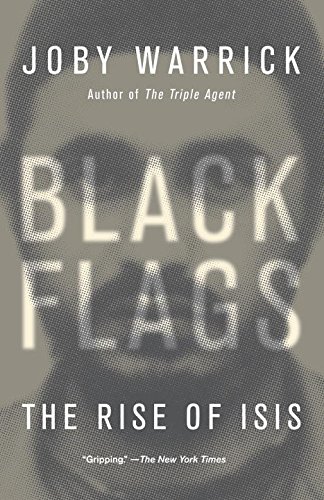
Verwandte Artikel zu Black Flags: The Rise of ISIS. Winner of the Pulitzer...
Inhaltsangabe
WINNER OF THE 2016 PULITZER PRIZE FOR GENERAL NONFICTION
"A Best Book of 2015"-The New York Times, The Washington Post, People Magazine, San Francisco Chronicle, Kansas City Star, and Kirkus Reviews
In a thrilling dramatic narrative, awarded the 2016 Pulitzer Prize for General Nonfiction, Joby Warrick traces how the strain of militant Islam behind ISIS first arose in a remote Jordanian prison and spread with the unwitting aid of two American presidents.
When the government of Jordan granted amnesty to a group of political prisoners in 1999, it little realized that among them was Abu Musab al-Zarqawi, a terrorist mastermind and soon the architect of an Islamist movement bent on dominating the Middle East. In Black Flags, an unprecedented character-driven account of the rise of ISIS, Pulitzer Prize-winning reporter Joby Warrick shows how the zeal of this one man and the strategic mistakes of Presidents Bush and Obama led to the banner of ISIS being raised over huge swaths of Syria and Iraq.
Zarqawi began by directing terror attacks from a base in northern Iraq, but it was the American invasion in 2003 that catapulted him to the head of a vast insurgency. By falsely identifying him as the link between Saddam and bin Laden, U.S. officials inadvertently spurred like-minded radicals to rally to his cause. Their wave of brutal beheadings and suicide bombings persisted until American and Jordanian intelligence discovered clues that led to a lethal airstrike on Zarqawi's hideout in 2006.
His movement, however, endured. First calling themselves al-Qaeda in Iraq, then Islamic State of Iraq and Syria, or ISIS, his followers sought refuge in unstable, ungoverned pockets on the Iraq-Syria border. When the Syrian civil war broke out in 2011, and as the U.S. largely stood by, ISIS seized its chance to pursue Zarqawi's dream of an ultra-conservative Islamic caliphate.
Drawing on unique high-level access to CIA and Jordanian sources, Warrick weaves gripping, moment-by-moment operational details with the perspectives of diplomats and spies, generals and heads of state, many of whom foresaw a menace worse than al Qaeda and tried desperately to stop it. Black Flags is a brilliant and definitive history that reveals the long arc of today's most dangerous extremist threat.
From the Hardcover edition.
Die Inhaltsangabe kann sich auf eine andere Ausgabe dieses Titels beziehen.
Von der hinteren Coverseite
In a thrilling dramatic narrative, Pulitzer Prize-winning reporter Joby Warrick traces how the strain of militant Islam behind ISIS first arose in a remote Jordanian prison and spread to become the world's greatest threat.
Auszug. © Genehmigter Nachdruck. Alle Rechte vorbehalten.
PROLOGUE
Amman, Jordan, February 3, 2015
Just after nightfall, a warrant arrived at the city's main women's prison for the execution of Sajida al-Rishawi. The instructions had come from King Abdullah II himself, then in Washington on a state visit, and were transmitted from his private plane to the royal court in Jordan's capital. A clerk relayed the message to the Interior Ministry and then to the prisons department, where it caused a stir. State executions are complicated affairs requiring many steps, yet the king's wishes were explicit: the woman would face the gallows before the sun rose the next day.
The chief warden quickly made the trek to the cell where Rishawi had maintained a kind of self-imposed solitary confinement for close to a decade. The prisoner, forty-five now and no longer thin, spent most of her days watching television or reading a paperback Koran, seeing no one, and keeping whatever thoughts she had under the greasy, prison-issued hijab she always wore. She was not a stupid woman, yet she seemed perpetually disconnected from whatever was going on around her. "When will I be going home?" she asked her government-appointed lawyer during rare meetings in the months after she was sentenced to death. Eventually, even those visits stopped.
Now, when the warden sat her down to explain that she would die in the morning, Rashida nodded her assent but said nothing. If she cried or prayed or cursed, no one in the prison heard a word of it.
That she could face death was not a surprise to anyone. In 2006, a judge sentenced Rishawi to hang for her part in Jordan's worst-ever terrorist attack: three simultaneous hotel bombings that killed sixty people, most of them guests at a wedding party. She was the suicide bomber who lived, an odd, heavy-browed woman made to pose awkwardly before TV cameras showing off the vest that had failed to explode. At one time, everyone in Amman knew her story, how this thirty-five-year-old unmarried Iraqi had agreed to wed a stranger so they could become a man-and-wife suicide team; how she panicked and ran; how she had wandered around the city's northern suburbs in a taxi, lost, stopping passersby for directions, still wearing streaks of blood on her clothes and shoes.
But nearly ten years had passed. The hotels had been rebuilt and renamed, and Rishawi had vanished inside Jordan's labyrinthine penal system. Within the Juwaida Women's Prison, she wore a kind of faded notoriety, like a valuable museum piece that no one looks at anymore. Some of the older hands in the state security service called her "Zarqawi's woman," a mocking reference to the infamous Jordanian terrorist Abu Musab al-Zarqawi, who ordered the hotel bombings. The younger ones barely remembered her at all.
Then, in the span of a month, everything changed. Zarqawi's followers, it turned out, had not forgotten Rishawi. The terrorists had rebranded themselves over the years and were now known in Jordan by the Arabic acronym Daesh-in English, ISIS. And in January 2015, ISIS asked to have Rishawi back.
The demand for her release came in the middle of Jordan's worst domestic crisis in years. A Jordanian air-force jet had crashed in Syria, and its young pilot had been captured alive by ISIS fighters. The group had broadcast photos of the frightened, nearly naked pilot being paraded around by grinning jihadists, some of them reaching out to embrace this great gift that Allah had dropped from the sky.
From the palace to the security agencies, the king and his advisers steeled themselves for even more awful news. Either the pilot would be publicly butchered by ISIS, they feared, or the terrorists would demand a terrible price for his ransom.
True to form, ISIS announced its decision in macabre fashion. Less than a week after the crash, the captured pilot's family received a call at home, from the pilot's own cell phone. On the other end, a stranger, speaking in Iraqi
„Über diesen Titel“ kann sich auf eine andere Ausgabe dieses Titels beziehen.
Weitere beliebte Ausgaben desselben Titels

Suchergebnisse für Black Flags: The Rise of ISIS. Winner of the Pulitzer...

Beispielbild für diese ISBN
Black Flags: The Rise of ISIS
Anbieter: AwesomeBooks, Wallingford, Vereinigtes Königreich
Verkäuferbewertung 5 von 5 Sternen

Paperback. Zustand: Very Good. Black Flags: The Rise of ISIS This book is in very good condition and will be shipped within 24 hours of ordering. The cover may have some limited signs of wear but the pages are clean, intact and the spine remains undamaged. This book has clearly been well maintained and looked after thus far. Money back guarantee if you are not satisfied. See all our books here, order more than 1 book and get discounted shipping. Artikel-Nr. 7719-9781101973431
Gebraucht kaufen
EUR 104,89
EUR 4,82 Versand
Versand von Vereinigtes Königreich nach USA
Versand von Vereinigtes Königreich nach USA
Anzahl: 2 verfügbar
Beispielbild für diese ISBN
Black Flags: The Rise of ISIS
Verlag:
Random House Lcc Us 01/y /31 M
ISBN 10: 1101973439
ISBN 13: 9781101973431
Gebraucht
Paperback
Anbieter: Bahamut Media, Reading, Vereinigtes Königreich
Verkäuferbewertung 5 von 5 Sternen
Paperback. Zustand: Very Good. Shipped within 24 hours from our UK warehouse. Clean, undamaged book with no damage to pages and minimal wear to the cover. Spine still tight, in very good condition. Remember if you are not happy, you are covered by our 100% money back guarantee. Artikel-Nr. 6545-9781101973431
Gebraucht kaufen
EUR 103,07
EUR 8,16 Versand
Versand von Vereinigtes Königreich nach USA
Versand von Vereinigtes Königreich nach USA
Anzahl: 1 verfügbar