
Verwandte Artikel zu Signals: New and Selected Stories (Vintage Contemporaries)
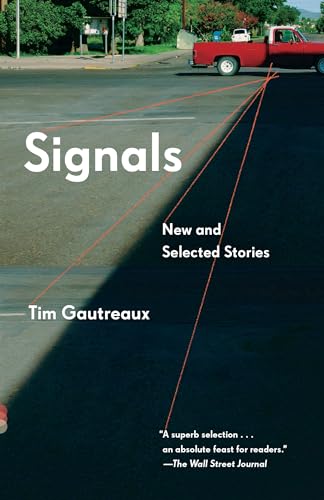
Inhaltsangabe
ONE OF THE WALL STREET JOURNAL AND NPR'S BEST BOOKS OF 2017
Containing twelve new stories and nine classics from previous collections, Signals is Tim Gautreaux at his best. Effortlessly conjuring the heat and humidity of the author’s beloved South, these stories of men and women grappling with faith, small town life, and blue-collar work are alternately ridiculous and sublime. For both longtime fans and readers lucky enough to encounter him for the very first time, Signals cements Gautreaux’s place as an American master.
Die Inhaltsangabe kann sich auf eine andere Ausgabe dieses Titels beziehen.
Über die Autorin bzw. den Autor
Tim Gautreaux is the author of three novels and the collections Same Place, Same Thing and Welding with Children, and his work has appeared in The New Yorker, The Atlantic, Harper’s, and GQ, as well as multiple times in The Best America Short Stories and New Stories from the South. His many honors include the National Magazine Award, the Southeastern Booksellers Award, the Heasley Prize, the John Dos Passos Prize, and the Louisiana Writer Award. After teaching for thirty years at Southeastern Louisiana University, he now lives, with his wife, in Chattanooga, Tennessee.
Auszug. © Genehmigter Nachdruck. Alle Rechte vorbehalten.
Gautreaux / SIGNALS
Radio Magic
Cliff had a great desire to be famous, if only in a small way. Coming from a long line of people whose only legacy was a grave marker, he figured he could do better. The older he got, the more intense his yen for fame, until at age fifty-two, after his last child left to join the navy, he started taking piano lessons. His teacher, a Miss Deutch, told him he was hopeless and had the worst sense of rhythm in the state of Ohio. He asked if he might be suitable for another instrument and she suggested the ocarina.
Cliff tried art lessons, but his misshapen nudes looked like white cattle that had grazed too long on a nuclear test site. Next he took a creative writing class and tried for two years to get something published, but even a limerick he’d embedded in a letter to the local paper about trash pickup had been cut by the editor. His quest went on throughseveral other episodes before he realized he might have to settle for turning his twins’ large bedroom into a man cave, the most famous man cave in the county, a room full of startling objects that his friends down at the waterworks would wonder at and maybe bring to the attentionof the regional news media.
The first treasure he installed was a crumbling moose head half the size of a Volkswagen. He purchased it through an ad he heard on the local radio station’s Swap Shop program, the cheapest way to buy anything manly and grotesque. Every morning he listened at seven while he was eating breakfast with his wife, Tammy, a good woman who tolerated his purchases in silence, suspecting that her sweet-natured and naïve husband could have worse habits. After the moose head, he purchased an electric slot machine with semi-nudeAsian cowgirls paintedon the glass, and next the trunk section of a 1947 Plymouth that hadbeen made into a neon-greensofa, then a pool table covered with hot-pinkfelt, followed by two red-glazedcow patty ashtrays, though no onehe knew smoked. The collection grew, and his friends came over to playcards on a giant wooden cable spool that had a Lithuanian flag paintedin its center. No one said much about all these items, though two fromthe chemical department cast suspicious glances at the twin dress dummiesshaped like overweight women. Cliff liked his collection thoughhe sensed that most of the members of his poker group seemed mildlydisturbed by it, especially by the skeleton of a goat hanging over thecard table, two blinding bulbs descending from its crotch.
One morning on Swap Shop, a man with slurred speech called in tooffer five chickens that had been dyed green. The station was in BlueShaft, West Virginia, a ruined coal-miningtown, and the locals wouldcall up and try to sell anything they had just to keep the lights on. Thenext seller was a woman who was trying to offload a whorehouse pianothat had been struck by lightning. Cliff thought the offerings were agood omen, that something special might be coming up. When a youngboy came on the air attempting to sell his only pair of pants becausehe’d outgrown them, Cliff reached to turn up the volume. As the childdescribed his jeans, Cliff took a trip into his young life, about the onlykind of travel he could afford, since his wife was an assistant publiclibrarian for the hamlet of Lincoln Foot, Ohio, and he was only the guyat the waterworks who gauged how much came in and went out.
In the middle of the program Tammy got up from the table. “Bye,sweetie,” she said as she brushed past. “Don’t buy another hornet’snest.”
Cliff closed his eyes. “You don’t have to keep bringing that up.” Oneof his early purchases from Swap Shop was a large nest for $10 from aman down the road. It was an early fall day and the farmer thought thehornets were long dead, and they were. Cliff hung the big nest in hisman cave and proceeded to write reports for the water company, notknowing that a few dozen live eggs had been left behind. They hatchedmore or less all at once when the central heat came on, and the youngstingers descended on Cliff’s head like tiny syringes of poison. After his eyes swelled shut he figured he’d better go to a doc-in-a-box,but he felldown the side steps, ruining a new sport coat, and when he got into thecar, he couldn’t see to drive, so he called an ambulance, guessing at thebuttons on his phone and calling the Sears washing machine repairmanby mistake. By the time he was brought to the hospital, his nose wasthe size of an adolescent squash. The charge for the ambulance service,emergency room treatment, and injections was monstrous, but whatkept him angry for a week was the $109 service bill from Sears.
Swap Shop ran a little longer than usual, and the last item of the daywas an antique wooden radio. He remembered his grandfather’s Crosley669, which he was allowed to play when he was a child. Back then,the broadcasts sounded antique, the music muzzled and full of soft popsand windy static, as if there were a fire inside the cabinet, the announcersounding faintly like Edward R. Murrow even when advertising colorTVs. Gramps let him stay up late, and after eleven o’clock Cliff wouldswitch on the police band, which hadn’t broadcast police radio sincethe 1940s, but way down on the left side of the dial, he could tease ina ham-radiooperator in Australia who always talked about fishing. Hewould click a different knob and the set would land on the abandonedshortwave band, but sometimes he could hear what sounded like Chinese,the radio chanting in a far-offand mystical faintness, coming andgoing like consciousness during a fragmented dream.
He jotted down the seller’s number and after many rings he spokewith a creaky-voicedwoman named Selma McKeithen, who lived downin nearby Blue Shaft. She wasn’t sure about the radio’s current condition,only that her deceased son, who had owned an electronics repairshop, had restored it years before, and she wanted fifty dollars for it.
Cliff called in to the waterworks and took the day off.
Blue Shaft, West Virginia, was just twenty miles from Cliff’s house.It had been slowly dying over the past six decades, one business closingup per year, ten newly boarded-uphouses per annum, fifty youngworkers moving out in the same time period, until the town felt like abig country house abandoned by its many grown children. The growlyold announcer on the radio read his announcements for yard sales andused car lots as if he could barely see the printed text.
Cliff drove past many dusty, empty storefronts. Behind them in the distance hovered mud-coloredmountains ribboned with seams oflow-gradecoal. Mrs. McKeithen lived in a large two-storyframe housesurrounded by broad, peeling galleries. He knocked and waited a longtime, thinking he’d been forgotten or was being ignored because theradio had already been sold. But after six or seven minutes of knockingand waiting, he heard slow, puffy footsteps and saw the white ceramicdoorknob turn as slowly as the second hand on a clock.
Mrs. McKeithen was straight in the back and had eyes the color ofblue willow china, but she was very old. She apologized for being soslow, explaining, as she motioned him in, that she’d just turned ninety-eight.After she closed the door, she evaluated him up and down.“You’re a little thick through the middle, aren’t you?”
He didn’t know what to say to that.
Putting up a hand, Mrs. McKeithen said, “My father used to say thata fat, happy dog wasn’t happy long.” Leading him to a back bedroomover her creaking floors, she pointed to the radio. “It belonged to myoldest son, Vernon.” A large mahogany floor model stood next to a tallwindow. A copper antenna wire snaked through the bottom of...
„Über diesen Titel“ kann sich auf eine andere Ausgabe dieses Titels beziehen.
Suchergebnisse für Signals: New and Selected Stories (Vintage Contemporaries)

Beispielbild für diese ISBN
Signals: New and Selected Stories
Anbieter: World of Books (was SecondSale), Montgomery, IL, USA
Verkäuferbewertung 5 von 5 Sternen

Paperback. Zustand: Good. ONE OF THE WALL STREET JOURNAL AND NPR'S BEST BOOKS OF 2017 Containing twelve new stories and nine classics from previous collections, Signals is Tim Gautreaux at his best. Effortlessly conjuring the heat and humidity of the author's beloved South, these stories of men and women grappling with faith, small town life, and blue-collar work are alternately ridiculous and sublime. For both longtime fans and readers lucky enough to encounter him for the very first time, Signals cements Gautreaux's place as an American master. Artikel-Nr. 00050002840
Gebraucht kaufen
EUR 12,33
Versand gratis
Versand innerhalb von USA
Versand innerhalb von USA
Anzahl: 2 verfügbar
Beispielbild für diese ISBN
Signals: New and Selected Stories (Vintage Contemporaries)
Anbieter: Roundabout Books, Greenfield, MA, USA
Verkäuferbewertung 4 von 5 Sternen

paperback. Zustand: Very Good. Condition Notes: Clean, unmarked copy with some edge wear. Good binding. Dust jacket included if issued with one. We ship in recyclable American-made mailers. 100% money-back guarantee on all orders. Artikel-Nr. 1668364
Gebraucht kaufen
EUR 13,82
Versand gratis
Versand innerhalb von USA
Versand innerhalb von USA
Anzahl: 1 verfügbar
Beispielbild für diese ISBN
Signals: New and Selected Stories (Vintage Contemporaries)
Anbieter: Robinson Street Books, IOBA, Binghamton, NY, USA
Verkäuferbewertung 4 von 5 Sternen
Paperback. Zustand: Very Good. Prompt Shipment, shipped in Boxes, Tracking PROVIDEDminor creasing else very good clean copy. Artikel-Nr. boiler34rm1248
Gebraucht kaufen
EUR 12,42
EUR 8,48 Versand
Versand innerhalb von USA
Versand innerhalb von USA
Anzahl: 1 verfügbar
Beispielbild für diese ISBN
Signals: New and Selected Stories
Anbieter: Kennys Bookstore, Olney, MD, USA
Verkäuferbewertung 5 von 5 Sternen
Zustand: New. 2017. Paperback. . . . . . Books ship from the US and Ireland. Artikel-Nr. V9781101972519
Neu kaufen
EUR 24,40
EUR 9,37 Versand
Versand innerhalb von USA
Versand innerhalb von USA
Anzahl: 15 verfügbar
Beispielbild für diese ISBN
Signals: New and Selected Stories
Anbieter: Revaluation Books, Exeter, Vereinigtes Königreich
Verkäuferbewertung 5 von 5 Sternen
Paperback. Zustand: Brand New. reprint edition. 363 pages. 8.00x5.00x1.00 inches. In Stock. Artikel-Nr. 1101972513
Neu kaufen
EUR 34,17
EUR 11,94 Versand
Versand von Vereinigtes Königreich nach USA
Versand von Vereinigtes Königreich nach USA
Anzahl: 1 verfügbar
Foto des Verkäufers
Signals : New and Selected Stories
Verlag:
Penguin Random House LLC Dez 2017, 2017
ISBN 10: 1101972513
ISBN 13: 9781101972519
Neu
Taschenbuch
Anbieter: AHA-BUCH GmbH, Einbeck, Deutschland
Verkäuferbewertung 5 von 5 Sternen
Taschenbuch. Zustand: Neu. Neuware - ONE OF THE WALL STREET JOURNAL AND NPR'S BEST BOOKS OF 2017Containing twelve new stories and nine classics from previous collections, Signals is Tim Gautreaux at his best. Effortlessly conjuring the heat and humidity of the author's beloved South, these stories of men and women grappling with faith, small town life, and blue-collar work are alternately ridiculous and sublime. For both longtime fans and readers lucky enough to encounter him for the very first time, Signals cements Gautreaux's place as an American master. Artikel-Nr. 9781101972519
Neu kaufen
EUR 27,74
EUR 35,00 Versand
Versand von Deutschland nach USA
Versand von Deutschland nach USA
Anzahl: 1 verfügbar
Foto des Verkäufers
Signals
Verlag:
Knopf Doubleday Publishing Group, 2017
ISBN 10: 1101972513
ISBN 13: 9781101972519
Neu
Softcover
Anbieter: moluna, Greven, Deutschland
Verkäuferbewertung 5 von 5 Sternen
Zustand: New. Tim Gautreaux is the author of three novels and the collections Same Place, Same Thing and Welding with Children, and his work has appeared in The New Yorker, The Atlantic, Harper&rsquos, and GQ, as well as multipl. Artikel-Nr. 900002766
Neu kaufen
EUR 20,64
EUR 48,99 Versand
Versand von Deutschland nach USA
Versand von Deutschland nach USA
Anzahl: Mehr als 20 verfügbar