
Verwandte Artikel zu Infant Massage (Fourth Edition): A Handbook for Loving...
Inhaltsangabe
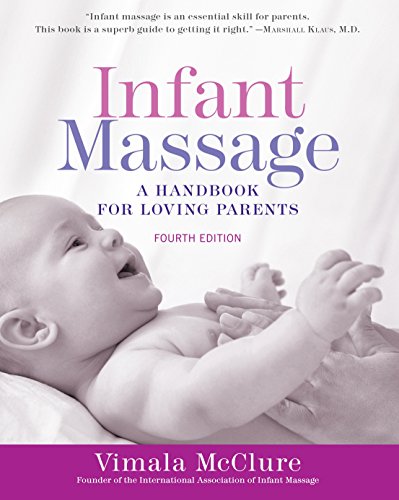
Master the techniques of infant massage and incorporate this joyful and wonderful healing art into your baby’s life with this revised and updated edition.
For generations, mothers around the world have known that the soft touch of their hands soothes, calms, and communicates their love to their babies. The latest scientific research confirms that physical affection is vital to the development and wellness of children—easing discomfort, releasing tension, improving sleep, helping premature infants gain weight, even aiding asthmatic children to improve their breathing. Now Vimala McClure, founder of the International Association of Infant Massage, has revised and updated her beloved classic. Inside you’ll find
• specific routines tailored to help relieve colic, fever, and chest and nasal congestion
• easy-to-follow instructions and photographs demonstrating each step
• new information on the benefits of skin-to-skin contact
• instructions for premature infants and babies with special needs
• lullabies, rhymes, and games to enhance the massage experience
• a special chapter dedicated to fathers
• compassionate advice for foster and adoptive parents
Praise for Infant Massage
“Speaking as a pediatrician, the best advice I can give you is to try the techniques described in this book.”–Stephen Berman, M.D., F.A.A.P., former president, American Academy of Pediatrics
“What a brilliant way to love and nurture a child! The first connection between parent and child is physical, through the body; by using the techniques Vimala McClure has developed, your parental relationship will be off to a magnificent start.”—Judy Ford, author of Wonderful Ways to Love a Child
Die Inhaltsangabe kann sich auf eine andere Ausgabe dieses Titels beziehen.
Über die Autorin bzw. den Autor
For more than thirty years, Vimala McClure has worked with parents and babies using the ancient practice of infant massage to help create warm, intuitive bonds of love in families. She is the founder of the International Association of Infant Massage and the author of Infant Massage: A Handbook for Loving Parents, The Tao of Motherhood, A Woman’s Guide to Tantra Yoga, and The Path of Parenting.
Auszug. © Genehmigter Nachdruck. Alle Rechte vorbehalten.
Chapter 1
Why Massage Your Baby?
Being touched and caressed,
being massaged,
is food for the infant.
Food as necessary
as minerals, vitamins, and proteins.
—Dr. Frédérick Leboyer
An Age-Old Tradition
A young mother gently cradles her baby in her lap as the afternoon sun streams through cracks in the wooden door. For the second time that day, she carefully removes the tiny cap and begins to unwrap the swaddling bands of soft white linen and wool.
Freed from his snug encasement, the baby kicks and waves his little arms, listening to the now-familiar swish-swish of the warm oil in his mother’s hands and the comforting sound of her balmy lullaby. So begins his twice-daily massage. The scene is in a Jewish shtetl, one of the small enclaves in Poland in the early nineteenth century, but we could be anywhere in the world, in any century, for it is a familiar tableau of motherhood in every culture throughout the ages.
From the Eskimos of the Canadian Arctic to the Ganda of East Africa, from South India to Northern Ireland, in Russia, China, Sweden, and South America, in South Sea Islands huts and modern American homes, babies are lovingly massaged, caressed, and crooned to every day. Mothers all over the world know their babies need to be held, carried, rocked, and touched. The gentle art of infant massage has been part of baby caregiving traditions passed from parent to child for generations. Asked why, each culture would provide different answers. Most would simply say, “It is our custom.”
Many of the family customs of our ancestors, turned aside in the early twentieth century in the interest of “progress,” are returning to our lives as modern science rediscovers their importance and their contribution to our infants’ well-being and that of whole communities. Cross-cultural studies have demonstrated that in societies where infants are held, massaged, rocked, breastfed, and carried, adults are less aggressive and violent, more cooperative and compassionate. Our great-great-grandmothers would stand up and utter a great “I told you so!” were they to observe our “new” discoveries in infant care.
Before your baby is born, you may envision yourself calmly and blissfully being a parent, or you may be terrified that you don’t know what to do with this new human depending on you for its very existence. It is fairly easy now, with the Internet, to read a lot about infants—what they need, what they don’t need, how to provide the best environment for them, how to respond to their cries and fusses, and so on.
Scientific research has blossomed over the past decades, and many of the parenting styles of our grandparents’ day have been proven to be almost barbaric. Figure out how to both take care of yourself and provide your infant with the love, attention, and healthy environment that she desperately needs. Those who say, “Well, I turned out all right! The way my parents did it will work for me,” don’t recognize the many problems and the physical, mental, and emotional health risks they faced or will face because of how they were raised.
If you can be firmly rooted in who you are, you will find that you can intuit the right decisions as you live with your baby. You will make mistakes, but as you relax, slow down, empower yourself with good information, and have confidence in who you are, you can correct your course as you go along. In this way, no permanent damage is done. Your child responds to you “being yourself.” Trying to parent in some way that isn’t coming from your deepest principles is confusing for your child, and damaging in the long term.
Only you can decide, according to what feels best to you, whether you give birth at home or in a hospital or birthing center, choose to immunize or not, breastfeed or not; whether your children wear exclusively natural fibers or not; whether or not you choose day care; how you discipline and communicate with a toddler; and so on. After doing your own research about the issues, make your decisions from a deep inner place that makes you feel like a good parent, instead of simply going with what your parents tell you or with the current cultural flow.
Over and over again, it has been shown that the current cultural flow is often wrong. At one time it was common and accepted to give babies opium to keep them quiet. At one time mothers were told to wear masks and not to breathe on their babies or breastfeed them for fear of “contaminating” them. At one time parents were told not to respond to infants’ cries for fear of “spoiling” them. At one time it was widely believed that babies didn’t feel pain and that they could not see or hear in the womb or for the first weeks of life. Take the experts with a grain of salt, and listen to your own heart about what is right for you and your family.
Both for babies and parents, the benefits of infant massage are more far-reaching than may at first be obvious. For infants, massage is much more than a luxurious sensual experience. It is a tool for maintaining the child’s health and well-being on many levels.
For parents, it is vital to feeling secure in your own ability to do something positive for—and get a positive response from—this squealing bit of newborn humanity suddenly and urgently put in your charge. It is not a therapy that you do to your baby; it is a deep communicative art that you do with your baby.
Can Babies Be Spoiled with Love and Attention?
Research can help us understand why traditional practices are so important. Knowing why, we are less quick to cast adrift customs that can deeply enrich our lives. Our concern about raising “spoiled” children comes from an earlier time when behaviorists, after discovering behavioral conditioning, thought that we could condition our babies to behave like little adults by ignoring their cries and not offering too much affection.
That approach eventually became popular again. (Fads swing like a pendulum from one extreme to another, and parenting advice is not immune to this phenomenon.) Popular baby care programs used to advise parents to put babies on rigid schedules, allow them to “cry it out” alone, and punish them for behavior that was not convenient for parents. The leaders of these movements also managed to convince parents that they damaged their infant’s metabolism by breastfeeding on demand (despite all research to the contrary) and created spoiled, selfish children if parents responded to their needs and comforted them when they cried. Parents were admonished never to allow their infants to sleep with them, for they could easily kill them (again, despite all research to the contrary). These ideas represent a swing away from the natural parenting practices that had gained momentum in the 1970s and achieved recognition from pediatricians as healthy and normal by the 1990s. Here is a more practical and research-verified approach:
•In order to become well-adjusted, kind, empathic adults, babies require a lot of attention, affection, and response to their needs.
•Breastfeeding on demand, breast milk in a bottle, and bottle-feeding that emulates breastfeeding as closely as possible are essential to a baby’s physical, mental, and emotional health as well as to continual bonding with parents.
•Cosleeping can easily be made completely safe if parents learn appropriate ways to make it happen.
Proof abounds that babies who are neglected and punished suffer bonding breaks and, without intervention, often grow up to be troubled if not antisocial or sociopathic, individuals. Since the mid-1970s, working with parents to...
„Über diesen Titel“ kann sich auf eine andere Ausgabe dieses Titels beziehen.
Suchergebnisse für Infant Massage (Fourth Edition): A Handbook for Loving...

Foto des Verkäufers
Infant Massage (Fourth Edition): A Handbook for Loving Parents
Anbieter: Dream Books Co., Denver, CO, USA
Verkäuferbewertung 5 von 5 Sternen

Zustand: acceptable. This copy has clearly been enjoyedâ"expect noticeable shelf wear and some minor creases to the cover. Binding is strong, and all pages are legible. May contain previous library markings or stamps. Artikel-Nr. DBV.1101965940.A
Gebraucht kaufen
EUR 3,90
Versand gratis
Versand innerhalb von USA
Versand innerhalb von USA
Anzahl: 1 verfügbar
Beispielbild für diese ISBN
Infant Massage: A Handbook for Loving Parents
Anbieter: World of Books (was SecondSale), Montgomery, IL, USA
Verkäuferbewertung 5 von 5 Sternen
Paperback. Zustand: Fair. Master the techniques of infant massage and incorporate this joyful and wonderful healing art into your baby's life with this revised and updated edition. For generations, mothers around the world have known that the soft touch of their hands soothes, calms, and communicates their love to their babies. The latest scientific research confirms that physical affection is vital to the development and wellness of children--easing discomfort, releasing tension, improving sleep, helping premature infants gain weight, even aiding asthmatic children to improve their breathing. Now Vimala McClure, founder of the International Association of Infant Massage, has revised and updated her beloved classic. Inside you'll find * specific routines tailored to help relieve colic, fever, and chest and nasal congestion * easy-to-follow instructions and photographs demonstrating each step * new information on the benefits of skin-to-skin contact * instructions for premature infants and babies with special needs * lullabies, rhymes, and games to enhance the massage experience * a special chapter dedicated to fathers * compassionate advice for foster and adoptive parents Praise for Infant Massage "Speaking as a pediatrician, the best advice I can give you is to try the techniques described in this book."-Stephen Berman, M.D., F.A.A.P., former president, American Academy of Pediatrics "What a brilliant way to love and nurture a child! The first connection between parent and child is physical, through the body; by using the techniques Vimala McClure has developed, your parental relationship will be off to a magnificent start."--Judy Ford, author of Wonderful Ways to Love a Child. Artikel-Nr. 00110224556
Gebraucht kaufen
EUR 3,95
Versand gratis
Versand innerhalb von USA
Versand innerhalb von USA
Anzahl: 2 verfügbar
Beispielbild für diese ISBN
Infant Massage: A Handbook for Loving Parents
Anbieter: World of Books (was SecondSale), Montgomery, IL, USA
Verkäuferbewertung 5 von 5 Sternen
Paperback. Zustand: Very Good. Master the techniques of infant massage and incorporate this joyful and wonderful healing art into your baby's life with this revised and updated edition. For generations, mothers around the world have known that the soft touch of their hands soothes, calms, and communicates their love to their babies. The latest scientific research confirms that physical affection is vital to the development and wellness of children--easing discomfort, releasing tension, improving sleep, helping premature infants gain weight, even aiding asthmatic children to improve their breathing. Now Vimala McClure, founder of the International Association of Infant Massage, has revised and updated her beloved classic. Inside you'll find * specific routines tailored to help relieve colic, fever, and chest and nasal congestion * easy-to-follow instructions and photographs demonstrating each step * new information on the benefits of skin-to-skin contact * instructions for premature infants and babies with special needs * lullabies, rhymes, and games to enhance the massage experience * a special chapter dedicated to fathers * compassionate advice for foster and adoptive parents Praise for Infant Massage "Speaking as a pediatrician, the best advice I can give you is to try the techniques described in this book."-Stephen Berman, M.D., F.A.A.P., former president, American Academy of Pediatrics "What a brilliant way to love and nurture a child! The first connection between parent and child is physical, through the body; by using the techniques Vimala McClure has developed, your parental relationship will be off to a magnificent start."--Judy Ford, author of Wonderful Ways to Love a Child. Artikel-Nr. 00109448520
Gebraucht kaufen
EUR 3,95
Versand gratis
Versand innerhalb von USA
Versand innerhalb von USA
Anzahl: 3 verfügbar
Beispielbild für diese ISBN
Infant Massage: A Handbook for Loving Parents
Anbieter: World of Books (was SecondSale), Montgomery, IL, USA
Verkäuferbewertung 5 von 5 Sternen
Paperback. Zustand: Good. Master the techniques of infant massage and incorporate this joyful and wonderful healing art into your baby's life with this revised and updated edition. For generations, mothers around the world have known that the soft touch of their hands soothes, calms, and communicates their love to their babies. The latest scientific research confirms that physical affection is vital to the development and wellness of children--easing discomfort, releasing tension, improving sleep, helping premature infants gain weight, even aiding asthmatic children to improve their breathing. Now Vimala McClure, founder of the International Association of Infant Massage, has revised and updated her beloved classic. Inside you'll find * specific routines tailored to help relieve colic, fever, and chest and nasal congestion * easy-to-follow instructions and photographs demonstrating each step * new information on the benefits of skin-to-skin contact * instructions for premature infants and babies with special needs * lullabies, rhymes, and games to enhance the massage experience * a special chapter dedicated to fathers * compassionate advice for foster and adoptive parents Praise for Infant Massage "Speaking as a pediatrician, the best advice I can give you is to try the techniques described in this book."-Stephen Berman, M.D., F.A.A.P., former president, American Academy of Pediatrics "What a brilliant way to love and nurture a child! The first connection between parent and child is physical, through the body; by using the techniques Vimala McClure has developed, your parental relationship will be off to a magnificent start."--Judy Ford, author of Wonderful Ways to Love a Child. Artikel-Nr. 00108276524
Gebraucht kaufen
EUR 3,95
Versand gratis
Versand innerhalb von USA
Versand innerhalb von USA
Anzahl: 8 verfügbar
Beispielbild für diese ISBN
Infant Massage (Fourth Edition): A Handbook for Loving Parents
Anbieter: ThriftBooks-Reno, Reno, NV, USA
Verkäuferbewertung 5 von 5 Sternen
Paperback. Zustand: Good. No Jacket. Pages can have notes/highlighting. Spine may show signs of wear. ~ ThriftBooks: Read More, Spend Less. Artikel-Nr. G1101965940I3N00
Gebraucht kaufen
EUR 5,96
Versand gratis
Versand innerhalb von USA
Versand innerhalb von USA
Anzahl: 1 verfügbar
Beispielbild für diese ISBN
Infant Massage (Fourth Edition): A Handbook for Loving Parents
Anbieter: ThriftBooks-Dallas, Dallas, TX, USA
Verkäuferbewertung 5 von 5 Sternen
Paperback. Zustand: Good. No Jacket. Pages can have notes/highlighting. Spine may show signs of wear. ~ ThriftBooks: Read More, Spend Less. Artikel-Nr. G1101965940I3N00
Gebraucht kaufen
EUR 5,96
Versand gratis
Versand innerhalb von USA
Versand innerhalb von USA
Anzahl: 2 verfügbar
Beispielbild für diese ISBN
Infant Massage (Fourth Edition): A Handbook for Loving Parents
Anbieter: ThriftBooks-Dallas, Dallas, TX, USA
Verkäuferbewertung 5 von 5 Sternen
Paperback. Zustand: Very Good. No Jacket. May have limited writing in cover pages. Pages are unmarked. ~ ThriftBooks: Read More, Spend Less. Artikel-Nr. G1101965940I4N00
Gebraucht kaufen
EUR 5,96
Versand gratis
Versand innerhalb von USA
Versand innerhalb von USA
Anzahl: 1 verfügbar
Beispielbild für diese ISBN
Infant Massage (Fourth Edition): A Handbook for Loving Parents
Anbieter: ThriftBooks-Phoenix, Phoenix, AZ, USA
Verkäuferbewertung 5 von 5 Sternen
Paperback. Zustand: Good. No Jacket. Pages can have notes/highlighting. Spine may show signs of wear. ~ ThriftBooks: Read More, Spend Less. Artikel-Nr. G1101965940I3N00
Gebraucht kaufen
EUR 5,96
Versand gratis
Versand innerhalb von USA
Versand innerhalb von USA
Anzahl: 1 verfügbar
Beispielbild für diese ISBN
Infant Massage (Fourth Edition): A Handbook for Loving Parents
Anbieter: ThriftBooks-Atlanta, AUSTELL, GA, USA
Verkäuferbewertung 5 von 5 Sternen
Paperback. Zustand: Good. No Jacket. Pages can have notes/highlighting. Spine may show signs of wear. ~ ThriftBooks: Read More, Spend Less. Artikel-Nr. G1101965940I3N00
Gebraucht kaufen
EUR 5,96
Versand gratis
Versand innerhalb von USA
Versand innerhalb von USA
Anzahl: 2 verfügbar
Beispielbild für diese ISBN
Infant Massage (Fourth Edition) : A Handbook for Loving Parents
Verlag:
Random House Publishing Group, 2017
ISBN 10: 1101965940
ISBN 13: 9781101965948
Gebraucht
Softcover
Anbieter: Better World Books, Mishawaka, IN, USA
Verkäuferbewertung 5 von 5 Sternen
Zustand: Good. 4th Edition. Former library copy. Pages intact with minimal writing/highlighting. The binding may be loose and creased. Dust jackets/supplements are not included. Includes library markings. Stock photo provided. Product includes identifying sticker. Better World Books: Buy Books. Do Good. Artikel-Nr. 14027380-6
Gebraucht kaufen
EUR 6,35
Versand gratis
Versand innerhalb von USA
Versand innerhalb von USA
Anzahl: 3 verfügbar